
One Piece East Blue Saga Guide
What this saga covers
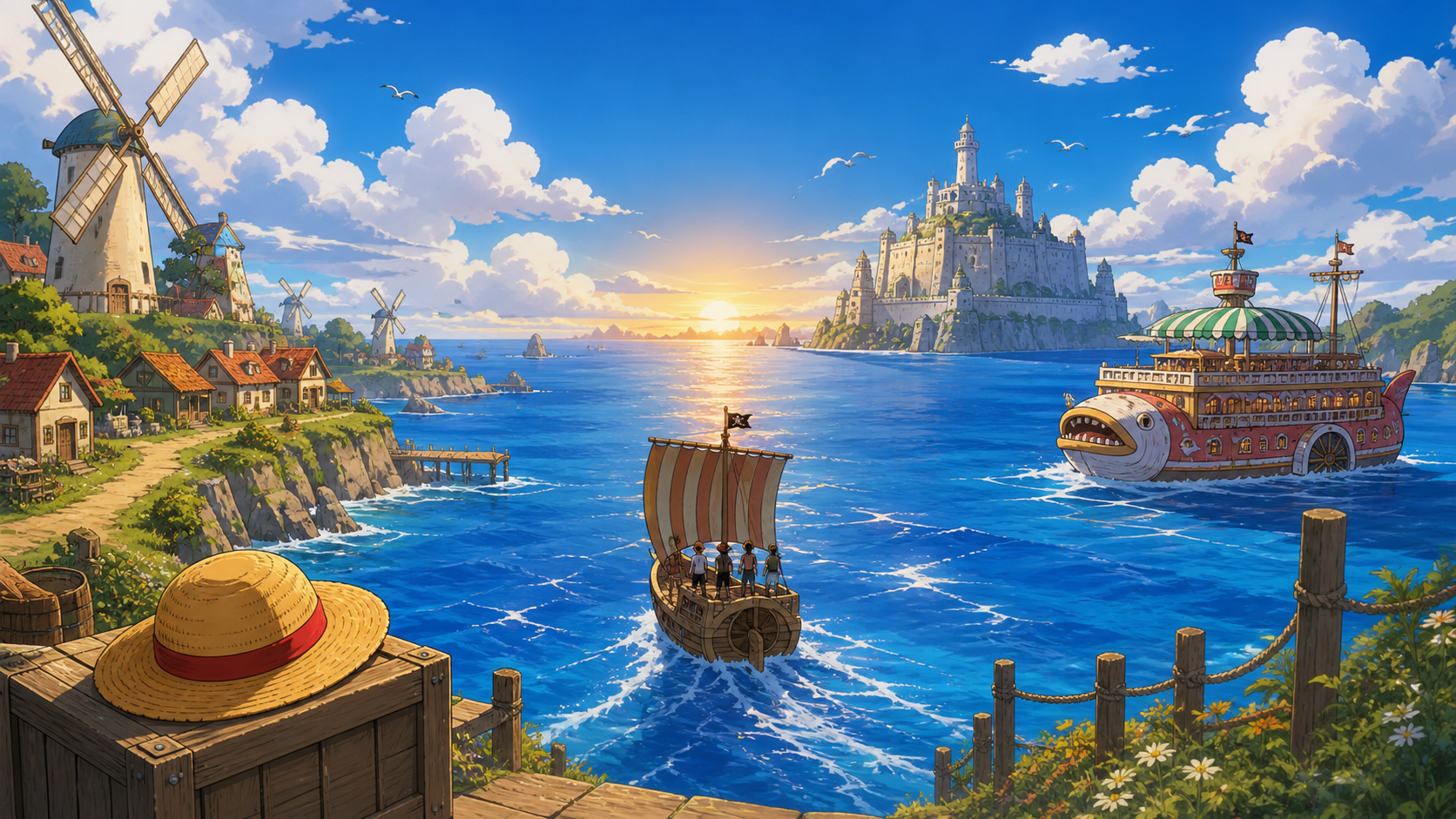
The East Blue Saga spans Romance Dawn, Orange Town, Syrup Village, Baratie, Arlong Park, and Loguetown. The television anime establishes the first crew, the Going Merry, and the passage into the Grand Line.
Romance Dawn: freedom gets a body
Luffy’s first victories are not about acquiring territory. He disrupts small systems of coercion and invites people to choose movement. Zoro joins without surrendering his own ambition, creating the crew’s basic contract: dreams travel together or not at all.
Orange Town and Syrup Village
Nami’s guarded cooperation and Usopp’s habitual storytelling show two survival strategies. One controls information and money; the other manufactures hope. Buggy and Kuro reveal how performance can become authority when a frightened community has incomplete evidence.
Baratie: hunger and labor
The floating restaurant turns food into the saga’s moral center. Zeff and Sanji insist a starving enemy still needs a meal. Mihawk’s arrival also measures Zoro’s dream against the world beyond local confidence.
Arlong Park: occupation behind the adventure
Nami’s maps, money, and apparent betrayal are products of organized coercion. Arlong controls police, information, labor, and the price of freedom. The crew’s intervention matters because the intervention follows Nami’s request rather than replacing her history with their heroism.
Loguetown and inherited symbols
Roger’s execution site places Luffy’s private dream inside a public history. Smoker, Dragon, and the Grand Line threshold widen the scale without resolving what piracy means in a world where the law often protects domination.
Anime pacing and additions
The anime expands crew time and introduces material around Apis before Reverse Mountain. Viewers separating manga-canon progression from anime-original adventures should still treat the broadcast experience as its own authored rhythm.
East Blue keeps the world small enough to see power clearly
Later One Piece islands arrive with royal families, intelligence agencies, ancient weapons, and wars involving thousands of people. East Blue begins with power close enough to touch. A marine captain controls one town because everybody is afraid of his son. Buggy occupies another town through spectacle and artillery. Kuro hides inside a household while planning to convert trust into inheritance. Arlong turns an entire village into a payment system.
The smaller scale is not politically simple. The saga establishes the pattern the series keeps enlarging: domination survives through labor, information, fear, and institutions that make resistance look unreasonable. Luffy rarely arrives with a complete analysis. The people living under each arrangement provide the knowledge. His contribution is refusing the lie that the arrangement cannot be broken.
The first crew is built from jobs, not matching personalities
Zoro fights, Nami navigates, Usopp shoots and invents, and Sanji cooks. Those summaries sound like a game menu until the saga shows why every job exists. Zoro’s discipline gives the crew force against enemies nobody else can stop. Nami reads weather, money, maps, and danger. Usopp turns distance and improvisation into protection. Sanji manages the food that lets every dream survive another day.
I love how badly their personalities fit at first. Nami distrusts pirates. Zoro has no interest in friendliness. Usopp wants recognition while expecting abandonment. Sanji is loyal to a restaurant he also needs permission to leave. Luffy does not solve those contradictions by demanding instant family. The ship becomes a place where people practice depending on one another before they are comfortable admitting dependence.
Women keep exposing the cost of male adventure
Makino, Kaya, Bellemere, Nojiko, Nami, and the women of Cocoyasi Village are not all written with equal depth, but together they keep interrupting the fantasy that adventure begins when men decide to leave home. Somebody grows food, tends wounds, raises children, keeps records, preserves a house, or survives the occupation while future pirates chase legends.
Bellemere’s death is especially important because Arlong does not kill her in a chaotic raid. He kills her through an administrative demand. Pay for every person in the household or declare that one child does not belong. Bellemere refuses the second option even though the declaration costs her life. The cruelty sits in the rule and in the armed force that makes the rule real.
Nami inherits both the love and the debt. Her maps become stolen labor. Her talent becomes useful to the occupying power. Her money becomes a ransom Arlong never intends to honor. By the time she asks Luffy for help, the request is not a damsel waiting for a stronger man. The request is a worker admitting that solitary survival cannot defeat a system designed to absorb everything she produces.
The Marines arrive as a compromised institution
Axe-Hand Morgan establishes that a uniform does not make authority legitimate. Nezumi makes the point harder by showing corruption connected to Arlong’s occupation. Smoker complicates the pattern because he takes law seriously and can recognize obvious cruelty, yet his pursuit of Luffy still asks viewers to question what the law has chosen to prioritize.
Coby provides the counterargument from inside the institution. He wants to become a Marine because public protection should mean something. His dream prevents an easy claim that every individual wearing the uniform is identical. East Blue instead asks whether decent people can transform a structure whose hierarchy rewards obedience and whose distant leadership already contains secrets the local recruits cannot see.
I appreciate that the saga does not settle the question. Smoker can oppose corrupt pirates while serving a government that tolerates other forms of domination. Luffy can free a town while remaining a pirate who rejects public accountability. The tension becomes one of the series’ durable engines.
Food, money, maps, and ships are part of the action
East Blue spends time on material needs. A crew requires a vessel, repairs, supplies, money, food, information, and a route. The Going Merry is a gift tied to Kaya and Merry, not a disposable vehicle that appears when the heroes earn enough points. Sanji’s cooking is linked to starvation. Nami’s navigation is linked to coercion and escape. Usopp’s repairs reveal the limits of affection without technical knowledge.
Those details protect One Piece from becoming a parade of isolated fights. Every battle changes who can eat, sail, work, travel, or speak safely afterward. The crew’s dreams sound enormous, but their daily survival depends on work that adventure stories often hide. East Blue keeps that work visible because the crew is small and every missing skill becomes an immediate problem.
Loguetown turns a beginning into inherited history
Luffy smiling at the execution platform echoes Roger, but the resemblance should not erase the difference between them. The public sees an image connected to an earlier era. Luffy experiences another moment in a life he insists belongs to him. Inherited symbols become interesting when they create pressure without fully determining the person carrying them.
Dragon’s intervention, Smoker’s pursuit, and the storm push the crew toward the Grand Line with more questions than answers. Who gets protected by law? What does the Will of D. mean? Why do certain people recognize Luffy before he recognizes the history surrounding himself? East Blue earns the expansion because the first islands already taught viewers how to read power in local detail.
Where the saga is weakest
The women frequently carry the emotional and logistical weight while men receive the decisive combat spectacle. Sanji’s behavior toward women begins with warning signs the story will later inflate into exhausting jokes. Usopp’s fear can be treated as humiliation instead of a legitimate survival response. Several villains become visually monstrous in ways that risk turning evil into a body type rather than a choice.
These weaknesses do not cancel the saga. They belong in the evaluation because affection does not require pretending every early decision aged well. East Blue remains powerful when the story trusts labor, community memory, and specific requests for help. The series becomes cheaper whenever a gag or stereotype replaces that attention.
East Blue is the baseline for every later rescue
The saga teaches viewers to ask who requested help, who understands the local danger, and what freedom would mean after the crew sails away. Luffy defeats Morgan, Buggy, Kuro, Krieg, and Arlong, but the emotional climax belongs to choices made before the final punch. Zoro accepts a future that preserves his promise to Kuina. Usopp leaves Kaya instead of turning her gratitude into a claim on her life. Sanji accepts Zeff’s permission to pursue the All Blue. Nami names the help she needs after eight years of trying to buy freedom alone.
That pattern becomes the standard for later islands. One Piece is strongest when liberation begins with residents explaining the cage and continues through their own decisions. The adventure becomes weaker whenever a visitor’s strength receives more attention than the community’s knowledge. East Blue gives CVM Sekai the measuring stick used throughout the episode Reacts and saga guides.
How the anime makes the crew feel lived in
The television adaptation has more time for meals, arguments, travel, reactions, and repeated jokes than a compressed summary suggests. Some additions slow the route toward the Grand Line, yet the extra proximity also makes the first separations hurt. The Baratie kitchen feels like a workplace. Cocoyasi Village feels populated by people who have learned when silence keeps a neighbor alive. Loguetown feels like a threshold rather than a checklist stop.
Japanese performances establish the crew’s rhythm early. Mayumi Tanaka gives Luffy a voice that can move from foolish delight to absolute moral clarity without turning either register into a disguise. Kazuya Nakai grounds Zoro’s threats in physical restraint. Akemi Okamura lets Nami’s confidence fracture before the story asks her to request help. Kappei Yamaguchi and Hiroaki Hirata build Usopp and Sanji from vocal habits that later comedy sometimes overuses but never fully erases.
Best route through the East Blue coverage
Use this saga guide for structure, themes, and consequences. Open the episode directory when a specific broadcast installment needs close production and performance analysis. Character profiles follow longer personal chronologies, while the series guide tracks adaptation history across the entire anime. Those pages answer different questions, so no single article needs to become an encyclopedia wearing one enormous coat.
My recommended reading order starts here, moves through the first crew profiles, and then follows the numbered React directories. Return after Alabasta and the early choices look different. Nami’s suspicion, Zoro’s obedience to a promise, Usopp’s fear of being useless, and Sanji’s relationship with food all become structural threads rather than introductory traits.
RaeRae’s verdict
East Blue succeeds because the crew is not assembled through résumé logic. Each person arrives with labor, grief, and a promise that changes what the ship must become. The saga is small enough to feel intimate and politically sharp enough to support everything that follows.