
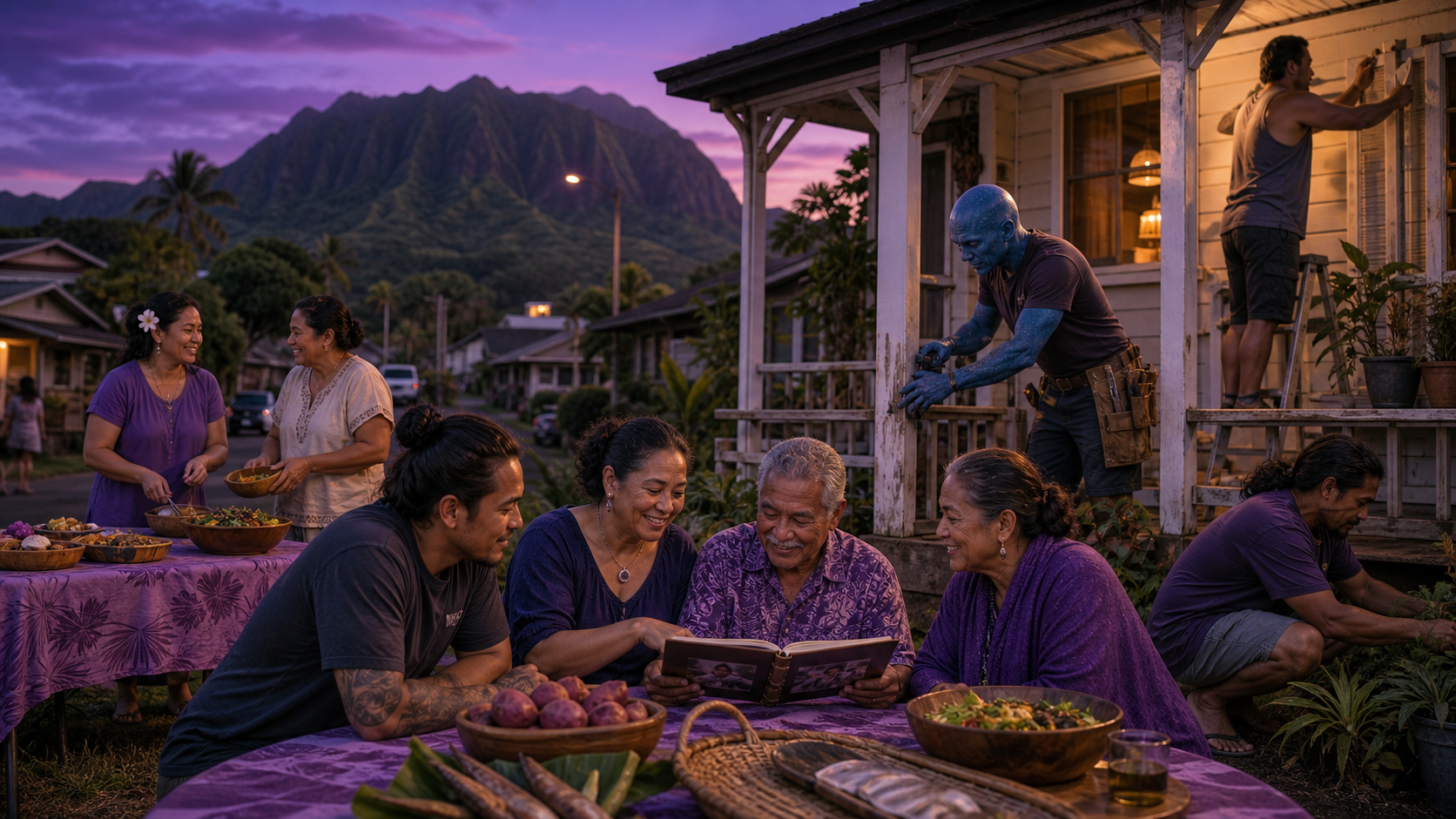
ANIME 101 · ʻOHANA · HAWAIʻI · FAMILY · CULTURAL CONTEXT
What ʻOhana Means Beyond the Quote: A Lilo & Stitch Cultural Context Guide
The quote opens the door. Hawaiian family, culture, land, and responsibility make the room much bigger.
Start with the word the movie made famous
Lilo tells Stitch that ʻohana means family and family means nobody gets left behind or forgotten. The line works because a child gives a frightened creature a rule simple enough to hold during crisis. The sentence is emotionally true inside the film. The sentence is not a complete dictionary, cultural history, or permission slip to turn a Hawaiian word into generic corporate warmth.
A fandom guide can love the line and keep learning. The Office of Hawaiian Affairs describes ʻohana as foundational to community wellbeing, knowledge, culture, land, and relationships across generations. Help moves in both directions. Recognition moves in both directions. Family becomes practice rather than a slogan somebody repeats after causing harm.
Pronunciation and spelling show respect
The word begins with an ʻokina, the mark shaped like a turned apostrophe that represents a consonant in the Hawaiian language. Writing ʻohana preserves more than typography. The mark affects pronunciation and signals that Hawaiian words have structures worth respecting rather than decorative spellings available for casual alteration.
Technical limitations sometimes produce ohana without the mark, especially in older databases, URLs, and search behavior. Public-facing copy should use ʻohana when the system supports the character. Search metadata can accommodate common spellings without making the stripped form the editorial standard.
Family is relational work
The film’s famous promise gains force because the Pelekai household keeps failing at perfect family performance. Nani loses patience. Lilo acts out. Stitch manipulates them. Doors break. Trust collapses and rebuilds. Nobody earns belonging through constant pleasantness. Everybody does owe repair when their choices hurt the others.
That difference separates care from indulgence. ʻOhana does not mean no boundaries. Nani can say no. Lilo can name betrayal. Stitch can face consequences. The promise means conflict does not automatically erase personhood or make abandonment the first solution.
Blood matters and chosen relationship matters
Nani and Lilo are sisters holding their immediate family together after parental loss. Stitch enters through adoption, first as a pet-shaped deception and later as a chosen family member. Jumba and Pleakley move from pursuers into household roles. The experiments become cousins through rescue and repeated commitment.
The franchise stretches family across blood, legal guardianship, adoption, friendship, shared home, and created kinship. The expansion works because the story keeps the sisters’ original bond central. Found family does not erase the grief, obligations, and history already present. New relationships join a household with roots.
Keiki and kūpuna widen the time frame
The Office of Hawaiian Affairs describes healthy ʻohana across generations, from keiki to kūpuna. Children receive knowledge, values, care, and identity from parents and elders. Adults also carry obligations toward children and elders. Family wellbeing becomes intergenerational rather than confined to one nuclear household.
Lilo & Stitch begins with a painful absence where older family support should be. Nani becomes guardian while still needing guidance and care herself. The gap makes the household vulnerable. A deeper franchise could show extended community and intergenerational relationships without pretending two grieving sisters should solve every problem alone.
ʻOhana connects with culture and ʻāina
OHA’s strategic framework places ʻohana beside moʻomeheu, culture, and ʻāina, land and water. The foundations remain distinct and intertwined. Family carries stories, values, language, and knowledge. Relationship to land shapes food, history, responsibility, burial, livelihood, and belonging. Pulling ʻohana away from those connections creates a portable slogan with most of the worldview removed.
The film’s Kauaʻi setting therefore matters to the family theme. The house, ocean, hula practice, roads, work, neighbors, and memory are not replaceable scenery. Stitch learns belonging in a particular household and place. The franchise weakens whenever global branding keeps the word and treats Hawaiʻi as optional wallpaper.
ʻĀina is not a vacation commodity
OHA describes land as a relative to respect and care for, not a commodity waiting for extraction. Mālama ʻāina names responsibility to care for land and resources. Aloha ʻāina carries love of land and country. Those ideas exceed anything one animated film can fully teach, but they help viewers understand why place cannot be reduced to tropical mood.
Fans should follow Native Hawaiian sources rather than using a fictional family as final authority. The movie can spark attention. Cultural organizations, practitioners, scholars, community members, and language resources should guide the learning that follows.
The family photograph is an archive
Lilo’s photograph of the family before loss holds evidence that the present household came from relationships still emotionally active. The image does not solve grief. The image gives grief a face and reminds Stitch that family includes people who are absent but not forgotten. Memory becomes part of belonging.
The line about nobody being forgotten therefore reaches beyond keeping living members physically together. Family carries names, images, stories, habits, and obligations across absence. That reading should remain careful rather than claiming the film represents every Hawaiian belief about ancestors. The scene gives us one child’s grief inside a culturally meaningful emphasis on relationship.
Kuleana is responsibility, not a cute assignment
Kuleana can carry meanings connected to responsibility, privilege, concern, and a person’s relationship to a task or domain. Casual fandom sometimes flattens the word into “job.” Responsibility in the film is morally complicated because Nani carries too much while Lilo carries adult-sized emotional work and Stitch learns duties he was never designed to value.
A useful analysis asks whether responsibility is reciprocal and supported. Nani has responsibility for Lilo, while agencies and community also hold responsibilities toward the family. Stitch has responsibility for harm, while Jumba has responsibility for creating him. Kuleana should not become language used to load vulnerable people with endless labor.
Aloha is more than friendliness
Mainland marketing often uses aloha as a greeting, farewell, or promise of cheerful hospitality. Cultural meaning is deeper and context matters. Love, compassion, presence, relationship, and responsibility cannot be reduced to customer service. A worker does not owe tourists endless pleasantness because a brochure used the word aloha.
The film lets local characters be irritated, strange, loud, tired, and imperfect. That humanity protects Hawaiʻi from becoming a service fantasy. Respecting aloha means moving beyond demands that residents perform the visitor’s preferred mood.
Hula is knowledge, discipline, and relationship
Lilo’s hula practice connects movement to teachers, music, story, discipline, and the memory of her mother. The competition in Lilo & Stitch 2 raises emotional stakes because dance carries family meaning. Treating hula as generic island entertainment would miss the structure that makes Lilo’s investment understandable.
Viewers should avoid assuming the franchise provides complete hula education. Different traditions, lineages, teachers, and contexts matter. The respectful path begins by recognizing depth and seeking Native Hawaiian practitioners when learning moves beyond film analysis.
Pidgin, local speech, and voice require care
Characters may use speech patterns shaped by Hawaiʻi’s multilingual history and local communities. Writers outside the community can turn those patterns into accent comedy or fake authenticity quickly. A profile should describe performance without imitating speech for flavor or treating one voice as representative of every resident.
Casting and writing authority matter. Local performers bring knowledge that cannot be replaced by a pronunciation sheet handed over after dialogue is finalized. Consultation helps. Creative power from the beginning helps more.
The story is not a Hawaiian mythology lesson
Lilo & Stitch is a science-fiction family story set in Hawaiʻi. The franchise uses Hawaiian words, practices, music, landscape, and local life, but the alien mythology comes from its own invented universe. Fans should not merge experiments with Native Hawaiian spiritual traditions or present franchise lore as cultural belief.
Keeping those categories clear protects both sides. Jumba’s laboratory deserves analysis as fiction. Hawaiian cultural concepts deserve sources grounded in community. A comparison can be thoughtful when the writer labels interpretation and avoids claiming equivalence.
Tourism shapes the household without defining the culture
Nani’s employment options and the film’s visitor scenes show an economy where local life and tourism meet. Tourism affects labor, housing, traffic, land use, cultural performance, and public imagery. The industry cannot explain every Hawaiian experience, and Hawaiian culture cannot be reduced to whatever visitors purchase.
The franchise works when residents possess lives outside visitor service. Lilo’s point of view, Nani’s guardianship, David’s care, community relationships, and household grief matter before any outsider arrives. The island is home first.
Nobody gets left behind is an aspiration
The line sounds absolute, while real families face separation, conflict, death, unsafe behavior, distance, and limits. Treating the promise as a guarantee can shame people who cannot hold every relationship together. Inside the film, the phrase works as a chosen direction during instability rather than proof that family life stays easy.
An aspiration asks what action moves the household closer to care. Who needs protection? Who needs accountability? Who needs material help? Who has been forgotten? The answer can include boundaries and outside support. Belonging should never require tolerating abuse.
Stitch receives family and must learn reciprocity
Lilo offers belonging before Stitch understands the cost of his choices. That grace saves him from a system prepared to treat him as a failed weapon. Grace does not complete his transformation. He must recognize harm, risk himself for others, communicate honestly, and choose the family when escape becomes possible.
The pattern mirrors the OHA emphasis on recognizing and being recognized, helping and being helped. Reciprocity prevents ʻohana from becoming a one-way rescue fantasy. Stitch needs care. The household also needs him to participate in care.
Nani should not carry the whole definition
Nani embodies responsibility so intensely that viewers can mistake exhaustion for the natural price of family. Her devotion is moving. The absence of reliable structural support is infuriating. ʻOhana should increase the circle of care around her rather than celebrate how much weight one young woman can survive.
A fandom ecosystem should keep asking where extended support, childcare, grief care, community resources, and institutional responsibility belong. Praising Nani without questioning her isolation turns love into an excuse for neglect.
Using Hawaiian words on CVM Sekai
Use the correct diacritics when known and technically supported. Define a term in context without pretending one English gloss captures every meaning. Link Native Hawaiian sources. Avoid scattering words across copy merely to create island flavor. Never use cultural language to make marketing sound warmer than the relationship being described.
When uncertainty remains, say so and consult better sources. RaeRae’s editorial voice can be opinionated about the movie while remaining humble about cultural authority. Strong voice and careful sourcing belong together.
What the franchise gets right
The original film keeps grief, poverty, sibling love, local life, beauty, humor, and alien chaos in the same frame. Family becomes chosen action. The child who feels strange recognizes another creature everybody calls dangerous. The sister who feels overwhelmed keeps trying. The alien who was designed to destroy learns that a home can be small, broken, and worth protecting.
That emotional architecture explains why ʻohana stayed attached to the franchise across decades. The line is memorable because the story earns the line through loss. Merchandising did not create the meaning, though merchandising can flatten the meaning afterward.
What fans can carry forward
Keep the quote. Keep the tears. Then remember that ʻohana belongs to a living language and culture, not to a corporation or a blue alien. Learn from Native Hawaiian organizations. Notice how family connects to culture, land, community, ancestors, and material wellbeing. Let the word become more specific as your understanding grows.
Fandom becomes richer when curiosity survives the catchphrase. One movie can open the door. Respect means refusing to declare the room fully explored after repeating the line everybody already knows.
The translation should stay open enough to breathe
“Family” is the necessary English doorway and still cannot carry every relationship, history, obligation, and cultural association by itself. Translation always selects. The movie selects the meaning a frightened outsider can understand during one scene. Cultural learning asks what the short translation leaves outside the frame and why those missing dimensions matter.
That does not make the quote wrong. The quote is beautifully situated. Problems begin when audiences treat a situated explanation as total ownership of the term. Humility lets the line remain emotionally powerful without turning a child’s sentence into a universal cultural encyclopedia.
A return button is not the end of the learning
This guide belongs inside a fandom hub because cultural context should sit beside reviews, reactions, characters, and lore rather than hiding in a formal appendix nobody visits. Readers should encounter the context while following the story questions that made them curious. Links to Native Hawaiian sources create a path outward from CVM Sekai.
RaeRae can say what the film made her feel, where the adaptation feels shallow, and why a scene keeps bothering her. Cultural authority stays with the people and institutions grounded in the culture. The two voices do different work, and honest labels keep both useful.
Sources and further learning
Begin with the Office of Hawaiian Affairs pages on ʻohana, ʻohana, moʻomeheu, and ʻāina as connected foundations, and ʻāina. These sources establish cultural context. This guide’s film interpretation remains RaeRae’s.
ʻOhana is a relationship word before it becomes a slogan
The franchise’s famous sentence travels easily because the emotional promise is clear: family members are not discarded when they become difficult. The Hawaiian word carries cultural relationships larger than the English marketing shorthand, including kinship, obligation, ancestry, and networks formed through care. A single film quote cannot function as a complete definition.
Using the quote responsibly means remembering that ʻohana is not a Disney invention and Hawaiʻi is not a metaphor created for Stitch’s redemption. The movie adapts a living term inside a specific place. Viewers can value the story while seeking Native Hawaiian sources for language, genealogy, history, and contemporary meaning.
Nobody gets left behind does not mean nobody may leave
The slogan can sound like permanent access when separated from context. Healthy family commitment does not require remaining in an unsafe home, accepting exploitation, or allowing every relative unlimited control. People may create distance and still understand themselves within a family history.
Lilo and Nani’s relationship works because neither abandonment nor separation is treated casually. The story also shows that keeping a family together requires resources, community, and choices. Love alone cannot repair housing, replace income, or process grief.
Found family expands responsibility
Stitch becomes family through repeated actions rather than a sentimental declaration alone. He learns the household’s losses, chooses to return, protects Lilo, and accepts that belonging changes what his power is for. Nani and Lilo also adjust their lives around a being whose needs cannot be reduced to a pet adoption.
Jumba and Pleakley eventually enter the household through the same process. Found family is not easier family. The network becomes larger, stranger, and more capable because responsibility moves in several directions.
The concept changes across franchise branches
The Hawaiian series extends ʻohana to the experiments, asking whether beings created as weapons can receive names, places, and relationships. Stitch! explores a new bond with Yuna in Japan, while Stitch & Ai builds another family network in China. Those branches should not claim that every local concept is interchangeable with Hawaiian kinship.
The useful comparison concerns behavior: who returns, who provides care, who listens, and whether belonging survives conflict. Cultural terms should remain located even when the franchise carries its family argument into another setting.
Cultural context should lead back to living voices
A fandom guide can clarify pronunciation, identify oversimplification, and explain why the quote means more than merchandise. A guide cannot replace Hawaiian educators, writers, language practitioners, historians, or community members speaking from their own expertise.
Treat this page as a doorway. Keep the emotional lesson from the film, then continue toward sources that do not need Stitch to make Hawaiʻi interesting. That additional reading strengthens the story rather than spoiling it.
The ʻokina at the beginning of ʻohana is a consonant in Hawaiian, not decorative punctuation. English-language keyboards, subtitles, merchandise, and older web pages often omit the mark, so you will encounter both ohana and ʻohana across franchise material. Using the ʻokina when possible recognizes that the word belongs to a language with its own sounds and writing conventions. Pronunciation guides are most useful when they lead to Hawaiian-language speakers rather than treating one familiar Disney word as the entire lesson. The same care applies to Hawaiʻi, Kauaʻi, and other place names whose diacritical marks are regularly removed in mainland publishing. Correct spelling does not prove cultural understanding, but casual erasure sends the opposite message. Start with the marks, listen to speakers, and remember that a quote learned from an alien can become an invitation to learn why the language survived efforts to suppress it. The phrase also should not be used to pressure Native Hawaiian people into explaining culture on demand. Curiosity creates a responsibility to find published work, support local expertise, and listen without expecting every source to translate the community into a Disney framework. ʻOhana existed before this franchise and carries meanings the franchise cannot own. The movie offers one emotional doorway. Respect begins when viewers keep walking after the familiar quote ends. Family language also carries obligations beyond affection. Showing up, sharing resources, remembering relationships, and taking responsibility after conflict matter more than repeating a line while leaving one person to do all the care work. Nani’s story makes that distinction visible.
The most respectful fandom use keeps the quote connected to people, place, and reciprocal care. ʻOhana is not a magic word that resolves conflict after somebody says it. The promise becomes meaningful through what family members do next: return, listen, share work, protect choice, repair harm, and make room for the person whose needs are inconvenient. That practice is why the line survives beyond merchandise.
Keep exploring
Return to the Lilo & Stitch hub for reviews, characters, episode reactions, rants, and guides.