
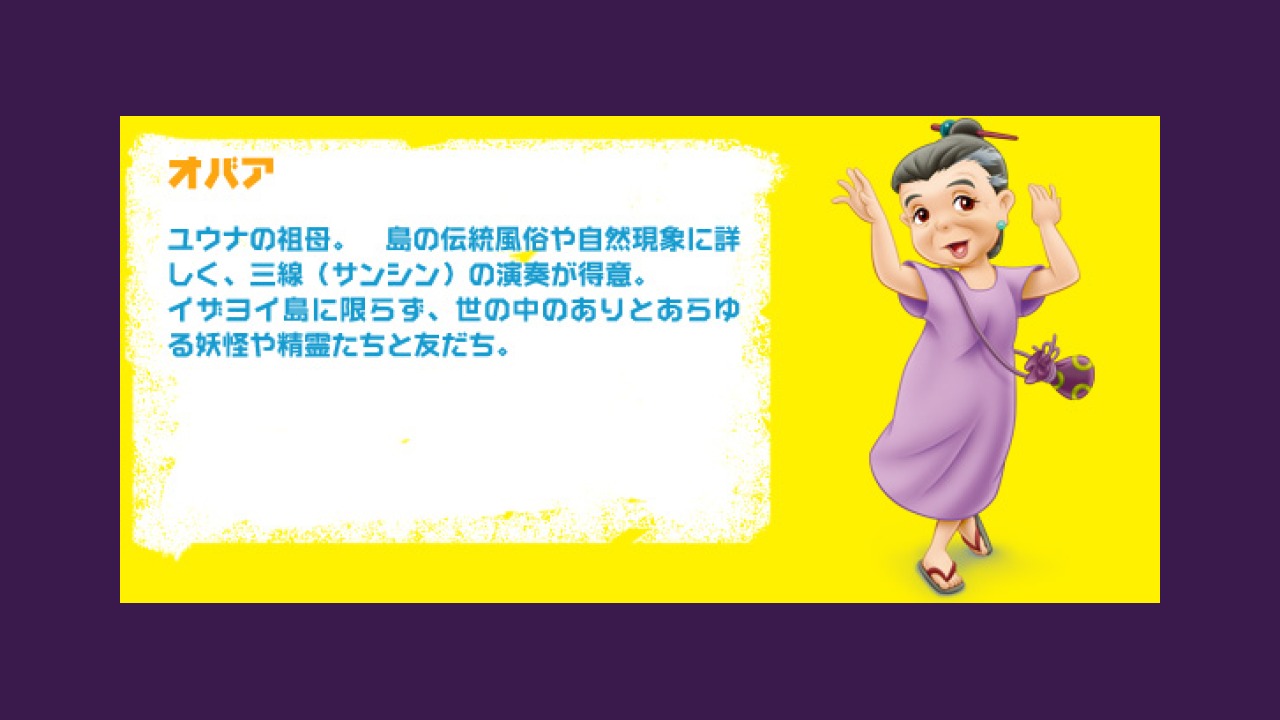
STITCH! CHARACTER PROFILE · OBaa · IZAYOI · FAMILY MEMORY
Obaa Character Profile: The Grandmother Who Knows Stitch Is Never the Strangest Thing on the Island
Stitch may be the loudest creature in the house. Obaa is the reason the house still knows what it believes after he leaves a hole in the wall.
Profile record
Name used in the series: Obaa
Role: Yuna’s grandmother and primary caregiver
Home: Izayoi Island
Known for: Family authority, island knowledge, spirit-world memory, practical care
Japanese voice: Hisako Kyōda
Appears in: The Japanese Stitch! television branch and its continuing family story
An elder who already understands the impossible
Obaa enters Stitch! with an advantage most adults in the franchise do not have. She does not need an alien invasion to teach her that the visible world is incomplete. Izayoi already holds stories, spirits, obligations, and warnings that shape how she reads danger. Stitch is extraordinary, but he is not allowed to make every mystery begin and end with himself.
That perspective gives the household its center. Yuna and Stitch can rush toward a problem because Obaa supplies memory, boundaries, food, correction, and the uncomfortable question they skipped. Her authority is rarely theatrical. It grows from staying, remembering, and knowing which local rule exists because somebody learned the hard way.
Grandmother, guardian, and working parent
Calling Obaa the grandmother can make her labor sound ornamental. In practice she is Yuna’s daily guardian while the girl’s parents are absent. She manages a home, receives strange creatures, judges whether Yuna is telling the whole truth, and absorbs consequences created by adventures she did not choose. The comedy depends on her endurance, but the character deserves more than a warm reaction shot after the damage.
Her care is practical rather than endlessly soft. She can be stern because affection without limits would leave Yuna carrying adult decisions alone. When Obaa assigns work or refuses an excuse, she protects the difference between being loved and being indulged. The best episodes let Yuna argue back without making either woman a villain.
What Obaa knows about Izayoi
Izayoi is not a decorative tropical replacement for Kauai. Its spiritual geography changes the branch’s storytelling, and Obaa is one of the people who can explain that geography without reducing it to a tourist brochure. She recognizes when a disturbance belongs to island tradition, when Stitch has offended something older than Jumba’s technology, and when a child’s confidence has outrun her understanding.
Her knowledge also prevents the series from treating every supernatural event as an alien experiment waiting for a number. Kijimunaa and other local presences have relationships, tempers, and histories of their own. Obaa’s recognition tells the audience that these beings do not become real only after Stitch notices them.
Obaa and Kijimunaa
Kijimunaa’s place around the family reveals the difference between tolerating a spirit and living in relationship with one. Obaa does not treat him as a novelty brought in for one lesson. She understands that familiarity can include irritation, affection, responsibility, and old rules that children only partly know. Their shared context makes the island feel inhabited before the opening credits begin.
That matters for Yuna. Her friendship with Kijimunaa is not a random fantasy added beside Stitch. It is part of a world Obaa helped preserve and interpret. When Yuna ignores a warning, she is not simply breaking grandmother’s arbitrary rule. She is testing inherited knowledge against immediate desire, which is a much richer conflict.
How she reads Stitch
Obaa neither panics at Stitch nor confuses his charm with innocence. She watches what he does after the joke lands. His strength can protect Yuna, but it can also destroy a room, frighten a neighbor, or turn a selfish impulse into a village emergency. Her judgment stays attached to consequences instead of species.
She also sees the tenderness beneath his performance. Stitch wants belonging so fiercely that he can turn goodness into a scorecard, especially when the Chitama Stone promises a measurable reward. Obaa’s household slowly teaches him that care is repetitive. You wash, repair, apologize, listen, and show up again after nobody is counting.
The forty-three-good-deed problem
The good-deed structure gives the early anime a clear engine, but Obaa’s presence exposes its weakness. A deed performed for a cosmic prize can still help somebody, yet the motive remains unfinished. She represents an older moral rhythm in which duty is embedded in relationships and place. Nobody hands her a glowing mark for holding a family together.
That contrast makes her an essential critic inside the premise. She does not need a lecture about ethical systems. Her ordinary choices show why goodness cannot be reduced to a tally. If Stitch wants the stone’s power, he must eventually understand the people whose needs produced the deed.
Discipline without emotional abandonment
Obaa’s sternness works because she does not disappear after correction. Yuna may be angry, embarrassed, or convinced that adults have misunderstood her, but home remains available. That continuity distinguishes discipline from rejection. The child is responsible for repair without being forced to earn her place in the family again.
The series is strongest when it gives this process time. A quick scolding followed by a reset can turn Obaa into a plot device. A fuller episode lets her ask what happened, name the harm, hear Yuna’s defense, and decide what repair actually fits. Her authority becomes relational rather than automatic.
The absent-parent pressure around Yuna
Yuna’s parents are not a neutral gap. Their absence changes what she expects from adults and how urgently she holds on to Stitch. Obaa cannot erase that ache, and the story should not ask her to. She provides safety while also living beside a grief, distance, and unanswered family history that belong to Yuna.
Obaa’s restraint matters here. She does not need to compete with Yuna’s parents or pretend the household lacks anything. She can love the child completely and still acknowledge that another relationship is missing. That honesty gives Yuna room to be grateful, angry, loyal, and lonely at the same time.
From Izayoi to New Town
The move into New Town changes the social pressure around Yuna and weakens Obaa’s direct presence in some stories. Urban school life, new friends, and status conflicts create a different kind of danger from island spirits. The branch risks losing part of its foundation whenever the older woman and Izayoi become background material rather than active memory.
Even at a distance, Obaa’s influence can be read in how Yuna assesses people, protects outsiders, and returns to the idea that belonging requires work. A thoughtful season review should track whether those values travel with Yuna or whether the relocation uses a new setting as an excuse to flatten earlier growth.
Hisako Kyōda’s Japanese performance
Hisako Kyōda voices Obaa in the Japanese production. Her performance carries age without making frailty the character’s defining joke. Warmth, suspicion, warning, and dry amusement can sit inside the same exchange. She sounds like someone who has already survived stories the children believe are happening for the first time.
This profile records the Japanese voice because Stitch! is the Japanese anime branch. Dub histories can be documented in distribution guides, but they should not displace Kyōda’s authorship of the original vocal performance on the central character page.
Why Obaa cannot be reduced to the wise elder
The phrase wise elder can become a polite way of stripping a woman of appetite, irritation, error, and private history. Obaa deserves the same scrutiny as the younger cast. When does protection become overcontrol? What does she choose not to tell Yuna? Which island rules does she interpret rather than merely repeat? How tired is she allowed to be?
Those questions do not diminish her. They rescue her from functioning as a vending machine for folklore and permission. A complete profile keeps her domestic labor, spiritual knowledge, humor, authority, and limits in the same frame. She is a person maintaining a household at the point where alien science and island cosmology keep colliding.
What the franchise gains through her
Obaa gives Stitch a home that cannot be conquered through cuteness. She makes him participate in a family led by someone who recognizes spectacle and then asks who is cleaning it up. Through her, the anime can connect chosen family to intergenerational care instead of treating friendship as the only bond worth dramatizing.
She also gives Yuna somewhere to return after bravery fails. That safety is not passive. It is the infrastructure underneath every adventure. The branch would be louder without Obaa, but it would understand far less about what makes an island, a household, and a promise continue after the crisis ends.
Sources and image record
Character identification and Japanese casting use the official TV Tokyo character archive, supported by Disney Japan release records and episode evidence across the Japanese production runs.
The hero uses official TV Tokyo Obaa artwork stored locally and placed on a CVM Sekai 16:9 canvas without altering the figure. The same file serves as featured image, hero, and directory card, with source, credit, and editorial-use metadata preserved.
Keep exploring
Return to the Stitch! anime hub, open the world and lore guides, or return to the complete franchise.
Obaa is a caregiver before she becomes the island exposition desk
Obaa feeds, houses, supervises, corrects, remembers, and creates continuity for Yuna. Those tasks happen whether an experiment or yōkai appears. The anime often needs her to explain the next mystery, but explanation should not hide the daily labor that makes Yuna’s independence possible.
A full profile keeps meals, schedules, repairs, worry, and household boundaries visible. Wisdom is not a floating trait. It grows inside repeated care, local relationships, mistakes remembered, and work other characters may not notice until it stops.
Local knowledge has a source and a limit
Obaa may know stories, sacred places, weather, families, plants, customs, and earlier incidents because she has lived in community. That does not mean she automatically knows every being the franchise introduces. Alien experiments, imported yōkai categories, and new technology can exceed her experience.
Her credibility improves when she says how she knows something and when she admits uncertainty. “My grandmother told me,” “I saw this once,” and “ask the person responsible for that site” are stronger than a universal answer delivered because the episode needs to move.
The wise-grandmother label can erase personality
Elder women in fantasy stories are often permitted wisdom, warmth, and one stern look while losing desire, humor, irritation, friendship, grief, and private ambition. Obaa should not exist only to stabilize younger characters. She has a life before Yuna’s current crisis and deserves relationships that do not pass through caregiving.
Ordinary preferences matter. What does she enjoy, avoid, collect, cook badly, remember fondly, or refuse to discuss? Those details prevent respect from becoming distance. A wise person can be petty, tired, wrong, and funny without losing dignity.
She should not be the only adult carrying Stitch
Jumba created Stitch. Pleakley joined his Earth life. Galactic institutions know his abilities. Leaving Obaa to absorb supervision, property damage, medical emergencies, and moral education transfers adult responsibility into one household without consent or funding.
Obaa can choose family involvement and still demand resources. Care does not prove she should do everything. Jumba owes technical support, repairs, safety planning, and a complete record. Pleakley owes domestic labor and communication. Institutions owe protection that does not become custody.
The Chitama Stone creates obligations for its guardians
If Obaa knows or interprets the stone’s trial, she must consider who consented to the forty-three-deed experiment and who bears the risk. The island community becomes the setting where Stitch practices morality, sometimes destructively. Magical tradition does not remove accountability.
She should be able to pause the process, question the counter, and revise unsafe rules. Season two proves the device can be reversed. Continuing without a public safety response would turn spiritual authority into negligence.
Her relationship with Yuna needs disagreement
Care becomes believable when Yuna can challenge Obaa and Obaa can change her mind. Absolute elder authority may look respectful while denying the younger character any path except obedience or secret rebellion.
A healthy disagreement identifies what is negotiable, what safety boundary remains firm, and when the conversation will reopen. Obaa can hold responsibility without treating every question as disrespect. Yuna can demand a voice without pretending experience has no value.
Karate context should come through practice, not slogans
Obaa’s relationship to Yuna’s karate can include discipline, family history, teachers, and the difference between ability and judgment. Official Okinawa karate materials emphasize restraint and peace-seeking principles alongside rigorous training.
She should not praise every successful strike. The important question is whether Yuna understood when force was necessary, proportionate, and likely to create more danger. Martial skill becomes character education only when it changes decisions outside the dojo.
Sacred landscapes require consent and stewardship
Obaa may know that a forest, stone, ruin, or path carries rules beyond visible ownership. She should explain who maintains the place, what behavior is prohibited, and what repair follows disturbance.
The series often uses sacred space as adventure machinery. Obaa can interrupt that pattern by treating access as a relationship, not a clue. Stitch’s curiosity does not grant permission to activate, remove, or fight around everything that looks magical.
Kijimunaa is not household equipment
A friendly supernatural being may help Yuna or Stitch, but ability does not create an obligation to serve. Obaa should model asking, respecting refusal, and recognizing when illness or fear changes what Kijimunaa can provide.
That boundary matters in a franchise where experiments are routinely assigned jobs based on useful powers. Local friendship should not reproduce the same ownership logic through softer language.
Tourism and community change belong in her memory
Obaa’s lifetime can reveal changes in visitors, work, prices, buildings, roads, heritage management, and which traditions became public performance. That perspective would make the island feel inhabited rather than preserved for the anime camera.
Memory should not become a claim that the past was pure. Earlier life contained hardship and conflict too. The value lies in comparison: what changed, who benefited, what was lost, and which adaptation helped people remain.
New Town changes her caregiving reach
When Yuna moves, Obaa may lose immediate knowledge of daily routines and risk. Calls, visits, transport, school contacts, and emergency planning become more important. The branch should show that distance rather than letting grandmother care teleport whenever the plot needs it.
Yuna may gain independence and still need dependable contact. Obaa’s task is not preventing adulthood. It is helping transition happen with information, resources, and a relationship that can survive reduced control.
She needs friends and peers of her own
An elder isolated inside one household becomes a symbol rather than a community member. Obaa should have peers who remember different versions of events, disagree about local stories, share work, and notice when she is carrying too much.
Peer relationships also distribute cultural authority. One grandmother should not represent every local perspective. Several adults with different knowledge make the setting more accurate and give Obaa room to ask for help.
Japanese voice performance belongs in the record
Obaa’s Japanese performance shapes humor, authority, tenderness, and the social distance inside family address. The profile should name the verified Japanese performer and identify which production season or special the credit covers.
A dub may change rhythm and tone. Analysis should state which track supplies the evidence rather than blending performances into one universal voice. For this Japanese branch, Japanese credits remain primary.
Caregiving needs money, rest, and succession
Love does not pay for repairs, replace lost work, or prevent burnout. Obaa needs financial support and practical help when Stitch creates costs. She also needs rest that does not become a crisis because nobody else learned the routine.
Succession is not replacement. Yuna can gradually take age-appropriate responsibility while Jumba, Pleakley, family, and community adults share the load. A care system is durable when one elder can be unavailable without the household collapsing.
Official image standard
Obaa’s featured image, hero, and landing card should use the same official Japanese character art stored locally. Her face must remain visible, and the crop should not reduce her to background beside Stitch.
Metadata needs source URL, official page, Japanese credit, alt text, and editorial-use note. A generated grandmother or generic village scene would erase the exact person the profile is meant to document.
Profile verdict
Obaa is the household’s continuity, a caregiver with situated knowledge, and an elder whose authority should remain accountable and interruptible. She becomes shallow when wisdom replaces personality or when every adult responsibility silently lands in her kitchen.
Her best future includes friends, rest, resources, documented knowledge, honest disagreement with Yuna, and the ability to say “I do not know” without losing respect. Let her care without becoming infrastructure.
The final receipt
Obaa’s defining receipt is not producing the right legend at the right moment. It is building a home where Yuna can ask questions, Stitch can be held accountable, and care does not depend on one woman never becoming tired.
Obaa and Yuna need conflict that does not threaten their bond
A grandmother and granddaughter can love each other completely and still disagree about safety, secrecy, independence, school, friendship, and the amount of chaos one blue alien should be allowed to bring home. If every disagreement ends with Obaa already possessing the correct answer, Yuna never gets to practice judgment and Obaa never has to reconsider an assumption.
Their strongest scenes should let both women have evidence. Obaa may recognize a danger Yuna cannot yet see, while Yuna may understand Stitch or a peer in a way Obaa does not. The resolution should come through listening, consequences, and revised boundaries. Family authority becomes believable when it can survive an argument without turning affection into a reward for obedience.
Karate changes how the profile should read her body
Obaa is not merely a seated elder who supplies oral history. Her connection to karate places knowledge in breath, stance, timing, repetition, and physical memory. Training also gives her a language for discipline that is different from punishment. A student repeats a form because control matters, not because an adult enjoys command.
That distinction belongs in her relationship with Stitch. His strength is immediate, but restraint must be practiced until it becomes available under stress. Obaa can understand that lesson without pretending alien abilities are identical to martial arts. She can teach attention, distance, recovery, and respect while Jumba remains responsible for the technical facts of Stitch’s body.
Sacred places are relationships, not fantasy equipment
The series gains emotional weight when a shrine, forest, stone, or shoreline is more than a colorful mechanism for the next plot. Obaa’s knowledge should include the duties attached to a place: who maintains it, who may enter, what must be asked, what should be left alone, and how damage is repaired. A sacred location is not public property simply because the heroes need an adventure there.
Her role is strongest when she refuses the tourist version of spirituality. She can explain that respect is behavioral, not decorative. Stitch cannot earn moral credit by completing a magical task while ignoring the people and places affected by it. Repair, apology, and changed conduct matter more than a counter announcing that a deed has been logged.
Kijimunaa should be treated as a neighbor with consent
When Kijimunaa enters the household orbit, Obaa is positioned to model a relationship that does not reduce him to a mascot, clue, or supernatural service. Knowledge of local stories does not grant ownership over a being. Friendship requires permission, privacy, and the possibility that he will refuse a request.
Obaa can also recognize when younger characters speak about Kijimunaa instead of to him. Correcting that habit would connect folklore to ordinary manners. The lesson is not that every legend is secretly available for human use. It is that sharing a place with another kind of person creates obligations even when their needs are unfamiliar.
Community change should be visible inside her choices
Izayoi does not remain untouched because the story calls it an island community. Visitors arrive, technology changes routines, children leave and return, businesses adapt, and unusual incidents attract attention. Obaa should have opinions about which changes help residents and which turn their home into scenery for outsiders.
Those opinions need not make her hostile to everything new. She may welcome safer infrastructure, better communication, or opportunities for Yuna while resisting extraction and spectacle. Giving her a mixed, practical response protects her from the lazy role of tradition personified. She is a resident negotiating the future, not a museum label guarding an imaginary past.
New Town tests whether her care can travel
When the story moves beyond the earliest island routine, Obaa’s importance should not vanish because the camera follows Yuna elsewhere. Distance reveals what part of their relationship depends on proximity and what survives through calls, visits, habits, and advice that Yuna chooses to carry.
The move also creates a useful limit. Obaa cannot solve every emergency from home, and Yuna must build a wider circle of trustworthy adults and peers. A mature version of their bond allows separation without abandonment. Obaa remains family while accepting that successful caregiving eventually produces decisions she does not control.
Friendship gives Obaa a life outside the household
A full character profile must ask who checks on Obaa when she is not performing care for Yuna. Friends can remember her younger years, challenge her version of an old story, invite her somewhere inconvenient, or notice exhaustion before the family does. Those relationships reveal a voice that is not always calibrated for a child.
Peer friendship also prevents the series from treating older women as interchangeable sources of comfort. Obaa should have specific loyalties, old disagreements, shared jokes, and people whose advice she sometimes ignores. The more social history she possesses, the more believable her knowledge becomes and the less it resembles a scriptwriter’s emergency information drawer.