
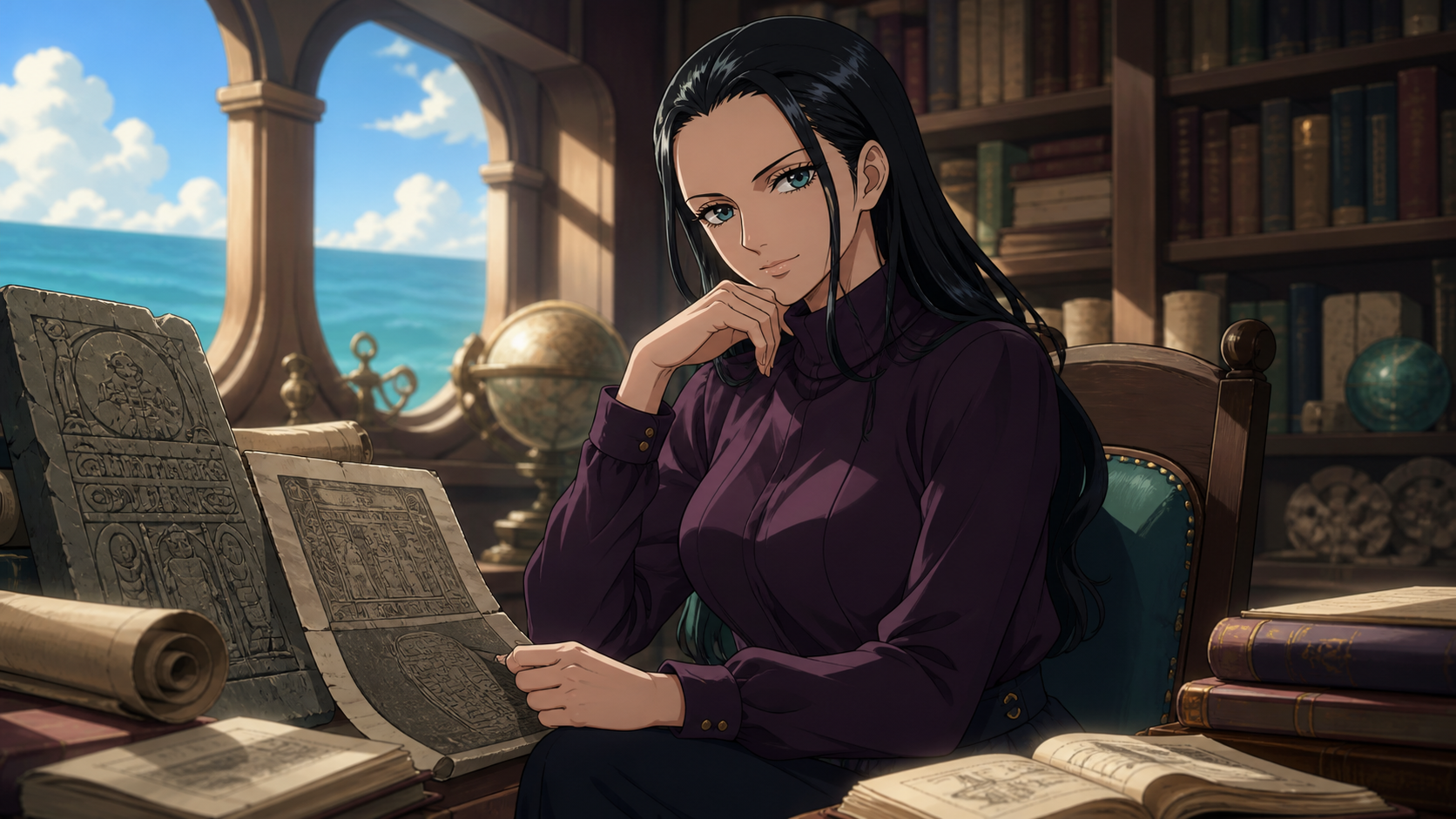
Nico Robin: One Piece Character Profile
Quick profile
Nico Robin is an archaeologist from Ohara, the sole surviving reader of the Poneglyph script, and a woman hunted since childhood because the World Government fears what she can learn and translate.
Literacy is power
Robin’s scholarship is not a decorative fascination with ruins. Reading connects buried testimony to present institutions. The government’s criminalization of archaeology proves that archives can threaten an empire more directly than weapons.
Ohara and manufactured guilt
The Buster Call destroys Robin’s home and then turns the survivor into evidence against the victims. Her wanted poster teaches the world to interpret a child through the language of state security. Survival becomes something she is trained to apologize for.
I want to live
Enies Lobby matters because Robin’s declaration is not sudden optimism. Robin’s declaration is a public refusal of the sentence imposed on her at eight years old. The crew cannot make the declaration for her, but they can create a place where saying she wants to live has consequences.
Hana Hana no Mi
Robin blooms limbs across surfaces, turning distance and visibility into tactical questions. Her power can restrain, gather information, protect allies, and produce enormous forms. The elegance of the imagery sits beside the bodily risk because damage can transfer back to her.
Revolutionary connection
Her years with the Revolutionary Army broaden the politics around her research. History does not liberate people automatically. History requires readers, organizers, and communities capable of acting on what the archive reveals.
The camera and adult womanhood
Robin’s composure is often sexualized by framing that has nothing to do with her choices. Adult confidence should not be treated as blanket consent for the camera to interrupt her intellectual work.
Japanese performance
Yuriko Yamaguchi gives Robin reserve, dry humor, terror, and warmth. Small changes in breath and pace let trust arrive gradually, which honors a survivor who learned that visibility could be fatal.
RaeRae’s verdict
Robin makes knowledge feel dangerous because knowledge is dangerous. Robin is not valuable merely as a key to the final island. She is a scholar rebuilding an erased intellectual lineage while learning that her own life belongs inside the future she is trying to uncover.
Ohara and the government that criminalized memory
Robin becomes an archaeologist as a child on Ohara, where scholars study the Void Century and Poneglyphs. The World Government answers research with a Buster Call. Warships destroy the island, civilians die, and official propaganda turns the surviving child into a demon rather than admitting that a state erased a community to protect a controlled history.
Jaguar D. Saul gives Robin a route out and a reason to believe she may find people who will not treat her existence as a threat. Nico Olvia’s brief reunion gives love no time to become ordinary family life. Professor Clover and the scholars leave her knowledge that cannot be safely discussed but cannot be forgotten.
Survival under criminal organizations
Robin spends years moving between pirates and criminal groups because every institution knows her bounty and few people can protect her without wanting to use her. Betrayal becomes a survival method before trust becomes possible. Crocodile values her ability to read Poneglyphs while expecting control over what she reveals.
Joining the Straw Hats is not instant healing. Robin observes, withholds, and prepares to disappear when CP9 threatens the crew. Enies Lobby matters because the crew rejects the government’s claim that her survival creates an unacceptable cost.
Poneglyph literacy is political power
Robin can read the ancient inscriptions that record buried history, weapons, promises, routes, and the Road Poneglyph information needed to reach Laugh Tale. That skill makes her essential to Luffy’s voyage and dangerous to a government built on historical censorship.
Archaeology is not treasure hunting with better vocabulary. Robin studies language, context, material evidence, provenance, and competing interpretations. A translation can change political meaning, so the crew must protect both the reader and the conditions that let her read carefully.
Flower-Flower Fruit mechanics and limits
The Flower-Flower Fruit lets Robin sprout copies of body parts on surfaces within range. Extra eyes gather information, ears monitor conversations, arms restrain or redirect opponents, wings slow a fall, and giant limbs increase force. Damage to a manifested limb can transfer pain or injury back to her body.
Her techniques reward sight lines, positioning, concentration, and anatomical judgment. Fish-Man Karate training adds stronger strikes, while Demonio Fleur creates a terrifying large form. Scale does not erase vulnerability. Robin can be interrupted, restrained, exhausted, or harmed through the limbs she creates.
I want to live and the consent inside rescue
Robin leaves with CP9 because the government threatens the Straw Hats. Her surrender is coerced, but the crew cannot complete the rescue by treating her stated refusal as meaningless. They reach Enies Lobby, destroy the flag, and demand the answer beneath the threat. Robin finally says she wants to live.
The declaration does not make earlier fear irrational. A child hunted for existing learns to leave before affection creates another target. The crew changes the calculation by accepting the danger with full knowledge rather than asking her to guarantee their safety.
Relationships and accountability
Luffy gives Robin a place without demanding a complete confession first. Nami offers practical friendship and another adult woman who does not compete with her intelligence. Chopper brings open affection. Franky shares the Enies Lobby rescue and understands what governments do to dangerous knowledge. Brook matches her dark humor. Saul remains the voice that told a lonely child she would find people who wanted her alive.
Robin can be secretive, fatalistic, and too willing to decide that disappearance protects everyone. Those habits come from survival, but trauma does not make unilateral choices harmless. Trust requires sharing enough danger for other people to choose their response.
Design chronology
Robin’s early design uses long dark hair, composed posture, hats, fitted clothing, and a calm face that conceals constant calculation. Her Alabasta wardrobe belongs to Miss All Sunday, a role inside Crocodile’s organization. Later clothing becomes brighter and more varied as the crew relationship grows safer.
The post-time-skip design changes her hair and often lightens the anime palette. Arc outfits can reflect local fashion, archaeology, cold-weather work, or infiltration. The best designs keep books, glasses, field clothing, or other signs of her profession visible instead of letting glamour erase the scholar.
Yuriko Yamaguchi’s Japanese performance
Yuriko Yamaguchi gives Robin restraint, dry humor, warning, tenderness, and grief. The performance rarely announces every feeling. Small changes in breath and pace let a calm sentence carry fear without turning Robin into an emotionless mystery woman.
Enies Lobby requires the controlled voice to break. Later comedy works because the same character can describe a horrifying possibility in a pleasant tone. Yamaguchi keeps the humor connected to a woman whose imagination was trained by real danger.
RaeRae’s verdict
Robin is dangerous to the World Government because she can read what power ordered everyone else to forget. Her existence proves censorship requires ongoing violence. Books can burn, islands can disappear, and a surviving reader can still carry the question forward.
I love Robin most when the story lets scholarship become action. She reads, translates, compares, remembers, and chooses what knowledge means for the people beside her. Archaeology is not background lore. Archaeology is the route to the truth the entire voyage keeps circling.
Robin’s calm is a survival skill, not an absence of feeling
Robin enters the crew with the stillness of somebody who has spent years making every room believe she can leave without regret. The calm is useful. Calm keeps employers from seeing fear, prevents allies from becoming obvious leverage, and lets her gather information while everybody else performs certainty. The same calm can make viewers underestimate how much emotional labor survival has required.
Ohara teaches Robin that knowledge can make a child a military target. The World Government does not merely kill scholars. The government manufactures a public story where the scholars threatened the world and the surviving child becomes a demon. That lie recruits ordinary people into the punishment. Every betrayal Robin experiences afterward is easier because the bounty tells frightened adults that abandoning her is responsible citizenship.
I want that history remembered whenever somebody calls her mysterious as though secrecy were a personality quirk. Robin learned that biography could become evidence against her. Trusting the Straw Hats requires more than deciding they are nice. She has to test whether belonging can survive the truth, danger, inconvenience, and the possibility that the state will punish everybody nearby.
Reading is an action with consequences
Poneglyph literacy makes Robin one of the most politically important people alive. The stones hold information power tried to remove from public memory, and the ability to read them turns archaeology into direct resistance. She does not need to punch the final ruler for her work to threaten the entire arrangement. A translated sentence can expose a weapon, recover a name, or prove that the official history was engineered.
That importance also raises an ethical question. Knowledge is not automatically liberating when access remains concentrated in one person. Robin protects information because disclosure can kill communities, but the long project cannot end with another private archive. Ohara’s scholars died because the state feared shared historical memory. The answer has to involve people learning, preserving, arguing, and deciding together what the recovered past demands.
“I want to live” remains powerful because the declaration is personal before becoming symbolic. Robin is not an archive asking to be preserved for future usefulness. She is a woman asking to exist. My favorite later scenes are the small ones where that right becomes ordinary: Robin laughing at a terrible drawing, offering a dark observation, caring for Chopper, or relaxing while the crew makes noise around her. Survival becomes life when a person no longer has to justify every breath through usefulness.
The crew gives Robin a future tense
For years Robin plans in short intervals: survive this employer, escape this betrayal, reach the next stone, never reveal enough to make attachment fatal. The Straw Hats change more than her safety. They give her reasons to imagine events after the next crisis. A destination can become exciting rather than merely useful. A meal can be enjoyed without measuring every exit.
That future tense matters when the plot turns her knowledge into a key for reaching Laugh Tale. Robin cannot become a device the crew protects only because she can read the road poneglyphs. Enies Lobby rejected the idea that her value depends on utility. The final voyage has to keep rejecting the same idea when her rare skill becomes strategically indispensable.
I want Robin to reach the true history as a scholar surrounded by people who would still choose her if every stone went blank. That distinction is the emotional proof of her story. Ohara gave her a mission. Saul gave her hope that friends existed somewhere. The crew gives her a life where the mission and the woman can survive together.
Her humor belongs to that recovered life too. Robin imagines gruesome outcomes in the same calm voice other people use to discuss weather, and the crew reacts as though a ghost entered breakfast. The joke never requires her to become bubbly for acceptance. She gets to keep the oddness survival produced while discovering that friends can answer oddness with affection. Healing does not mean returning to the child she was before Ohara. Healing means the adult survivor can be loved without editing away the person she became.
Robin’s relationship with Nami is especially valuable because neither woman is asked to become the other’s moral tutor. They share information, space, jokes, danger, and the exhausting experience of watching their male crewmates invent preventable emergencies. Nami’s practical authority and Robin’s historical perspective meet without competition. Fandom often isolates women into separate rankings because scarcity says only one can be important at a time. The Sunny offers a better arrangement. Their skills address different problems, their histories shape different boundaries, and mutual regard does not require either woman to surrender complexity for a marketable friendship pose.
Official sources and routes
ONE PIECE.com: Nico Robin official character profile
ONE PIECE.com: anime staff and Japanese cast
Watch One Piece on Crunchyroll
Browse One Piece character profiles