
New Fist of the North Star OVA 3 React: Sorrow Did Not Rebuild the City
Immediate reaction: The trilogy closes its rival fists and water war, but the people of Lastland still have to convert release into a future nobody owns.
Spoilers: This React discusses the complete OVA episode and its ending.
A finale must resolve the men and answer what their conflict changed for everyone else
The third OVA inherits two kinds of closure. Kenshiro and Seiji need an emotional and martial conclusion, while Lastland needs a future beyond Sanga’s resource monopoly and the rival salvation that followed it. The first kind is easier to stage because a body can embody decision. The second requires institutions, distribution, and time.
The episode’s success depends on whether those scales remain connected. Sorrow should reveal why a man chose domination without making the city’s suffering an accessory to his self-knowledge. Victory should return water and also return political imagination. Otherwise the finale would free the reservoir while leaving ownership untouched.
Pain becomes wisdom only when it reduces the harm a person is willing to impose
The franchise repeatedly treats sorrow as the emotional substance that separates worthy strength from empty violence. That idea can be beautiful and can become a shortcut. Suffering does not automatically teach care. Sanga and Seiji demonstrate how injury may instead harden into entitlement, spectacle, or a demand that strangers validate the wounded self.
Kenshiro carries sorrow differently because he does not require other people to perform it for him. Memory informs restraint. The finale’s title gains meaning when sorrow becomes responsibility rather than status. A man who has suffered deeply is not owed authority. He possesses more evidence about why authority must protect another person’s freedom.
Recognition matters only if the person beneath the image accepts consequence
The final confrontation asks Seiji to exist beyond the composed rival identity. Once performance can no longer secure obedience or self-certainty, the person underneath must face what the image permitted him to do. Emotional exposure is not the same as repair, but it is the condition from which responsibility might begin.
The narrative temptation is to let a magnificent final gesture settle the account. Sacrifice can express love, regret, or recovered conscience and cannot reimburse the people whose choices were constrained. Seiji deserves human complexity without receiving narrative immunity. The city deserves memory precise enough to retain both his wound and the wounds he caused.
Healing becomes reconstruction when Sara can choose how knowledge reaches the whole city
Sara’s future is one of the finale’s most important measures. If she remains merely the person Kenshiro protected, the trilogy has misunderstood its own politics. Her medical knowledge challenges monopoly because it can circulate care through relationships the former regime did not control.
Reconstruction should expand that capacity without turning Sara into another indispensable center. Apprentices, shared practice, consent, and access matter. The healer deserves a life beyond permanent service, while the community deserves systems that do not collapse if one gifted person leaves. Kenshiro opens physical space; Sara and the people of Lastland decide what kind of care inhabits it.
Information has to stop being private currency if the city is going to become governable
Tobi’s survival depended on knowing more than the person beside him and revealing only what circumstance rewarded. Under tyranny, that habit may be adaptive. After liberation, it can preserve the same hierarchy in smaller form. A city rebuilding itself needs records, testimony, routes, and public knowledge that cannot be monopolized by one useful intermediary.
His value does not disappear when information becomes shared. Local expertise remains essential, and trust can turn it toward coordination rather than leverage. The question is whether Tobi can imagine safety without always owning the map. His answer represents the social transition the finale can only begin.
A released resource becomes justice only when access is governed differently
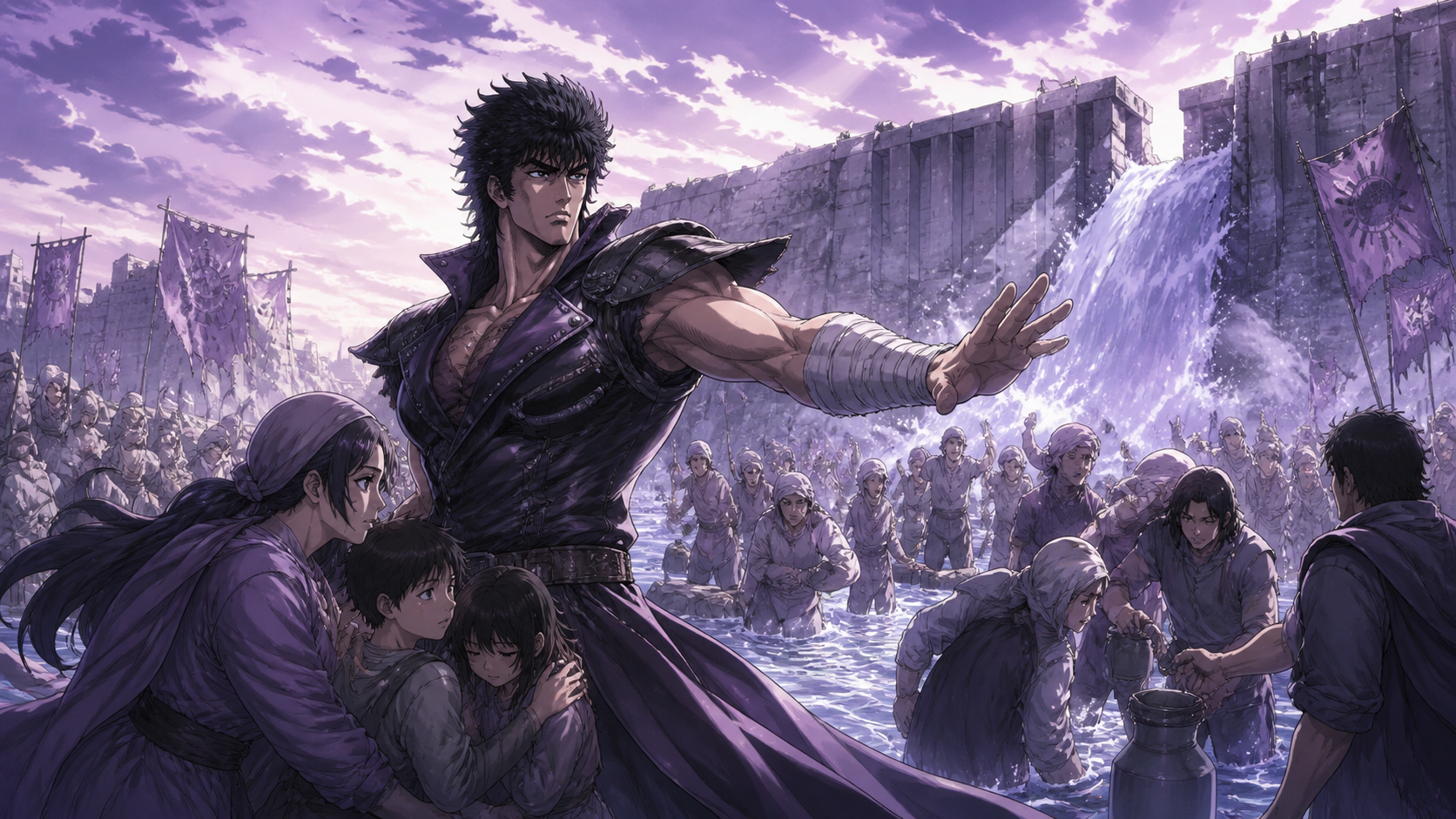
The image of water returning carries enormous cathartic force because thirst structured every earlier decision. Bodies can drink, heal, move, and imagine planting. The regime’s sacred performance collapses into material truth: water was never proof of one ruler’s favor. It was a resource withheld.
Distribution remains the next conflict. Who maintains the reservoir, allocates during drought, protects against contamination, and listens when access fails? A cheering crowd is not yet an institution. The finale is emotionally honest when release feels like a beginning rather than a completed society. Freedom needs pipes, rules, labor, and the right to question all of them.
The traveler’s departure can protect autonomy and can abandon the difficult aftermath
Kenshiro’s wandering structure requires him to leave after intervention. Remaining could turn protection into permanent rule, especially when a grateful city is vulnerable to attaching legitimacy to strength. Departure refuses ownership. It also means survivors perform the slower work without the body that made immediate retaliation less likely.
The tension cannot be solved through purity. Kenshiro must judge whether staying enlarges agency or replaces it. The finale benefits from letting civilians act before he disappears, demonstrating that reconstruction is already theirs. A horizon shot should not mean the hero completed the future. It should mean the people behind him have begun authoring it.
The trilogy’s metallic severity becomes most expressive when dawn finally enters the frame
Hard digital shadows and direct gore defined the earlier chapters, making Lastland feel sealed inside threat. The finale’s visual release works when light and water soften surfaces without pretending trauma vanished. Color becomes an ethical transition: the world contains possibilities not designed by the ruler.
More animation detail does not guarantee more emotional detail. The memorable images are those where environment and choice align—a hand turning toward care, citizens moving together, a fighter’s pose losing certainty. The production finds maturity not in how explicitly a body can break, but in how clearly a community can begin moving after the break.
8.3 out of 10 — emotionally satisfying, politically unfinished, and honest enough to let rebuilding remain work
When a Man Carries Sorrow resolves the trilogy’s rival fists with conviction and returns attention to the resource that made Lastland governable through fear. Sara, Tobi, Seiji, and Kenshiro each face a question about what knowledge or strength is for. The finale still gives male sorrow more duration than communal aftermath.
Its best achievement is refusing to make water symbolic only. Bodies need it after the speeches end. The city’s future will depend on access, care, information, and shared authority. Kenshiro can destroy the claim that one person owns survival. Lastland must build the structures that make the claim difficult to revive.
The finale works because controlled voices finally permit fracture
Koyasu’s Kenshiro and Gackt’s Seiji have spent the trilogy using restraint differently. Kenshiro’s control protects judgment from pride; Seiji’s control protects an idealized identity from contradiction. The finale becomes emotionally persuasive when those surfaces no longer sound equivalent and strain reveals what each man was preserving.
Vocal fracture should not be treated as automatic redemption. It makes interior conflict audible and leaves consequence intact. The performances carry the ending when recognition enters without turning the entire city into therapy for powerful men. Silence after a line can preserve the people whose pain is not being spoken.
Can the city remember a complicated man without converting complexity into innocence
Communities leaving tyranny often inherit contested memory. One person may recall help, another coercion, and both accounts can be true. A beautiful ending encourages legend to smooth contradiction because mourning prefers a coherent object. Lastland needs a history sturdy enough to retain the fracture.
Humanity does not require choosing between monster and misunderstood victim. It requires recognizing that harmed people can harm, charismatic people can love, and final insight does not erase prior choices. Memory becomes protective when it prevents the next wounded savior from using complexity as immunity.
The trilogy’s final image changes when reconstruction rather than combat becomes the object of attention
On first viewing, the ending’s emotional momentum belongs to Kenshiro and Seiji. Rewatching makes the people around them more visible: who moves toward water, who helps another body, who remains frightened, and what physical systems survive the old rule. Those details decide whether the finale contains a future.
The third OVA improves when read as an opening rather than a perfect conclusion. Water returns, knowledge remains, and the traveler leaves. Nothing guarantees justice. The lack of guarantee is not failure if citizens possess more agency than before. Hope becomes credible when it looks like work rather than applause.
Sorrow Does Not Automatically Produce Repair
The finale treats sorrow as a threshold to wisdom, but pain can just as easily harden entitlement or produce withdrawal. Ethical change appears only when feeling alters behavior: releasing control, telling the truth, accepting consequence, and investing in other people’s futures.
Seiji’s interior recognition cannot replace restitution to those harmed by his movement. The city needs records, resources returned, and survivors able to speak without participating in his redemption.
Sorrow matters when it becomes responsibility. Without that conversion, the emotion remains another dramatic possession centered on the man who caused the crisis.
Restored Water Needs Rules the Public Can Inspect
Water flowing again is not the same as water justice. Someone must maintain pumps, monitor contamination, schedule repairs, protect access during shortages, and decide how disputes are resolved. If those functions remain private, the next monopolist inherits an intact system.
Residents should participate in distribution and know where records are kept. Emergency priority may be necessary, but criteria must be public and revisable.
The released resource becomes a common good only when governance changes alongside ownership. Otherwise the finale offers abundance as a temporary image while leaving the administrative machinery of deprivation untouched.
Sara and Tobi Need Authority in Reconstruction
Sara understands health consequences and Tobi understands routes, networks, and the city’s hidden transactions. Their knowledge should shape reconstruction without making either person an unaccountable replacement ruler. Expertise needs defined responsibility, shared records, and public review.
Both also need recovery. The story should not assume that surviving crisis creates unlimited capacity for governance.
A workable coalition pairs their knowledge with residents, technicians, caregivers, and people previously excluded from decisions. Reconstruction becomes collective when no single expert controls the resource, the map, or the narrative of what happened.
Kenshiro Leaving Should Be a Transfer, Not an Abandonment
The traveler’s departure protects local autonomy when residents have information, resources, and authority to continue. It becomes abandonment when the hero leaves unresolved security, injured people, or concentrated power because the emotional arc has concluded.
Kenshiro should confirm who maintains water, how former enforcers are handled, and whether Sara and Tobi have support. He can leave without owning the city while still recognizing transition as part of rescue.
The final measure is not whether he walks toward the horizon beautifully. It is whether people behind him can govern the morning after he disappears.
Reconstruction should include a public account of who lost access to water, who disappeared, which healers were prevented from working, and which neighborhoods carried the greatest burden. Without that record, restored flow can wash away responsibility faster than it repairs trust.
Residents need memorials and practical restitution shaped by their testimony, not only a story about the men whose conflict ended. Sara and Tobi can help preserve evidence while ensuring vulnerable witnesses choose how they participate.
The city becomes governable when memory is treated as infrastructure alongside pipes, medicine, and routes.
Production facts are separated from the editorial judgment
Episode titles, the three-part release structure, novel source, Takashi Watanabe direction, Takehito Koyasu as Kenshiro, Gackt as Seiji, and the 2003–2004 release context are anchored to the contemporary AV Watch production report and Japanese release record. All political, psychological, and ethical analysis is CVM Sekai editorial criticism.