
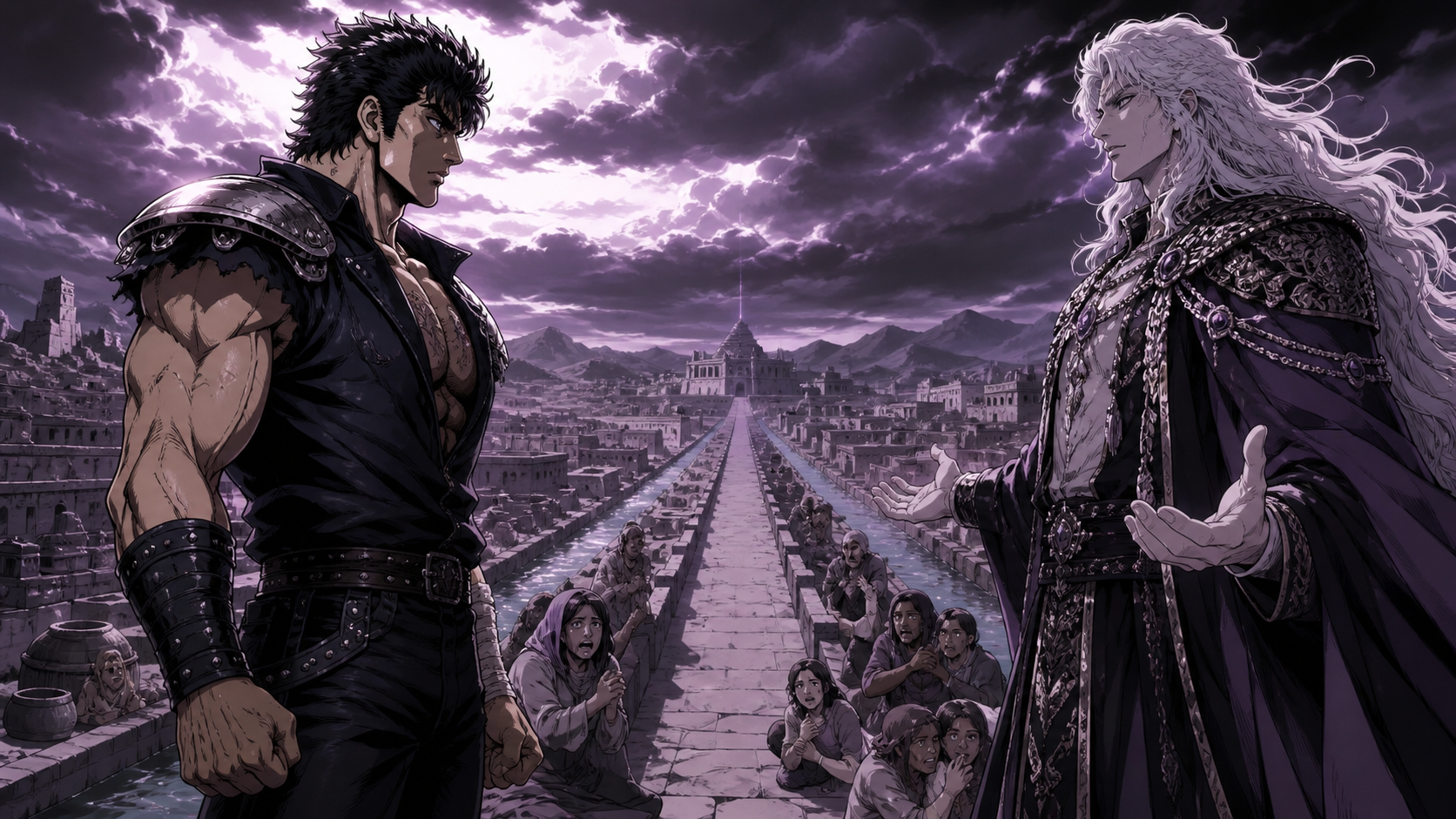
New Fist of the North Star OVA 2 React: The Forbidden Fist Made Salvation a Brand
Immediate reaction: Seiji turns martial inheritance into spectacle while Lastland learns how quickly a wounded population can be recruited by a beautiful answer.
Spoilers: This React discusses the complete OVA episode and its ending.
A rival fist becomes dangerous when it offers people an identity before it offers them safety
The second OVA brings Seiji forward as more than another obstacle waiting for Kenshiro. He represents a competing interpretation of inheritance and a competing performance of masculine salvation. Where Kenshiro arrives reluctantly, Seiji understands the political value of being seen, named, and believed.
Lastland’s vulnerability makes that performance effective. People emerging from one monopoly are not automatically free from the desire for certainty. A charismatic figure can turn relief into allegiance before institutions have been rebuilt. The forbidden fist matters because it promises power without requiring the community to develop its own.
The beautiful rival is not shallow because he performs; performance is how he makes injury govern strangers
Seiji’s composure, visual polish, and controlled voice make him legible as an alternative center. His charisma is not evidence that followers lack intelligence. It is a technology built from coherence. In a fractured city, someone who appears completely certain can feel safer than collective decisions that remain visibly unfinished.
The episode should not confuse wounded history with moral exemption. Seiji may possess reasons for wanting power, recognition, or vengeance. Those reasons explain the emotional architecture of domination. They do not grant jurisdiction over people who did not cause the wound. The more compelling he becomes, the more precise accountability must become.
A celebrity voice produces distance that sometimes becomes exactly the character’s mask
Gackt’s Japanese performance entered the project as a deliberate event, tied to the production’s music and its desire for a reimagined era. The voice has a cool, composed quality distinct from conventional animation performance. That distance can sound limited and can also make Seiji feel like someone continually presenting an idealized version of himself.
The useful question is not whether the performance resembles the classic cast. It is whether its reserve supports the character. Seiji needs charisma that feels constructed without becoming empty. When the voice lets strain appear beneath control, the casting becomes conceptually sharp. When every line remains equally polished, mystery risks replacing interiority.
Refusing the rival’s frame is more important than proving a higher place inside it
Seiji’s challenge invites a familiar hierarchy: determine which fist is stronger and let victory certify the correct worldview. Kenshiro’s ethical distinction cannot rest only on winning. It appears in his refusal to treat people as the audience whose admiration proves his worth.
He fights because domination has entered bodies and choices, not because another man’s confidence injured his pride. This restraint separates protection from competition, even when the animation understandably stages their encounter as spectacle. Kenshiro becomes most powerful when he declines the emotional economy that would make Seiji the center of his self-understanding.
Expertise should not become a moral prize awarded to the fighter the story prefers
Sara’s knowledge and relationships make her essential to Lastland’s future, which also makes her vulnerable to being positioned between competing men. The narrative can use her reaction as evidence of who is worthy, narrowing a healer into a mirror for masculine virtue.
Her actual stake is larger. She must judge what kind of power permits care, whether the city can survive transition, and how healing knowledge should circulate. A serious reading keeps those decisions visible even when the plot emphasizes rivalry. Sara is not proof that Kenshiro is good. Kenshiro’s goodness is partly measured by whether Sara remains free.
Collective belief changes quickly because yesterday’s certainty already betrayed it
The citizens’ shifting responses can look fickle if viewed as personal weakness. Politically, instability is predictable. When institutions collapse, people seek signals about where safety now resides. Seiji supplies an image coherent enough to organize fear, while Kenshiro refuses to campaign for belief.
The episode’s tragedy is that a community trained to receive authority has little practice producing it. Exposure of one false savior does not teach deliberation. Reconstruction requires shared information, access to water, and ways to disagree without losing survival. A crowd becomes a community when people can make decisions between spectacles.
Prohibition creates mystique, but secrecy also hides who decided the danger and who benefits from control
A forbidden technique carries instant narrative authority. The label implies historical judgment and promises knowledge too potent for ordinary circulation. That can be true and still leave questions. Who prohibited it, what harm did they identify, and why was secrecy considered safer than accountable teaching?
The franchise’s martial schools often combine technical discipline with inherited myth. The OVA becomes richer when prohibition is treated as an institutional choice rather than mystical branding. Dangerous knowledge may require boundaries. Boundaries become legitimate through responsibility, not through a lineage insisting nobody outside it may ask.
Digital spectacle works when choreography reveals control slipping from the men performing it
The OVA’s hard surfaces, CG accents, aggressive compositing, and direct impact aim for a modern brutality distinct from the broadcast series. The confrontation benefits when camera movement preserves spatial logic and lets posture show psychological change. A barrage of effects without readable decisions would reduce both fighters to demonstrations.
The strongest moments make technique conversational. Seiji presents certainty, Kenshiro diagnoses it, and each adjustment exposes what the other believes about dominance. Violence remains extreme, but the scene has an argument beneath the anatomy. That is the difference between a climax and a technology reel.
8.1 out of 10 — a compelling rivalry that sometimes mistakes polished mystery for interior depth
The Forbidden Fist expands the trilogy’s central problem from water monopoly to salvation monopoly. Seiji’s charisma, Gackt’s unusual performance, Sara’s contested agency, and the city’s unstable belief give the episode real psychological material. The middle chapter occasionally delays clarity in order to preserve coolness.
Its value lies in showing why liberation is vulnerable to branding. People denied collective authority may attach survival to the next coherent man. Kenshiro’s best answer is not being more marketable. It is creating the conditions under which nobody needs a martial celebrity to authorize water, care, or truth.
Gackt’s songs make Seiji feel like a character who arrived with his own weather
The production’s decision to connect Gackt’s music and performance gives Seiji unusual authorship over the OVA’s atmosphere. Song does not merely accompany him; it extends the cultivated image through which he becomes credible. The result suits a chapter about salvation as brand, where aesthetic coherence can persuade before policy is examined.
This integration can also overprotect the character, allowing mood to substitute for dramatic evidence. Music should deepen tension between the image and the person rather than certify that mystery is profundity. The episode is strongest when sound creates attraction while the narrative keeps asking what that attraction costs everyone outside Seiji’s self-construction.
Would we recognize domination if the person offering it looked wounded, composed, and beautiful
Sanga’s coercion is easy to name because resource monopoly and punishment are visible. Seiji presents the harder test. He offers identity, confidence, and the sense that suffering can be organized into meaning. People may consent to his symbolic authority before understanding how narrow their future becomes inside it.
Humanity requires judging effect without denying charisma. A compelling person can be sincerely wounded and still use followers as material. Kenshiro’s refusal to compete for adoration matters because it denies the premise that beauty or pain grants jurisdiction. The audience must make the same refusal while remaining honest about why the performance works.
The middle chapter improves when Seiji is watched as a political actor rather than a secret waiting to be solved
First viewing naturally emphasizes revelation: what is the forbidden fist, who is Seiji, and how will Kenshiro answer him? Rewatching frees attention for recruitment, staging, and the management of public belief. Seiji’s entrances and controlled disclosures become choices about audience rather than merely cool direction.
This perspective also restores Sara and the citizens to the episode. Their responses are not decorations around rival men. They reveal which forms of power feel plausible after betrayal. The chapter remains uneven, but its psychology becomes clearer once mystery stops consuming every question.
Seiji Offers Belonging Before He Offers Safety
Seiji’s appeal works because people need an explanation for suffering and a group that recognizes them. His brand supplies identity, ritual, and a hierarchy of special knowledge before it proves that anyone will be safer. That sequence turns emotional need into political leverage.
Followers should not be dismissed as foolish. Betrayed institutions make certainty attractive, especially when the person offering it appears wounded and disciplined.
The ethical response is not humiliation. Communities must offer truthful information, material security, and forms of belonging that do not require surrendering judgment to one charismatic body.
Forbidden Knowledge Needs Transparent Governance
Calling a technique forbidden creates mystery while hiding who prohibited it, what evidence justified the decision, and whether enforcement protects the public or preserves institutional monopoly. Secrecy can contain danger and can also make abuse impossible to evaluate.
Governance should distinguish technical details that must remain restricted from ethical rules that everyone can know: consent, prohibited uses, oversight, sanctions, and who can report harm.
Seiji exploits the vacuum around hidden authority. The answer is not unlimited disclosure; it is accountability broad enough that prohibition cannot become mythology controlled by whoever performs it most beautifully.
Sara Is an Expert, Not the Moral Trophy Between Rivals
Both men’s conflict risks making Sara’s judgment valuable only when it validates one fighter. Her medical knowledge, political reading, and personal boundaries exist independently of whom she trusts romantically or strategically.
She should be able to disagree with Kenshiro, assess Seiji without forgiving him, and refuse roles assigned by either man. Protection means preserving those options rather than placing her behind the winner.
The rivalry becomes ethically legible when Sara’s expertise changes the plan and when her safety is not used as proof that one form of masculinity deserves the story’s approval.
A Crowd Can Leave a Movement Without Becoming a New Mob
When Seiji’s claims fracture, followers may feel shame, anger, grief, or fear of punishment. Rapid disillusionment can redirect collective energy toward scapegoats instead of accountability. People need safe exit routes, truthful records, and ways to distinguish organizers of harm from those recruited through desperation.
Public reckoning should preserve evidence without demanding instant emotional clarity from everyone involved.
The OVA’s political aftermath matters because domination does not disappear when a charismatic mask slips. The social needs that made the mask persuasive still require institutions capable of meeting them.
Seiji’s wounded image also creates a trap for critics: any boundary can be framed as cruelty toward someone who has suffered. Trauma deserves recognition without becoming authority over other people. The crowd can understand what shaped him and still refuse the hierarchy he built.
Accountability should separate explanation from entitlement. Seiji may need care, distance, and a truthful hearing, but he does not gain control of Sara, Kenshiro, or followers because pain made his performance compelling.
The OVA’s rivalry becomes most human when compassion stops being confused with surrendering judgment to the most visibly wounded man.
Beauty can invite attention; it cannot establish moral jurisdiction.
Production facts are separated from the editorial judgment
Episode titles, the three-part release structure, novel source, Takashi Watanabe direction, Takehito Koyasu as Kenshiro, Gackt as Seiji, and the 2003–2004 release context are anchored to the contemporary AV Watch production report and Japanese release record. All political, psychological, and ethical analysis is CVM Sekai editorial criticism.