
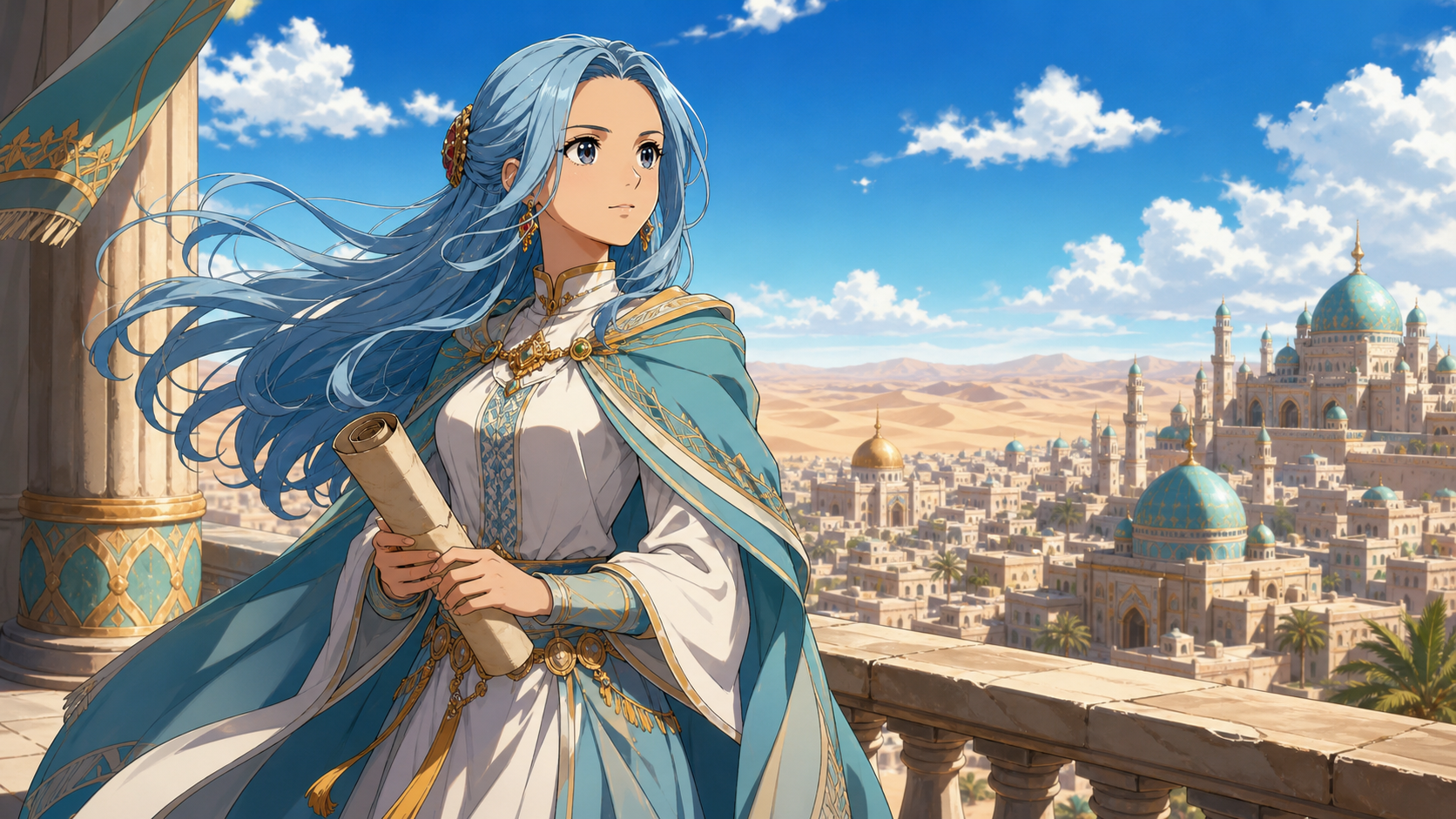
Nefertari Vivi: One Piece Character Profile
Quick profile
Nefertari Vivi is the princess of Alabasta, a former Baroque Works infiltrator, and an honorary Straw Hat. She enters the conflict as Miss Wednesday before revealing a mission to stop a civil war engineered by Crocodile.
Infiltration and political labor
Vivi spends years gathering evidence inside the organization destabilizing her country. The work requires performance, patience, and the acceptance that useful information may arrive too late to prevent every loss.
A princess who must be heard
Her status gives access but not automatic authority. Vivi repeatedly has to persuade soldiers, rebels, pirates, and her own allies. Leadership becomes communication under conditions designed to make every side distrust the others.
Alabasta’s manufactured crisis
Crocodile weaponizes drought, rumor, state force, and scarcity. Vivi recognizes that the visible battle is not the whole system. Stopping violence requires exposing who benefits from making neighbors interpret each other as enemies.
Choosing to stay
Vivi does not board the ship after Alabasta because responsibility to her people is also a chosen dream. The farewell marked by raised arms rejects the idea that adventure is the only valid form of freedom.
Reverie and global stakes
Her later position at the Reverie places Alabasta’s history inside the conflict over the Empty Throne and the meaning of the initial D. Vivi remains politically important because the government cannot safely contain what her family represents.
Official profile and the shape of her role
ONE PIECE.com identifies Nefertari Vivi as the princess of the Alabasta Kingdom, born February 2, voiced in Japanese by Misa Watanabe, and a former member of the Straw Hats. She has no Devil Fruit and no conventional pirate bounty. Her power comes from political knowledge, endurance, persuasion, and a willingness to enter danger personally.
Vivi begins under the codename Miss Wednesday, so the audience meets performance before title. The reveal does not replace a fake criminal with a sheltered princess. Infiltration, combat, diplomacy, and the years spent studying Baroque Works are all parts of the same person.
Baroque Works infiltration is patient political labor
Vivi and Igaram enter Crocodile’s organization to discover who is destabilizing Alabasta. The mission requires them to obey enough of the criminal structure to remain useful while searching for evidence that may arrive too late. Their cover creates moral compromise without turning the pair into secret super-agents who control every outcome.
At Reverse Mountain, Vivi first opposes the Straw Hats as Miss Wednesday. Necessity changes the relationship. She must disclose her identity, accept help from unpredictable pirates, and trust people with information that could destroy her country if sold. Political judgment here means choosing among dangerous options rather than waiting for certainty.
Little Garden teaches the cost of rushing alone
Vivi’s urgency is rational because civil war is approaching. Urgency also tempts her to treat her own body as an expendable shortcut. The crew’s journey through Little Garden shows that reaching Alabasta requires surviving the route, respecting local dangers, and allowing other people to carry part of the mission.
Her relationship with Nami becomes especially important when illness threatens the navigator. Vivi supports seeking a doctor even while every delay increases the danger at home. The choice proves that care is not separate from leadership. A ruler who sacrifices every person for the abstract nation eventually has no nation worth saving.
Drum Island clarifies what a ruler owes the public
Vivi stops Luffy from escalating a confrontation with frightened citizens and bows to request medical aid. She understands that being correct about Nami’s emergency does not give the group permission to ignore a community’s fear. Leadership must produce cooperation under pressure, not merely announce moral superiority.
The contrast with Wapol is deliberate. He treats the state as personal property and medicine as leverage. Vivi treats rank as a duty to lower the temperature, explain the need, and accept humiliation when lives depend on access. Her body language becomes political practice.
Crocodile manufactures a crisis from systems, not one lie
Operation Utopia weaponizes drought, Dance Powder, rumor, state uniforms, scarcity, and the reputation of King Cobra. Crocodile does not need every citizen to believe the same story. He needs enough people to distrust one another that ordinary mistakes become proof of conspiracy.
Vivi recognizes the visible battle as only one layer. Koza and the rebel army have real grievances, royal soldiers face real danger, and Baroque Works agents push both sides toward irreversible violence. Exposing Crocodile matters, but truth requires a channel capable of reaching people inside noise and grief.
The clock tower makes communication a physical struggle
Vivi races through Alubarna trying to stop armies that cannot hear her. Her voice fails against explosions, distance, and momentum. The sequence refuses the comforting idea that sincerity automatically reaches an audience. Communication needs timing, access, amplification, and people positioned to carry the message.
The hidden bomb turns public panic into a deadline. Pell’s intervention and the Straw Hats’ separate fights create room for Vivi to keep speaking. Victory becomes collective infrastructure around a political demand: stop killing neighbors for a plan designed by the person profiting from the war.
Karoo is a partner, not royal decoration
Karoo carries messages, crosses hostile terrain, absorbs injuries, and repeatedly chooses to remain beside Vivi. Their relationship makes care visible without human speech. She depends on him, worries about him, and trusts his judgment under pressure.
The Super Spot-Billed Duck Squad also reminds the story that resistance networks are not composed only of famous fighters. Movement, delivery, distraction, and endurance can determine whether information arrives. Alabasta survives through many forms of labor.
Choosing Alabasta does not reject freedom
After Crocodile falls, Luffy invites Vivi to continue sailing. She wants the adventure and loves the crew, but remaining with her people is also a chosen dream. The decision rejects a narrow freedom story where liberation always means leaving home, office, or responsibility behind.
The raised X marks protect the crew from publicly acknowledging pirates while giving Vivi the answer she needs. Belonging survives without possession. She does not have to board the Sunny forever to make the relationship real, and the crew does not demand abandonment as proof of affection.
Reverie places Alabasta inside the global argument
Vivi arrives at the Reverie with experience of a Warlord exploiting government legitimacy. The gathering promises diplomacy while operating beneath the Celestial Dragons, the Empty Throne, and institutions willing to erase inconvenient nations. Her courtesy never means ignorance of that structure.
Cobra’s questions about the Nefertari family, the poneglyphs, and the initial D make Alabasta dangerous to the highest authority. Vivi becomes a target not because she commands an army but because her lineage intersects with suppressed history and because she has relationships the government cannot neatly classify.
After Cobra, survival becomes a political act
The death of Cobra and the attempt to control the public account force Vivi into flight. News media, official statements, and revolutionary symbolism compete to define events before witnesses can speak. Morgans provides mobility, but his newsroom has its own appetite for spectacle.
Vivi’s task is no longer simply returning to a stable palace. She must survive, determine whom to trust, protect the truth of what happened, and understand why the Nefertari name matters to Imu. The princess trained to stop a manufactured civil war now faces information warfare on a global scale.
Leadership without combat inflation
Vivi uses Peacock Slashers and can fight ordinary agents, but later relevance should not require a sudden power scale designed to imitate the strongest pirates. Her established strengths are intelligence gathering, coalition building, public speech, memory, and the courage to enter spaces where title offers limited protection.
One Piece needs characters whose decisions change history without every decision becoming a named attack. Vivi’s authority remains credible because she understands institutions and still treats individual lives as more than pieces on a board.
Japanese performance by Misa Watanabe
Misa Watanabe gives Vivi ceremonial composure, impatience, open grief, and a voice that can crack without surrendering the argument. The performance avoids treating idealism as naivety. Vivi sounds like somebody who has seen institutions fail and continues organizing anyway.
Her best scenes move between command and pleading because both are tools. A princess may issue orders, but a leader also asks, listens, negotiates, and repeats the truth when the first attempt disappears beneath violence.
RaeRae’s final word
Vivi proves that belonging does not require permanent proximity and freedom does not require abandoning responsibility. She is a Straw Hat because the journey changed what everyone was willing to risk. She is Alabasta’s princess because staying means accepting accountability after the celebration ends.
Her story keeps asking whether a sincere voice can interrupt systems built to make neighbors mishear each other. Sincerity alone cannot do the job. Vivi brings evidence, allies, timing, humility, and stubborn repetition. That is not glamorous magic. That is political work, and One Piece is stronger whenever the series remembers the difference.
Vivi understands that legitimacy is practiced in public
Vivi’s title gives her access, but the Alabasta crisis proves that a crown cannot substitute for public trust. Crocodile engineers scarcity, misinformation, and violence so citizens stop believing the state can protect them. Vivi cannot solve that crisis by revealing herself once and expecting everybody to obey. She has to cross the country, listen to people already suffering, and find a way for competing groups to hear one another through manufactured chaos.
Drum Island matters because Vivi stops Luffy from answering an armed crowd with force. She kneels, asks for help, and accepts humiliation because Nami needs treatment. The scene is not proof that subjects should worship a self-sacrificing princess. The scene shows a future ruler recognizing that leadership sometimes means controlling the powerful people standing beside her.
I love Vivi because desperation does not erase her political imagination. She keeps insisting that rebel soldiers, royal guards, civilians, and children belong to the same future even when every incentive rewards choosing a side and calling the other side disposable. The insistence is exhausting. That exhaustion makes her credible.
Staying in Alabasta is also an adventure
Vivi’s farewell is often described as giving up the pirate journey for duty. She chooses another form of danger. Rebuilding after civil conflict means restoring water, institutions, records, trade, and trust while powerful enemies remain interested in the kingdom. No victory parade completes that work.
The raised X marks let the crew acknowledge her without exposing the relationship. Their silence is care shaped by surveillance. Vivi belongs to the Straw Hats because belonging does not require permanent physical proximity or identical work. She carries the voyage into governance, and the crew carries her into every promise about what freedom should protect.
My Vivi ending cannot be a decorative throne. Cobra’s death and the Reverie crisis push her into a global struggle where Alabasta’s history, the Will of D., and the World Government meet. She should remain a political actor who makes decisions, not a royal witness waiting for pirates to restore her home again.
Karoo belongs inside that political story. He is not transportation with a funny face. He chooses danger, carries messages, protects Vivi, and becomes part of the communication network holding Alabasta together. Their partnership shows leadership working through trust across species and rank. Vivi does not become less serious when she cries over a giant duck. The affection reveals what her politics is trying to save.
Vivi’s bond with Nami also keeps royalty from floating above material life. Nami thinks about weather, money, illness, routes, and the cost of every delay. Vivi thinks about water, public trust, rebellion, and the lives hidden behind a national decision. Their friendship grows through shared practical intelligence rather than a princess borrowing a commoner for moral education. Both women know what coercion looks like when a powerful man controls the resource everybody needs. Their farewell hurts because each recognizes the work waiting for the other. The voyage and the kingdom are not competing proofs of courage. They are connected fronts in the same argument about freedom.
Official sources and routes
ONE PIECE.com: Nefertari Vivi official character profile
ONE PIECE.com: current anime staff and Japanese cast
Watch One Piece on Crunchyroll
Browse One Piece character profiles