
Orochimaru’s Hideout Discovered
Naruto learns to build power through a partner’s agency while Kakashi’s team enters a place shaped by Orochimaru’s refusal to recognize it.
Naruto's next lesson begins by changing the shape of help
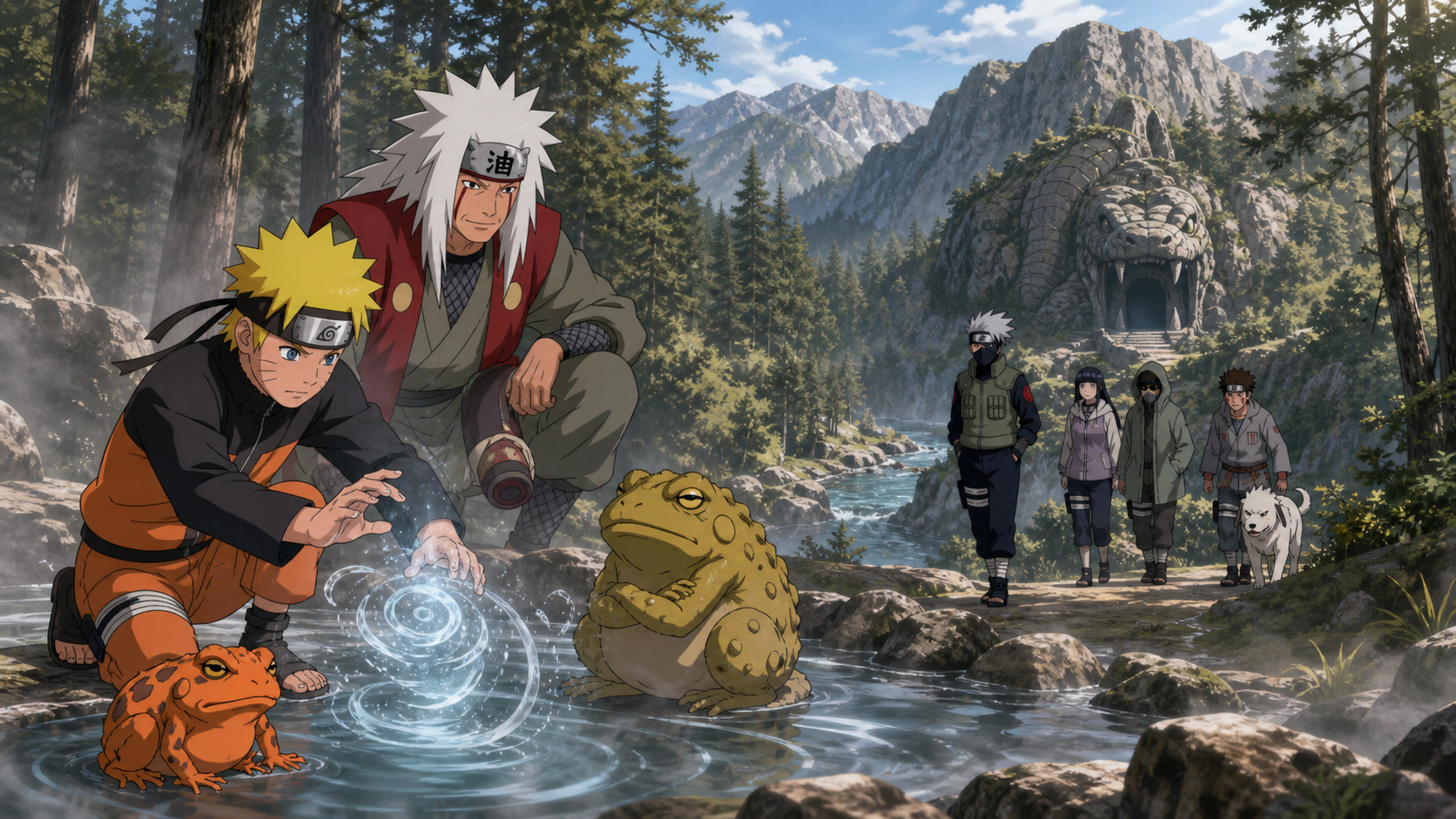
Jiraiya does not answer the Rasen Shuriken restriction with a substitute superweapon. He takes Naruto to the hot springs and proposes collaboration ninjutsu with a toad.
The shift is important. Naruto has just completed a technique through thousands of shadow-clone training hours, yet its close-range design makes it unsafe. The next path asks him to coordinate with another living mind rather than multiply himself.
Progress becomes relational instead of merely cumulative.
Collaboration cannot be commanded like a clone
Shadow clones share Naruto's instincts, urgency, and chakra source. A summoned partner has preferences, timing, fear, and limits of its own.
Naruto therefore cannot treat Gamakichi or Gamatatsu as an extra limb. He has to communicate the intended result, listen to what the toad can actually produce, and adjust his chakra around a contribution he does not control.
The training is difficult because cooperation requires agreement, not just concentration.
The hot springs create room for an unfinished idea
The setting feels lighter than the battlefield, but the work is not trivial. Steam, water, and open space let Naruto experiment without placing teammates inside the destructive radius of his forbidden technique.
Jiraiya gives him a place where mistakes can become observation instead of injury.
That is one of the quiet responsibilities of mentorship: designing conditions where failure remains survivable long enough to teach something.
Jiraiya teaches by redirecting momentum
Naruto responds badly to stagnation. Simply ordering him to stop would leave his energy attached to the forbidden technique and make secrecy more tempting.
Jiraiya redirects that energy toward a challenge connected to Naruto's existing strengths: summons, improvisation, and stubborn relationship-building.
He does not erase Tsunade's medical boundary. He helps Naruto keep moving without violating it.
A discovered hideout is evidence, not certainty
Elsewhere, Kakashi's tracking team approaches Orochimaru's abandoned base. The title promises discovery, but finding a door does not mean finding the person who built the network.
Hideouts can be emptied, trapped, staged, or left with only the material their owner no longer values. The team has to distinguish absence from safety.
The site matters because it records methods, movement, and priorities even when its central figure has already gone.
The tracking team reads what secrecy failed to erase
Hinata's Byakugan, Shino's insects, Kiba's scent work with Akamaru, and Kakashi's field judgment approach the same problem from different sensory systems.
Each can challenge the others' first interpretation. A scent trail may identify movement; insects can reveal disturbed spaces; the Byakugan can expose chambers hidden behind stone.
Their strength is not simply four useful abilities. It is the overlap that makes deceptive evidence harder to sustain.
Orochimaru's architecture treats people as materials
An abandoned laboratory still carries the logic of the person who used it. Cells, sealed rooms, instruments, and escape routes reflect an organization built around experimentation without consent.
The horror does not require Orochimaru to stand in the room. Systems preserve values in their design.
Finding the hideout means entering a place where bodies were categorized by usefulness and discarded when they stopped producing results.
The two storylines share a question about partnership
Naruto is learning how to work with toads as partners whose cooperation must be earned. The investigation moves through the remains of a network where Orochimaru treated followers and test subjects as tools.
That contrast gives the episode coherence beyond geography.
One path creates power by respecting another being's agency. The other extracts power by denying agency until only utility remains.
The mission widens beyond Sasuke
Any Orochimaru lead carries the hope of information about Sasuke, but the hideout also points toward victims, experiments, and threats unrelated to Naruto's personal goal.
The Leaf cannot reduce the investigation to one missing teammate. Whatever operates through these sites may endanger people who have never met Sasuke.
Determination becomes more responsible when it can recognize harm outside the story that first motivated it.
RaeRae's reaction
I like that Episode 91 pairs goofy-looking toad practice with one of the series' ugliest institutional shadows. The surface tones differ, but both threads ask what happens when someone needs another being's power.
Naruto has to persuade, coordinate, and adapt. Orochimaru builds spaces where refusal is irrelevant.
That moral difference matters more than which technique looks stronger.
Discovery opens a door rather than resolving the mystery
Episode 91 moves the arc forward without pretending that a location is an answer. Naruto begins a safer form of training whose outcome depends on partnership. Kakashi's team reaches a hidden site whose emptiness may reveal as much as its contents.
Both groups are working with incomplete information. Neither can force certainty without damaging what they need to understand.
The next step is therefore patient: learn the partner, read the evidence, and let what remains reshape the plan.
Official episode reference: Naruto Official episode guide
Licensed episode route: Crunchyroll licensed episode page
Jiraiya answers a forbidden technique with a relationship
Naruto expects progress to mean stronger wind chakra or another way to force the Rasen Shuriken into usefulness. Jiraiya changes the assignment. He asks Naruto to create an attack with a toad.
The shift matters because the last breakthrough concentrated risk inside Naruto’s body. Collaboration distributes capacity while introducing another person’s agency as a condition the technique must respect.
Gamakichi and Gamatatsu are not interchangeable summons
They have different temperaments, abilities, attention spans, and relationships with Naruto. Choosing a partner requires knowing who can contribute what, not selecting a generic toad-shaped resource.
Naruto’s social memory becomes tactical knowledge. He has to remember earlier encounters, listen to present limits, and build around the toad actually standing beside him.
Gamatatsu’s limitations are information, not comedy alone
His appetite, confusion, and incomplete training create humor, but treating him as useless would repeat the error of measuring every ally against one expected function.
Naruto can ask what Gamatatsu understands, what chakra nature he can support, and what conditions help him focus. Collaboration begins where judgment stops pretending another person should already know the plan.
Gamakichi can translate between Naruto’s urgency and his brother’s pace
He understands more of the tactical goal and more of Gamatatsu’s communication. That position makes him a bridge rather than merely the smarter summon.
Good teamwork often depends on someone translating expectations across different abilities. The translator’s labor should be recognized instead of disappearing behind the final combined jutsu.
The hot springs make experimentation physically legible
Water, steam, and open terrain show how elements move and interact. Naruto can observe spread, pressure, and control without placing a village street inside the test.
The environment provides feedback gentler than a battlefield. Jiraiya has designed a place where mistakes remain visible and recoverable.
Jiraiya’s teaching works because he redirects instead of shaming
Naruto is proud of Rasen Shuriken and angry that he cannot use it. Calling that pride childish would push him toward secrecy.
Jiraiya acknowledges the need to grow, then offers another problem worthy of attention. The boundary remains firm while momentum finds a safer channel.
Collaboration challenges Naruto’s habit of doing everything himself
Shadow clones look like teamwork but share one mind. A summon can disagree, misunderstand, or refuse. Naruto must explain instead of assuming intent transfers automatically.
That challenge reaches beyond technique. The boy who fears losing people often tries to carry every rescue personally. Partnership asks him to trust help that remains independent.
The tracking team approaches the hideout as a layered evidence problem
Kiba and Akamaru read scent. Shino’s insects read environmental disturbance. Hinata reads chakra and hidden structures. Kakashi reads how all those signals fit operational risk.
No single sense receives automatic authority. Agreement strengthens a finding, while contradiction tells the team where deception may be operating.
Finding an entrance does not prove the mission found the right target
Orochimaru uses multiple bases, abandoned rooms, false trails, and people sent in his place. A discovered hideout may be recent, obsolete, or deliberately visible.
The team needs dates, movement patterns, supplies, and chakra traces before connecting the site to Sasuke or current operations.
Hinata can identify spaces built to defeat ordinary search
Byakugan vision can reveal chambers behind walls, underground routes, chakra pathways, and figures concealed beyond line of sight.
Her report should distinguish clear observation from interpretation. A shape that resembles a person may be a trap, corpse, or experiment. Precision protects the team from urgency.
Kiba and Akamaru can separate occupation from abandonment
Fresh scent, food, sweat, medicine, and repeated movement create a different record from dust and old chemicals. Tracking can turn an empty room into a timeline.
Orochimaru may disguise or contaminate trails, which is why scent needs support from insects, vision, and physical evidence rather than heroic certainty.
Shino’s insects can search without concentrating every body at one door
Distributed reconnaissance lowers the risk of a single ambush trapping the entire team. Insects can mark branches, test airflow, and reveal movement beyond visible corridors.
The method fits a networked enemy. Orochimaru built many routes. Shino answers with many observers connected to one careful analyst.
Kakashi must protect specialists while they concentrate
Extended Byakugan use, scent reading, and insect control all demand attention. A tracker focused on distant evidence may miss the nearby hand setting a trap.
Command means assigning cover and deciding when information is sufficient to move. The best perception is useless if the person gathering it is left exposed.
An Orochimaru facility should be treated as a possible rescue site
Cells, restraints, records, and medical equipment may point to living subjects rather than only enemy intelligence. Entry plans need medics, containment tools, and evacuation capacity.
The Leaf cannot define success solely as finding Sasuke or capturing an agent. People harmed outside Naruto’s personal story remain part of the mission.
Evidence from experiments requires ethical handling
Samples may contain human tissue, altered bodies, or identifying information. Treating those materials as useful research without acknowledging victims would reproduce Orochimaru’s logic.
Konoha should document provenance, seek identities, return remains where possible, and restrict knowledge that could enable repetition.
The hideout preserves power relationships after its owner leaves
Narrow cells, hidden observation points, locked laboratories, and escape tunnels reveal who was allowed to move and who was expected to be contained.
Architecture records hierarchy. The team can learn how Orochimaru organized fear even if every room is empty.
Naruto’s training and Orochimaru’s laboratory offer opposite models of experimentation
Jiraiya creates a space where participants can fail, communicate, and adjust. Orochimaru creates spaces where other bodies absorb risk for his curiosity.
Both pursue new power. Consent, care, and who pays for failure define the moral distance between them.
Sasuke’s possible connection must not collapse every clue into hope
Naruto and Sakura want any hideout to become a route toward their teammate. That desire can make weak evidence feel conclusive.
Kakashi’s team should report what the site proves before guessing what everyone wants it to mean. Hope survives better when it is not built on fabricated certainty.
RaeRae’s full take
Jiraiya taking Naruto to practice with two toads after Tsunade bans the self-damaging jutsu is exactly the redirect I needed. Do not just tell this boy no and leave him alone with urgency. Give him another door.
Gamatatsu being difficult is part of the lesson. A partner is not a clone waiting for Naruto’s intention to arrive preinstalled. He has to explain, listen, and make the technique belong to both of them.
The hideout thread is darker because Orochimaru never learned that distinction. Every room asks what another body could do for him, never what that person wanted.
Discovery is not victory. It is the point where the tracking team owes the evidence patience, the possible victims care, and each other enough caution to survive the next door.
The team should establish a clean route back before entering
A hidden base may contain collapsing passages, seals, poison, or enemies who cut off the obvious exit. Marking a verified route gives injured people and recovered victims somewhere to move.
Shino’s insects can maintain trail markers while Kiba monitors scent changes. Retreat planning is not pessimism. It is part of rescue.
Every opened chamber should be documented before the next one
Moving quickly can destroy the sequence that explains how a facility operated. Photographs, sketches, and location notes preserve relationships between equipment, records, and restraints.
That context may identify experiments or reveal where occupants moved. Evidence without position can become a pile of objects stripped of meaning.
The team needs a protocol for people who appear hostile but were coerced
Orochimaru’s subjects may attack because of seals, conditioning, fear, or promised survival. Immediate danger still requires response, but not every fighter inside the hideout chose the institution freely.
Restraint, medical evaluation, and questioning outside the facility can separate active allegiance from captivity that learned to defend itself.
Kakashi should assume the hideout reports back to someone
Disturbed seals, missing insects, opened doors, or altered chakra may alert a remote observer. Discovery can start a clock even when no alarm sounds.
The team should decide which evidence matters most and what can be left behind. Thoroughness becomes dangerous if the network already knows they entered.
Hinata can search for living chakra before valuable documents
Records may expose Orochimaru’s system, but a person still trapped inside has the more urgent claim. Byakugan search should prioritize signs of life, restricted movement, and unstable chakra.
Intelligence protects future victims. Rescue protects someone whose future is happening now.
Kiba and Akamaru should maintain contamination awareness
Chemicals, blood, preserved tissue, and experimental animals can overwhelm scent or create health risks. Protective distance and sample handling matter.
If Akamaru reacts unusually, the team should treat that as evidence of environmental danger rather than pushing him forward because his nose is useful.
Jiraiya should let the toads define success with Naruto
A combined technique needs goals both partners understand: element, timing, direction, range, and a signal to stop. Naruto cannot hold the whole design privately and expect cooperation to appear.
Shared criteria make failure discussable. Each participant can name which part broke without turning frustration into blame.
Gamatatsu’s appetite can become part of training rather than an interruption
Food may motivate attention, but bribery alone will not create trust. Naruto can use familiar routines to establish timing while learning what Gamatatsu enjoys and fears.
Partnership grows through ordinary interaction between attempts. Technique is only one expression of the relationship.
Collaboration should reduce danger rather than multiply uncontrolled chakra
Combining elements can produce effects larger than either partner expects. The hot springs training area needs boundaries, observers, and a safe abort signal.
Jiraiya’s responsibility is ensuring that relational power does not become another excuse to ignore the bodies creating it.
The discovered hideout changes the village’s intelligence map
Even an abandoned base can reveal supply routes, allied settlements, communication methods, and patterns connecting other facilities. The value may be network-wide rather than immediate.
Konoha should compare findings with earlier sites and allied reports. Orochimaru survives through fragmentation, so the response must connect evidence he expected investigators to keep separate.
Episode 91 connects two storylines by asking the same moral question in opposite rooms: what do you believe another living being is for? Naruto begins with frustration because collaboration is slower than commanding clones. Gamakichi and Gamatatsu have their own abilities, moods, and timing. That inconvenience is the lesson. A partner is not an extra hand Naruto summons to complete his private idea. The technique has to be negotiated into existence. Across the country, Orochimaru’s hideout preserves the answer he chose. Cells, corridors, equipment, and abandoned traces show a system where bodies mattered only as long as they served his research. Consent was an obstacle removed from the design. That is why Kakashi’s team must enter carefully and ethically. The site may contain victims trained to look like enemies, remains stripped of names, or records useful enough to tempt Konoha into repeating the same extraction. Hinata, Shino, Kiba, and Akamaru bring several ways of seeing because no single reading should decide what happens to people inside. Kakashi brings the responsibility to slow those readings down until they agree. Discovery is not possession. Evidence does not become morally neutral when the right village collects it. I want Naruto’s training to keep its ridiculous warmth because meals, arguments, misunderstandings, and laughter are how partnership becomes real before power arrives. I want the hideout investigation to keep its discomfort because silence inside a laboratory does not mean nobody is owed care. Both groups are learning that method shapes outcome. Naruto can build a safer future by sharing agency with a toad. The Leaf can answer Orochimaru by preserving agency for anyone his network tried to erase. A new jutsu and a new intelligence lead matter, but the episode’s real progress is refusing to make usefulness the only value another life is allowed to have. The search team should leave the cave with more than coordinates. It should carry names, dates, routes, warnings, and any person waiting to be treated as a person. Naruto should leave the hot springs with more than a combined attack. He should understand what his partners contributed and what they need before trying again. Those outcomes sound quieter than conquest or forbidden research, but they are the difference between power that expands community and power that consumes it. Jiraiya’s most important instruction may be creating enough safety for that difference to become practice. Kakashi’s most important order may be stopping the team before discovery turns into ownership.
RaeRae checkpoint: Naruto’s safer path begins when another living being gets a voice inside the technique. Orochimaru’s hideout shows what power becomes when every other voice is removed.
Receipts and official routes
- Licensed title and official account of Naruto beginning collaboration training while Kakashi’s tracking team investigates Orochimaru’s discovered hideout: Naruto Official Site episode guide.
- Licensed episode title, number, and watch route: Crunchyroll.