
The Next Step
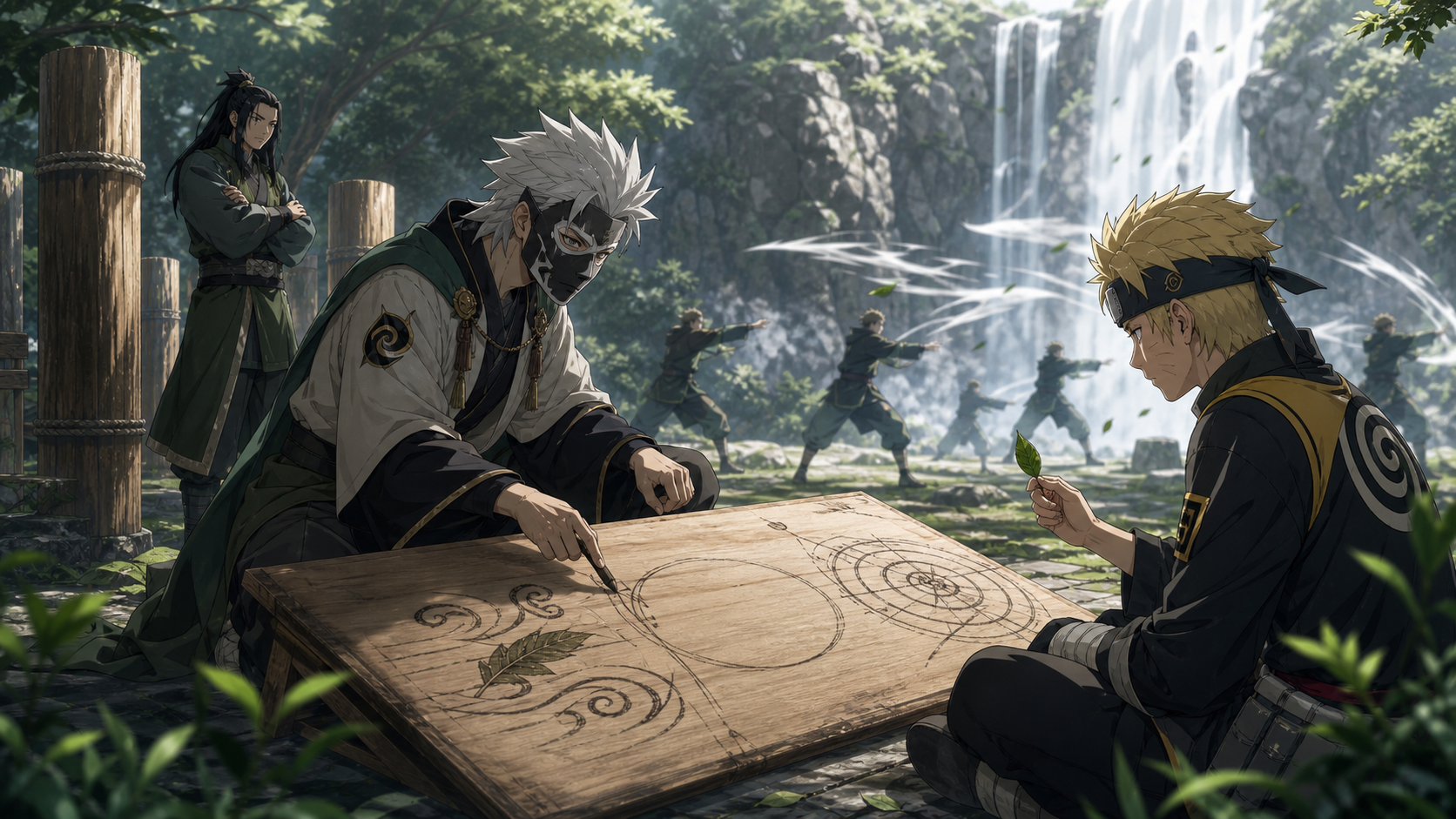
Kakashi turns Naruto’s ambition into a technical question: how do you build a jutsu when no one has already solved it for you?
Kakashi defines the difference between learning and inventing
Episode 76 returns to Naruto's Wind Style training with a necessary correction. Mastering an existing technique means following a path someone else has already mapped. Creating a new jutsu means discovering the path while walking it.
Kakashi's lecture gives Naruto a more honest picture of the work ahead. Talent, clones, and determination can accelerate practice, but none of them supplies an answer that does not yet exist.
The next step is not more repetition alone. It is judgment.
Wind nature is a material, not a finished technique
Naruto has learned to sharpen chakra until it can cut a leaf and divide a waterfall. Those achievements prove that he can produce Wind Style at a remarkable level.
They do not automatically tell him how that chakra should live inside a new jutsu. Nature transformation gives the energy a property. Shape transformation gives it structure, direction, and duration.
Naruto must make those systems cooperate without allowing either one to collapse.
The Rasengan creates an unusually difficult foundation
The Rasengan is already a highly refined form of shape transformation. Its rotating chakra remains concentrated without hand signs, which is part of what makes it so powerful and so difficult.
Adding wind nature is not like painting a completed object a different color. Naruto has to alter the technique's internal behavior while preserving the control that keeps it coherent.
The better the foundation, the less casually it can be changed.
Kakashi teaches by making complexity visible
Kakashi's strength as an instructor is his ability to break an intimidating objective into relationships Naruto can test. He distinguishes shape from nature and explains why combining them is historically difficult.
That explanation does not reduce the challenge. It gives Naruto useful places to fail.
When an attempt collapses, he can ask whether the wind property disappeared, the shape destabilized, or his attention divided too early.
Naruto has to become an observer of his own effort
Naruto's traditional answer to difficulty is to try again with greater intensity. That persistence remains essential, but invention asks him to notice what changes between attempts.
A thousand shadow clones repeating the same mistake would only multiply exhaustion. A thousand clones testing variations and returning evidence can become a research method.
His growth depends on converting effort into information instead of treating effort as proof by itself.
Shadow clones turn time into a dangerous resource
The clone-training method gives Naruto an advantage few shinobi could survive. Every clone contributes experience when released, allowing days of practice to collapse into hours.
The cost arrives through accumulated fatigue and mental strain. Speed can encourage carelessness precisely when the technique demands finer control.
Kakashi and Yamato are not merely helping Naruto advance quickly. They are keeping acceleration from outrunning responsibility.
Yamato protects the boundary around experimentation
Naruto's chakra is never only his own technical problem. Exhaustion can weaken his control over the Nine-Tails, turning an ambitious session into a danger for everyone nearby.
Yamato's Wood Style provides containment while Kakashi provides instruction. Their roles make clear that Naruto's breakthrough is a supported achievement, not an isolated feat of genius.
Safe experimentation requires people willing to watch the consequences others cannot see from inside the attempt.
The village's search gives training an invisible clock
While Naruto studies the mechanics of invention, Konoha's teams continue hunting Hidan and Kakuzu. The two threads seem separate only because Naruto has not yet been sent into the confrontation.
Every lesson occurs while Akatsuki remains uncontained. The technique may be needed before Naruto considers it elegant, complete, or comfortable.
That pressure makes Kakashi's insistence on fundamentals more important, not less.
A new jutsu expresses the person who creates it
Copying can reproduce a solution. Invention reveals how a shinobi understands the problem. Naruto's wind nature suits his directness, but the final technique will also need the adaptability he has learned through clones, teamwork, and repeated failure.
The goal is not merely a stronger Rasengan. It is a technique only Naruto's unusual chakra, experience, and imagination could assemble.
Technical originality grows from personal history.
RaeRae's reaction
I appreciate an episode willing to treat training as intellectual work. Naruto is not standing around until motivation unlocks a bigger explosion. Kakashi is teaching him why the problem is hard and how to read failure without being defeated by it.
The shadow-clone shortcut is exciting, but the episode keeps showing that faster experience is not automatic understanding. Naruto still has to decide what each attempt means.
That makes the eventual breakthrough feel earned before we even see its final form.
The next step is learning how to ask a better question
Episode 76 reframes Naruto's challenge. He already knows that he wants Wind Style inside the Rasengan. He does not yet know what conditions make that combination stable.
Kakashi gives him language for the problem, Yamato gives him a safe boundary, and the clones give him enough trials to explore it. None of them can perform the final act of understanding for him.
The next step is not a destination Kakashi can point toward. It is Naruto learning how to recognize the path he is creating.
Official episode reference: Naruto Official episode guide
Licensed episode route: Crunchyroll licensed episode page
The Fourth Hokage’s unfinished work raises the standard without deciding Naruto’s worth
Kakashi tells Naruto that adding elemental nature to the Rasengan defeated even the Fourth Hokage. That fact gives the project historical weight. It can also become a dangerous comparison if Naruto hears it as a requirement to surpass a dead legend before he deserves confidence.
The useful lesson is technical: the problem remains unsolved because it is genuinely difficult. Naruto is not failing at an ordinary assignment. He is researching the limit of a technique inherited from someone brilliant.
Inheritance should provide a foundation, not a script
Naruto receives the Rasengan through Jiraiya and the Fourth Hokage’s work, but he cannot complete the new jutsu by imitating either man. Their achievement brings him to the edge of the known method. His wind nature and clone experience determine what comes next.
That is a healthier form of inheritance than Kazuma demanded from Sora. Naruto can honor the past by changing it. Respect does not require obedience to an unfinished design.
Kakashi motivates Naruto with possibility and must guard against pressure
Hearing that the Fourth Hokage could not complete the task fires Naruto’s ambition. Kakashi knows exactly which challenge will make him lean forward. A teacher using that motivation also accepts responsibility for the intensity it creates.
Encouragement should remain paired with stop conditions, recovery, and honest feedback. “You may be able to do this” is not the same as “you must damage yourself until you do.” Naruto will blur that distinction unless adults keep it visible.
The next step is integration, where simple progress becomes unstable
Naruto has demonstrated wind transformation and understands the Rasengan’s shape. Combining them creates interactions neither isolated exercise contained. More wind may rupture the sphere. More shape control may suppress the cutting property.
Integration therefore produces new failure rather than merely adding two successes. That can feel like regression if Naruto expects a straight line. Kakashi needs to normalize the messy stage where mastered parts stop behaving once they meet.
Clone teams can test variables instead of repeating one guess
Naruto can divide the problem among groups. One set adjusts wind intensity, another studies rotation, another changes concentration or timing. When clones disperse, he can compare results rather than absorb a pile of nearly identical frustration.
This turns his signature technique into collaborative research conducted through one mind. The advantage is not raw volume alone. It is the ability to explore several branches in parallel and bring their evidence back together.
Naruto needs a record beyond memory
Accumulated clone experience can become overwhelming. Simple notes, diagrams, or Kakashi’s observations would help distinguish successful conditions from impressions. A breakthrough should be reproducible after rest, not dependent on remembering one sensation among hundreds.
Shinobi culture loves secret techniques, but documentation protects teammates and future users. Knowledge becomes safer when it survives the inventor’s exhaustion.
Yamato’s role includes protecting the training site and nearby people
Containing the Nine-Tails is the obvious responsibility, but an unstable wind-infused Rasengan may create its own range and debris. The waterfall area needs boundaries, observation points, and a signal that clears everyone before a serious attempt.
Safety cannot focus only on Naruto’s body. A responsible experiment accounts for the people and environment around the technique. Power that works by injuring the support team is not ready.
Naruto’s hand and arm deserve attention before the technique looks complete
Wind chakra sharp enough to cut a waterfall may also damage the user at close range. Numbness, pain, loss of control, or tissue stress are not inconveniences to hide from Sakura or Yamato.
The final form should include a delivery method that limits exposure. If the inventor must accept permanent injury every time, the technique is not simply costly. It may be unfinished in a medically important way.
Hidan and Kakuzu collecting Chiriku’s bounty shows their next step too
While Naruto moves from nature training toward invention, Akatsuki moves from massacre toward monetization and the next hunt. The exchange station confirms Asuma’s behavioral theory and brings both paths closer.
The pair’s process is efficient because every stage supports another objective. Capture Yugito, hand her off, enter the Land of Fire, kill Chiriku, collect the bounty, continue toward the Nine-Tails. Konoha has to interrupt the chain, not wait for the final target.
Kakuzu’s greed is a vulnerability that remains dangerous to exploit
The bounty station makes him more predictable, but it also places civilians and intermediaries around the confrontation. A team cannot simply attack the building and call the prediction successful.
Surveillance, evacuation, and evidence preservation matter. Turning motive into a lead is only the first step. The plan must account for what happens when a nearly indestructible opponent realizes the route has been read.
Hidan’s impatience can fracture the pair’s rhythm
Hidan may resent detours for money while Kakuzu values the transaction. Their disagreement gives observers information about timing and priorities. It does not guarantee the partnership will collapse.
Provoking one member could make the other more cautious or more violent. Shikamaru’s team needs to distinguish exploitable tension from wishful thinking. Enemies can despise each other and still coordinate lethally.
The Leaf team and Naruto are approaching the same intersection unknowingly
Asuma’s squad follows the bounty logic while Naruto develops the jutsu likely to matter against Kakuzu. Neither side sees the complete future. Their separate work will soon share consequences.
This is how preparation often works. People solve the problem visible from their position, then discover how those solutions connect. The village’s strength depends on whether information and support can meet before the crisis does.
Naruto should not be deployed simply because the technique shows one success
A single stable attempt proves possibility, not readiness. He needs repetition under varying conditions, medical evaluation, teammate briefing, and a fallback if the jutsu fails. Battlefield pressure will remove the controlled environment Kakashi and Yamato created.
Urgency may shorten testing, but it cannot erase the distinction between prototype and dependable technique. Sending Naruto too early turns the enemy encounter into the next experiment.
Asuma’s squad needs the same respect for readiness
Finding the correct bounty station does not mean the team understands Hidan’s ritual or Kakuzu’s bodies. They may have location without capability intelligence.
Commanders should reinforce, observe, and preserve an exit. Emotional connection to Chiriku can make delay feel dishonorable. Entering an unknown ability without preparation may only add more bodies to the market.
The next step is often less glamorous than the breakthrough
For Naruto, it is another controlled variation, another failed sphere, and another honest report about pain. For Konoha, it is checking exchange routes, confirming a body, and coordinating teams. None looks like the decisive moment.
Stories become believable when progress includes this middle labor. The spectacular answer depends on people willing to do the precise thing before applause exists.
Creation requires Naruto to tolerate not knowing
He cannot ask Kakashi for the missing answer because Kakashi does not have it. That uncertainty may frustrate a student accustomed to teachers demonstrating the target. It also marks Naruto’s transition from learner toward innovator.
Not knowing is not failure when the work produces better questions. Which rotation preserves wind? Where does the chakra escape? What does a near-success share with the last one? Curiosity turns uncertainty into method.
Kakashi should distinguish impossibility from lack of precedent
The Fourth Hokage failing to complete elemental transformation inside the Rasengan does not prove the combination cannot exist. It proves one extraordinary shinobi did not solve it during the time and conditions available to him.
That distinction protects Naruto from two bad conclusions: that success is guaranteed because he is special, or that failure would make him lesser than his predecessor. Research begins where precedent ends. The outcome remains uncertain until the method works safely and repeatedly.
Naruto’s clones need assigned questions
Sending every clone to make the complete jutsu encourages chaotic variation that is difficult to interpret. Kakashi can divide the work: one group studies wind intensity, another rotation, another shell stability, and another the moment both transformations meet.
When clones disperse, Naruto receives organized evidence rather than one wall of fatigue. The method respects his unique advantage while adding the structure invention requires.
One successful sphere should trigger analysis before celebration
If Naruto briefly stabilizes the combination, everyone should record what changed. Which clone sequence preceded it? How long did the form last? What happened to the hand, target, and surrounding air? Could he stop it voluntarily?
A prototype teaches more when the team studies the near-success before attempting a larger version. Excitement can make people skip exactly the observation needed to reproduce the result.
The final technique needs a teammate-safe deployment plan
A powerful close-range wind jutsu may affect anyone near the target or the user. Naruto’s team needs signals, minimum distance, approach angles, and a plan if an ally becomes trapped inside the danger zone.
Mastery includes communicating those limits before battle. A secret technique that surprises teammates as effectively as enemies is not ready for team use.
Rest allows clone experience to become understanding
Naruto may feel that sleep wastes the advantage of accelerated training. In reality, reflection and physical recovery help the brain organize hundreds of returned attempts. Pushing immediately into another wave can bury the useful pattern under more noise.
Kakashi should schedule pauses as part of the method, not rewards granted after collapse. Rest is where repetition becomes learning.
The invention should expand Naruto’s choices instead of replacing them
A spectacular new jutsu can become the answer to every opponent, especially when so much effort went into creating it. Naruto must retain clones, feints, teamwork, retreat, and the option not to use the technique around civilians.
Power is most dangerous when investment makes restraint feel like waste. The next step succeeds if Naruto gains another deliberate choice, not one expensive move he feels obligated to prove.
The title sounds simple because progress is often described after the hard part has been edited out. From a distance, Naruto learned wind nature and moved to the next step. Up close, the step contains hundreds of failures, several people monitoring risk, an inherited technique with an unsolved limit, and enemies moving while the answer remains unstable. That fuller picture matters. It keeps achievement from becoming a myth about one gifted boy trying harder than everyone else. Naruto’s determination is real, but so are Kakashi’s explanation, Yamato’s containment, Sakura’s concern, the clones’ accumulated evidence, and the rest that lets his mind use it. Innovation is collective even when one person performs the final jutsu. The same honesty should shape how Konoha remembers the eventual battle. If Naruto arrives with a breakthrough, the village should not pretend the technique appeared because crisis demanded it. It was built through preparation, supervision, failure, and people who protected the inventor from the deadline. That history gives the power a moral frame. It reminds everyone that Naruto is not an emergency resource activated when Akatsuki appears. He is a young shinobi learning how to create something dangerous without letting danger decide what his body owes. That is progress worth celebrating, even before the finished technique reaches his waiting hand.
RaeRae’s full take
I love Kakashi telling Naruto plainly that this problem beat the Fourth Hokage. Not to make Naruto worship difficulty, but to show him he is standing at the edge of known work.
The comparison becomes useful only if adults keep it from becoming a demand. Naruto does not owe anyone a damaged body to prove he can surpass a legend.
Shadow clones should function like research teams, not an exhaustion factory. Test different variables, compare results, and write something down before five hundred headaches arrive at once.
Yamato’s containment and Sakura’s medical concern belong inside the achievement. Support does not make the jutsu less Naruto’s.
Meanwhile, Kakuzu collecting Chiriku’s bounty proves Asuma’s team read the motive correctly. Now they need a plan that does not turn the exchange station into collateral.
The next step for both sides is disciplined integration: connect knowledge, people, and action without letting urgency destroy the thing they are trying to protect.
RaeRae checkpoint: Naruto is not just making a stronger Rasengan. He is learning how to invent without confusing pain with progress, inheritance with obedience, or one successful attempt with battlefield readiness.
Receipts and official routes
- Japanese title, Naruto’s wind nature, the Fourth Hokage’s unfinished elemental Rasengan goal, Kakashi’s encouragement, and Hidan and Kakuzu collecting Chiriku’s bounty: Naruto Official Site episode guide.
- Licensed title, episode number, the next transformation-training stage, and watch route: Crunchyroll.