
Nightmare
The failed reunion follows Naruto home and refuses to stay asleep.
The mission ends, but Naruto's mind does not leave the hideout
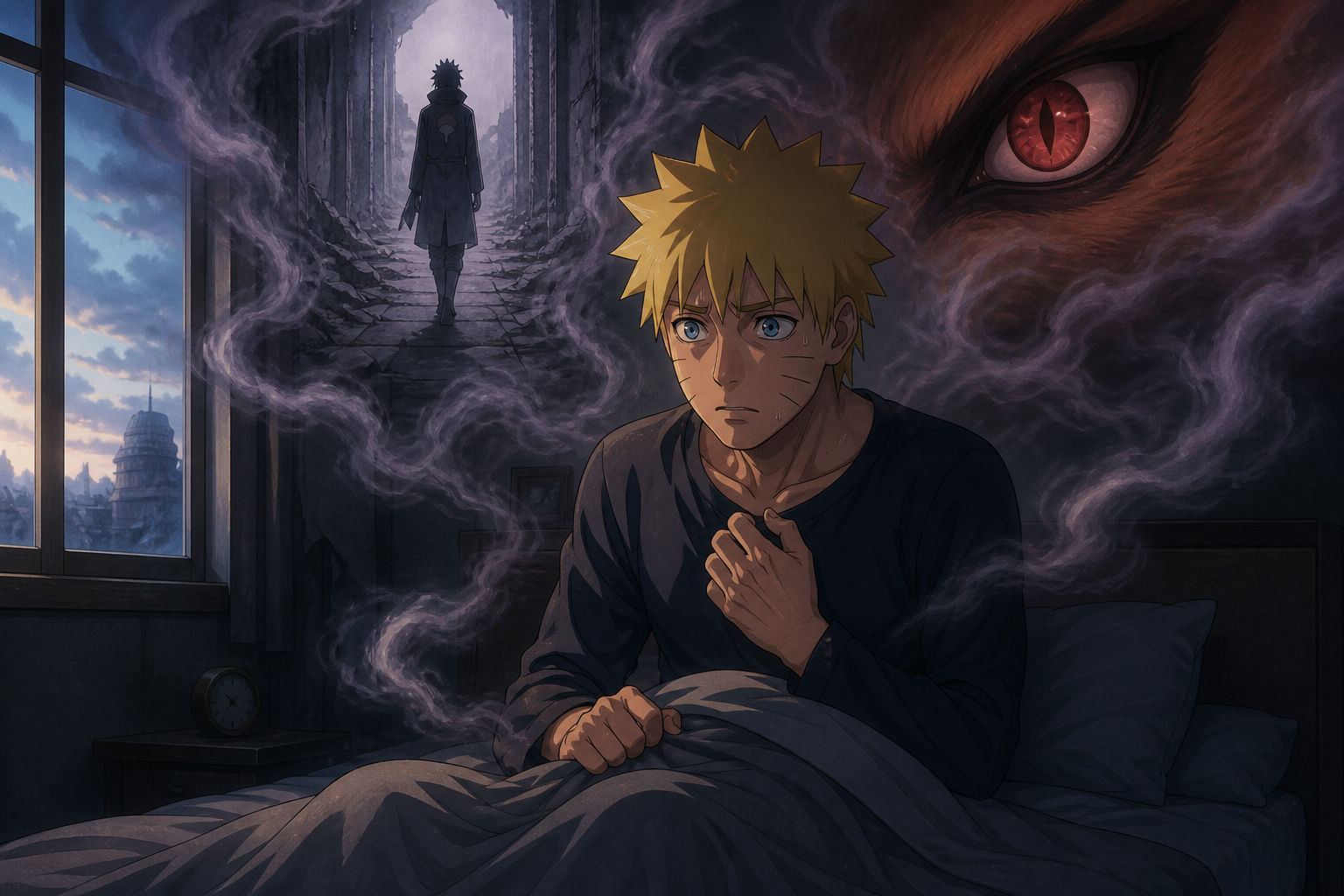
Episode 54 opens several days after Team Kakashi returns without Sasuke. The physical danger is over, yet Naruto wakes from a nightmare with pieces of the failed reunion still clinging to him.
That aftermath matters. Naruto has spent years converting pain into motion: train, pursue, promise, try again. Sleep removes the activity that usually protects him from feeling the full weight of failure. In the dream, Sasuke can keep walking away and the Nine-Tails can keep pressing against the limits Naruto barely understands.
The mission came home with him because the consequences were never confined to Orochimaru's hideout.
A nightmare carries what determination cannot resolve
Naruto's conscious story is simple. He will get stronger and bring Sasuke back next time. The nightmare contains everything that statement leaves out: fear that Sasuke does not want to return, guilt over Sakura's injury, and terror of the power Naruto loses himself inside.
Dreams do not deliver a reliable prophecy, but they can reveal unresolved pressure. Naruto's mind is refusing the clean reset his words attempt to create. The failed reunion was not only a tactical setback. It challenged the identity Naruto built around never giving up.
If persistence guarantees eventual success, what does Naruto do with evidence that persistence can also hurt people?
Sasuke's departure becomes an image Naruto cannot control
Naruto has watched Sasuke leave more than once: at the village, in the Valley of the End, and now inside Orochimaru's domain. Each departure reinforces the same helpless position. Naruto reaches toward a bond while Sasuke defines freedom as moving away from it.
The nightmare turns that memory into repetition. Sasuke does not need to argue. His receding silhouette is enough. Naruto's fear is not only that he lacks strength. It is that Sasuke's choice may remain unchanged no matter how strong Naruto becomes.
That possibility is harder to fight than an opponent because it requires respect for another person's agency without surrendering concern for their safety.
The Nine-Tails lingers as both weapon and warning
Naruto's transformation brought enormous force to the Tenchi Bridge, but it did not bring him closer to Sasuke. It injured Sakura, erased Naruto's memory, and left his body damaged. Sasuke then suppressed the fox with the Sharingan.
The nightmare keeps the Nine-Tails present because Naruto has not integrated what happened. He cannot continue treating the chakra as a reserve he may access whenever ordinary effort fails. The power has its own will, and surrendering to it changes the person Naruto becomes in front of his friends.
Fear of the fox is not weakness. It is information Naruto needs before training can become safer.
Waking up does not end the emotional event
Naruto expects the room to restore reality, but traces of the dream remain. That sensation captures how trauma can follow a person across the boundary between danger and safety. The body wakes before the nervous system accepts that the threat has passed.
The village outside is familiar. Naruto's room is ordinary. Neither fact erases the image of Sasuke's cold expression or Sakura's wound.
This quiet disorientation gives the episode a different rhythm from the previous arc. There is no enemy to punch. Naruto must live inside feelings action cannot immediately solve.
Failure can become a teacher if Naruto lets it stay specific
Naruto often responds to failure with a broad promise to work harder. Episode 54 suggests the lesson needs to be more precise. He did not fail only because Sasuke was stronger. He lost control of the Nine-Tails, ignored his body's limits, and entered the reunion expecting emotion to overcome a three-year transformation in Sasuke's life.
More effort without a different method would reproduce the same danger. Naruto needs chakra control, a better understanding of his elemental nature, and a team strategy that does not turn Sakura or Yamato into emergency containment.
Naming the actual failures makes growth possible without turning the entire mission into self-condemnation.
The transition to a new threat does not erase the old one
The episode begins the Guardian Shinobi Twelve arc, shifting attention toward new tensions around the Leaf and the Fire Temple. That transition could make the Sasuke mission feel paused. Naruto's nightmare prevents that emotional disappearance.
Sasuke remains part of the story even when he is off-screen because the reunion changed Naruto. The next training cycle and mission will carry the knowledge gained in the hideout.
This is how a long story maintains consequence: the plot moves forward while the characters remain marked by what happened before.
Rest is not the opposite of commitment
Naruto's instinct is to prove devotion through endurance. He pushes injured muscles, suppresses fear, and treats stopping as a betrayal of the promise. The nightmare shows why rest cannot be optional.
A body and mind denied recovery do not become more loyal. They become less capable of judgment. Naruto's attempt to save Sasuke requires him to remain present, train effectively, and protect the teammates who choose to accompany him.
Sleep is not surrender, even when sleep is difficult. Recovery is part of the work.
Sakura's injury remains inside Naruto's fear
The episode's official synopsis focuses on the nightmare, but the emotional context includes the truth Naruto recently learned. Sakura was injured by his transformed body. Naruto cannot separate that knowledge from the fear of the Nine-Tails.
He may want to center his own guilt, but the more important task is accountability. Sakura's wound is not evidence that Naruto is irredeemable. It is evidence that his current relationship with the fox is unsafe.
The distinction matters because shame freezes people while responsibility asks them to change.
RaeRae's reaction
I appreciate the story giving Naruto a quiet aftermath instead of letting one loud vow erase the hideout. He failed to bring Sasuke home, learned he hurt Sakura, and watched Sasuke suppress the power that had just overwhelmed everyone else. Of course his mind is not calm several days later.
The nightmare feels like Naruto's body asking him to stop converting every fear into forward motion. He does not need less love for Sasuke. He needs a version of that love that leaves enough Naruto present to recognize Sakura, listen to Yamato, and make a different choice when the Nine-Tails reaches for control.
I also like the new arc beginning under this shadow. It keeps the story from treating Sasuke as a box that can be closed between missions. The failed reunion becomes part of Naruto's next stage instead of a detached event.
Morning creates room for a different response
Episode 54 does not solve the nightmare. It brings Naruto back into daylight, where fear can become information and failure can become a training goal.
Sasuke remains gone. The Nine-Tails remains inside him. The dream may return. What changes is the possibility that Naruto can respond without repeating the exact pattern that caused the fear.
The next steps will test whether he treats power as an answer by itself or learns the control, patience, and responsibility the reunion proved he needs.
Official episode reference: Naruto Official episode guide
Licensed episode route: Crunchyroll licensed episode page
The nightmare begins where Naruto’s public confidence ends
Awake, Naruto can promise another attempt, demand more training, and turn disappointment into visible determination. Sleep removes the audience and the performance.
The dream holds the fear underneath: Sasuke may keep choosing distance, the Nine-Tails may keep taking control, and effort may not protect the people Naruto loves.
Confidence and fear can coexist. The private fear does not make the public commitment false. It reveals what the commitment costs to maintain.
Naruto’s mind repeats what his body could not finish processing
The Tenchi Bridge mission moved from provocation to transformation, injury, infiltration, reunion, defeat, and retreat without a safe pause.
Naruto’s conscious memory even contains a gap where the four-tailed state took over. The nervous system still experienced danger his narrative cannot reconstruct completely.
Dream repetition is the mind attempting to organize an event that action forced it to leave unfinished.
Sasuke’s image carries rejection more powerfully than another fight
The dream does not need to invent a larger technique. Sasuke walking away already contains Naruto’s central terror.
An enemy can be defeated. Another person’s refusal cannot be punched into consent without destroying the relationship one claims to protect.
The nightmare confronts Naruto with powerlessness that physical training alone cannot solve.
The Nine-Tails appears because failure and shame remain connected
Orochimaru triggered the transformation by pressing Naruto’s sense of failure around Sasuke. Sasuke later suppressed the fox inside Naruto’s mindscape.
Both memories link emotional vulnerability to loss of control. The nightmare keeps the link active because Naruto has not yet learned another response.
Training must address the trigger, not only the amount of chakra released afterward.
Fear of his own power is rational after Sakura’s injury
Naruto now knows his transformed body struck Sakura while he was unconscious. The fear is not abstract anxiety about becoming monstrous. It is a response to documented harm.
Calling the fear weakness would pressure him to reach for the same power again without examining the danger.
Fear can support responsibility when it leads to preparation rather than self-hatred.
Shame offers Naruto a familiar but useless punishment
He can tell himself that hurting Sakura proves something terrible about who he is. That conclusion repeats the village stigma around the Nine-Tails and makes isolation feel deserved.
Shame does not teach control, restore Sakura’s safety, or explain the seal. It centers Naruto’s identity instead of the conditions that need to change.
Accountability asks a harder, more practical question: what will protect everyone next time?
Sakura should not become a symbol inside Naruto’s guilt
Her injury belongs first to her experience. Naruto may feel devastated, but the wound is not primarily evidence in a story about his goodness or failure.
Sakura has the right to describe what happened, set boundaries, and decide how the event affects trust.
Repair begins when Naruto listens to her rather than using imagined forgiveness to quiet his nightmare.
Rest forces Naruto to encounter limits he usually outruns
During missions, there is always another corridor, opponent, or objective. In bed, the body becomes unavoidable.
Exhaustion, interrupted sleep, and intrusive imagery show that determination cannot make recovery optional.
Rest is part of protecting a promise because an injured and dysregulated Naruto is less able to choose responsibly.
A quiet room can feel less safe than a battlefield
The battlefield gives danger a visible location. Naruto’s room should signal safety, yet the threat now arrives through memory and his own body.
That mismatch can make waking disorienting. Nothing external is attacking, but the nervous system continues its defense.
Safety has to be relearned after crisis. Familiar walls alone cannot command it.
The failed reunion challenges Naruto’s identity as the person who never quits
Refusal to quit has helped him survive abandonment, stigma, and impossible training. The trait becomes dangerous when every pause feels like a betrayal of self.
The hideout provided evidence that the current method failed and harmed others. Adapting is not quitting.
A resilient identity must include learning, retreat, and recovery, not only renewed intensity.
Failure needs to remain specific enough to teach
Naruto did not fail because he is worthless or because the bond was imaginary. He failed to control the Nine-Tails, underestimated Sasuke’s growth, and expected emotional persistence to overcome a conflict of values.
Each failure suggests a different response: safer chakra training, intelligence about Uchiha power, and deeper understanding of Sasuke’s motives.
Specificity converts pain into usable knowledge.
The dream cannot tell Naruto what Sasuke actually feels
A nightmare uses Naruto’s fear, not authoritative access to Sasuke’s interior. The dream version may be colder, more final, or more threatening than the real person.
Naruto must not confuse anxiety with evidence. Sasuke’s choices at the hideout matter; imagined future rejection remains imagination.
Healing includes separating what happened from what fear predicts will always happen.
Sasuke’s refusal remains real even if the dream exaggerates it
Avoiding catastrophizing does not mean denying the encounter. Sasuke chose revenge, rejected return, and demonstrated overwhelming power.
Naruto needs room for hope without rewriting those facts.
Responsible hope begins from the current evidence rather than the version of Sasuke memory wants or fear invents.
The fox and Sasuke become fused inside Naruto’s emotional map
Sasuke’s name triggered the Nine-Tails, and Sasuke’s Sharingan suppressed it. The person Naruto wants to save now occupies both sides of the crisis.
That fusion gives Sasuke too much control over Naruto’s internal state, even when absent.
Naruto must separate his care for Sasuke from the mechanism that turns every reminder into a command for escalation.
The new training arc begins with emotional evidence
Elemental affinity and technique may appear like a clean pivot into skill development. The nightmare tells us why technical growth is needed and what technical growth cannot solve alone.
Naruto needs power that remains accessible without surrendering consciousness. He also needs judgment capable of choosing when power serves care.
The emotional aftermath gives the training an ethical purpose beyond catching Sasuke’s strength.
Wind is coming, but control matters more than spectacle
The next stage will identify Naruto’s chakra nature and open a path toward a signature technique. More force could reproduce the same pattern if Naruto treats it as another shortcut past feeling.
Learning elemental control requires precision, patience, repetition, and attention to limits.
Those qualities are exactly what the failed reunion proved his emotional practice needs too.
A new mission does not close the Sasuke file inside Naruto
The story moves toward the Fire Temple and Guardian Shinobi Twelve conflict. Naruto’s nightmare prevents the transition from functioning as emotional amnesia.
Long narratives can change villains and settings while consequences continue shaping the protagonist.
Sasuke remains present as memory, motivation, and unresolved responsibility even when the next episode points elsewhere.
Trauma should not become a shortcut to maturity
The nightmare may prompt growth, but Naruto did not need to be injured, lose control, or hurt Sakura in order to deserve better understanding.
Suffering creates information. It does not become good because someone later learns from it.
An editorial voice can recognize growth without thanking harm for occurring.
The adults owe Naruto more than another containment plan
Jiraiya, Tsunade, Kakashi, and Yamato know pieces of the seal, tail thresholds, and prior incidents. Naruto needs honest information appropriate to the risk he carries.
Preparing adults to stop him while leaving him underinformed preserves institutional control rather than building self-control.
Support should include explanation, consent where possible, recovery care, and a plan he helps create.
Yamato’s role should move from emergency brake to partner
Wood Style can suppress the chakra after escalation. A healthier relationship would let Yamato help Naruto recognize early signs, set boundaries, and understand intervention before crisis.
Containment becomes less frightening when it belongs to an agreed safety practice.
Naruto needs a teammate with a specific ability, not a handler assigned to a dangerous asset.
Sakura’s medical knowledge belongs in the recovery conversation
She understands the physical damage the cloak causes and experienced its danger directly. Her expertise should influence the plan.
Including Sakura must not mean making her responsible for managing Naruto’s emotions or absorbing future risk.
A medical teammate can provide evidence while remaining a person entitled to protection.
Naruto’s room reveals how little private support he has
He wakes alone with the aftermath. The isolation echoes childhood even though he now possesses friends and mentors.
Having relationships does not automatically make people available at the hour trauma interrupts sleep.
Recovery may require Naruto to learn that asking for company or help is not weaker than training alone.
Morning is not resolution, but it restores choice
The dream controls the sequence while Naruto sleeps. Waking returns the ability to decide what happens next.
He can hide, train recklessly, seek information, speak to Sakura, or accept support. Daylight does not remove fear. It gives fear a context in which choice is possible.
That return of agency is the episode’s quiet victory.
Recovery becomes meaningful when waking choices address the specific fears that sleep keeps returning.
Morning offers agency, not automatic peace or easy forgetting.
RaeRae’s full take
I needed this episode to let Naruto be haunted. The hideout did not end because the team crossed back into Konoha. Sasuke’s refusal, Sakura’s injury, the four-tailed body, and the Sharingan inside Naruto’s mind all came home.
Naruto is excellent at turning pain into motion. The nightmare removes motion and makes him sit with the part determination cannot punch. Sasuke may keep saying no. The Nine-Tails may hurt someone again. Loving harder may not solve either problem.
I do not want shame to become the lesson. Naruto is not secretly the fox, and Sakura’s wound is not proof he deserves isolation. The wound is a receipt that his current relationship with the power is unsafe.
The adults owe him real information. Training everyone else to contain Naruto while he discovers the rules through catastrophe is not protection.
I also refuse to let Sakura disappear into his guilt. She deserves a voice in what repair looks like, and she should not have to reassure Naruto before her own pain can count.
Morning does not fix anything, but it returns choice. Naruto can make the next stage about controlled power, shared planning, rest, and a form of hope that listens to evidence. That is more difficult than another vow. It is also the only version capable of protecting the people the vow is supposed to honor.
RaeRae checkpoint: The nightmare is not telling Naruto to love Sasuke less. It is telling him that love without rest, control, truth, and boundaries has started borrowing other people’s bodies to pay its cost.
Receipts and official routes
- Episode placement, Naruto’s nightmare after the failed reunion, Sasuke’s lingering image, and the Nine-Tails fear carried into the next arc: Naruto Official Site episode guide.
- Licensed episode route: Crunchyroll.