
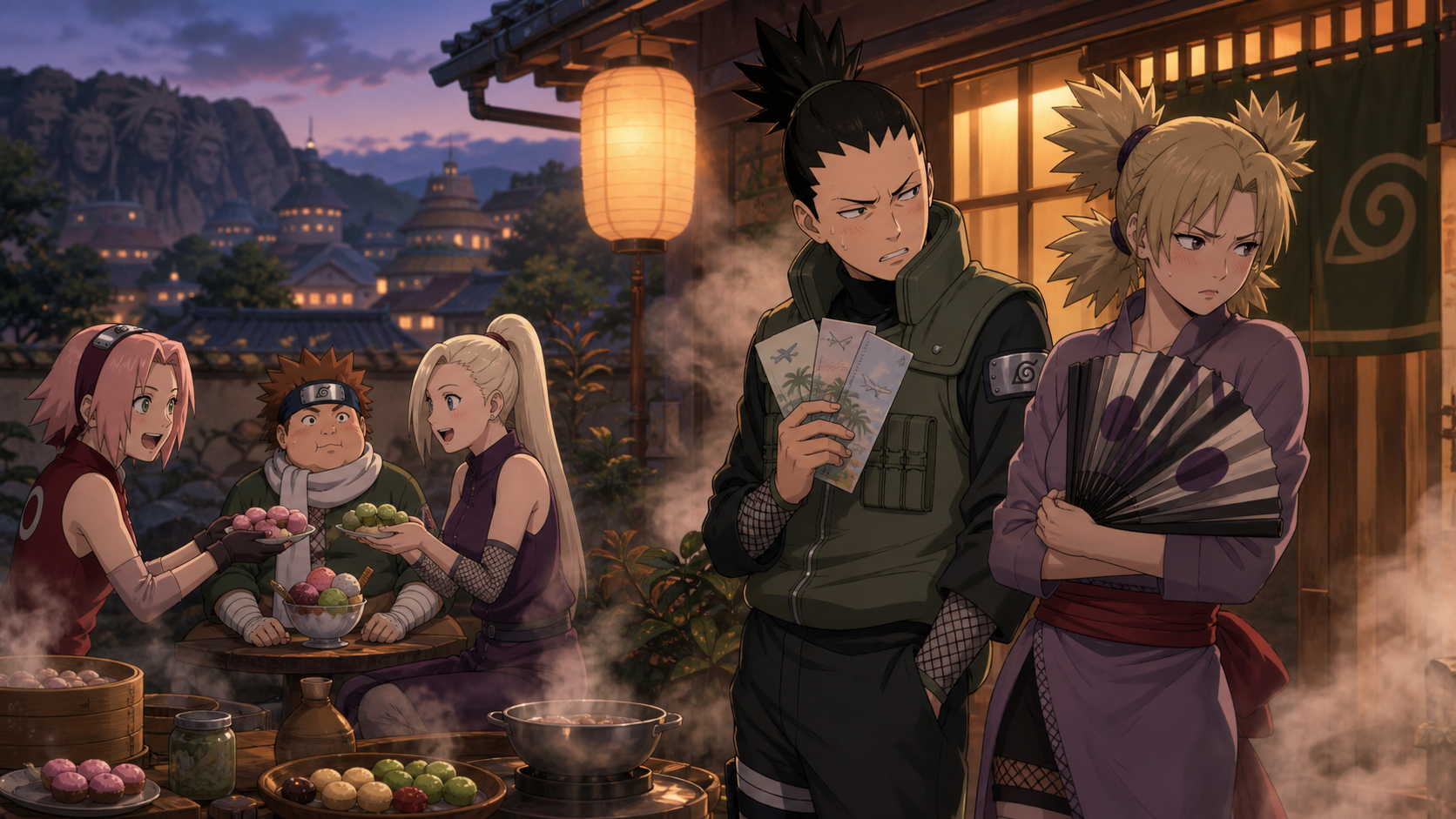
Steam and Food Pills
Vague efficiency turns Shikamaru’s gift research into a romantic misunderstanding, while Sakura and Ino learn that attention matters more than competitive femininity.
Episode at a glance
- Series
- Naruto Shippuden
- Episode
- 496
- Arc
- Konoha Hiden: The Perfect Day for a Wedding
- Japanese airdate
- March 2, 2017
- What matters
- Shikamaru’s missing context hurts Temari, while Sakura and Ino discover that their rivalry has been carrying intimate knowledge of each other all along.
Bottom line
“Steam and Food Pills” turns Naruto and Hinata's wedding-gift assignment into two stories about people who know each other well and still communicate badly. Shikamaru rejects cash as impersonal, then builds a thoughtful honeymoon idea from Choji's enthusiasm for eating ice cream in the snow. His mistake comes after the idea: he asks Temari for help without explaining that the trip belongs to Naruto and Hinata. Temari hears a romantic invitation, Shikamaru reads her reactions as logistical feedback, and Choji happily leaves them together. Their near visit to a hot-spring inn becomes funny because the attraction between them is obvious to everyone except the people refusing to name the conversation. Ino and Sakura create a parallel mess when both choose the same portrait frame. Rather than accept shared taste, they turn the purchase into a contest over femininity, then ask Choji to judge them. His answer sends two medical shinobi into a food-pill cook-off that exposes how eagerly both women perform an external standard. Each secretly makes the other's favorite flavor, proving that rivalry has not erased intimate knowledge. The episode lands when they taste one another's work and decide to shop together. Gifts become meaningful through attention, not gender, price, or victory. Choji understands that lesson first, even while eating enough sweets to collapse.
Episode 496 continues Konoha Hiden
Episode 496 is titled “Steam and Food Pills.” The episode aired in Japan on February 23, 2017, and adapts another part of *Konoha Hiden: The Perfect Day for a Wedding*.
Team 10, Sakura, and Temari lead the search.
Shikamaru visits Yamanaka Flowers
He and Choji ask Ino to help them plan a wedding present. Shikamaru approaches the task like a group assignment where shared thought can reduce uncertainty.
Friendship does not guarantee free consulting.
Ino has already chosen her gift
She refuses to reveal the shop or let her teammates copy her answer. The secret mission has made originality feel competitive.
Kakashi's evaluation distorts cooperation.
Shikamaru wants an efficient solution
Efficiency has protected lives throughout his career. Shopping frustrates him because no calculation can prove which object will communicate affection correctly.
Emotional labor resists tactical certainty.
Choji takes him to Yakiniku Q
Food gives their conversation a familiar setting. Choji can think about celebration through hospitality because shared meals already organize much of his social world.
Comfort supports reflection.
Orochimaru appears as a server
The former enemy's unexplained background labor turns an ordinary lunch into surreal comedy. Yamato's watchful presence keeps the joke connected to unresolved danger.
Peace remains institutionally strange.
Choji has finished his shopping
He has vouchers for dinner at an upscale tea house. His certainty shocks Shikamaru, who expected his friend to be equally lost.
Simple knowledge can outpace elaborate strategy.
The vouchers suit the couple
Naruto and Hinata receive time together rather than another object to store. A meal offers privacy, pleasure, and relief from public attention.
An experience can become a practical gift.
Choji bought space for three
His plan includes a place for himself at a separate table. The detail is funny because he respects their date while refusing to miss excellent food.
Generosity and appetite coexist.
Shikamaru considers giving cash
Money would let Naruto and Hinata choose exactly what they need. He rejects the idea because the transfer would demand little personal thought from him.
Flexibility is useful, but intention matters too.
Choji talks about ice cream
His attention moves toward eating frozen dessert somewhere snowy. The apparently irrelevant thought unlocks Shikamaru's stalled planning.
Ideas rarely arrive through orderly channels.
A honeymoon becomes Shikamaru's answer
He imagines giving the couple a trip to a hot-spring destination. Rest after years of war and public duty makes emotional sense for both partners.
Leisure can acknowledge survival.
Shikamaru wants a woman's opinion
He assumes Hinata's reaction requires a female interpreter. The assumption narrows women into a shared taste category rather than recognizing individual preference.
Gender cannot replace knowing the recipient.
Temari appears at the worst possible moment
Choji immediately identifies her as someone Shikamaru can ask. Existing attraction makes a neutral research question emotionally charged.
Context changes ordinary language.
Shikamaru underestimates Temari's interest
He thinks of her primarily as a formidable warrior and doubts that romantic travel would matter to her. Strength and tenderness become false opposites in his reasoning.
Competence does not cancel desire.
Choji announces the subject first
He tells Temari that Shikamaru wants to ask something, leaving his friend no quiet route of escape. The nudge is intrusive and effective.
Matchmaking hides inside assistance.
Shikamaru mentions honeymoons without context
He asks whether a hot-spring trip sounds appealing but never names Naruto and Hinata. Temari reasonably interprets the question through their own relationship.
Missing information creates the misunderstanding.
Temari believes Shikamaru is asking her
Her surprise and blush reveal that the possibility matters. She agrees while trying to manage vulnerability in public.
Hope makes ambiguity dangerous.
Shikamaru hears useful confirmation
He treats her answer as proof that Hinata would enjoy the destination. His strategic mind fails because he has modeled the wrong conversation.
Intelligence depends on accurate premises.
Choji suggests immediate research
Since the day remains open, he encourages them to inspect possible locations together. The proposal deepens Temari's interpretation and gives Shikamaru practical data.
One sentence advances two different stories.
Choji leaves for dessert
He excuses himself for sweets after a full meal and abandons the pair to their awkward outing. Appetite conveniently performs social engineering.
The friend understands more than he explains.
Shikamaru and Temari spend the day together
Their route resembles a date even though neither person names one. Shared activities allow attraction to surface without direct admission.
Behavior speaks around withheld language.
Shikamaru tries to improve her mood
He notices discomfort but misidentifies the cause. His concern remains genuine despite incomplete understanding.
Care can survive interpretive failure.
A target game creates common ground
Both shinobi understand precision and competition. Shikamaru's prize gives the outing a small, tangible warmth.
Familiar skills ease romantic tension.
Ino reaches the gift shop
She finds a portrait frame she considers cute, simple, and distinctive. The object would let Naruto and Hinata choose which shared memory occupies the center.
Presentation can honor future memory.
Sakura reaches for the same frame
The coincidence should confirm that both friends know the couple. Instead, old rivalry turns agreement into a threat.
Similarity becomes competitive evidence.
Both women pretend not to want the frame
Each tries to discourage the other while protecting her own purchase. Their conversation relies on transparent bluffing rather than honest negotiation.
Pride makes shopping needlessly difficult.
The store removes them
Their argument disrupts other customers and crosses the shop's boundary. Personal history does not excuse public disturbance.
Consequences interrupt the performance.
Rivalry shifts toward femininity
Unable to settle ownership of the frame, Ino and Sakura argue over which woman better fits a gendered ideal. The category has little connection to Naruto or Hinata's needs.
Competition abandons the original purpose.
Choji becomes the reluctant judge
They stop him and demand an answer. The question places a friend in a social trap where either choice could create conflict.
Forced judgment rarely produces truth.
Choji names cooking
He associates femininity with preparing good food. His personal preference becomes a rule the women immediately attempt to satisfy.
Taste is not a universal definition.
Food pills become the contest
Sakura and Ino translate domestic cooking into shinobi production. Their medical knowledge, chakra control, and field experience shape the challenge.
Professional skill enters a gendered test.
Both women use serious technique
Neither treats the competition casually. Years of training support tiny pieces of concentrated nutrition rather than battlefield medicine.
Peace redirects expertise toward play.
Choji samples both pills together
As judge, he refuses to privilege presentation before tasting. Eating both at once prevents him from identifying which maker produced which flavor.
Fairness needs a better method.
Both recipes taste excellent
Sakura and Ino have each grown beyond earlier weaknesses and know how to balance useful ingredients with pleasure. The result defeats the premise that one must lose.
Mutual competence breaks the ranking.
Choji collapses
The women fear that their combined recipes harmed him. Their medical instincts return as soon as rivalry encounters possible danger.
Care outranks competition under pressure.
Sakura and Ino taste each other's work
They test the pills to identify a problem and discover flavors they genuinely enjoy. Direct experience replaces assumption.
Understanding begins through reception.
Each made the other's favorite flavor
They wanted to overwhelm a rival by creating something irresistible to her. The strategy reveals close attention accumulated across years.
Rivalry has preserved knowledge of love.
Choji blames the ice cream
He wakes and concludes that excessive dessert, not either food pill, caused the collapse. His appetite resolves the apparent medical emergency.
Comedy clears both cooks of failure.
Ino and Sakura choose cooperation
They abandon the contest and decide to search for wedding gifts together. Shared taste becomes a resource instead of a threat.
Friendship returns to the task.
The hot-spring inn raises the stakes
Shikamaru wants Temari to inspect the women's facilities so he can evaluate the destination fully. Temari hears another intimate step in what she believes is their trip.
Ambiguity reaches a private threshold.
Temari is not ready to enter
Her hesitation reflects emotional consent, not indecision about architecture. Shikamaru continues to treat the moment as research.
The same doorway carries different meanings.
Shikamaru says he needs her
He means that only she can assess the women's side. Temari hears a confession sharpened by the romantic setting.
Technically accurate words can still mislead.
The misunderstanding finally breaks
Naruto and Hinata enter the explanation too late. Temari realizes that Shikamaru never invited her on a honeymoon.
Clarity arrives after avoidable vulnerability.
Temari responds with force
She hits Shikamaru after embarrassment turns into anger. The scene plays through established slapstick, though attraction does not make physical retaliation healthy communication.
Comedy does not erase the boundary.
Shikamaru learns the cost of vagueness
His plan was thoughtful, but his explanation treated context as optional. A strategist who anticipates enemy choices failed to anticipate the ordinary meaning of his own words.
Precision matters outside battle.
Temari's reaction confirms mutual possibility
Her mistaken hope would not exist without interest. The episode advances their relationship through denial rather than a direct romantic declaration.
Subtext becomes visible before speech.
Team 10 reconvenes at Ichiraku
Shikamaru, Choji, and Ino compare progress over ramen. The location ties wedding preparation back to Naruto's most familiar comfort.
Community gathers around food again.
Choji remains the episode's quiet catalyst
His gift inspires Shikamaru, his suggestion creates the Temari outing, and his answer triggers the cooking contest. He appears uncomplicated while moving every relationship forward.
Emotional intelligence can look casual.
The title joins both plots
Steam belongs to the hot-spring misunderstanding. Food pills belong to Sakura and Ino's rivalry. Both stories turn care into a test before returning care to shared experience.
Two comic objects expose the same problem.
Gifts reveal the giver's values
Choji offers hospitality, Shikamaru offers rest, and Ino and Sakura want to frame memory. None of those forms requires a universal standard.
Specific friendship creates meaningful variety.
Episode 496 rewards honest attention
The strongest choices come from listening: Choji knows pleasure, Shikamaru notices exhaustion, and Sakura and Ino know one another's tastes. Trouble begins whenever performance replaces explanation.
Care becomes clearer when nobody needs to win.
Shikamaru’s good idea cannot survive missing context
I understand why Shikamaru thinks a honeymoon is a thoughtful gift. Naruto and Hinata have spent years being watched, deployed, celebrated, threatened, and treated as symbols. Giving them private time acknowledges that peace should include rest, pleasure, and the right to be ordinary together. It is strong because it sees both people rather than buying another object for the village hero. Then Shikamaru ruins his own kindness by treating explanation like unnecessary labor.
He asks Temari whether she would enjoy a hot-spring trip, invites her to inspect the location, and tells her he needs her without once naming the couple whose honeymoon he is researching. Temari is not foolish for reading those words romantically. She responds to the conversation he actually offers. Shikamaru privately supplies the missing subject and assumes she can see it. Intelligence cannot rescue communication when one person believes context is obvious and the other person has been given no access to it.
The misunderstanding is funny because their attraction has been visible for years, but Temari’s vulnerability is real. She permits herself to believe Shikamaru is finally choosing directness. Every new step confirms that hope until Naruto and Hinata’s names collapse the entire day. Her embarrassment deserves more than the old joke where a woman hits a man and physical force becomes shorthand for feelings nobody will name. Temari has a right to be angry. She does not have a right to strike him. Attraction does not turn violence into healthy communication, and slapstick does not remove the boundary.
Shikamaru also needs accountability beyond rubbing the injury and calling women troublesome. His vagueness created the situation. A sincere apology would name the misleading language, acknowledge the emotional position it put Temari in, and stop making her reaction the only problem worth discussing. He is capable of mapping twelve battlefield outcomes before an enemy moves. The challenge of adulthood is applying some of that care when the stakes are another person’s dignity rather than a mission result.
Sakura and Ino are competing for a gendered prize nobody needs
The portrait-frame fight begins with evidence that Sakura and Ino know the couple similarly. They could laugh, choose coordinating gifts, or shop together. Instead, Kakashi’s hidden evaluation converts agreement into scarcity: if the gifts look alike, perhaps only one woman will appear original enough to attend. Their old rivalry rushes into the space and quickly stops being about Naruto or Hinata at all. They demand a verdict on which of them is more feminine, as though friendship, competence, or womanhood can be distributed to one winner.
Choji’s answer reflects his own appetite, not a universal standard. Cooking can be loving labor, professional craft, daily necessity, joyful art, or exhausting obligation. It does not certify gender. Yet Sakura and Ino accept the test because both have been trained by a world that praises women for strength while still expecting their worth to remain legible through beauty, romance, and service. These are two elite medical shinobi using extraordinary control to prove themselves through somebody else’s definition. The absurdity is the point, but the pressure beneath it is familiar.
The food pills expose how deeply they already see one another. Each recipe is designed around the other woman’s favorite flavor. They call it strategy because rivalry feels safer than tenderness, but attention is attention. You do not memorize what delights someone unless their delight has mattered to you. When they taste each other’s work, the contest loses its authority. Direct experience tells them what ranking could not: both women are skilled, both gifts carry care, and neither person’s value requires the other person to shrink.
I also love that danger snaps them out of performance. The second Choji collapses, Sakura and Ino stop trying to win and become healers together. Their first response is concern, examination, and responsibility for possible harm. Choji eventually reveals that his own heroic commitment to dessert caused the crisis, but the women’s reflex tells the truth about them before the explanation arrives. Competition is learned behavior. Care is the relationship they return to when something matters.
Choji understands celebration as nourishment
Choji looks like the comic appetite moving between two plots, yet he has the clearest gift from the beginning. Dinner vouchers offer Naruto and Hinata an experience, privacy, and excellent food without pretending to summarize their entire relationship. His extra reservation for himself is shameless and hilarious, but even that detail respects the couple’s table. He wants to enjoy the place nearby, not sit between them. Choji knows that feeding people can be both pleasure and care, and he does not apologize for understanding the world through taste.
Choji keeps creating opportunities, noticing desires his friends bury beneath analysis and pride, then letting them decide what the movement means.
Final verdict
“Steam and Food Pills” is a warm, messy argument for saying what you mean and noticing what people actually offer. Shikamaru’s honeymoon gift is thoughtful, but thoughtfulness toward Naruto and Hinata does not excuse carelessness with Temari. Sakura and Ino’s shared frame is not a failure of originality, and their food pills do not need to crown one ideal woman. The episode becomes honest when everybody stops treating affection like a contest. Temari’s hope deserves clear language. Sakura and Ino’s knowledge deserves cooperation. Choji’s hospitality deserves recognition as more than a hunger joke. Kakashi’s secret policy remains the pressure behind every unnecessary performance, because friends who fear losing access will keep trying to make love look measurable. The better wedding is one where nobody has to defeat a friend to prove they belong.
Sources and watch notes
What I am carrying forward
Episode 496 replaces competition with attention, although Shikamaru and Temari still owe each other an honest conversation. Episode 497 will move the gift problem into the Kazekage’s household, where diplomatic status, sibling care, and one terrifyingly expensive idea complicate the celebration.