
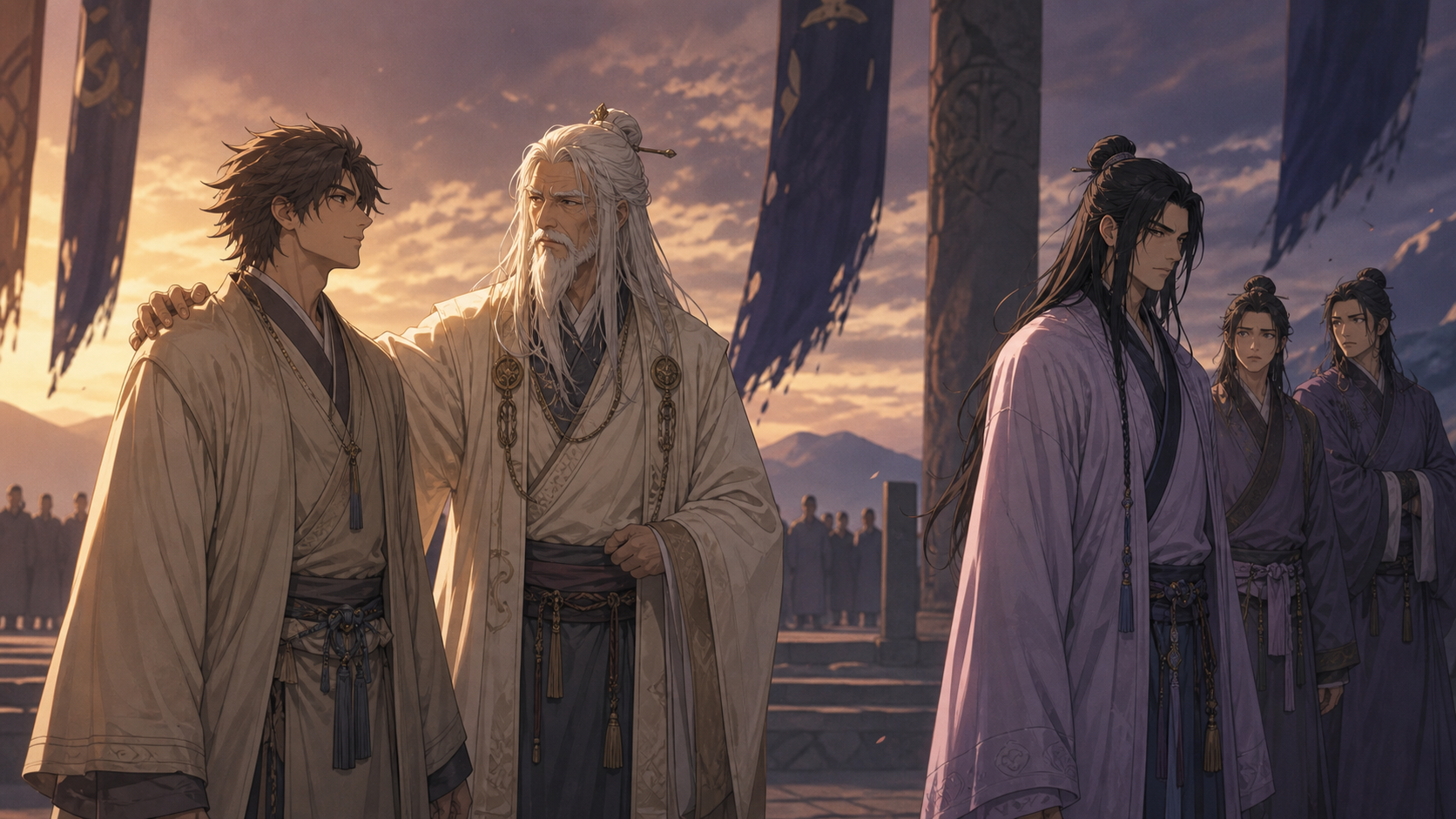
The Successor
Hagoromo chooses the right philosophy through a process almost designed to make the losing son feel cheated.
Bottom line
“The Successor” chooses the right philosophy through a process almost designed to make the losing son feel cheated. Asura builds clean water with a village, teaches residents Ninshu, and returns after a year with relationships capable of surviving his departure. Indra creates water alone, destroys the contaminated God Tree remains, and comes home first. His solution works until residents fight over access and nearly destroy their settlement. Hagoromo therefore names Asura his successor, but only after withholding the criteria, extending the timeline, and treating community aftermath as information Indra never had a chance to repair. Black Zetsu turns that procedural wound into entitlement, murder, and war. Indra kills his own loyal followers to awaken the Mangekyo Sharingan, then attacks a celebration built around the brother he once protected. The episode condemns power without bonds, yet also demonstrates how institutions can manufacture grievance when leaders confuse private wisdom with transparent judgment. Hagoromo's verdict is defensible. His succession process is not.
Episode 468 closes the anime-expanded origin arc
Episode 468 is titled “The Successor.” The Japanese title is “Kokeisha.” The episode aired in Japan on July 21, 2016.
The brothers' inheritance and conflict are canonical history, while most events in this detailed version were created for the anime.
Hagoromo names Asura
The announcement surprises both brothers and the assembled Ninshu community. Visible talent, seniority, and speed all appeared to favor Indra.
The decision reveals that Hagoromo was testing method rather than simple completion.
Indra asks the necessary question
He wants to know why the son who returned first and solved the assigned problem was rejected. His anger does not make the question illegitimate.
Fair authority must explain unexpected judgment.
Both missions produced water
Indra and Asura each removed dependence on contaminated God Tree residue by creating a safer water source. Their immediate material outcomes appear similar.
The difference emerges after delivery.
Indra worked alone
He used extraordinary ability to create the resource and destroy the dangerous remains without relying on villagers. Speed and control minimized delay.
Residents received an answer they did not learn to govern.
Water rights fracture the village
After Indra leaves, people fight over access to the new source. The resource solves scarcity without establishing shared ownership, distribution, maintenance, or conflict resolution.
Infrastructure creates politics the moment water begins flowing.
The village nearly destroys itself
Competition becomes severe enough to threaten the settlement. Indra's technical success therefore fails Hagoromo's unstated standard of durable peace.
A finished structure is not a finished community.
Asura leaves collective capacity
His villagers spent a year locating water, digging together, learning Ninshu, and deciding when to burn the poisonous roots. Their process created relationships alongside infrastructure.
Shared labor supplied a governance practice.
The comparison favors sustainability
Indra delivered a resource. Asura helped people build the ability to manage a resource together.
Hagoromo chooses the method closest to Ninshu's central promise.
The criteria were never disclosed
Neither scroll stated that post-departure conflict, resident participation, or social durability would determine succession. Indra completed the assignment he understood.
Hidden standards turn evaluation into revelation.
Hagoromo extended the contest
Indra returned long before Asura, yet their father waited a year for the younger son. The delay allowed a different method to reach completion.
Patience served wisdom while looking like favoritism.
Indra received no repair opportunity
Hagoromo learned about the water dispute after his son's departure but apparently did not send him back to address the failure. Judgment replaced feedback.
A test became a sentence rather than instruction.
Leadership education should allow correction
If the mission exists to teach, then discovering unintended harm should begin another phase. If the mission exists only to rank sons, communities become evidence in a family contest.
Neither option fully honors Ninshu.
Hagoromo praises the Sharingan
He recognizes Indra's gift and ability before asking him to support Asura. The compliment cannot offset the loss of an identity built around succession.
Praise after exclusion may sound ceremonial.
Support becomes Indra's assigned future
The older brother is asked to place his strength under the leadership of someone he has always surpassed technically. Cooperation could preserve their bond.
The request still demands immediate humility without grief or dialogue.
Indra leaves the gathering
Withdrawal prevents an open explosion but also removes him from every person capable of challenging Black Zetsu's interpretation.
Isolation turns injury into a closed argument.
Two followers choose Indra
Loyal students go after him and consider appealing to Hagoromo. Their support proves that Indra already has relationships, even if hierarchical ones.
The episode refuses to leave him entirely alone.
Their loyalty could have challenged the verdict
A peaceful appeal might expose flaws in Hagoromo's process and create room for a shared leadership structure. The followers offer a political path.
Black Zetsu's ideology requires that path to die.
Indra thanks them
His gratitude makes the next act colder. He understands their devotion and accepts its emotional value before using their lives.
Recognition becomes preparation for betrayal.
He kills his own followers
Indra murders the two people who stood beside him. The act cannot be excused as disappointment, manipulation, or family neglect.
He chooses power through deliberate human sacrifice.
Mangekyo is purchased with trust
Black Zetsu taught him that loss unlocks greater eyes. Indra creates the required grief by destroying bonds himself.
The protective brother from Shiro's death has embraced the attacker's logic.
Manufactured loss completes the corruption
Earlier, Black Zetsu arranged Shiro's death around Indra. Now Indra reproduces the method without needing another staged accident.
Manipulation succeeds when the target becomes an author of harm.
Responsibility remains with the killer
Black Zetsu cultivated grievance and supplied the doctrine. Hagoromo supplied procedural failure. Neither moved Indra's hand for him.
Context explains the road without erasing agency.
The celebration proceeds without him
The Ninshu community gathers to honor Asura's appointment while Indra's absence hangs over the feast. Institutional continuity is treated as achieved before family rupture is addressed.
Joy occupies an unstable foundation.
Taizo trusts Asura's leadership
He values a leader who understands people's hearts and grew through the village mission. His judgment comes from direct experience of Asura's mercy and mistakes.
Support has a relationship behind the judgment.
Kanna's presence carries the mission home
She followed Asura from the village where the yearlong project changed daily life. Her attendance shows that his connection survived beyond task completion.
The community result has a witness.
Romance enters lightly
Taizo teases Kanna about her feelings for Asura, and she denies the claim with embarrassment. The brief exchange humanizes the gathering before violence arrives.
Kanna still matters beyond romance as a local organizer.
Asura questions his own appointment
He does not treat succession as an entitlement earned through moral superiority. Doubt preserves awareness of Indra's ability and pain.
Reluctance alone does not solve the political rupture.
Hagoromo blames the Sharingan's effect
He argues that Indra's eyes impaired his ability to understand other people. The explanation identifies isolation while risking biological fatalism.
A dojutsu cannot absolve years of family and institutional choices.
Eyes become a moral shorthand
The episode associates visual power with private certainty and Asura's bonds with shared understanding. The contrast is clear but overly neat.
Indra had ethical concern before adults failed to nurture that instinct.
Hagoromo asks for brotherhood again
He wants Asura to work with Indra rather than replace him completely. The request reflects the original dream of complementary strengths.
No reconciliation plan accompanies the hope.
Power is transferred to Asura
Hagoromo gives the chosen son greater chakra and authority. The act equips him to defend Ninshu while confirming Indra's fear that recognition brings power.
Spiritual succession becomes material advantage.
Indra attacks the feast
He returns with Mangekyo Sharingan and rejects the appointment through violence. The celebration becomes a battlefield among family and followers.
His grievance has crossed into collective punishment.
Love is recast as weakness
Indra argues that bonds dilute power and that control should shape Ninshu. Cooperation looks inefficient beside the certainty of command.
He mistakes dependence for incapacity.
His doctrine contradicts his own history
Love for Asura once sent Indra racing toward the boar attack. Loyal followers offered support after the succession loss.
He learned strength through bonds before choosing to destroy them.
Hagoromo recognizes the Mangekyo cost
The new pattern tells him Indra suffered or caused an intimate loss. Horror arrives after the family failed to ask where his earlier Sharingan came from.
Knowledge comes too late to prevent sacrifice.
Asura resists the first assault
The younger brother can now withstand techniques that once overwhelmed him. Hagoromo's power matters, but the community gathered around Asura also matters.
His strength is visibly plural.
Susanoo escalates the attack
Indra surrounds himself with an enormous chakra warrior. The defense embodies solitary power: one person enclosed inside force capable of dominating everyone outside.
Protection has become separation.
The community shares chakra
Hagoromo and the Ninshu followers give energy to Asura. Their contribution is voluntary and coordinated rather than extracted.
The creed becomes a combat method without abandoning relationship.
Shared power still becomes violence
Asura uses collective chakra to fight his brother. Cooperation does not make an attack ethically clean by itself.
The immediate goal is defense against Indra's assault.
Truth-Seeking Balls block destruction
Asura manifests Hagoromo's advanced power and prevents Indra's strike from reaching the community. The imagery aligns him closely with later Naruto.
Mythic scale replaces the village arc's grounded labor.
The wooden avatar answers Susanoo
Asura forms the immense many-handed construct associated with his inherited power. The brothers' ideological conflict becomes a spectacle of giant bodies.
Their childhood disagreement has become geography-changing force.
Asura defeats Indra
Collective chakra overcomes solitary might. The battle visually confirms Hagoromo's verdict.
Winning the clash cannot repair the bond or restore the murdered followers.
Asura reaches toward his brother
After victory, he attempts aid rather than execution. The gesture preserves love without pretending no harm occurred.
Mercy remains available after defense.
Indra refuses recognition
He rejects Asura and Ninshu, then escapes. Refusal lets him preserve a self-image in which defeat proves conspiracy rather than error.
Exile hardens doctrine.
A rival sect begins
Indra gathers followers around power, control, and techniques derived from chakra. Ninshu's practical branch becomes an institution competing with Hagoromo's relational creed.
The family disagreement reproduces socially.
Hagoromo writes a warning
The Sage leaves a Stone Tablet meant to caution Indra's descendants about the Sharingan and destructive escalation. Written memory attempts to reach generations he cannot guide personally.
Text becomes another vulnerable institution.
Black Zetsu edits the record
Kaguya's will alters the tablet so later Uchiha readers pursue the Infinite Tsukuyomi and power through combined chakra. Historical evidence becomes a weapon.
Manipulation moves from one child to an entire lineage.
The cycle outlives both brothers
Indra vows that his chakra will continue opposing Asura's creed across reincarnations. Conflict becomes an inheritance assigned to descendants who never consented.
Grievance seeks immortality.
Indra visits Hagoromo near death
Years later, he returns not to reconcile but to declare that the struggle will continue until love-led Ninshu disappears. The father hears the result of his failed hope.
Time has not softened the doctrine.
Hagoromo tells Asura the final warning
On his deathbed, he entrusts the younger son with knowledge of Indra's vow. Asura inherits leadership, family grief, and an endless defensive assignment.
Succession carries an unresolved brother within the inheritance.
The episode makes Black Zetsu too convenient
His manipulation explains continuity from Kaguya to the Uchiha, but the device can flatten political failures into one villain's plan. Hagoromo, Indra, and their institutions still make consequential choices.
History needs more than a puppet master.
The anime parallels Naruto and Sasuke aggressively
Susanoo, an Asura avatar resembling Naruto's later chakra form, and familiar rivalry imagery make reincarnation immediately legible. The visual shortcut reduces some individuality.
Ancient brothers become prototypes too often.
The water dispute is the strongest evidence
Indra's village does not fail because his technique lacks power. Residents fight because resource delivery arrived without shared governance.
That consequence offers a clearer leadership critique than inherited eye symbolism.
Hagoromo should have named co-leadership
Indra's technical brilliance and Asura's relational method could have complemented each other under transparent limits. Asking one to support the other after a secretive contest preserved hierarchy.
Ninshu preached bonds while selecting one throne.
The succession system contradicts the creed
A philosophy of shared burdens is transferred through unilateral paternal appointment. Hagoromo never asks the wider community how leadership should work.
The institution begins with concentrated authority.
Asura remains the better choice
Procedural flaws do not make Indra safer. Murdering loyal followers and attacking civilians disqualify his claim beyond any dispute about the test.
Understanding grievance does not require rewarding terror.
A correct outcome does not repair a bad process
Asura’s village retains water, relationships, knowledge, and a way to govern the resource after he leaves. Indra’s village receives water quickly and nearly destroys itself over access. Hagoromo has a serious reason to prefer Asura’s method.
Indra still deserved to know the standard before the verdict and receive a chance to address the unintended consequence his first solution created.
Feedback would have tested leadership better than surprise
Sending Indra back after the water conflict could reveal whether he listens, shares authority, and repairs harm once exceptional power stops being sufficient. Judgment ends the lesson at the exact moment the lesson becomes useful.
If a candidate cannot respond to failure, that response is better evidence than a father’s private interpretation of failure from afar.
Co-leadership was the missing institutional imagination
Indra understands technique, risk, speed, and enforcement. Asura understands participation, endurance, and the social life of infrastructure. Their strengths could check each other if authority were distributed transparently.
Hagoromo preaches connection while transferring Ninshu through a single paternal appointment. The structure recreates the hierarchy the creed claims to resist.
Indra’s followers prove he was never bondless
Two students leave the celebration to support him and even propose a peaceful appeal. Their loyalty contradicts the claim that he cannot form relationships.
Indra murders them because Black Zetsu taught him to convert attachment into ocular power. That choice destroys the strongest evidence that another political route remained available.
Manipulation becomes responsibility when Indra repeats the method
Black Zetsu arranged Shiro’s death and taught grief as a power mechanism. Indra later creates his own required loss by killing people who trusted him.
The victim of manipulation has become an author of manipulation’s violence. Context remains essential, but it cannot remove the agency visible in that reproduction.
The feast celebrates continuity too early
Asura doubts himself, Kanna and Taizo carry real evidence of his leadership, and the community deserves joy. Indra’s absence still signals a rupture the institution has not addressed.
Installing a successor is not the same as stabilizing succession. Ceremony can make unresolved conflict look finished until violence enters the room.
Asura’s victory cannot become moral proof by combat
Collective chakra defeats Susanoo and protects the gathering, which validates cooperation as defense. Winning does not retroactively make every part of Hagoromo’s process fair.
The better philosophy survives the attack. It should also remain capable of criticizing the institution that selected it.
Fair leadership selection needs published criteria, comparable evidence, feedback, and a chance to repair unintended harm. Without those safeguards, even a wise decision can look like private preference backed by authority. The institution then asks the losing person to trust a process that never trusted him with its standards, which gives manipulation a grievance ready to weaponize against everyone nearby.
RaeRae’s verdict
“The Successor” works because Hagoromo can be right about Asura and wrong about how he gets there. Durable water and shared governance are stronger leadership evidence than an impressive resource delivered without community capacity.
Indra’s grievance deserves examination. His murders do not deserve reward. Black Zetsu cultivates the wound, but Indra chooses to make loyal people into fuel. The cycle begins where opaque authority, scarce recognition, and personal violence reinforce one another.
Final verdict
“The Successor” lands its central comparison because water exposes what combat cannot. Indra can create the resource alone, but his village nearly collapses over access after he leaves. Asura spends a year helping residents build water, knowledge, and relationships together. Hagoromo is right to value the second outcome. He is wrong to hide the criteria, delay judgment without explanation, and deny Indra a chance to repair unintended harm. That failure does not excuse what follows. Indra murders the followers who chose him, converts their loyalty into Mangekyo power, and attacks a community celebrating his brother. Black Zetsu guides the corruption, but Indra becomes responsible when he reproduces the manipulator's method. The tragedy is not that Asura was chosen. The tragedy is that a creed built around connection created succession through one father's private verdict, then acted surprised when hierarchy turned brotherhood into a war over recognition.
RaeRae’s call
Hagoromo’s verdict is defensible; his process is not. Indra completed the stated task, never received transparent criteria, and was denied a repair phase after his village fought over water. That procedural wound matters. It does not excuse murdering the followers who chose him or attacking a community. Black Zetsu supplies doctrine and pressure. Indra supplies the decisive violence. Accountability can hold institutional failure, manipulation, and personal agency in the same frame.
Episode details and viewing routes
- Official episode reference: Naruto Official episode guide
- Licensed episode route: Crunchyroll licensed episode page
What I am carrying forward
Hagoromo chose Asura because his village retained shared capacity while Indra’s village fought over water after he left. The verdict favored Ninshu’s relational purpose but arrived through undisclosed criteria and no repair opportunity.
Indra murdered his loyal followers to awaken the Mangekyo Sharingan, attacked Asura’s celebration, and rejected reconciliation after defeat. Black Zetsu altered the Stone Tablet so the conflict would continue through descendants. Episode 469 returns to Team 7 through Kakashi’s long-running face reveal mission.