
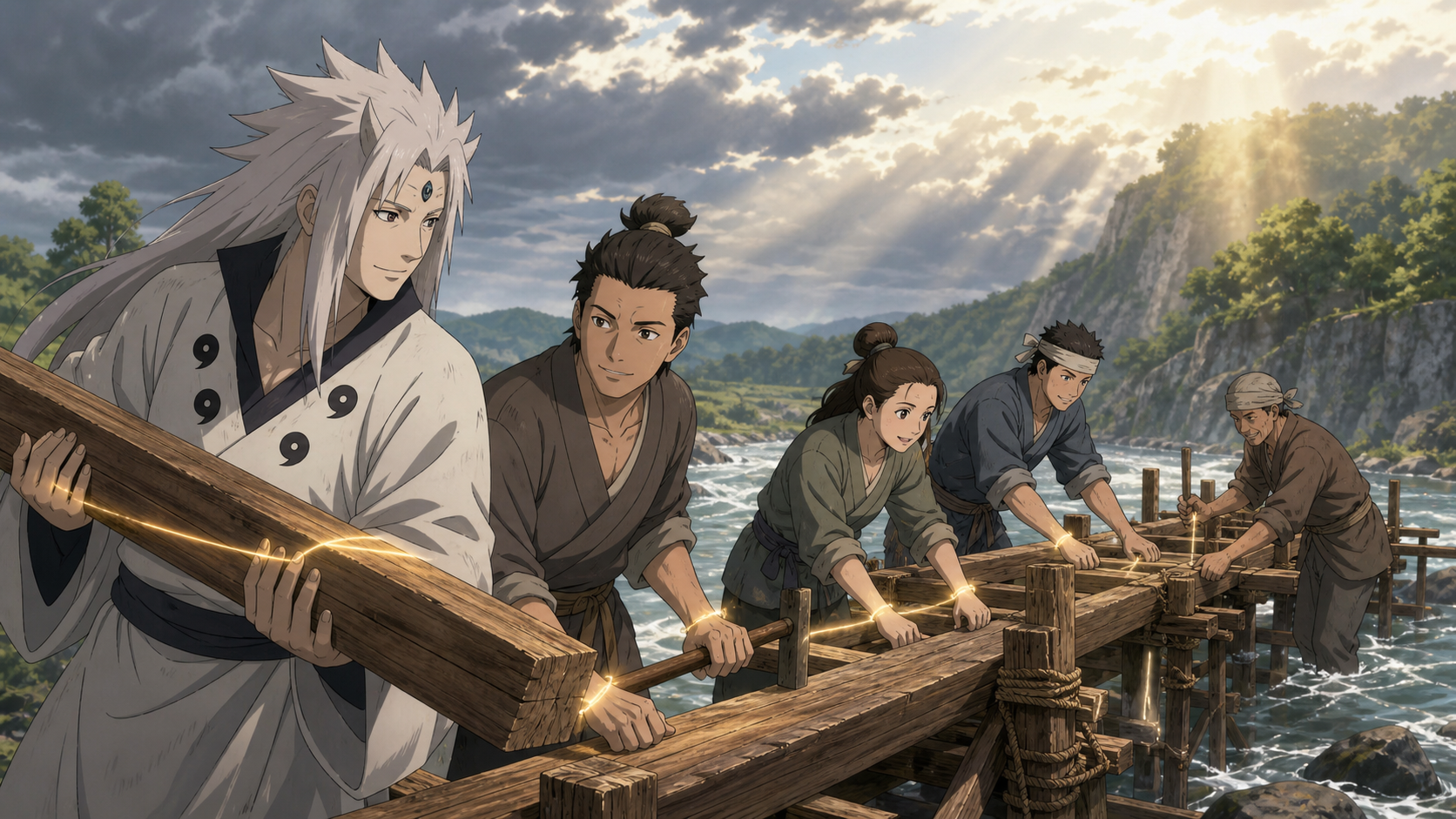
Ninshu: The Ninja Creed
Hagoromo begins with roads, bridges and shared burden because chakra only becomes a practice of peace when ethical relationships give power direction.
Bottom line
“Ninshu: The Ninja Creed” understands that connection sounds cheap until somebody helps rebuild the bridge. Hagoromo does not begin his peace mission by giving strangers a sermon about chakra. He finds Futami profiting from a broken crossing, refuses to solve the problem with one godlike blast, and works through heat, rain, exhaustion, and public suspicion until the man benefiting from hardship finally picks up a tool. Villagers join because they see labor worth joining. Only then does chakra become a shared practice for understanding another person's pain. The episode also exposes the limit of Hagoromo's dream. Connection is not permanent protection against greed, hierarchy, or violence. Ninshu later becomes ninjutsu because people learn how to shape the same energy into force. A good tool cannot carry ethical relationships by itself.
Episode 464 begins another anime-expanded history
Episode 464 is titled “Ninshu: The Ninja Creed.” The Japanese title is “Ninshu.” The episode aired in Japan on June 9, 2016.
The story pauses the Kaguya battle to expand Hagoromo's travels and the early practice that later becomes shinobi ninjutsu.
The four Hokage remain awake
Hashirama, Tobirama, Hiruzen, and Minato are unaffected by Infinite Tsukuyomi because they are reanimated bodies rather than living targets. They stand in a silent world without access to Team 7's dimension.
Knowledge becomes their next useful task.
Madara's lower body marks the battlefield
The Hokage find what remains after Black Zetsu used him for Kaguya's return. Madara's apparent victory ended in bodily dispossession.
The evidence confirms that the war has changed beyond their sight.
Hagoromo appears before them
The Sage of Six Paths manifests through chakra gathered around the battlefield. Ancient history arrives to people who built and led the modern village system.
The meeting connects the founders' ideals with the consequences visible around them.
He explains Naruto and Sasuke's inheritance
Naruto carries Asura's reincarnating chakra, while Sasuke carries Indra's. Hashirama and Madara were the previous pair.
The cycle gives the Hokage context without reducing either boy to a repeated script.
Kaguya is now their enemy
Hagoromo tells them his mother has returned and that Naruto and Sasuke are fighting her. The threat predates every hidden village.
The Hokage cannot solve the battle through normal command structures.
Hagoromo begins with unfinished responsibilities
After sealing Kaguya, he must decide where the nine tailed beasts can live and how the damaged land will recover. Victory creates work rather than a clean ending.
Peace begins in the aftermath people still inhabit.
The tailed beasts need homes
Hagoromo created nine distinct lives from the Ten-Tails' chakra. Treating them as people means considering environment, safety, and future relationships.
He does not begin by assigning them to armies.
The battlefield remains scarred
Months of conflict with Kaguya and the Ten-Tails left regions physically ruined. Soil, routes, water, and settlement life need repair.
Spiritual teaching cannot substitute for reconstruction.
Gamamaru shares a prophecy
The sage toad has seen a blue-eyed boy who will know the names of all nine beasts and call forth a miracle. Hagoromo does not yet know Naruto.
The prophecy frames hope without providing a timetable or method.
Names matter inside the vision
The future boy will not merely command nine power sources. He will know Shukaku, Matatabi, Isobu, Son Goku, Kokuo, Saiken, Chomei, Gyuki, and Kurama as individuals.
Recognition precedes cooperation.
Hagoromo doubts his next direction
He has enough power to reshape geography and still does not know how to help people live differently. The uncertainty protects him from assuming victory made him morally complete.
Gamamaru tells him to travel.
The journey replaces rule from above
Hagoromo could remain at a sacred center and wait for people to seek him. Walking brings him into local problems before a religious institution can filter them.
He learns what connection must accomplish in ordinary life.
A broken bridge blocks a route
The first major problem is physical and easy to understand. People cannot carry goods safely across a river.
The missing crossing isolates households and creates opportunity for exploitation.
Futami profits from the hardship
He offers transport or manipulates travelers because the broken bridge gives him leverage. Scarcity becomes income.
Repair threatens the small advantage he built around everyone else's inconvenience.
Hagoromo sees through the scheme
He recognizes that Futami is not simply helping stranded people. The man controls access because no public route remains.
Accurate judgment does not lead Hagoromo to punish him immediately.
Hagoromo asks what people need moved
He begins by helping travelers cross rather than delivering a moral lecture. Service reduces the immediate harm Futami exploits.
The response makes an alternative visible.
He chooses to rebuild the bridge
A permanent crossing removes the structural opportunity for the scam. Stopping one transaction would leave the next traveler dependent.
Repair addresses cause rather than chasing symptoms.
Hagoromo limits his supernatural power
He could complete the structure with chakra in a dramatic instant. Instead, he cuts, carries, fits, and secures materials through sustained work.
The choice keeps local people capable of understanding and joining the process.
Labor makes his intention believable
Villagers can watch a stranger sweat through the same weather and weight they know. His body provides evidence that the bridge matters beyond performance.
Trust begins before chakra links anyone.
Heat tests the first day
Hagoromo continues working under exhausting conditions. No audience applause appears to reward each log.
Commitment becomes visible through repetition.
Rain does not end construction
Storms slow the work and make the crossing more dangerous. Hagoromo stays with the task instead of declaring the environment unworthy.
The bridge must function in the weather people actually face.
Futami becomes frustrated
Every completed section threatens his control over the route. He initially resents the person removing his advantage.
The episode lets self-interest resist community repair honestly.
Futami eventually helps
Watching Hagoromo work without demanding payment or obedience changes the calculation. Futami picks up the labor he once opposed.
Participation begins before perfect motives arrive.
Villagers join the effort
The visible partnership gives others confidence that the bridge can be completed. More hands turn one traveler's project into shared infrastructure.
Community forms around a job with a concrete benefit.
Nobody waits for a miracle
Hagoromo's power could make him the sole solution. By working at human pace, he allows skill, responsibility, and ownership to spread.
The bridge belongs to the people who helped build the crossing and will maintain the structure.
Completion changes the local economy
Travelers can cross without bargaining with one gatekeeper. Goods, medicine, news, and relationships move more freely.
Connection is material before becoming mystical.
Hagoromo credits Futami
He recognizes the man's choice to help instead of freezing him inside the identity of exploiter. Accountability includes acknowledging changed conduct.
Futami now has a reason to choose a different life.
Futami asks to follow him
The completed bridge does not end their relationship. He wants to understand the person who changed a community through patient work.
Hagoromo gains his first companion through example rather than recruitment pressure.
Hagoromo admits uncertainty about himself
When Futami asks who he is, the Sage does not present a polished title. He is still deciding how power should relate to service.
Honest uncertainty makes room for mutual discovery.
Futami wants a life with purpose
Following Hagoromo offers a path beyond extracting value from scarcity. He can use effort to create routes instead of controlling access.
The choice is practical moral change.
They continue rebuilding crossings
One bridge becomes a repeated method across settlements. Each new location brings different materials, people, and resistance.
Ninshu grows through local work rather than one central announcement.
Hagoromo shares chakra gradually
He connects his energy with followers so they can sense one another more directly. Chakra becomes a language for carrying thought, pain, and intention.
The practice aims at understanding before technique.
Different people show different chakra
Individual energy retains distinct qualities. Connection does not require everyone to become identical.
Ninshu works when difference becomes legible rather than erased.
Shared pain can interrupt easy judgment
Feeling another person's burden makes exploitation and violence harder to defend as abstractions. Consequence enters the relationship directly.
Empathy becomes practice rather than a slogan.
Chakra cannot guarantee compassion
Knowing another person's pain does not force a humane response. People can ignore, exploit, or weaponize what they understand.
Connection creates opportunity, not moral automation.
Ninshu spreads through followers
People who traveled and worked with Hagoromo carry the practice elsewhere. The network grows beyond his direct presence.
Decentralization allows continuity and variation.
The tailed beasts receive places to grow
Hagoromo leaves each young being in an environment suited to life beyond the Ten-Tails. He expects them to become symbols of connection across generations.
Later capture will betray that hope.
Humanity converts chakra into ninjutsu
People discover how to mold energy for elemental techniques, defense, labor, and combat. The practical possibilities expand quickly.
The creed becomes a technology that no founder can fully control.
Ninjutsu is not automatically a corruption
Healing, barriers, transport, farming, rescue, and defense can all use shaped chakra. The ethical break comes from relationship and purpose, not hand signs alone.
The same tool can connect or dominate.
Power without ties creates calamity
Hagoromo's warning identifies the missing condition. Technique separated from responsibility lets ability outrun care.
Kaguya's rule already demonstrated that pattern at the greatest scale.
The bridge models the creed better than doctrine
People identify a shared need, labor beside one another, change a harmful incentive, and keep a route open. Chakra later deepens a bond already built through action.
Shared understanding can also sharpen manipulation when one person learns exactly where another person hurts. Ninshu therefore needs consent, limits, and a community willing to challenge abuse. Hagoromo can open a channel, but he cannot make every participant respect what the channel reveals. The later shinobi world proves the danger repeatedly: sensory knowledge supports rescue and surveillance, medical skill supports healing and experimentation, and clan intimacy supports care and coercion. Connection carries responsibility because knowledge creates leverage.
The episode's strongest theology is carpentry.
The four Hokage embody Ninshu's mixed legacy
Hashirama built a village through alliance. Tobirama created institutions and dangerous techniques. Hiruzen inherited compromise. Minato used extraordinary power for protection and war.
No leader represents a pure outcome.
Hashirama and Madara repeated the sons' conflict
Their friendship, ideological split, and reincarnated chakra carried Asura and Indra's tension into the village era. History created pressure without removing choice.
Both men made decisions their ancestors did not dictate line by line.
Naruto and Sasuke can answer differently
They inherit the same conflict and possess the sealing power Hagoromo divided between them. Their relationship includes rivalry, injury, loyalty, and ongoing choice.
The cycle becomes meaningful only if interruption remains possible.
The anime expansion slows the present battle again
Sasuke remains trapped in another dimension while Naruto faces Kaguya. Pausing for Ninshu history risks frustrating viewers who need the rescue to continue.
The episode earns some patience through a clear thematic connection to teamwork.
The bridge also keeps the history from floating above the series as abstract doctrine. Naruto’s strongest alliances have always formed through repeated effort, embarrassment, disagreement, and visible care. Hagoromo’s labor supplies an early version of that same practice before later institutions turn chakra into rank and weaponry.
A bridge is a better beginning than a sermon
Hagoromo arrives with knowledge nobody around him possesses and power capable of ending the construction problem instantly. He chooses to learn the route, move timber, endure weather, and let the community watch intention become work.
That sequence gives Ninshu credibility before doctrine arrives. People do not trust him because a sacred title says they should. They see him reduce a burden without demanding dependence in return.
Infrastructure decides who gets to belong
A broken crossing is not scenery. It determines who can reach food, medicine, work, relatives, markets, and information. Futami’s leverage grows because everyone else’s movement has become negotiable.
Repair changes more than travel time. It removes one person’s ability to convert public isolation into private control. Connection begins with access that cannot be withheld for obedience.
Hagoromo refuses the hero trap
One blast of chakra could produce a bridge and leave every villager waiting for the powerful stranger whenever the structure needs maintenance. Human-paced construction spreads knowledge, ownership, and confidence alongside the finished crossing.
Helping is not always doing everything alone. Sometimes the more responsible use of power is creating conditions where other people can participate without being made spectators to their own survival.
Futami is allowed to change without becoming innocent
He profited from hardship and opposed the repair threatening his advantage. Joining the work matters because conduct changes the future, not because one afternoon of labor erases the people he exploited.
Hagoromo recognizes the new choice without rewriting the old one. That balance is what redemption stories need: accountability for harm, room for changed action, and no magical arithmetic pretending the two cancel perfectly.
Shared labor creates consent before shared chakra
The villagers can see the bridge, decide whether to help, choose a task, and leave the worksite. Their relationship forms through visible goals and negotiated effort before Hagoromo introduces an intimate spiritual link.
That order matters. Connection entering a community through voluntary cooperation is different from power entering first and defining participation afterward.
Feeling another person is not permission to enter them
Ninshu promises direct understanding through chakra. The promise sounds beautiful because misunderstanding has driven so much violence. Intimacy still needs boundaries. Access to another person’s pain, intention, or inner energy creates leverage as surely as it creates empathy.
A creed of connection must include consent and limits or it becomes a gentler vocabulary for surveillance. Knowing more about somebody does not grant ownership of what they revealed.
Empathy is an opportunity, not an automatic virtue
People can feel pain and respond with care. They can also identify the exact wound most useful for manipulation. The Naruto world repeatedly shows medical knowledge used for healing and experimentation, sensory skill used for rescue and tracking, and clan bonds used for protection and control.
Connection supplies information. Character and accountable institutions decide what people do with it.
Chakra becomes dangerous when relationship becomes rank
Hagoromo shares power to make internal experience legible between people. Later systems sort chakra into bloodlines, village assets, military specialties, and measures of personal worth.
The technology did not force that hierarchy. Governments and clans built hierarchy around the technology because concentrated power offered status, security, and coercive advantage. Founders cannot leave ethics inside a tool and expect the tool to enforce them forever.
The tailed beasts prove names are only a beginning
Hagoromo names nine lives and imagines future humans meeting them through recognition. Villages later capture, distribute, and seal those beings inside children while continuing to use their individual names.
Language can acknowledge personhood while policy denies it. Real recognition changes what somebody is allowed to choose, where they may live, and whether their body can become state property.
The Hokage are evidence of mixed inheritance
Hashirama built alliance and left coercive tailed-beast distribution. Tobirama created useful institutions and policies that hardened distrust. Hiruzen valued community while permitting grave failures under his leadership. Minato protected the village by placing an unbearable future inside his child.
Ninshu’s legacy is not pure because no institutional legacy is. Every generation receives tools, ideals, compromises, and consequences together.
Naruto’s practice looks more like carpentry than prophecy
He builds relationships through repeated presence, shared danger, arguments, promises, mistakes, and visible labor. People do not join him because he transmits a flawless philosophy. They watch him carry burdens he could have ignored and remain when rejection would be easier.
That is Hagoromo’s bridge at another scale. Trust grows because someone keeps showing up where connection has material cost.
A prophecy may name the future child, but only repeated choices can turn inherited possibility into a relationship strong enough to change history.
RaeRae’s verdict
“Ninshu: The Ninja Creed” is strongest when it keeps theology covered in sawdust. Hagoromo does not announce connection from above. He helps remove a gatekeeper’s leverage, works until Futami chooses a different role, and leaves a community with infrastructure it can understand and maintain.
The episode also knows its ideal is fragile. Chakra can carry pain and become a weapon. Names can recognize tailed beasts while villages still imprison them. Connection needs consent, limits, resources, and institutions capable of correction. Otherwise the bridge becomes another route controlled by whoever arrives strongest.
Ninshu: The Ninja Creed makes peace physical
Hagoromo's ideal begins with roads, bridges, shared burden, and people choosing to help. Chakra matters because relationship gives the power direction.
Episode 465 will introduce Asura and Indra as children and show how unequal talent begins pulling Hagoromo's family toward another conflict.
RaeRae’s call
Ninshu works when connection changes material life. The bridge restores movement, removes Futami’s gatekeeping advantage, and gives villagers a project they can own together. Chakra deepens that relationship, but it cannot guarantee care. Empathy can become surveillance, names can coexist with captivity, and useful techniques can serve domination. Hagoromo’s creed therefore survives through practice, not purity: consent, shared labor, limits, correction, and people willing to keep rebuilding what power breaks.
Episode details and viewing routes
- Official episode reference: Naruto Official episode guide
- Licensed episode route: Crunchyroll licensed episode page
What I am carrying forward
Hagoromo met the four reanimated Hokage and explained Kaguya’s return, Naruto and Sasuke’s inheritance, and the history connecting their present battle to his family.
His story followed Ninshu from a broken bridge to shared chakra. Futami changed through labor rather than command, villagers joined a practical act of connection, and the tailed beasts received names and homes. Episode 465 introduces Asura and Indra and tests whether Hagoromo’s creed can survive unequal talent inside his own family.