
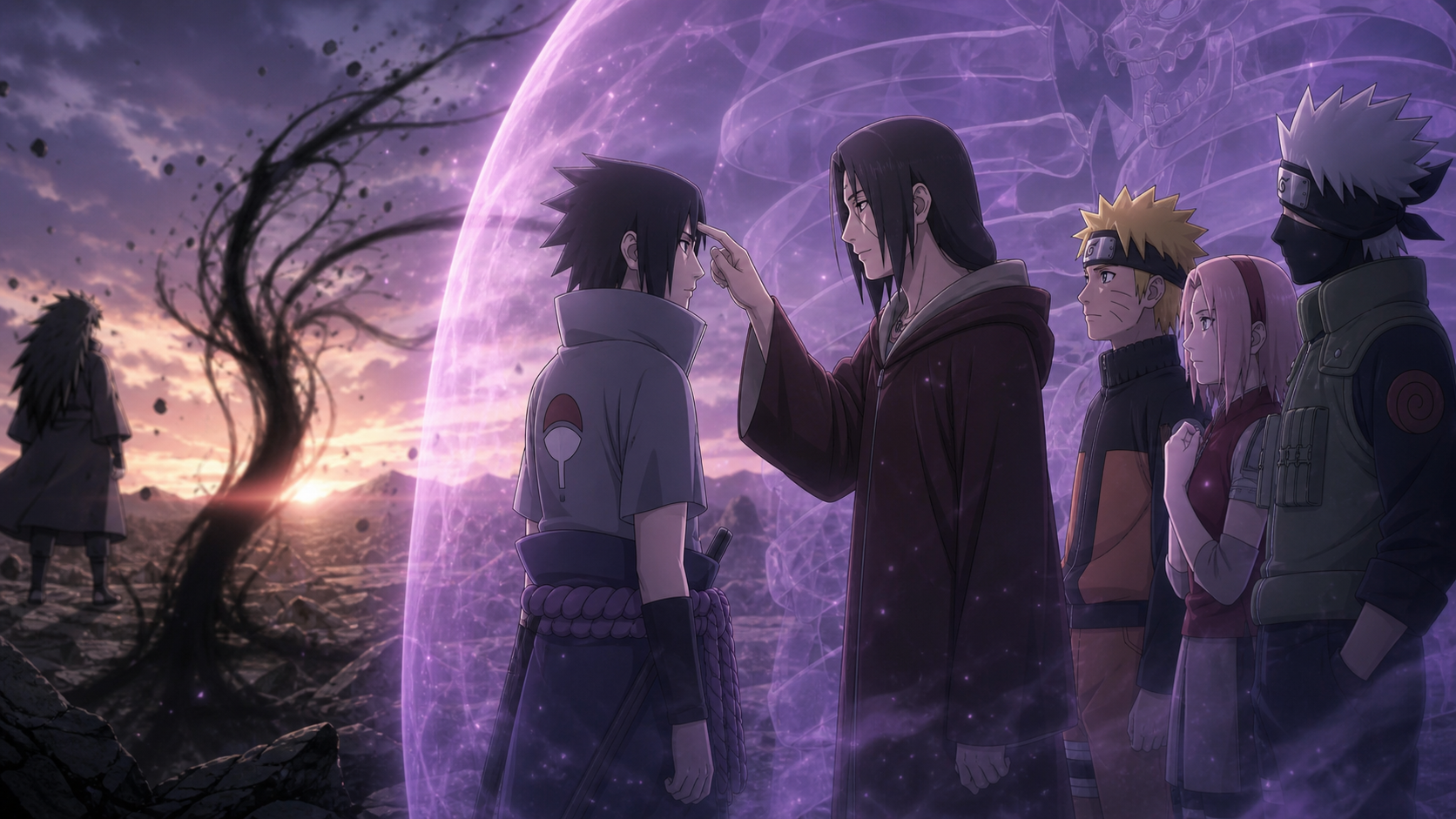
Itachi’s Story: Light and Darkness – Truth
Itachi’s final truth gives Sasuke room to choose, while Black Zetsu reveals that even the man who manipulated generations was carrying another script.
Bottom line
“Truth” closes Itachi's story by showing the one judgment he finally got right: Naruto might protect Sasuke without treating his brother as a problem to control. That realization matters because nearly every method Itachi used on Sasuke was wrong. He fed a child hatred, tortured him with the massacre, designed a death that would make him a village hero, planted Amaterasu as a posthumous command, and later prepared Shisui's eye to override Sasuke's will. Naruto rejects the forced choice underneath all of those plans. He will defend Konoha if Sasuke attacks, but he will not kill Sasuke or abandon the effort to bring him home. Then the memories end, Infinite Tsukuyomi's light fades, and Madara starts celebrating victory one betrayal too early. Black Zetsu stabs him and reveals that even the man who manipulated generations was carrying someone else's script.
Itachi’s surveillance keeps love inside coercive form
He follows Sasuke’s development, learns about Chidori, and evaluates Naruto because concern never stopped. Sasuke receives none of that concern as care he can recognize. He receives Tsukuyomi, threats, and another performance of the murderer role.
Private love cannot cancel public harm. When protection is designed so the protected person experiences only terror, the protector has confused intention with outcome.
Tsukuyomi is torture serving a preferred ending
Itachi wants Sasuke strong enough to kill him and return to Konoha as a hero. Repeating the massacre inside his brother’s mind is meant to intensify the hatred powering that route.
The desired ending does not make the method necessary. Itachi steals years of emotional possibility and treats Sasuke’s nervous system like a training tool for a role Sasuke never chose.
Naruto rejects the binary that trapped Itachi
Protect Konoha or protect Sasuke sounds familiar because Danzō built the massacre around the same structure. Naruto refuses to discard either responsibility. He will stop Sasuke from attacking the village and keep treating him as somebody worth bringing back.
That answer is not easy optimism. It accepts conflict, danger, and repeated effort without pretending care requires one person’s elimination.
Kotoamatsukami proves the lesson remained incomplete
Itachi trusts Naruto enough to ask the question and still implants Shisui’s eye as a command that would overwrite Sasuke’s political will. The backup plan reveals how quickly fear returns him to control.
He wants Sasuke safe and loyal more than he wants Sasuke free to reach a painful conclusion. Edo Itachi’s later admission matters because he finally names that reflex as failure.
Final truth respects Sasuke by refusing a command
The memories explain childhood, Shisui, the coup, Danzō, the massacre, exile, and continued attention. They do not demand that Sasuke forgive Konoha, absolve Itachi, or adopt a prescribed future.
For once, information expands the younger brother’s choices rather than narrowing them. That is the closest Itachi comes to loving Sasuke without managing the answer.
Black Zetsu turns Madara into the object he made of others
Madara believes Black Zetsu is his own will, so independent betrayal remains literally unthinkable. The assumption resembles every plan built on treating another person as an extension of the planner.
He controlled Obito, the tailed beasts, the trapped world, and generations of Uchiha history. Then a being he called a tool reveals that his victory supplied somebody else’s return.
The two revelations move in opposite ethical directions
Itachi’s truth gives Sasuke context and leaves the meaning unsettled. Black Zetsu’s truth announces that Madara’s understanding of history was engineered toward Kaguya. One disclosure returns agency. The other proves how much agency was stolen.
Truth is not automatically liberating. Timing, purpose, and whether the listener remains free to respond decide what information becomes.
The finale also refuses to let confession become a receipt for forgiveness. Sasuke may understand why Itachi acted and still judge the methods, the massacre, and the life built around enforced hatred. Context restores complexity, not innocence. The recipient decides what repair requires, however uncomfortable for everyone seeking easy closure afterward.
RaeRae’s verdict
“Truth” closes Itachi’s story where it should: not with sainthood, but with a better form of love arriving too late to undo the earlier damage. Itachi finally lets Sasuke see enough without attaching a command. That gift matters precisely because Tsukuyomi, Amaterasu, Kotoamatsukami, the villain role, and the planned heroic revenge all tried to control what Sasuke would become.
Naruto represents the lesson Itachi could not live early enough. Protecting a village and protecting one person can remain conflicting duties without turning into permission to discard either. Then Madara learns the same control lesson at catastrophic scale. He treated Black Zetsu as his will and humanity as bodies inside his peace plan. The tool moves, the bodies become fuel, and the victor discovers he never owned the ending. Control keeps failing because people and histories are not extensions of the planner.
Episode 458 closes one story and opens Kaguya's return
Episode 458 is titled “Itachi's Story: Light and Darkness – Truth.” The Japanese title is “Makoto.” The episode aired in Japan on April 28, 2016.
The episode finishes Sasuke's passage through Itachi's memories before returning fully to the Fourth Great Ninja War.
The arc reaches familiar Part I ground
Itachi and Kisame are carrying out Akatsuki work when news from Konoha becomes personal. The story now overlaps events viewers already watched from Naruto and Sasuke's perspectives.
Repetition has value only when the new viewpoint changes the meaning.
Itachi gathers information about Sasuke
He learns how his brother has developed inside the village. Distance has not ended his surveillance.
Concern survives beneath the criminal role, but concern still operates without Sasuke's knowledge or consent.
Sasuke has awakened the Sharingan
The eye Itachi once feared his baby brother might gain through pain has appeared exactly that way. Sasuke's trauma now carries the Uchiha power adults expected.
Itachi helped create the conditions he once wanted to prevent.
Kakashi taught Sasuke Chidori
Sasuke has a mentor who understands the Sharingan and can direct lightning chakra into a lethal technique. The development proves the boy is becoming formidable.
Power also gives Sasuke another route toward the revenge Itachi prescribed.
Itachi learns about Naruto
The Nine-Tails jinchūriki is no longer only Akatsuki's future target. Naruto is Sasuke's teammate, rival, and closest bond.
That relationship introduces a person Itachi cannot control through clan history.
Naruto complicates the private plan
Itachi designed Sasuke's life around hatred for one brother and loyalty to Konoha. Naruto gives Sasuke attachment outside both categories.
The friendship creates hope and another variable Itachi tries to evaluate.
Akatsuki's visit to Konoha has two purposes
The stated mission concerns Naruto and the Nine-Tails. Itachi also needs to check Sasuke after Hiruzen's death and remind Danzō that the surviving Uchiha remains protected.
One journey serves organizational cover and private warning.
Seeing Sasuke does not produce honesty
Itachi could not reveal the massacre's political truth without endangering the arrangement that kept Sasuke alive. He instead reinforces the villain role.
Secrecy again turns protection into direct harm.
Tsukuyomi repeats the massacre
He forces Sasuke to experience the clan's deaths over and over. The technique deepens hatred and destroys the emotional stability Sasuke had built with Team 7.
No later explanation can make that torture necessary care.
Itachi wants Sasuke strong enough to kill him
His plan requires the younger brother to become an avenger, defeat the criminal responsible for the clan, and return to Konoha as a hero. The ending sounds neat from the planner's distance.
Sasuke must spend his youth consumed by rage to reach that ending.
The plan treats Sasuke as a story role
Itachi assigns him survivor, avenger, hero, and protector without asking what life Sasuke wants. Every identity supports Konoha's stability and Itachi's need for punishment.
Love cannot excuse writing another person's future in blood.
Sasuke leaves Konoha for Orochimaru
The hatred Itachi cultivated makes forbidden power more attractive than friendship or village protection. Sasuke chooses the mentor most likely to use his body.
The plan designed to keep him loyal helps drive him away.
Itachi watches his strategy fail
Sasuke becomes stronger, but not through the honorable village path Itachi imagined. Growth follows isolation, curse-mark power, and obsession.
The result should force a reevaluation of the method.
Naruto refuses to give up on Sasuke
The teammate Sasuke tried to leave still treats the bond as active. Naruto does not confuse departure with proof that the person is beyond reach.
Persistence offers what Itachi's secret planning never allowed: relationship as a shared struggle.
Itachi approaches Naruto directly
He eventually stops relying only on reports and tests the person closest to Sasuke. The conversation asks Naruto to choose between an individual and the village.
Itachi frames the problem through the same binary that shaped the massacre.
Konoha and Sasuke become competing duties
If Sasuke attacks the Leaf, Naruto may have to stop someone he considers family. Itachi wants to know which loyalty wins.
The question assumes protection must end with one side discarded.
Naruto calls Sasuke a brother
He claims a bond stronger than official teammate status. The statement challenges Itachi because Naruto has chosen sibling responsibility without blood or clan expectation.
Chosen family enters a story dominated by inherited duty.
Naruto says his bond may be stronger
He tells Itachi that he treats Sasuke as a brother more fully than Itachi did. The line is bold, painful, and earned by the evidence.
Naruto stayed present while Itachi managed Sasuke from shadows.
Defending Konoha does not require killing Sasuke
Naruto says he will protect the village if Sasuke attacks. He refuses to turn that defense into permission to abandon or execute his friend.
He holds two responsibilities without pretending the conflict will be easy.
Naruto intends to bring Sasuke back
The goal is not submission followed by silence. He wants Sasuke restored to relationship and community after the threat is stopped.
That answer moves beyond Itachi's hero-or-traitor categories.
Itachi accepts the answer
Naruto's refusal gives him hope that someone can reach Sasuke through trust rather than control. The older brother recognizes a capacity he does not possess.
Acceptance is progress, even though his later contingency shows the lesson remains incomplete.
Shisui's crow becomes another backup plan
Itachi places the eye carrying Kotoamatsukami inside Naruto. The intended command will force loyalty to Konoha if Sasuke turns against the village after taking Itachi's eyes.
The mechanism contradicts the trust he just placed in Naruto.
Control remains Itachi's reflex
He wants Naruto to succeed and still prepares mind control in case relationship fails. Fear makes another person's will feel like an unacceptable risk.
The contingency repeats the flaw behind his entire life.
Edo Itachi later admits the mistake
His final growth comes when he recognizes that trying to handle everything alone caused failure. Naruto and other people cannot be reduced to instruments inside his plan.
The truth matters because he names his own responsibility.
Sasuke's battle with Itachi completes the false script
The brothers eventually fight, and Sasuke appears to achieve the revenge assigned to him. Itachi dies after pushing the confrontation toward the desired conclusion.
His body reaches the planned ending while Sasuke's life immediately escapes the plan.
Tobi reveals the hidden history
The masked man explains Konoha's order, the coup, and Itachi's sacrifice. Sasuke learns that the brother he hated also protected him.
Truth does not heal him. Truth redirects his rage toward the village.
The lie creates the opposite outcome
Itachi wanted Sasuke to kill a criminal and remain loyal to Konoha. Sasuke learns the state used his brother and decides Konoha deserves destruction.
Control fails because concealed truth always leaves the reveal to someone else.
Reanimation gives the brothers another meeting
Kabuto brings Itachi back during the war, and Sasuke follows him into the fight over Edo Tensei. The second partnership allows more honest contact than their living relationship ever had.
They fight beside each other instead of performing enemy roles.
Itachi finally tells Sasuke enough
Before the Reanimation Jutsu releases him, Itachi shares his memories and admits he should have trusted Sasuke from the beginning. He no longer demands a specific political answer.
His final love is less conditional than his earlier protection.
Sasuke finishes receiving the memories
Inside Susanoo, the long sequence reaches its end. He has seen childhood trauma, Shisui, the coup, Danzō, the massacre, Akatsuki, and Itachi's attention from afar.
Understanding expands without dictating what Sasuke must decide next.
Infinite Tsukuyomi's light fades
The dangerous moonlight finally weakens. Team 7 can leave the barrier without falling into the global genjutsu.
The private memory ends as the world's forced dreams continue.
Sasuke lowers Susanoo
Naruto, Sakura, Kakashi, and Sasuke return to the battlefield. Protection no longer requires isolation inside the chakra shell.
Whether Sasuke will treat them as partners remains unresolved.
Madara descends believing he has won
The Infinite Tsukuyomi holds the world's population, and resistance looks too small to change the outcome. Madara presents himself as the person who finished history's conflict.
Certainty arrives just before his control disappears.
Madara criticizes Hashirama's dream
He argues that the shinobi system built from cooperation failed to end suffering. Villages produced wars, exploitation, and repeated betrayal.
The critique contains real evidence even when his solution removes human freedom.
Infinite Tsukuyomi offers peace without consent
Madara believes private dreams eliminate conflict because nobody can oppose another person's desire. The bodies hanging from the God Tree reveal the price.
Peace becomes permanent captivity managed by one victor.
The episode links Madara and Itachi through control
Both men fear what people will choose when left free. Itachi uses lies and planned commands around Sasuke. Madara uses a global genjutsu around humanity.
Scale differs, but the protective logic shares a dangerous root.
Black Zetsu moves behind Madara
The figure Madara treated as an extension of his own will approaches without raising suspicion. Confidence makes the victor vulnerable to the servant he never considered independent.
The supposed tool has a hidden purpose.
Black Zetsu stabs Madara through the chest
The attack interrupts his declaration of victory. Madara's body, power, and plan are seized at the moment he believes nobody can challenge him.
The manipulator discovers that he was also manipulated.
Madara cannot understand the betrayal
He believed Black Zetsu came from his will and therefore could not possess a conflicting agenda. The assumption mirrors every controller's mistake.
Treating another being as an extension of oneself makes independent action invisible until too late.
Black Zetsu claims Kaguya's will
He reveals loyalty to Kaguya Ōtsutsuki and says he has waited across ages for this moment. The Uchiha tablet and shinobi history have been altered toward her return.
Madara's grand plan becomes one stage in an older scheme.
Chakra floods toward Madara
Energy from the people trapped in Infinite Tsukuyomi gathers at his body. The apparent endpoint becomes a transformation process.
Humanity's stolen chakra will rebuild the person Black Zetsu serves.
Naruto and Sasuke try to intervene
They recognize the threat and attack before the transformation completes. Action replaces the waiting required under Susanoo.
The two rivals respond together because the danger exceeds either private agenda.
Their power cannot stop the swelling mass
Madara's body expands under chakra far beyond normal limits. The heroes who survived the moonlight now face an enemy forming from the entire trapped world.
Victory over Madara is no longer the immediate problem.
Truth changes meaning across the episode
Sasuke receives personal truth from Itachi. Madara receives historical truth from Black Zetsu. One revelation offers context and leaves a choice. The other announces that a choice was engineered.
Information can free a person or prove how long freedom was compromised.
The arc does not absolve Itachi
His childhood, coercion, and love explain how he reached the massacre. His choices still destroyed lives and traumatized Sasuke.
The strongest ending allows compassion and accountability to remain together.
Naruto represents the lesson Itachi learned late
Trusting other people does not guarantee a painless result. Naruto may fail, disagree, or face a terrible fight with Sasuke.
Shared responsibility remains healthier than one protector secretly controlling every outcome.
Sasuke leaves the memories with agency
Itachi's final gift does not command forgiveness, loyalty, or revenge. Sasuke must decide what the truth means in the world still facing war.
That freedom is the respect his brother denied him for most of his life.
Episode 458 ends the intermission with a betrayal
The Itachi story begins with a child studying why people die and ends with an ancient scheme using nearly every shinobi life as fuel. Individual trauma and manipulated history meet on the battlefield.
Episode 459 will reveal Kaguya's emergence and begin explaining the origin of the chakra conflict behind the war.
RaeRae’s call
Itachi’s final truth succeeds because it stops short of another order. Sasuke receives context and keeps the right to decide what it means. Naruto had already shown the alternative to Itachi’s binaries: defend Konoha, refuse Sasuke’s destruction, and keep both responsibilities alive. Madara then learns the same lesson through betrayal. He called Black Zetsu his will and humanity his peace project. Neither belonged to him. Protection becomes violence when another person is allowed to exist only as the ending a planner chose.
Episode details and viewing routes
- Official episode reference: Naruto Official episode guide
- Licensed episode route: Crunchyroll licensed episode page
What I am carrying forward
Itachi’s memories showed Sasuke the concern, coercion, planning, and failures behind his life without requiring a political answer. Infinite Tsukuyomi’s light faded enough for Team 7 to leave Susanoo.
Madara declared victory, treating Black Zetsu as his own will. Black Zetsu stabbed him, revealed loyalty to Kaguya, and drew chakra from the trapped world into Madara’s swelling body. Naruto and Sasuke could not stop the transformation. Episode 459, “She of the Beginning,” reveals what emerges.