
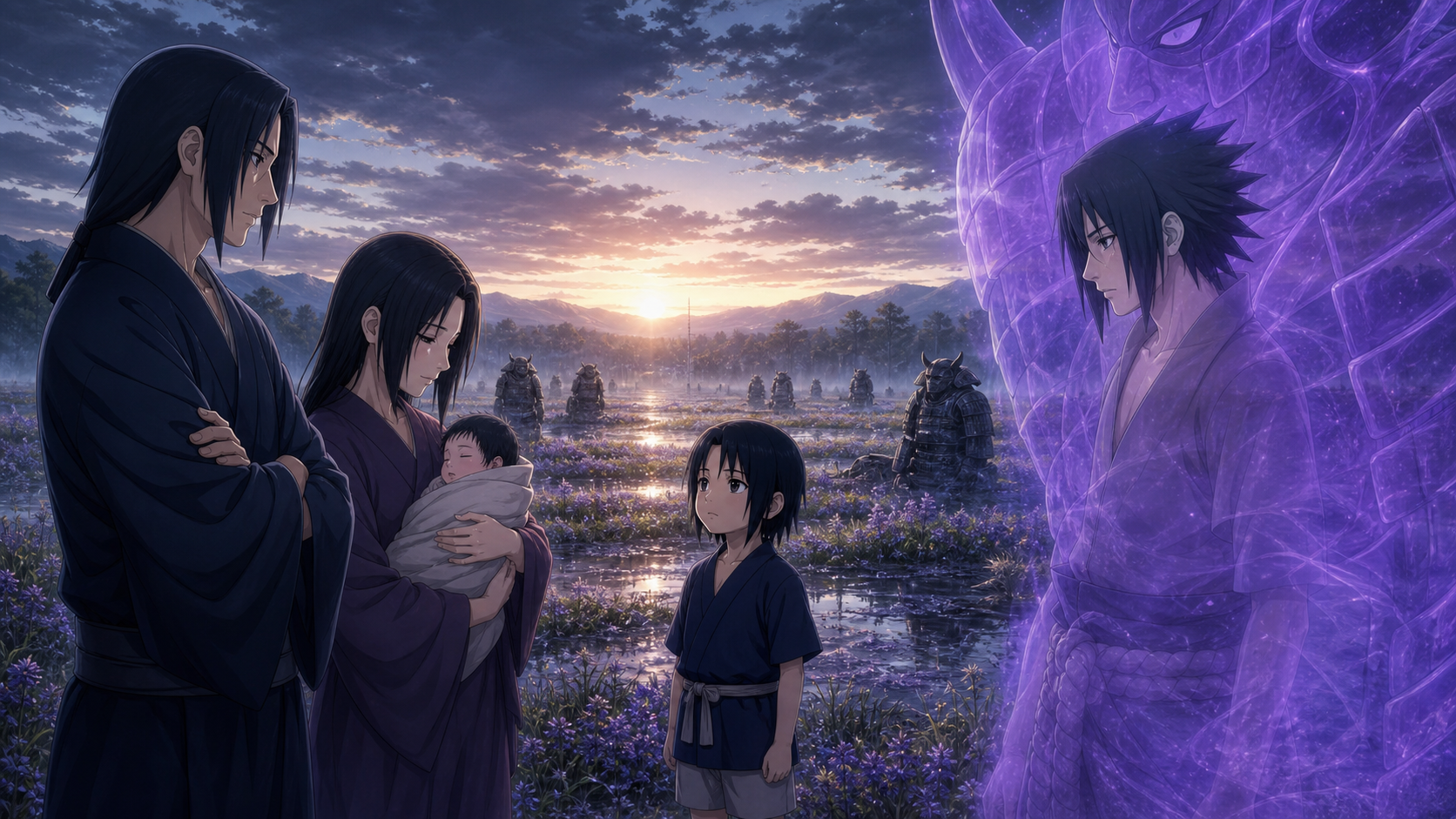
Itachi’s Story: Light and Darkness – Birth and Death
The village sees a useful prodigy where the audience should also see a four-year-old carrying war, death and questions no adult helped him process.
Bottom line
“Birth and Death” refuses the easy lie that Itachi Uchiha entered the world as a calm little genius who naturally understood sacrifice. He was a four-year-old child standing among corpses, carrying questions no adult helped him process. The episode places his compassion beside his first kill, his attempt to die beside the birth of Sasuke, and his wish for peace beside a shinobi system that keeps teaching children to absorb adult failures. That contrast explains Itachi without excusing what he later does. Back in the war, Sasuke protects Team 7 from the Infinite Tsukuyomi while shutting Sakura and Kakashi out of every decision. The resemblance hurts. Both brothers learned to call isolation protection, and both believed carrying the whole answer alone would spare everyone else.
Functioning is not evidence that a child is fine
Itachi gives water, survives an attack, kills quickly, asks intelligent questions, and later saves himself from the cliff. Adults can read every action as proof of unusual maturity. The same evidence also shows a child adapting because nobody else removed the danger.
Competence can hide distress from people eager to use competence. Itachi’s ability should have increased the care surrounding him, not lowered the amount adults believed he needed.
Sasuke’s birth gives love somewhere concrete to live
Itachi cannot solve war, clan suspicion, mortality, or the shinobi economy as a child. A baby brother offers one person he can hold, watch, and imagine protecting. That specificity helps him survive.
It also narrows peace into personal control. When protection becomes the only language Itachi trusts, Sasuke’s safety can be used to justify secrecy, manipulation, and choices Sasuke never approved.
The episode also makes the present-day echo impossible to miss. Sasuke’s shelter is physically necessary, yet his refusal to explain anything repeats Itachi’s belief that protection grants exclusive authority. Naruto can respect the danger outside and still object to the contempt inside. A family pattern does not become healthy because the person repeating it loves everyone involved. Love needs room for protected people to remain full participants.
RaeRae’s verdict
“Birth and Death” is strongest when it refuses to call trauma wisdom. Itachi is brilliant, compassionate, observant, and frighteningly capable. He is also four years old on a battlefield, attacked after offering water, left to process his first kill through explanation instead of care, and pushed close enough to despair that a crow interrupts his fall.
Sasuke’s birth gives him a reason to stay and a person to love. It does not heal the belief that safety depends on carrying every burden alone. Present-day Sasuke repeats that pattern inside Susanoo, protecting Team 7 while denying Sakura and Kakashi information or standing. Understanding the brothers means seeing how love and control became tangled. It never requires pretending the harm that follows was inevitable or acceptable.
Episode 451 begins Itachi's final story
Episode 451 opens the anime arc commonly known as “Itachi's Story: Light and Darkness.” The Japanese title, “Umareru Inochi, Shinu Inochi,” means “Life That Is Born, Life That Dies.” The episode aired in Japan on March 3, 2016.
The story returns from Tsunade's long dream to the real battlefield before entering the memories Itachi left with Sasuke.
Infinite Tsukuyomi has already won outside Susanoo
Moonlight covers the world, and nearly every living target hangs within the God Tree's roots. Konoha, the other villages, and the Allied Shinobi Forces have fallen into private dreams designed around desire.
The scale makes Team 7's small pocket of darkness feel less like safety and more like the last locked room in the world.
Naruto wants to leave the protection
Naruto's first instinct is action. He wants to go outside Sasuke's Susanoo and help the people trapped beyond the chakra shell.
That response is predictable and still important. Naruto measures a plan by whether somebody can be reached, not by whether waiting offers cleaner odds.
Sasuke stops Naruto for a good reason
Sasuke warns that the moonlight will catch Naruto too. The warning is correct. Charging into the light would add another prisoner without freeing anyone.
Sasuke's judgment keeps Team 7 alive, which makes his next choices harder to dismiss as simple cruelty.
Minato sees the villages disappear into dreams
Minato watches the light claim Konoha and the other settlements. The Fourth Hokage cannot shield the population he once died protecting.
His presence makes the disaster personal. Leadership, speed, and sacrifice cannot reverse a technique that has already reached everyone at once.
Tobirama cannot cut people free
Tobirama attempts to release shinobi from the God Tree's roots and fails. The inventor who built so many systems and techniques meets a prison that will not yield to direct force.
The failure establishes the battle's new reality before the episode looks backward.
Black Zetsu notices Sasuke's defense
Black Zetsu recognizes that Susanoo blocks the Infinite Tsukuyomi's light. Team 7 has not escaped notice. Their temporary shelter also identifies the only remaining resistance.
Protection creates a target as surely as exposure creates a victim.
Sakura asks what is happening outside
Inside Susanoo, Sakura asks for information. She cannot see through the barrier, yet she remains a medical ninja and a member of the team facing the crisis.
Her question is reasonable. Sasuke treats the request as interference.
Sasuke tells Sakura that she cannot help
Sasuke says Sakura can do nothing about the current problem. Tactical limits exist, but his delivery erases her agency rather than explaining the danger.
Keeping someone safe does not require keeping that person ignorant.
Kakashi receives the same dismissal
Kakashi speaks, and Sasuke shuts him down too. Team 7's former captain has lost the Sharingan, but experience did not vanish with the eye.
Sasuke protects the group while refusing the group as partners.
Naruto calls out the disrespect
Naruto objects to the way Sasuke speaks to Sakura and Kakashi. He understands the need to remain under Susanoo without accepting contempt as a leadership method.
The disagreement separates sound caution from the arrogance wrapped around Sasuke's caution.
Sasuke believes only his judgment matters
He argues that they are probably the only people who avoided the genjutsu and that nobody can act until the light fades. The assessment may be accurate.
Accuracy does not make one person the sole owner of every decision.
The shelter repeats an Uchiha family habit
Sasuke's Susanoo surrounds his teammates, yet he closes himself off inside the same protection. He takes responsibility for survival and denies everyone else a meaningful role.
The episode then turns toward the brother who perfected that habit.
Itachi's memories return through Sasuke
Sasuke recalls the memories Itachi shared when the Reanimation Jutsu ended. These scenes do not come from a village report or a polished clan legend.
They arrive as a dead brother's final attempt to let Sasuke see the road behind his choices.
Four-year-old Itachi walks through a war zone
The Third Shinobi World War surrounds Itachi before he is old enough to understand the political language adults use to defend war. Bodies cover the ground, and death becomes his first large lesson about the shinobi world.
Calling him mature in this moment would miss the horror. A preschool-aged child is being forced to witness adult violence.
Fugaku brings his son to the battlefield
Fugaku wants Itachi to understand war. The lesson may come from a desire to harden the future clan heir or to show him the cost of conflict.
Whatever Fugaku intended, exposure replaces care. Knowledge arrives without protection or recovery.
A wounded Iwa shinobi asks for water
Among the dead, one enemy soldier remains alive long enough to ask Itachi for a drink. The request strips away village symbols for a moment.
The person before Itachi is thirsty, injured, and dying.
Itachi gives water before asking permission
Itachi responds with compassion. He does not consult clan loyalty or battlefield rules before helping another human being.
That instinct matters because later accounts often make his mercy sound intellectual. Here, mercy begins as immediate feeling.
The soldier recognizes a shinobi
Once the wounded man understands that Itachi belongs to the enemy, fear and training take over. He attacks the child who just gave him water.
War turns a humane exchange into a threat within seconds.
Itachi kills to survive
Itachi slashes the man's throat. The child acts quickly enough to live, and another body joins the battlefield.
Skill does not make the act emotionally safe. Competence only means a four-year-old can complete the violence adults placed before him.
Compassion receives punishment
The sequence teaches a brutal lesson: helping someone may create an opening for attack. A child could easily learn that trust is dangerous and private judgment is safer than shared vulnerability.
That lesson will echo through Itachi's entire life.
Itachi asks Fugaku why people fight
He does not celebrate the kill. He asks his father to explain why war happens and why people continue creating such suffering.
The question comes from shock, not philosophical distance.
Fugaku explains war without healing the child
Fugaku gives an account of conflict and the shinobi world. Information answers the surface question, but an explanation cannot process fear, guilt, or the memory of a throat opening under a child's hand.
Itachi receives a system to study and no visible permission to fall apart.
The village honors the dead after the fighting
Konoha holds a service for people lost in the war. Public mourning gives the village a shared ritual and a respectable story about sacrifice.
Itachi already knows that individual deaths are uglier and more confusing than ceremonial language admits.
The Uchiha talk about Kakashi's Sharingan
Clan members discuss an Uchiha eye carried by Kakashi Hatake. Their concern reflects bloodline ownership, grief, and the growing distance between the clan and village.
Even at a memorial, political suspicion competes with mourning.
Obito's eye becomes a clan grievance
Kakashi received the Sharingan from Obito as a dying gift, but many Uchiha do not share that private history. They see a prized inheritance outside the family.
The dispute shows how one person's bond can become another group's evidence of disrespect.
Itachi watches adults sort death into sides
The battlefield showed him bodies without useful distinctions. The funeral restores village, clan, ownership, and reputation to the conversation.
Adults keep rebuilding categories around the same loss that horrified him.
Orochimaru speaks with young Itachi
Itachi encounters Orochimaru and asks about life and death. Orochimaru's interest in escaping mortality gives the conversation an uneasy edge.
One child wants suffering to make sense. One adult has begun treating death as a technical problem to defeat.
Orochimaru offers no moral shelter
Orochimaru can recognize the question without giving Itachi comfort. His answer belongs to a man already fascinated by knowledge, bodies, and permanence.
The exchange leaves Itachi alone with the scale of his fear.
Itachi stands at the edge of a cliff
The child later looks down from a high ledge and jumps. The scene must not be softened into proof that he was unusually serious.
Itachi attempts to end his life before he has reached an age when most children can name such despair.
Genius did not protect him from trauma
Fans and characters often praise Itachi's intelligence as though intelligence made him emotionally older. His mind gives him more ways to examine war, not more power to survive every conclusion.
No amount of talent turns childhood trauma into informed adult choice.
A crow interrupts the fall
Itachi notices a crow while descending. That small living presence breaks his focus on death and creates a moment in which another action becomes possible.
The interruption does not solve his pain. The crow gives him one opening to choose survival.
Itachi saves himself with a kunai
He uses a kunai to slow the fall and reaches safety. The same shinobi training connected to battlefield violence becomes a tool for remaining alive.
His survival depends on skill, chance, and a sudden change of attention.
The crows become companions
Itachi begins forming a bond with crows. Later, the birds become part of his genjutsu, his visual identity, and the unsettling way he enters and leaves a scene.
This episode roots that famous symbol in a childhood decision not to die.
Mikoto tells Itachi about the baby
At home, Mikoto explains that Itachi will have a younger sibling. The news brings birth into a story crowded with bodies and questions about death.
Family gives Itachi a future tense he can picture.
Sasuke is born into Itachi's wounded world
Baby Sasuke does not erase the battlefield or the cliff. His birth gives Itachi a specific person to love inside a world he already distrusts.
That love becomes genuine, fierce, and eventually dangerous because Itachi believes protection must be carried alone.
A little brother creates a concrete purpose
Peace can sound impossibly large to a child. Keeping Sasuke safe offers a face, a room, and a body small enough to hold.
Itachi's broad fear of war narrows into devotion to one person.
The burden also becomes heavier
Love does not automatically repair trauma. A child who already believes danger waits behind compassion may respond by controlling information, hiding pain, and making decisions for the person he protects.
Sasuke's birth gives Itachi hope and another reason to fear loss.
Other children invite Itachi to play
Boys approach him and offer ordinary companionship. Their presence shows a childhood still available in fragments.
Itachi turns toward training instead.
Training feels safer than play
Shuriken practice has rules, repetition, and measurable improvement. Friendship asks for trust after Itachi learned how quickly trust can become danger.
Work gives him control that human closeness cannot promise.
The boys throw stones at him
Rejection becomes aggression when the children target Itachi with rocks. He avoids the attack and uses a single stone to redirect the others.
The display confirms extraordinary coordination while exposing his social isolation.
Talent widens the distance
The other boys cannot reach his skill, and Itachi does not know how to meet them in ordinary play. Every impressive response makes him look even less like a peer.
Praise for genius often ignores the loneliness built around the label.
Itachi watches Sasuke sleep
At night, he remains near his baby brother. The quiet scene gives his attention somewhere gentle to rest after war, death, and rejection.
Sasuke cannot demand an explanation or challenge Itachi's guarded habits yet.
The wind warns that peace will not last
An ominous change in the air reaches Itachi while he watches over Sasuke. The Uchiha conflict has not erupted, but the family already lives under forces larger than the children.
The episode closes the birth scene beneath a coming political storm.
Present-day Sasuke repeats the same protection
Inside Susanoo, Sasuke shields Naruto, Sakura, and Kakashi while deciding that only his knowledge counts. His methods resemble the brother whose memories he carries.
Both men love through protection and damage relationships through secrecy.
Sasuke has not finished learning from Itachi
Receiving memories does not guarantee understanding. Sasuke can see what Itachi endured while repeating the belief that one capable Uchiha should manage everybody else's fate.
The barrier around Team 7 becomes emotional as well as physical.
False peace frames Itachi's childhood
Infinite Tsukuyomi promises a world without conflict by removing consent and trapping every person inside desire. Itachi spent his life wanting peace after seeing war too young.
The present crisis shows why peace built through control remains another form of violence.
Birth and death define the episode's argument
The wounded soldier dies. Itachi nearly dies. Sasuke is born. Crows interrupt one ending, and a new brother gives Itachi someone to protect.
Life and death do not form a neat balance. They crowd the same child until love and fear become difficult to separate.
Episode 451 explains without absolving
Understanding Itachi's trauma does not erase the Uchiha massacre, Sasuke's torture, or the choices that follow. The episode supplies the emotional conditions that made terrible logic feel reasonable to him.
Explanation matters most when viewers refuse to turn explanation into acquittal.
A child needed care before the village needed his brilliance
Konoha, the Uchiha, and Fugaku all notice Itachi's ability. Nobody in this episode gives equal attention to the cost of what he witnessed and did.
The shinobi world sees a useful prodigy where the audience should also see a hurt four-year-old.
Birth and Death opens the arc with the right wound
The Itachi story begins before ANBU orders, clan surveillance, or the massacre. The first wound comes from adults placing a child inside war and mistaking his ability to function for proof that he was fine.
Episode 452 will follow the boy into the Academy, where achievement rewards the same isolation that already threatens him.
RaeRae’s call
Itachi needed care before Konoha needed his brilliance. A child surviving war, killing efficiently, and asking adult questions is not proof that exposure caused no damage. Sasuke gives him hope, but love cannot stay healthy when protection means controlling every fact and choice. Present-day Sasuke repeats the same isolation inside Susanoo. Explanation should sharpen accountability for the adults and institutions that shaped both brothers, not erase accountability for what the brothers later do.
Episode details and viewing routes
- Official episode reference: Naruto Official episode guide
- Licensed episode route: Crunchyroll licensed episode page
What I am carrying forward
Infinite Tsukuyomi trapped the world while Sasuke protected Team 7 inside Susanoo and excluded Sakura and Kakashi from decisions. Sasuke then received Itachi’s memories.
Four-year-old Itachi witnessed war, killed a wounded enemy in self-defense, and attempted to end his life before a crow interrupted the fall. Sasuke’s birth gave him a concrete bond, while training and isolation became safer than peers. Episode 452, “The Genius,” follows the system rewarding those adaptations.