
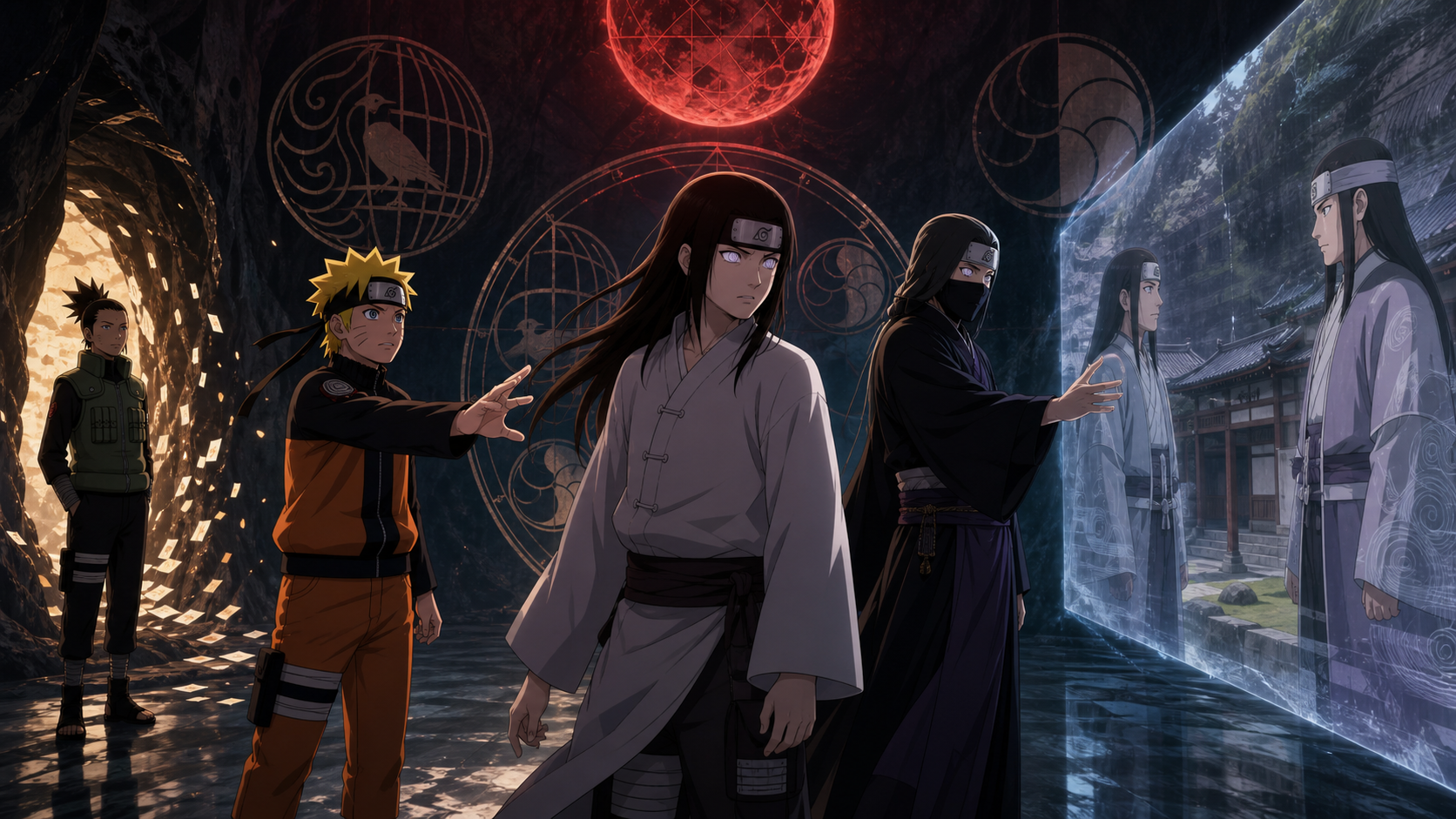
The Masked Man
The stranger uses a true institutional betrayal to recruit Neji, but the young teams answer by rejecting abandonment without surrendering their judgment.
Bottom line
“The Masked Man” puts Konoha on trial through the Hyūga Affair, and the evidence is ugly even before the stranger starts manipulating the record. Kumogakure’s representative tried to abduct Hinata, Hiashi killed him, and Cloud demanded Hiashi’s body under threat of war. Konoha delivered Hizashi instead because identical twin bodies let the village protect the clan head while satisfying the demand. Hizashi reportedly chose that death to save his brother and village. Choice made under war pressure, clan hierarchy, and a seal placed on branch-family bodies is not simple freedom. The masked man recognizes that contradiction and uses the truth to recruit Neji. Elsewhere, Shikamaru’s team returns to help Team Jiraiya rescue the trapped children. That choice answers the stranger better than any speech: young shinobi can reject abandonment without surrendering judgment to the next angry man in a mask.
Episode 436 continues the priority test
Episode 436 belongs to the anime-original “Jiraiya Shinobi Handbook” arc inside Tsunade’s Infinite Tsukuyomi dream. The episode aired in Japan on November 5, 2015.
The title “The Masked Man” does not refer to waking-canon Obito in this context. Jiraiya’s fictional story has created a different masked figure connected to the Hyūga.
Team Asuma changes course
Shikamaru initially stopped Ino and Chōji from diving blindly into the sinkhole. That decision bought time to assess the danger rather than turning three more people into captives.
The team later enters the underground route with a plan and joins Team Jiraiya’s rescue. Caution becomes preparation instead of abandonment.
Returning matters more than looking correct
Shikamaru’s first choice looked cold. Changing course could look inconsistent to somebody obsessed with authority. Good leadership should change when new evidence changes the safest useful action.
Pride would make him defend the original decision after conditions moved. Responsibility brings him back.
A praying villager provides context
Team Asuma encounters a woman who explains that strangers warned residents the settlement might become a battlefield and encouraged evacuation. She also speaks about Mashima, the village protector.
The warning suggests the operation’s planners anticipated civilian danger. Warning people is better than surprise. Creating the danger remains another matter.
Evacuation did not protect every child
Ashitaba and Komichi still became trapped underground. Plans built around evacuation often fail at the people least able to leave quickly, understand orders, or access adults.
A warning does not end responsibility for residents who remain.
Team Jiraiya faces a tunnel creature
Yahiko, Konan, and Nagato move through the underground passages after the children. A creature attacks inside the confined route.
The environment limits movement and visibility. Large techniques can collapse more ground around the people they are trying to save.
Nagato protects the group
Nagato uses his power to defend his teammates during the attack. The action shows control after his earlier surge helped create the collapse.
Power becomes protective through placement and restraint, not merely scale.
Konan reaches the children
Konan gets to Ashitaba and Komichi. Her paper techniques and composure suit a rescue inside unstable tunnels where brute force could worsen the damage.
The episode lets her act as more than the quiet member standing behind Yahiko and Nagato.
A second creature changes the rescue
The rescuers discover another underground threat. One successful defense does not make the route secure.
The creatures turn the sinkhole into a sustained rescue problem rather than a single dramatic jump.
Chōji enters through the ceiling
Chōji breaks into the underground space and protects Konan and the children. His desire to help finally gains a tactical route.
The entrance is very Chōji: direct, physical, and timed around somebody else needing a shield.
Shikamaru immobilizes a creature
Shikamaru uses shadow control to restrain one of the attackers. His contribution proves that waiting did not mean refusing the rescue.
He enters when his technique can change the group’s odds instead of adding another uncoordinated body to the hole.
Ino supports the joint effort
Ino’s team functions as a unit during the underground response. Her earlier moral urgency and Shikamaru’s analysis no longer have to compete.
The best rescue plan uses both. Somebody must insist that the children matter, and somebody must make sure the rescuers can get them out.
Team Asuma and Team Jiraiya cooperate
The two groups fought moments earlier. Civilian danger gives them a shared task before trust is complete.
Cooperation begins with behavior. Neither side needs to settle every political question before stopping a child from being killed.
The misunderstanding starts to break
Yahiko expected Konoha shinobi to value rules above lives. Shikamaru’s return complicates that judgment.
The Leaf team followed mission logic long enough to avoid a blind trap, then came back when they could help. That sequence does not fit a simple accusation of institutional obedience.
Naruto and Neji remain isolated
While the rescue develops, Naruto and Neji are separated inside the masked man’s controlled space. Their allies cannot hear the argument or challenge the presentation.
Isolation gives the speaker power over pacing, evidence, and emotional framing.
The masked man offers forbidden truth
The stranger promises to show what Konoha hides when rules matter more than comrades. That offer appeals to Naruto’s distrust of abandonment and Neji’s experience under Hyūga hierarchy.
The phrase “truth” does not guarantee a complete record. The person selecting images also selects omissions.
A gate leads into the Hyūga Affair
The masked man takes Naruto and Neji through a gate and shows scenes connected to the Hyūga Affair. The incident already shaped Neji’s childhood and his hatred of the main-family system.
Replaying that history inside a controlled vision forces him to encounter the wound without preparation or family support.
Kumo came under a peace agreement
Kumogakure sent a head ninja to Konoha during negotiations. The diplomatic visit should have reduced conflict.
Instead, the representative attempted to abduct young Hinata for the Byakugan. Peace language became cover for bloodline theft.
Hiashi killed the abductor
Hiashi caught the Kumo ninja and killed him while protecting his daughter. The immediate act was defense against kidnapping.
Cloud then demanded Hiashi’s body as compensation and threatened renewed war. The aggressor village used diplomacy to shift responsibility after its own representative failed.
Konoha accepted the hostage logic
Rather than expose the attempted abduction and reject the demand, Konoha sought a body that could prevent war. Political survival narrowed the question to who could be surrendered.
That decision protected thousands from possible conflict by assigning the cost to one family branch.
Hizashi became the substitute
Hizashi, Hiashi’s identical twin and Neji’s father, could provide a body close enough to satisfy Kumo while the Caged Bird Seal protected the Byakugan after death.
The branch-family system made him the available solution. His body had already been marked as subordinate before the diplomatic crisis began.
Official history says Hizashi chose
Hiashi later explained that Hizashi volunteered because he wanted to save his brother, clan, and village through his own decision. That choice matters. Reducing him to a passive object would erase the agency he tried to reclaim.
Agency does not erase coercive conditions. He chose among options created by kidnapping, war threat, clan hierarchy, and a seal controlling his body.
The branch seal changes the meaning of consent
Hizashi lived under the Caged Bird Seal. Main-family authority could inflict pain, enforce obedience, and protect the Byakugan through branch-family bodies.
A man raised inside that system may sincerely choose sacrifice. The system still trained him to understand his life as available protection for the main house.
Neji inherited the consequence
Neji lost his father and grew up believing destiny had already assigned every branch member a cage. Adults withheld the full explanation until bitterness had shaped him.
The village preserved peace and left a child to carry the moral injury privately.
The masked man understands Neji’s anger
Possessing a Byakugan gives the stranger credibility when discussing Hyūga suffering. He can speak from knowledge unavailable to an outsider.
That connection does not prove every conclusion. Shared injury can build trust, and manipulators know how to use shared injury.
He frames Konoha as incapable of reform
The masked man uses the Affair to argue that village rules will always sacrifice comrades. The historical evidence supports condemnation of the decision and system.
The leap from “Konoha committed this wrong” to “Konoha can only remain this wrong” is an ideological claim.
He tries to recruit Neji
The stranger wants Neji to join a campaign for forced change. He offers anger a direction and the possibility of overturning the structure that killed Hizashi.
Recruitment arrives while Neji is isolated and watching his father’s death. That timing is emotional coercion wearing the clothes of political education.
Naruto challenges the conclusion
Naruto refuses to accept that painful history gives the masked man ownership of Neji’s future. Naruto has always argued that inherited systems can be confronted without surrendering the person to another master.
His answer needs more than optimism. Neji deserves actual structural change, not another promise that friendship will make the seal less abusive.
Neji faces a real grievance
The masked man is not inventing Neji’s suffering. The branch system is violent. Hizashi died in a political exchange. Konoha benefited from that death.
Rejecting the recruiter cannot require denying the case against the village.
Reform and manipulation coexist in the scene
The stranger may want a legitimate injustice corrected while using illegitimate methods. Those facts can coexist.
Naruto and Neji must separate the grievance from the person claiming exclusive authority to solve the grievance.
The Byakugan remains a clue, not full proof
The episode presents the masked figure through a Byakugan connection and visions of the Hyūga Affair. Later installments reveal more about the identity.
At this point, the safe conclusion is direct Hyūga knowledge. Naming the person as settled before the story completes the reveal would overstate Episode 436.
Kakashi and Guy appear inside spheres
The separated Konoha teams locate their captured leaders confined within unusual spheres or containment spaces. The jōnin are visible but not freely reachable.
The display forces students to see the people Minato ordered them not to rescue impulsively.
The captor condemns Konoha’s obedience
The voice attacks the rookies for allowing rules to outrank comrades. Showing the captive leaders turns an abstract criticism into emotional pressure.
The setup is designed to make compliance look heartless and rescue look like the only morally acceptable move, regardless of trap conditions.
Naruto and Neji enter the sphere
Naruto and Neji move toward or into the controlled space surrounding the captives, after which they are separated into the masked man’s location.
The mechanism confirms that the captives function as bait and transport points inside the test.
The masked man controls the evidence room
He decides which images appear, when Naruto can speak, how long Neji watches, and what choices are offered afterward.
Even accurate history becomes propaganda when one person controls every question and withholds his own identity.
Team Asuma supplies the counterexample
While the masked man argues that Konoha shinobi always choose rules over lives, Shikamaru’s team returns and joins former opponents to save children.
Their behavior does not erase the Hyūga Affair. Their behavior proves institutional history does not predetermine every young shinobi’s choice.
Jiraiya’s students revise their judgment too
Team Jiraiya initially attacks Konoha and expects rigid obedience. Cooperation underground shows them a more complicated group.
They also have to update their beliefs when evidence changes. Ethical testing that refuses to accept a passing result becomes persecution.
The episode connects clan and village sacrifice
Hizashi’s death protected the main family and village. The trapped children risk becoming collateral to a mission. The missing jōnin become bait for their students.
Each conflict asks who receives protection and whose body becomes the affordable cost.
The Hyūga Affair deserves more than fate language
Neji once understood the tragedy through destiny. Episode 436 places political decisions behind that destiny: a kidnapping attempt, diplomatic threat, elder calculations, clan structure, and controlled seal.
People built the cage. People can dismantle the cage.
The episode risks simplifying Hizashi’s choice
Some versions of the story lean so hard on Hizashi volunteering that the institution escapes judgment. Other readings erase his choice and treat him only as a victim.
Both extremes miss the tension. Hizashi chose a sacrifice inside conditions designed to make his sacrifice useful.
The masked man has a case and a trap
His case against Konoha contains real evidence. His trap asks Neji to let justified anger replace independent judgment.
The most dangerous recruiter rarely lies about everything. He identifies a wound accurately, then claims only his method can stop the pain.
Peace negotiations made one family pay the bill
Kumogakure’s representative attempted to abduct Hinata, Hiashi stopped him, and Konoha accepted the demand for a Hyūga body to preserve the treaty. Diplomacy displaced its cost downward.
The village called that stability, but the agreement protected institutions by making one family absorb the violence.
Hizashi chose inside a structure designed to choose him
He could claim the decision as love for Hiashi and Neji, yet the branch family already existed to protect the main family through bodily control.
Consent matters, but it cannot cleanse a system that narrowed honorable action until self-sacrifice looked like the only meaningful freedom available.
The branch seal remains present in every argument
Neji’s forehead carried proof that hierarchy could punish, control, and destroy the cadet line’s Byakugan after death. The institution lived inside his body.
When the masked man condemns Konoha, Neji is not hearing theory. He is hearing somebody name a mechanism he survived daily.
Accurate history gives the recruiter credibility
The masked man does not begin with an obvious lie. He presents facts Konoha’s official story softened through duty, honor, and sacrifice language.
Manipulation becomes stronger when it tells the truth institutions avoided, then insists only the manipulator can explain what that truth requires next.
Naruto cannot answer harm with optimism alone
Saying Konoha can change is not sufficient if the branch seal, clan hierarchy, and state secrecy remain unexamined. Hope needs a mechanism and people willing to surrender privilege.
Naruto’s value is his refusal to abandon Neji, not proof that friendship automatically reforms the village.
Neji owes nobody immediate forgiveness
He can reject the masked man’s recruitment without declaring the Hyūga system acceptable. Refusing one coercive answer does not invalidate the grievance that made it persuasive.
Neji’s judgment belongs to him, including the right to demand reform without becoming anybody’s symbol of reconciliation.
The evidence room is another form of control
The masked man selects the memories, controls the gate, isolates Naruto and Neji, and decides when the captives can respond. Information arrives inside captivity.
A fair historical reckoning would allow questions, competing testimony, departure, and verification. This presentation turns recognition into a recruitment funnel.
Team Asuma offers behavior instead of a speech
Shikamaru revises course, Chōji enters the collapse, Ino supports the joint rescue, and Team Jiraiya adjusts its judgment of Konoha. Cooperation becomes observable evidence.
Their action does not erase the Hyūga Affair. It shows that inherited institutions do not completely determine what young shinobi must choose now.
Reform requires more than exceptional friendships
Naruto loving Neji cannot by itself dismantle the branch seal or redistribute authority inside the Hyūga clan. Personal loyalty matters because it keeps Neji from facing the accusation alone, but institutions survive exceptions.
Change would require records, testimony, protection for dissenters, an end to bodily control, and main-family members willing to surrender power. Without those steps, celebrating one friendship risks using Neji’s resilience to certify the system that harmed him. Hope becomes credible when somebody can name who must act, what must end, and how the people carrying the seal will control the repair.
RaeRae’s verdict
“The Masked Man” is strongest when the underground rescue contradicts the stranger’s absolute argument in real time. Shikamaru does not become a hero because he ignores orders. He becomes useful because he pauses, reassesses, and returns with a way to help. Team Jiraiya learns that Konoha’s rookies can prioritize lives without abandoning thought.
The Hyūga Affair remains an institutional disgrace even if Hizashi chose the final sacrifice. Kumo attempted bloodline theft. Konoha preserved peace by accepting the premise that a Hyūga body had to pay. The branch system supplied the body. The masked man is right to condemn that structure and wrong to treat Neji’s grief as recruitment property.
RaeRae’s call
The masked man has a case and a trap. Konoha preserved a treaty by accepting Hyūga blood. Hizashi claimed his sacrifice, but he chose inside a branch system designed to make his body available for the main family. Neji’s seal means he understands that violence physically, and he owes nobody forgiveness to prove growth. The recruiter earns credibility by naming what official history softened, then abuses that credibility by controlling the memories, room, and exit. Naruto cannot answer with optimism alone. Team Asuma offers the stronger counterargument: revise the plan, return for the children, cooperate across suspicion, and let present behavior prove that inherited systems do not own every future choice.
Episode details and viewing routes
- Official episode reference: Naruto Official episode guide
- Licensed episode route: Crunchyroll licensed episode page
What I am carrying forward
Team Asuma entered the underground area and joined Team Jiraiya against creatures threatening Ashitaba and Komichi. Konan reached the children, Chōji protected them, and Shikamaru restrained an attacker. Their cooperation began correcting Team Jiraiya’s belief that Konoha rookies would always place rules above lives.
The masked man showed Naruto and Neji images of the Hyūga Affair: a Kumo representative attempted to abduct Hinata, Hiashi killed him, Cloud demanded Hiashi’s body, and Hizashi died as the substitute. The stranger used that history and his Byakugan connection to pressure Neji toward his cause. Episode 437 continues the test while Naruto confronts the power Minato sealed inside him.