
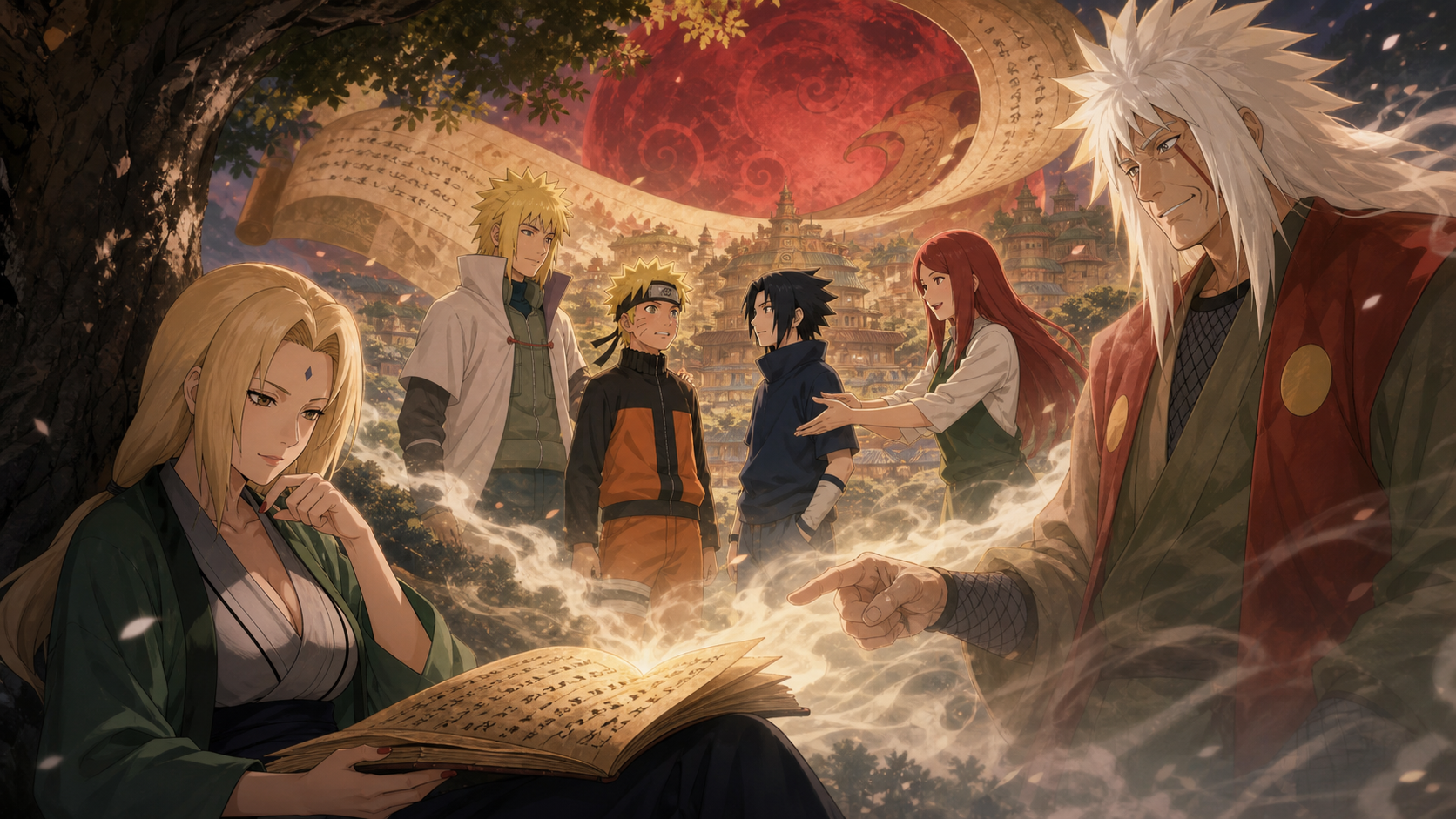
The Loser Ninja
Tsunade reads the childhood everybody wanted Naruto to have and discovers that love can change suffering without replacing his difficult work.
Bottom line
“The Loser Ninja” gives Naruto the childhood everybody wished he had and refuses to pretend love would solve every problem. Minato survives the Nine-Tails attack. Kushina is home to drag her son out of bed and demand breakfast. The Uchiha remain in Konoha, Itachi can answer his own front door, and Sasuke has not lost his family. Naruto still struggles, still feels measured against his father, and still reaches Kurama through an argument before reaching anybody through friendship. Tsunade’s dream is a story inside Jiraiya’s unfinished story, so the alternate world reveals several wishes at once. She wants Jiraiya alive enough to finish writing. She wants Minato and Kushina to raise their child. She also wants Naruto’s character to survive the removal of his worst suffering. The episode’s answer is imperfect but honest: pain shaped Naruto, yet pain never owned his courage.
Episode 432 begins a long alternate tale
Episode 432 opens “Jiraiya Shinobi Handbook: The Tale of Naruto the Hero,” an anime-original arc running inside Tsunade’s Infinite Tsukuyomi dream. The Japanese title is “Ochikobore Shinobi,” or “The Loser Ninja.” The episode aired in Japan on October 1, 2015.
This is not a recovered canon manuscript from the manga. The anime invents Jiraiya’s final work as the framing device for an alternate Naruto history.
Tsunade cannot resist Infinite Tsukuyomi
Team 7 remains protected beneath Sasuke’s Susanoo, but Tsunade and the other exposed shinobi fall into the dream. Her status as Hokage and legendary medical ninja offers no defense against a genjutsu cast across the world.
Infinite Tsukuyomi does not care how competent the captive is. The technique reads desire, then builds a private room around that desire.
Her dream begins in familiar Konoha
Tsunade wakes in the Leaf Village and finds a manuscript waiting on a table. The setting looks calm enough to lower suspicion. Her fantasy does not begin with wealth, youth, or casino winnings.
The object waiting for her matters more than any luxury. Someone has left words behind.
Jiraiya has one final manuscript
The cover identifies the work as “Jiraiya Shinobi Handbook.” Tsunade recognizes the pages as Jiraiya’s last manuscript and begins reading.
That premise gives her something waking life denied: one more conversation with Jiraiya after his death. He cannot sit across from her, but his voice can continue through a story.
Tsunade dreams through somebody else’s writing
The layered structure is strange on purpose. Madara traps Tsunade. Dream Tsunade reads fictional Jiraiya. Fictional Jiraiya writes an alternate Naruto. Every layer places another person between Tsunade and her own wish.
That distance fits her. She has spent years turning grief into work, gambling, anger, and responsibility. Asking directly for Jiraiya to live might feel too exposed. Reading his final pages lets her approach the loss sideways.
The novel begins with the Nine-Tails attack
Jiraiya’s story opens on a malevolent Nine-Tails attacking a village. Shinobi fight the beast, and Minato risks his life to seal the threat.
The broad shape resembles Naruto’s real history. The difference arrives at the point Tsunade would most want to revise: Minato survives.
Minato lives through the sealing
Minato remains Fourth Hokage after the attack. The alternate history keeps his talent, office, and family rather than turning his newborn son into an orphan carrying a village’s fear.
Survival changes Naruto’s house, public identity, and access to care. The episode does not erase the Nine-Tails seal. Naruto still carries Kurama and the political burden attached to that power.
Kushina survives too
Kushina lives alongside Minato and raises Naruto. Her presence changes the emotional temperature immediately. She can scold, feed, watch, embarrass, and protect her son through ordinary mornings.
The dream grants Naruto something grand battles could never restore: routine parental inconvenience.
Breakfast becomes evidence of love
Kushina wakes Naruto, complains about his behavior, and expects him to eat with the family. Minato receives blame for spoiling him.
Nothing about the scene is monumental. That is why the scene hurts. Canon Naruto wanted people waiting at home, and the alternate boy can take that security for granted enough to rush past breakfast.
Minato and Kushina disagree like parents
The family does not behave like a polished memorial. Kushina gets irritated. Minato is gentler. Naruto resists both. Their love includes friction.
That texture keeps the fantasy from becoming a framed photograph. Parents who survive must still perform the daily labor of raising a difficult child.
The village still dislikes Naruto
Some villagers remain uncomfortable with Naruto because he carries the Nine-Tails. Minato’s position forces a layer of respect, but formal deference does not create affection.
The episode separates status from belonging. Being the Hokage’s son protects Naruto from open treatment as a disposable outcast. The same title can make every failure more visible.
Privilege changes the shape of stigma
Alternate Naruto has parents, housing, food, protection, and public standing. Those advantages matter and should not be minimized. He also lives beneath the combined shadow of the Nine-Tails and the Fourth Hokage.
People can fear what he contains while resenting what his name provides. The boy remains socially complicated rather than universally loved.
Naruto still runs toward Sasuke
Naruto goes to the Uchiha home to collect Sasuke. The daily habit shows that their connection exists before Team 7 leaves the village.
Sasuke complains and denies that they are friends. Naruto keeps showing up anyway. Apparently even an alternate universe cannot convince those two to use normal friendship vocabulary.
Itachi answers the door
Itachi greets Naruto at the Uchiha home. His presence establishes the largest political change beyond Minato’s survival. The massacre did not happen.
Sasuke has a brother, household, clan, and ordinary source of irritation. The alternate world removes the revenge mission that defined his waking adolescence.
The Uchiha remain in Konoha
Minato remembers joining the Third Hokage at a meeting with the Uchiha to secure their continued allegiance. The village handles conflict through political contact rather than leaving suspicion to rot behind surveillance.
The episode does not give enough detail to prove every structural injustice ended. A meeting is not reform. Still, leadership addresses the fracture before genocide becomes the outcome.
Minato’s survival changes political timing
Minato offers another authority figure between Hiruzen, Danzō, and the Uchiha crisis. His presence creates the possibility of negotiation while the clan still has leverage and before Itachi becomes a weapon against his own family.
The alternate history suggests leadership choices mattered. The massacre was never an unavoidable weather event.
Sasuke has reasons to compete without revenge
Alternate Sasuke still bristles at Naruto and resists closeness. Family survival does not turn him into a cheerful supporting character.
Competition can grow from pride, expectations, talent, and comparison without requiring a murdered clan. That version gives Sasuke room to be difficult without making trauma his only personality engine.
Naruto remains the underperformer
The title calls Naruto a loser ninja even though he is the Hokage’s son. His parents cannot perform his training, judgment, or missions for him.
Minato’s brilliance may make Naruto’s struggles feel worse. Every mistake invites comparison with a father whose legend walks around alive.
The gate guards find a collapsed shinobi
Two Konoha guards discover an unconscious shinobi near the village entrance. He can barely say “Ageha.” The mystery becomes the episode’s active mission thread.
The name does not yet provide enough information to explain the attack. Konoha has a wounded man, missing context, and signs that other shinobi may be in danger.
Kakashi takes Team 7 to the cemetery
Kakashi brings Naruto, Sasuke, and Sakura to Konoha’s cemetery and memorials. The lesson makes shinobi death visible before the team begins the search mission.
Alternate history has spared several beloved people, but the ninja system still produces graves. This world is kinder in specific places, not bloodless.
Sakumo’s story enters the lesson
Kakashi discusses his father, Sakumo Hatake, whose decision to save comrades instead of completing a mission led to disgrace and suicide. The story forces Team 7 to confront the violence hidden inside professional honor.
Sakumo chose people and was punished by the village culture those people served. Kakashi carries that contradiction into every lesson about comrades and rules.
The cemetery challenges Naruto’s fantasy of glory
Naruto wants recognition and the Hokage title. Graves show the cost behind heroic language. Shinobi work does not guarantee applause, fairness, or survival.
The visit also gives “loser” another meaning. A village can label someone a failure because he saved lives instead of protecting the mission record.
Naruto misses the ground beneath him
During the developing mission, Naruto fails to notice a chasm and falls. The mistake fits his impulsive movement and weak attention to ordinary hazards.
Being Minato’s son does not grant inherited field awareness. The world has no patience for pedigree when the path disappears.
The fall brings him before Kurama
Naruto enters the internal space and encounters the Nine-Tails. Their relationship begins from hostility and necessity rather than the empathy they build in waking canon.
Kurama remains confined. Naruto remains the person whose body carries that confinement. Parental survival did not solve the ethics of the seal.
Naruto demands rent
Naruto asks for chakra as payment for living inside him. The argument is brash, transactional, and funny. He approaches an ancient tailed beast like an unwanted tenant behind on bills.
The line also asserts bodily ownership. Naruto did not choose the seal, and Kurama occupies a place inside his life. He wants something back.
Kurama helps from self-preservation
Kurama lends chakra because Naruto’s death would threaten the beast’s own survival. Cooperation begins through aligned interests, not trust.
That starting point is believable. Relationships between captor, captive, weapon, and host cannot become friendship because one boy asks nicely.
Naruto summons Gamabunta
Using Kurama’s chakra, Naruto summons Gamabunta and survives the fall. The feat demonstrates enormous potential beneath his poor fundamentals.
The episode keeps the familiar Naruto pattern: failure and ingenuity exist in the same person. Calling him a loser describes current performance, not his limit.
His teammates find him alive
Sasuke and Sakura reach Naruto and discover he survived. The rescue does not become a public triumph. His teammates see the result and must account for a boy who keeps escaping outcomes that should crush him.
That tension feeds Sasuke’s rivalry. Naruto’s growth can feel unfair from the outside because people rarely see every desperate negotiation behind the breakthrough.
Minato remembers how the seal was divided
Minato reflects on splitting the Nine-Tails’ chakra between Kushina and Naruto. The alternate version preserves more of the family while distributing the beast’s power differently.
The decision still uses their bodies as containment sites. Loving motives do not erase the burden of making a child part of a village defense system.
Jiraiya believed Naruto could master the power
Minato remembers Jiraiya’s confidence that Naruto could control the Nine-Tails. That faith helps justify the sealing choice inside the novel.
Faith can support a child, but adults should be careful when faith becomes permission to assign danger. Naruto’s potential does not make the burden fair.
Several genin teams receive the search mission
The village dispatches young teams to locate missing shinobi connected to the wounded man and the name Ageha. Team 7 becomes part of a broader operation rather than the only available group.
The ensemble structure lets this alternate world revisit the familiar rookie teams under changed family and political conditions.
The episode asks whether Naruto remains Naruto
Removing orphanhood creates a difficult character question. Naruto’s loneliness drove his hunger for recognition, but his compassion and persistence cannot belong exclusively to abuse.
Episode 432 preserves his impulsiveness, insecurity, loyalty, and refusal to stay down. The exact personality changes, as any child raised by loving parents should change. The moral center remains recognizable.
Tsunade’s wish includes Minato’s family
Tsunade lost Nawaki, Dan, Jiraiya, and countless shinobi under systems she later had to lead. Her dream story saves Minato and Kushina, giving their child the family that war took.
The choice feels consistent with a Hokage who inherited responsibility for Naruto after too many adults were already gone.
Her wish also saves the Uchiha
The alternate Uchiha outcome suggests Tsunade wants a Konoha where leadership interrupts catastrophe earlier. Itachi can remain a brother rather than becoming the instrument of a state-backed massacre.
That revision does not absolve the clan, village elders, or political tension. The dream changes the decision path before everybody reaches the cliff.
Jiraiya writes hope through revision
Fictional Jiraiya uses familiar people and changes the conditions around them. The method resembles his lifelong belief that stories can imagine an answer before society knows how to live that answer.
His novel does not create a perfect world. The characters still need missions, conflict, and choices. Hope arrives through different chances.
The frame softens Tsunade’s captivity
Watching Tsunade read can make the arc feel like a harmless novel break. The outer truth remains brutal. She has not chosen a quiet day with Jiraiya’s manuscript. Infinite Tsukuyomi has selected the manuscript because she cannot put the pages down.
The pleasure of reading becomes the mechanism keeping her unconscious.
The new opening marks a production shift
Episode 432 introduces the opening theme “LINE” and the ending theme “Troublemaker.” The theme change announces a new broadcast block even though the war has paused inside dream material.
The arc’s length asks viewers to accept an alternate serial within the final conflict. That production decision remains divisive because placement affects patience as much as content quality.
The arc begins with a strong premise
Minato alive, Kushina present, the Uchiha intact, and Jiraiya writing from beyond death create immediate emotional interest. These changes target some of the franchise’s deepest losses.
The danger lies in repeating familiar Part I events with slightly rearranged furniture. Episode 432 earns attention by showing consequences rather than relying only on cameos.
Where the episode is strongest
The family breakfast, Itachi at home, and Kakashi discussing Sakumo all turn alternate history into lived detail. Nobody needs a speech explaining why these changes matter.
Small interactions prove who survived and what ordinary life became possible.
Where the episode is weaker
The novel-within-a-dream frame adds distance and confusion. Viewers must track Tsunade’s fantasy, Jiraiya’s fictional manuscript, and alternate versions of familiar events while the actual war waits outside.
The mystery around Ageha also arrives before the alternate family world has fully settled. The episode carries a great deal of setup in one broadcast slot.
Love changes the floor beneath Naruto
Breakfast, disagreement, correction, and two parents expecting him home create ordinary security the waking child never received. Naruto can still fail, boast, and chase Sasuke, but those mistakes no longer threaten his basic belonging.
Support does not erase effort. It changes whether effort begins from safety or abandonment.
The surviving Uchiha remain a political question
Itachi answering the door and Sasuke growing up without revenge are emotionally powerful, yet survival alone does not prove Konoha repaired surveillance, segregation, distrust, or clan representation.
The alternate world opens a possibility. It should not let living faces substitute for institutional accountability.
Tsunade dreams with Jiraiya’s voice inside her
Her fantasy does not simply resurrect the people she misses. It gives Jiraiya authorship and lets his manuscript imagine a generation spared several foundational losses.
That framing makes the wish communal, but it also shows how grief borrows another person’s language when direct desire feels too exposed.
A safer childhood still contains genuinely difficult work
Naruto must learn patience, teamwork, chakra control, and respect. The difference is that adults can correct him without confirming his fear that nobody wants him when he comes home.
RaeRae’s verdict
“The Loser Ninja” opens the Jiraiya Shinobi Handbook arc with a question worth exploring: if Naruto kept his parents and Sasuke kept his clan, which parts of their bond, rivalry, and damage would remain? The first answer avoids easy perfection. Naruto gains love and status while still carrying Kurama, public discomfort, and personal insecurity. Sasuke gains family while keeping pride and resistance.
The layered framing may exhaust viewers who want the war to continue, and the arc will need to earn nineteen episodes of interruption. This opening earns one. Tsunade receives Jiraiya’s voice, Naruto receives breakfast with both parents, and the story still sends him toward a chasm where courage has to become his own.
RaeRae’s call
The alternate Naruto remains recognizable because love does not perform his work for him. Minato and Kushina give him breakfast, boundaries, protection, and a home where failure does not threaten belonging. He still struggles, competes, falls, and makes ridiculous demands of Kurama. The Uchiha remain alive, which changes Sasuke’s reasons for rivalry, but their survival should not be mistaken for proof that Konoha solved the politics around them. Tsunade receives this world through Jiraiya’s manuscript because her dream wants more than personal resurrection. She wants the writer she loved to imagine a village where children inherit support before they inherit grief.
Episode details and viewing routes
- Official episode reference: Naruto Official episode guide
- Licensed episode route: Crunchyroll licensed episode page
What I am carrying forward
Infinite Tsukuyomi trapped Tsunade in a dream where she found Jiraiya’s final manuscript, “Jiraiya Shinobi Handbook.” The story imagined Minato surviving the Nine-Tails attack, Kushina raising Naruto beside him, and Konoha negotiating with the Uchiha before a massacre occurred. Naruto remained socially disliked by some villagers and continued struggling as a shinobi despite being the Hokage’s son.
Naruto collected Sasuke from the Uchiha home, where Itachi was alive. A wounded shinobi appeared near Konoha and could only say “Ageha.” Kakashi taught Team 7 about shinobi graves and Sakumo Hatake. Naruto later fell into a chasm, bargained with Kurama for chakra, summoned Gamabunta, and survived. Konoha dispatched several genin teams to search for missing shinobi. Episode 433 continues that mission.