
Naruto’s Rival
Konohamaru stops measuring progress by whether he catches Naruto before dinner and starts using inherited technique to protect people when Naruto is absent.
Bottom line
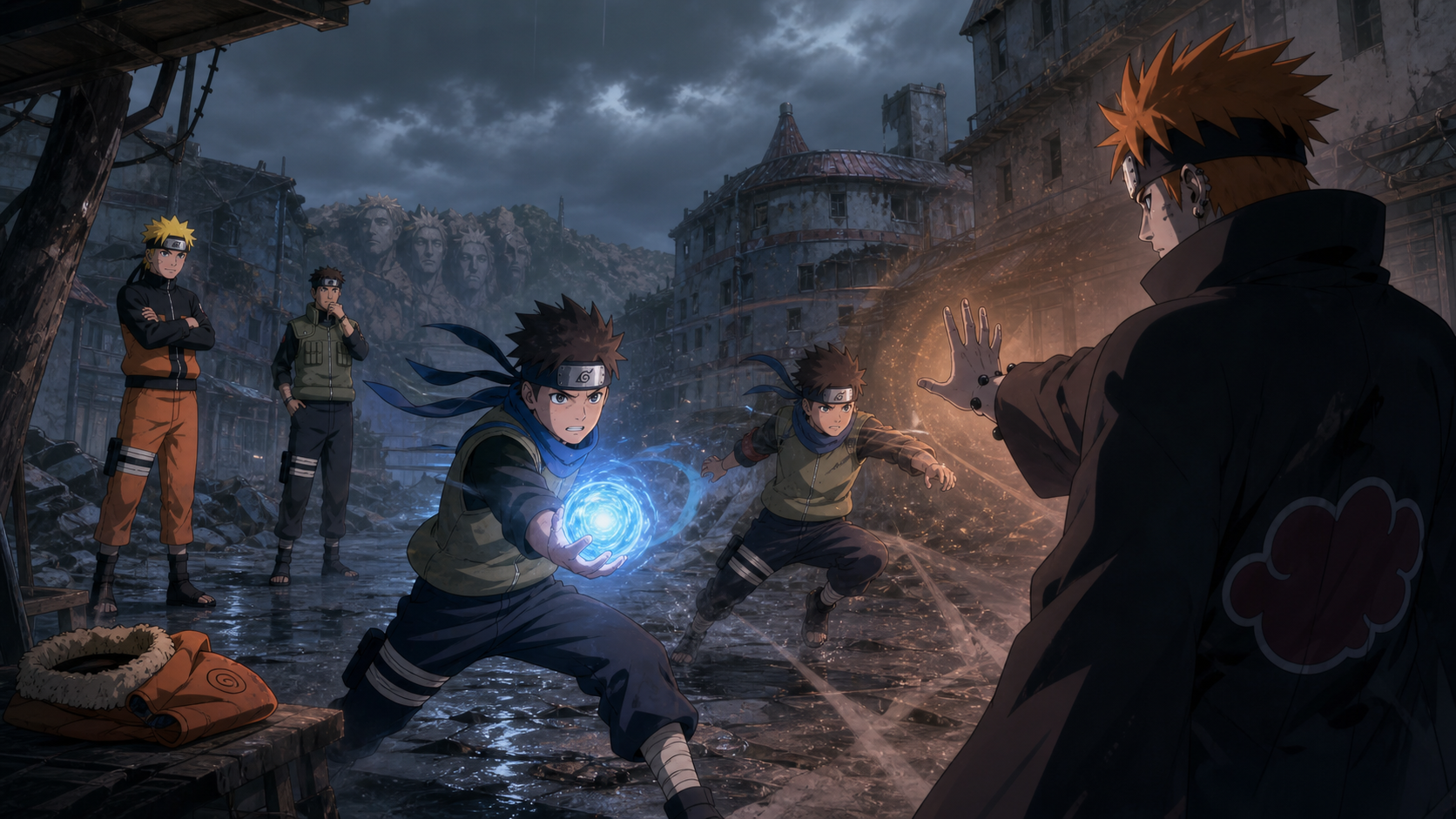
“Naruto’s Rival” completes Konohamaru’s Rasengan training by making rivalry useful. Konohamaru bursts the rubber ball through another Sexy Technique analogy, then discovers Naruto is already learning to cut a waterfall with Wind Release. Naruto shows him the shortcut that made the Rasengan workable in his own hands: one shadow clone controls rotation while the original supplies chakra. Konohamaru cannot create a stable clone, so he challenges Naruto to a race. Naruto will finish his wind-nature stage; Konohamaru will master Shadow Clone Technique. Naruto wins first. Konohamaru keeps training. Asuma’s death then changes what improvement means for the Sarutobi child. Becoming stronger is no longer a game of catching his hero before dinner. By the time Pain attacks Konoha, Konohamaru can use a clone as a feint, form a Rasengan, and drive the Naraka Path into the ground. He also protects Naruto’s old orange jacket in the evacuation shelter. Technique and clothing carry the same message: inheritance is not worshipping a relic. Konohamaru keeps what matters safe, then uses what Naruto taught him to act without waiting for Naruto to return.
Episode 423 completes the Konohamaru flashback
Episode 422 ended during the rubber-ball power stage. Episode 423 continues through Shadow Clone training, final Rasengan formation, and Pain’s assault on Konoha.
The story spans several earlier Shippuden arcs.
This episode is anime-original framing
The broadcast expands Konohamaru’s training chronology with Naruto. His use of Rasengan against the Naraka Path is established in the manga, but the episode’s connective training story is anime-original.
The final React should describe that distinction precisely.
Tsunade is angry that Orochimaru escaped again
The Tenchi Bridge operation produced information and a direct encounter without capturing him or recovering Sasuke. Tsunade reads the result as another dangerous failure.
The village’s larger crisis continues around the children’s training.
Shizune mentions Konohamaru’s Rasengan lessons
News that Naruto is teaching the Fourth Hokage’s technique reaches the Fifth Hokage. The claim sounds improbable because Konohamaru is young and Naruto is an inexperienced instructor.
Inheritance becomes village gossip before mastery.
Tsunade wagers on whether Konohamaru will succeed
Her response turns uncertainty into a bet, consistent with her history of gambling. The joke also places institutional attention on a training project happening outside formal curriculum.
The Academy student is attempting a jōnin-level technique.
Konohamaru bursts the rubber ball
He applies the power insight developed at the end of Episode 422. The resistant ball finally ruptures under concentrated chakra pressure.
Stage two is complete.
Sexy Technique remains part of his learning language
Konohamaru uses transformation and sudden reveal as an analogy for contained force. The crude joke becomes a mnemonic rather than the source of chakra power.
Mechanics and comedy should not be confused.
Konohamaru searches for Naruto
He wants the teacher to verify progress and assign the final stage. Demonstrating the burst is also a chance to reverse the usual comparison.
Students need witnessed milestones.
Naruto is training in Wind Release
Kakashi and Yamato are helping him identify his chakra nature and add wind transformation to the Rasengan. Naruto is again a student while serving as Konohamaru’s teacher.
Learning and teaching occur at the same time.
Kakashi’s shadow-clone method accelerates Naruto’s work
Naruto can create many clones and retain their accumulated experience after release. The method turns his unusual chakra reserve into parallel training time.
His greatest advantage becomes a learning system.
Yamato controls the Nine-Tails risk
Rapid chakra depletion and frustration can loosen Naruto’s control. Wood Release allows Yamato to suppress dangerous eruptions during the training.
Acceleration depends on supervision and safety.
Konohamaru demonstrates his rubber-ball solution
Naruto, Kakashi, and Yamato see the transformed analogy behind the burst. Their embarrassment does not invalidate the result.
An awkward method can still satisfy the mechanical requirement.
Naruto is proud of Konohamaru
He recognizes persistence rather than demanding that the student copy his own visualization. The approval matters because Konohamaru built the solution during Naruto’s absence.
Good evaluation leaves room for difference.
The final Rasengan stage requires containment
Rotation and power must remain inside a stable sphere rather than exploding outward. The user has to maintain shape while sustaining force.
Control completes what pressure began.
Naruto demonstrates his clone-assisted method
One body supplies chakra while a shadow clone shapes and rotates the sphere. The division lets Naruto bypass the one-handed control Minato originally achieved.
Adaptation made the technique usable for him.
Konohamaru cannot make a stable shadow clone
His standard clone experience does not automatically provide the solid body and chakra division required. The missing prerequisite blocks Naruto’s workaround.
Teaching a shortcut can reveal another skill gap.
Konohamaru challenges Naruto to a race
He will master Shadow Clone Technique before Naruto finishes the current Wind Release stage. Calling Naruto a rival turns the unequal relationship into a shared deadline.
Competition supplies structure.
Naruto accepts the challenge
He does not dismiss Konohamaru because of age or rank. The response treats the student’s ambition seriously while continuing his own work.
Respect can include wanting to win.
Konohamaru’s first clones fail
The bodies are unstable, incomplete, or too short-lived to shape a Rasengan. Repeated attempts drain his chakra without producing a usable partner.
Failure identifies the control problem.
Moegi and Udon monitor his condition
They see exhaustion building as Konohamaru trains beyond ordinary Academy work. Their concern provides the supervision Naruto cannot offer while occupied elsewhere.
Peers become the immediate safety net.
Konohamaru collapses from overtraining
The race encourages effort but does not protect his body from depletion. Rivalry becomes dangerous when progress is measured only by endurance.
Determination still needs recovery.
Moegi and Udon ask Sakura for food pills
Sakura has prepared supplements for Naruto’s accelerated training and adapts that support for Konohamaru. Medical knowledge enters a technique story through recovery logistics.
Training includes nutrition and monitoring.
Food pills do not replace rest
The supplements can provide energy, but they cannot make uncontrolled chakra division safe or eliminate accumulated strain. The final article should avoid treating them as a reset button.
Physical limits remain real.
Naruto completes his stage first
His clone army and existing Rasengan mastery let him progress faster. Konohamaru loses the formal challenge.
The result does not end his training.
Naruto’s win models continuation after a wager
He does not use victory to reduce Konohamaru’s ambition. Their rivalry establishes another benchmark rather than a final hierarchy.
Competition can survive a clear result.
News of Asuma’s death reaches the village
Kotetsu and Izumo return with the report after the Akatsuki battle. The loss changes the atmosphere surrounding Konohamaru’s playful race.
Sarutobi inheritance becomes immediate grief.
Asuma was Konohamaru’s uncle
The family connection gives the death personal weight beyond the loss of a respected jōnin. Konohamaru sees another adult in his lineage disappear during village service.
Legacy is no longer abstract.
The funeral interrupts ordinary training time
Konoha gathers while Asuma’s teammates and family face the consequences of the mission. No technique can make the ceremony optional.
Grief enters the schedule without permission.
Konohamaru watches Naruto’s response
Naruto carries anger, sadness, and determination toward the fight with Kakuzu. Konohamaru sees rivalry redirected into responsibility for other people.
Strength gains a reason beyond catching up.
Naruto leaves to support the Kakuzu battle
His Wind Release training reaches the combat stage through Rasenshuriken. Konohamaru remains behind with his own unfinished clone control.
Their paths separate after the shared race.
Konohamaru masters Shadow Clone Technique
Continued work produces a stable physical duplicate capable of coordinating chakra. The prerequisite becomes part of his permanent toolkit.
The lost race still changes his ability.
Clone assistance completes the Rasengan method
Konohamaru uses one body to supply chakra and another to control shape, following Naruto’s workaround. The resulting sphere holds rotation and power together.
He inherits an adaptation, not Minato’s original execution.
Naruto and Konohamaru form Rasengan side by side
The visual compares teacher and student without claiming equal scale or experience. Tsunade and Shizune witness the technique line continuing into another generation.
Institutional skepticism receives direct evidence.
Tsunade loses the spirit of her wager
Konohamaru’s success proves that the unlikely student could learn the technique. The point is less the gambling result than the village recognizing new capability.
Achievement changes expectation.
Naruto prepares for Mount Myōboku
Jiraiya’s death and Pain’s threat send him toward Sage Mode training. He leaves Konoha again under circumstances more dangerous than the earlier missions.
Konohamaru cannot assume a quick return.
Naruto entrusts his old jacket to Konohamaru
The orange Part I jacket has been stored since Naruto came home in new clothing. Giving the keepsake turns affection into a concrete responsibility.
The object carries history without being a weapon.
Konohamaru treats the jacket as treasure
He does not wear the clothing to imitate Naruto or display borrowed status. His task is preservation while Naruto faces danger elsewhere.
Guardianship differs from possession.
Pain attacks Konoha before Naruto returns
The village is invaded by six Paths seeking the Nine-Tails. Konohamaru faces the destruction without the rival whose technique he learned.
Inheritance is tested during the teacher’s absence.
Konohamaru encounters the Naraka Path
The Path can summon the King of Hell, interrogate victims, and restore damaged Paths. The opponent’s role makes escape and intelligence especially important.
Konohamaru is badly outmatched in direct experience.
Ebisu tries to protect his student
The instructor places himself between Pain and Konohamaru. His mentorship extends beyond classroom discipline and the episode’s sexualized jokes.
The adult accepts frontline responsibility.
Konohamaru observes before attacking
He studies the Naraka Path’s interrogation and movement rather than rushing forward. The patience differs from his earlier need to prove every improvement immediately.
Training has changed judgment as well as technique.
A shadow clone becomes the captured target
Konohamaru uses the solid duplicate as a feint. The opponent commits to the apparent body while the original remains positioned to counter.
The prerequisite skill becomes battlefield deception.
Konohamaru attacks with Rasengan
He emerges from the opening and drives the sphere into the Naraka Path. The technique Naruto struggled to explain becomes a decisive answer under lethal pressure.
Inheritance turns into independent action.
The Naraka Path is defeated in the encounter
Konohamaru knocks the body down and survives, but the Path later appears again during the larger assault. The article should not claim permanent destruction.
Scene victory and final elimination are different outcomes.
Konohamaru states his own name and rank
He identifies himself as a genin named after the village and demands to be remembered. The declaration echoes Naruto’s insistence on being seen without copying Naruto’s exact identity.
Recognition becomes self-authored.
Konoha is destroyed by Almighty Push
Pain’s large-scale attack reduces much of the village to rubble. Buildings, homes, archives, and ordinary belongings disappear in the blast.
Protecting one jacket becomes unexpectedly difficult.
Konohamaru moved the jacket to protected storage
He placed Naruto’s keepsake with village valuables inside the evacuation shelter. Preparation saves the object before destruction arrives.
Care works through logistics.
Naruto returns to learn the jacket survived
After the Pain crisis, Konohamaru can show that he kept the entrusted treasure safe. The reveal answers Naruto’s trust with completed responsibility.
Preservation becomes a quiet victory beside combat.
The storage box connects to The Last
The anime uses the same container associated with Kushina’s knitted scarf, and the scarf is visible with the jacket. The visual creates a later-film connection within anime continuity.
The final React should label that connection as an adaptation detail.
The title names an unequal but real rivalry
Konohamaru cannot match Naruto’s power during this period. Rivalry describes the standard he pursues and the freedom to challenge his teacher.
Equality of respect does not require equality of strength.
Naruto’s method survives because Konohamaru adapts the method
The shadow-clone workaround transfers successfully, while Konohamaru’s analogies and training pace remain his own. Copying the structure leaves room for personal cognition.
Inheritance works through variation.
Asuma’s death prevents the story from staying trivial
The episode’s games and gags occur inside a village losing active protectors. Konohamaru’s need to grow is not validated by tragedy, but tragedy changes the responsibilities attached to growth.
Comedy and grief occupy the same apprenticeship.
The final React should credit Moegi and Udon
They monitor exhaustion, seek Sakura’s help, and remain present through the training. Konohamaru performs the finished technique, but the route is not solitary.
Support belongs in the record.
The final React should preserve Naruto’s own learner status
He teaches Rasengan while Kakashi and Yamato teach him Wind Release. Naruto is not presented as a finished master handing knowledge downward.
Several generations learn simultaneously.
The final React should not call Konohamaru a Pain killer
His Rasengan incapacitates or defeats the Naraka Path in that exchange, and the accomplishment is substantial. The body’s later reappearance prevents a permanent-kill claim.
Accurate praise needs no inflation.
Japanese performance requires direct listening
Claims about Konohamaru’s competitiveness, Naruto’s pride, Tsunade’s skepticism, Sakura’s concern, or Ebisu’s courage require lawful scene-level Japanese listening.
No invented vocal analysis belongs in publication.
Moegi and Udon keep the training from becoming a solo legend
They notice Konohamaru’s exhaustion, look for help, and remain beside him while Naruto is occupied with his own training. The finished Rasengan may sit in Konohamaru’s hand, but the route there includes friends doing unglamorous care work.
If we only remember the strike against Pain, we erase the people who helped him stay alive long enough to learn it.
Sakura’s food pills reveal the infrastructure behind progress
Training stories love the spectacular breakthrough and rush past recovery, nutrition, monitoring, and medical knowledge. Sakura’s small intervention makes those hidden requirements visible.
The pills are support, not permission to ignore bodily limits. Care strengthens effort when it helps a student recover, not when it turns exhaustion into another performance.
Asuma’s death changes the meaning of catching up
Before the funeral, Konohamaru’s race with Naruto is playful. Afterward, Sarutobi inheritance is attached to a absence. Strength cannot restore his uncle, but it can shape what Konohamaru does when another person needs protection.
The episode is strongest when it lets grief redirect ambition without pretending tragedy was necessary for growth.
Ebisu proves mentorship when the village becomes dangerous
Episode 422 used him for jokes, yet Pain’s assault shows the responsibility underneath them. Ebisu places himself between the Naraka Path and his student even though the opponent can kill him.
Konohamaru’s counterattack does not make the adult disposable. It answers protection with protection and turns their teacher-student bond into mutual responsibility.
The jacket matters because caretaking is also action
Konohamaru does not wear Naruto’s old jacket to borrow his identity. He stores it with the village valuables and preserves it through destruction. That choice is quieter than a Rasengan, but it requires foresight before the emergency arrives.
Fandom often treats keepsakes as decoration. Here, the object becomes a test of whether trust can survive absence, rubble, and fear.
The Naraka Path fight rewards observation before force
Konohamaru is outmatched, so charging straight ahead would only prove that courage can be wasteful. He watches, uses a shadow clone as the captured target, and attacks through the opening his own deception creates.
The victory belongs as much to judgment as power. Naruto passed down a method, while Konohamaru decided when and how to use it.
RaeRae’s verdict
“Naruto’s Rival” earns its title by allowing Konohamaru to lose. Naruto wins the training race. He completes his Wind Release stage first, leaves for combat, and continues toward abilities Konohamaru cannot approach. The loss does not invalidate rivalry because the real function of the challenge was movement. Konohamaru learns Shadow Clone Technique, finishes the Rasengan through Naruto’s two-body workaround, and keeps working after the shared deadline disappears.
The Pain sequence then proves that inheritance has become judgment rather than imitation. Konohamaru does not wait for Naruto to save Ebisu. He studies the Naraka Path, offers a clone as the apparent victim, and uses the resulting opening. Saving the old jacket matters for the same reason. Naruto trusted him with something from the life he had before Shippuden, and Konohamaru moved that treasure into protected storage before the village was flattened. One act preserves a person. One preserves an object. Both show a younger shinobi taking responsibility while the hero is gone. That is enough to make him Naruto’s rival without pretending he is Naruto’s equal.
RaeRae’s call
Konohamaru loses the race and still wins the argument. He does not need to surpass Naruto in one afternoon for the rivalry to matter. Moegi and Udon sustain the training. Sakura contributes recovery knowledge. Ebisu protects his student when Pain arrives. Asuma’s death gives inheritance a painful urgency, while Naruto’s jacket gives Konohamaru a responsibility that cannot be solved with force. When he faces the Naraka Path, he observes, deceives, and strikes without waiting for his hero to come home. That is not a miniature Naruto. It is Konohamaru using inherited knowledge with his judgment, then keeping both a person and a piece of history safe.
Episode details and viewing routes
- Official episode reference: Naruto Official episode guide
- Licensed episode route: Crunchyroll licensed episode page
What I am carrying forward
Konohamaru completed the rubber-ball stage and challenged Naruto to a race: he would master Shadow Clone Technique before Naruto finished his Wind Release stage. Naruto won, but Konohamaru continued. After Asuma’s death and Naruto’s fight with Kakuzu, Konohamaru created a stable shadow clone and used Naruto’s two-body method to form the Rasengan.
Before leaving for Mount Myōboku, Naruto entrusted his old orange jacket to Konohamaru. During Pain’s assault, Konohamaru used a shadow clone feint and Rasengan to defeat the Naraka Path in their encounter and protect Ebisu. He had already moved the jacket into the evacuation shelter’s valuables storage, so the keepsake survived Konoha’s destruction. Episode 424 returns to manga-canon war action with Naruto and Sasuke’s Six Paths powers.