
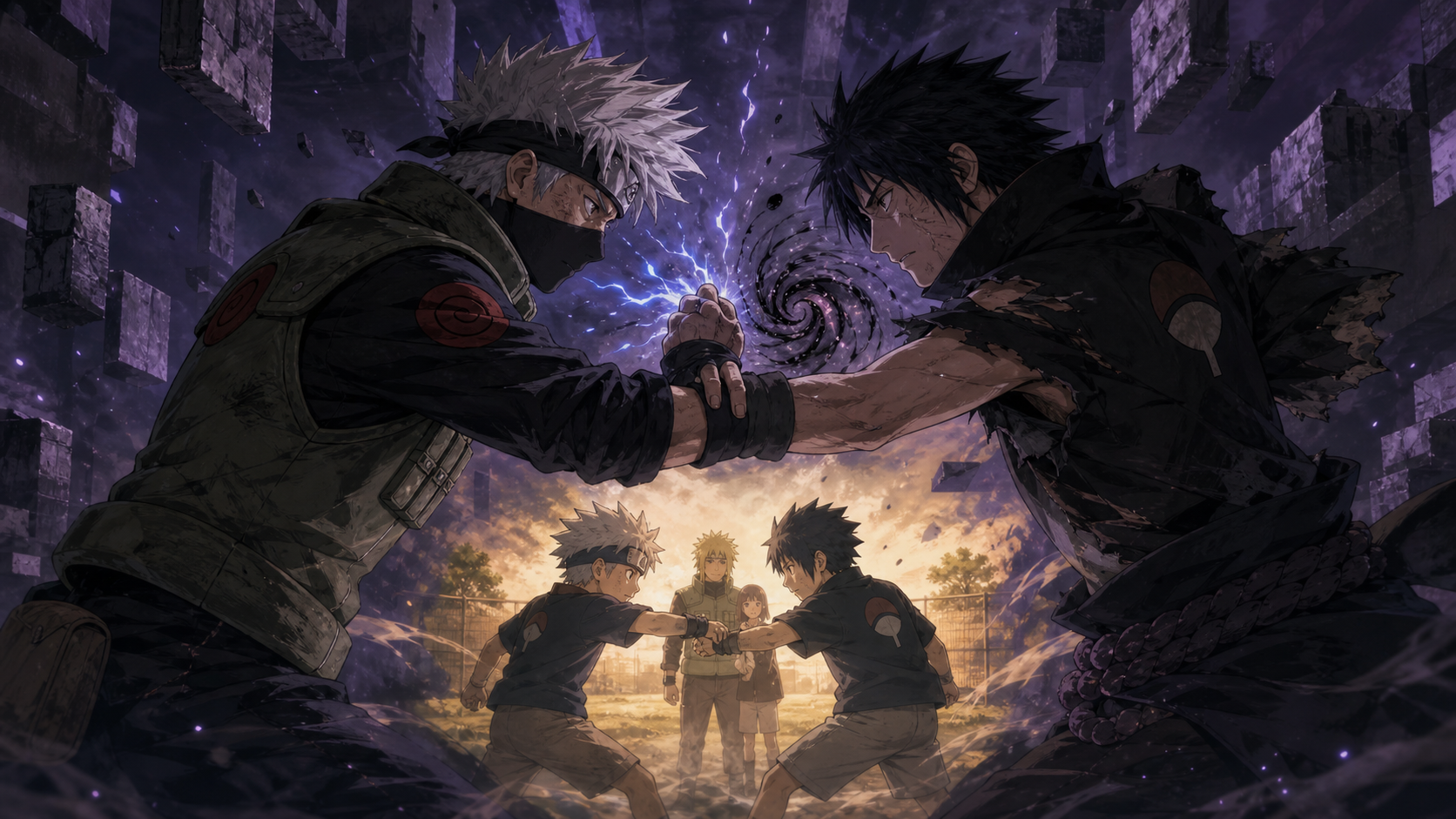
Kakashi vs. Obito
Their bodies remember teamwork after trust is gone, turning childhood timing into lethal prediction while each man chooses which world deserves protection.
Bottom line
“Kakashi vs. Obito” turns one of the series’ most emotionally loaded friendships into a fight with almost no decorative excess. Adult strikes overlap with childhood sparring, showing that muscle memory survived after trust collapsed. Kakashi still hopes the boy who valued comrades can return. Obito insists that the old self and old world no longer matter. When words fail, Kakashi chooses to protect the living world and drives a lightning-charged hand through Obito’s chest. The wound is also part of Obito’s plan: he needs Kakashi to destroy the seal Madara placed inside his heart. Obito returns to the battlefield free of that control and moves to become the Ten-Tails’ jinchūriki himself. Kakashi wins the duel’s immediate exchange, but Obito uses their shared history, Kakashi’s hesitation, and his own body as tools in a larger fight for control.
The Kamui dimension removes the audience
No alliance cheers, no commander gives orders, and no monument tells either man who he used to be. Kakashi and Obito face each other in a stripped space connected to their shared eyes.
The privacy makes every movement personal without making the public stakes smaller.
Kakashi gives hope one last chance
He believes the child who cared about teammates still exists somewhere inside the adult enemy. That belief grows from memory rather than ignorance of Obito’s crimes.
Hope remains human until hope prevents necessary protection.
Obito rejects his former identity
He describes the hopeful boy as part of a dead world. The rejection protects his current ideology from evidence that he once chose differently.
Erasing the earlier self makes accountability easier to avoid.
Conversation reaches a limit
Kakashi has listened to Obito’s grief, answered the dream-world argument, and acknowledged the failures of reality. Obito continues pursuing the Infinite Tsukuyomi.
Respecting personhood does not require endless discussion while thousands face annihilation.
Kakashi chooses the living world
He decides to stop Obito because Naruto, Sakura, the alliance, and everyone outside the dimension still have futures at stake. The choice does not mean the shinobi system deserves defense without reform.
People deserve protection while institutions remain open to judgment.
Their adult stances echo childhood training
The episode overlays present combat with younger bodies practicing under Minato. Familiar posture and timing survived beneath years of separation.
The same knowledge once used for teamwork now helps each predict the other’s lethal move.
That continuity makes the duel more painful than a contest between strangers. Every successful counter confirms how closely they once watched one another, how much attention survived beneath resentment, and how thoroughly the skills built for mutual protection have been redirected. The choreography becomes evidence of a relationship neither man can honestly call irrelevant, even while Obito argues that the past has no claim on him.
Muscle memory carries relationship history
Kakashi knows Obito’s habits because they argued, trained, competed, and protected one another. Obito knows where Kakashi hesitates and how he responds under pressure.
Intimacy can become tactical vulnerability when trust turns into conflict.
The flashbacks do not soften the danger
Childhood images make the fight sadder without converting adult Obito into an innocent boy. The man before Kakashi helped engineer war and mass death.
Past tenderness provides context, not immunity.
Taijutsu gives neither man distance
Close combat forces bodies into direct contact. They cannot hide the duel behind giant avatars or armies.
Every block and counter acknowledges the person on the other side.
The choreography keeps cause and effect clear
Movements answer earlier habits, feints create openings, and wounds follow specific choices. The fight feels like communication through learned physical language.
Clarity gives the emotion room to land.
Kakashi’s hesitation remains visible
He has spent years mourning Obito and living by a lesson attached to his name. Killing the person he believed dead forces grief to restart in a different form.
Difficulty does not mean he lacks resolve.
Obito expects the hesitation
He knows Kakashi’s guilt and attachment well enough to build them into the confrontation. The emotional bond becomes part of his tactical calculation.
Manipulation works best when the underlying feeling is real.
Both men carry Rin into the fight
Kakashi remembers the promise he failed to keep. Obito remembers the death that Madara used to define reality for him.
Rin remains absent while two men use their interpretations of her life to justify present choices.
Rin cannot decide the duel for them
No imagined answer from her can substitute for the living men accepting responsibility. A dream version would only repeat the problem by giving Obito the response he programmed.
They must choose without borrowing her voice.
Kakashi lands the decisive strike
His lightning-charged hand penetrates Obito’s chest in an echo of Rin’s death. The visual forces both the character and viewer back into the original trauma.
Repetition makes the cost unmistakable without making the situations identical.
The wound does not become revenge for Rin
Kakashi acts to stop the Infinite Tsukuyomi and protect the world outside. Framing the strike as payback would turn Rin into another authorization for violence.
Protection is the defensible purpose.
Obito wounds Kakashi too
The exchange leaves both former teammates physically damaged. Neither exits as an untouched moral victor.
Their bodies carry the fact that shared history could not prevent mutual harm.
Winning the exchange does not end the threat
Kakashi appears to defeat Obito in the private dimension, but the war continues and Madara remains active. Obito has planned beyond the duel.
Tactical success needs verification before anyone calls the danger over.
Obito returns to Madara
He leaves the Kamui dimension wounded and reaches the main battlefield. Madara expects to control the next stage of the plan.
The older manipulator still treats Obito as an instrument built for his own revival.
Madara placed a seal in Obito’s heart
The control mechanism prevented Obito from acting fully against Madara’s design. A body already altered after injury carried another hidden form of ownership.
Mentorship becomes literal bodily control.
Obito used Kakashi to remove the seal
He arranged the confrontation so Kakashi’s strike would destroy the mechanism. The choice reveals planning, desperation, and willingness to weaponize Kakashi’s trauma again.
Freedom gained through manipulation carries another victim.
Kakashi did not consent to the medical function
He believed he was making a lethal protective choice. Obito withheld the fact that the wound served as a procedure.
The hidden purpose does not erase Kakashi’s agency, but the deception changes the encounter.
Madara’s control explains without absolving
The seal constrained Obito and confirms that Madara never treated him as an equal partner. Obito still made years of choices within and around that constraint.
Coercion changes responsibility without making every later act involuntary.
Removing one controller does not create ethical freedom
Obito can now act against Madara’s immediate command. He uses that freedom to pursue the same mass dream project through his own control.
Autonomy describes who chooses, not whether the choice is right.
Madara expects obedience from his creation
He groomed Obito, gave him knowledge and power, shaped his access to Rin’s death, and planned to use him as a resurrection tool. The relationship was never reciprocal.
Madara wanted a successor only until the successor’s body completed Madara’s return.
Obito refuses to remain a proxy
He rejects the role of temporary Madara and asserts his own claim over the plan. That refusal has emotional force because he sees the exploitation clearly.
The result is a struggle between two would-be controllers, not liberation for the world.
The Ten-Tails becomes the next point of control
Rather than let Madara dictate the transformation, Obito moves to seal the creature within himself. The decision concentrates catastrophic power in a body already wounded and manipulated.
Personal control replaces partnership with the beast.
Jinchūriki history repeats at a larger scale
Villages sealed tailed beasts into people to create military assets. Obito now applies the same structure to the Ten-Tails for a global coercion project.
The scale changes while the disregard for the being and host body remains.
Obito treats his body as expendable
Years of replacement tissue, implanted eyes, seals, wounds, and planned sacrifice have taught him to view the body as equipment. Becoming the host continues that pattern.
Self-directed use does not make the underlying damage healthy.
The forbidden move changes the war
The alliance prepared to fight a contained creature and two external controllers. A Ten-Tails jinchūriki creates a different concentration of intelligence, mobility, and power.
Every existing plan now requires immediate revision.
Kakashi remains injured and isolated
He does not instantly return to Team 7 after the duel. The wound and knowledge of Obito’s plan leave him in the private dimension.
His absence continues to mark the reunion outside as incomplete.
The teacher cannot see the students together
Naruto, Sakura, and Sasuke have reassembled while Kakashi fights the history that shaped his teaching. He misses the image he spent years wanting.
War rarely delivers emotional milestones to everyone at the same time.
Kakashi’s decision still matters
Obito planned around the wound, but Kakashi’s refusal of the Infinite Tsukuyomi remains genuine. He chose the uncertain world and the people living within that shared reality.
The choice also protects every person who never agreed to become a character inside Obito’s private answer to grief. Kakashi defends their right to keep making imperfect decisions.
Manipulation of the outcome cannot retroactively erase the moral choice.
Obito proves the danger of partial information again
Kakashi acts without knowing about the heart seal, just as Obito once judged Rin’s death without knowing the Hidden Mist plan. Both moments show how controlled information shapes irreversible action.
The parallel should increase the demand for truth, not imply equal guilt.
Their situations remain different
Kakashi faces an active mass-casualty architect after attempting conversation. Obito witnessed a teammate’s coerced death while isolated by Madara.
Visual echoes deepen the story without collapsing distinct responsibility.
The fight rejects clean redemption timing
Kakashi cannot reach Obito through one perfect memory or phrase. Obito’s remaining capacity for change will require more than nostalgia.
People are not restored on the schedule most convenient to those who love them.
The episode protects physical storytelling
Sparse dialogue, matched movements, and childhood overlays communicate years of relationship without a narrator translating every beat. Viewers can follow the emotional logic through bodies.
Trusting the audience makes the fight stronger.
The duel is built from shared muscle memory
Kakashi and Obito predict each other because their bodies learned timing together before ideology separated them. Every counter preserves evidence of partnership beneath present hostility.
Familiarity does not make the fight romantic or inevitable. It makes the loss concrete. Skills developed for mutual protection now increase each man’s capacity to wound the other.
Childhood and adulthood occupy the same movement
The choreography moves between sparring children and lethal adults without claiming nothing changed. Similar gestures carry different stakes, knowledge, and responsibility after years of war.
The visual overlap shows continuity while keeping decisions visible. Obito was manipulated and injured; he also spent years directing harm. Kakashi was traumatized and isolated; he kept returning to people.
Rin is present without becoming the prize
Both men carry her loss, yet the duel cannot be reduced to two boys fighting over a girl. Rin had her own loyalty, fear, decision, friendships, and place inside the Mist operation.
She should be remembered as a teammate whose coerced death shaped them, not an object that explains male rivalry by existing between them.
Kakashi fights to stop present harm
He still wants Obito to return, but the Kamui space has reached a point where words do not protect the alliance outside. Kakashi’s force answers an active threat.
A boundary can be compassionate when delay would expose more people. He does not need hatred to decide that Obito’s plan cannot continue.
Obito fights with another objective hidden
He allows Kakashi’s attack to serve the removal of Madara’s control seal. That concealed purpose changes the encounter because Kakashi is made an unwitting participant in Obito’s attempt to reclaim bodily autonomy.
Wanting the seal destroyed is legitimate. Manipulating Kakashi reproduces the information asymmetry Obito condemns in others.
Madara’s seal is a bodily violation
The control placed inside Obito’s heart turns rescue into ownership. Madara preserved a child’s life while designing the conditions under which that life would remain useful to him.
Medical intervention without consent became a political leash. Naming Obito’s later agency must not erase the older man’s deliberate invasion and control of his body.
Removing coercion does not erase prior choices
Once the seal is gone, Obito gains more freedom from Madara’s direct mechanism. The deaths, manipulations, tailed-beast extractions, and war already carried out remain part of his record.
Liberation creates a clearer next decision. It does not retroactively make every action before liberation involuntary.
Kakashi deserves to know how his strike was used
He believes he is stopping Obito and may interpret the wound through their private history. Concealing the seal’s purpose denies Kakashi information about what his body accomplished.
Truth matters because manipulated participation can deepen trauma. Obito owes disclosure if any repair or meaningful cooperation becomes possible later.
The private arena hides public consequences
Inside Kamui, the fight looks like a closed conflict between former teammates. Outside, every second affects Naruto, the alliance, the Ten-Tails, and civilians whose future Obito intends to overwrite.
Neither man owns the stakes simply because the relationship is intimate. Their choices remain answerable to everyone placed in danger.
Kakashi refuses to let guilt decide the outcome
Obito’s accusation targets the part of Kakashi that already believes he failed Rin and his team. Surrender could feel like accepting deserved punishment.
Kakashi fights anyway because guilt is not a reliable court. His obligation to living people cannot be canceled by the harshest interpretation of his childhood.
Obito’s pain does not grant exclusive moral authority
He knows what losing Rin did to him. Kakashi knows what being forced through her body did to him. Minato, Rin, and people harmed later hold other parts of the record.
Suffering creates testimony, not ownership of truth. Accountability becomes possible when multiple experiences remain present.
The animation honors technique without excusing violence
Fluid choreography can make the duel beautiful to watch while the story remains about two survivors hurting one another. Craft recognition should not turn harm into proof that the conflict was necessary.
The scene’s power comes from clarity: movement reveals history, hesitation, prediction, and purpose without requiring spectacle to replace meaning.
A victory here cannot restore the old team
Kakashi can land the decisive strike, and Obito can remove the seal. Neither result returns them to the day before Kannabi Bridge or restores Rin.
The next ethical possibility is not reversal. It is changed action in the present: stop the war, tell the truth, protect people, and accept judgment.
Connection survives without guaranteeing reconciliation
Their shared timing proves the relationship still exists as memory and skill. That survival does not obligate Kakashi to trust Obito or require victims to welcome him back.
A bond can create a route toward accountability while boundaries remain. Reconciliation, if possible, would need consent from more people than the two men fighting.
The duel ends with agency newly exposed
Obito has used Kakashi to break Madara’s mechanism and now faces another decision about the Ten-Tails. Kakashi has acted to defend reality and must learn what the wound changed.
The fight matters less as a scoreboard than as a transition. Hidden control is removed, concealed purpose remains, and responsibility moves into the next choice.
The childhood flashes also prevent the adult duel from becoming a story about natural enemies. These men practiced, competed, argued, and protected the same team before institutions and manipulation reorganized their relationship. That history does not guarantee recovery, but it disproves inevitability. Obito was not born wanting illusion, and Kakashi was not born emotionally unreachable. People and systems helped build both outcomes. Naming those influences expands accountability because it shows where intervention once mattered and where different choices can still matter now for everyone still living outside.
RaeRae’s verdict
“Kakashi vs. Obito” is brutal because both men know exactly how the other moves. Their childhood training survives as a map for adult injury. Kakashi gives hope a final chance, then chooses to defend the living world. That choice is necessary and devastating. Obito uses the strike to remove Madara’s heart seal, proving that even the duel’s apparent ending sat inside another plan.
The removed seal exposes Madara’s abuse without clearing Obito’s record. Obito gains freedom from one controller and immediately moves to concentrate the Ten-Tails inside himself. He refuses to be Madara’s tool while still trying to turn the whole world into his own dream. Kakashi wins the intimate fight. The war inherits a more dangerous Obito.
RaeRae’s call
Kakashi and Obito move like teammates because history still lives in their bodies, but familiarity does not excuse the harm. Madara’s seal is a violation, Obito’s need to remove it is legitimate, and using Kakashi without disclosure repeats manipulation. The duel stops an immediate threat and opens a freer decision. Repair still requires truth, boundaries, protection, and accountability to everyone outside Kamui.
Episode details and viewing routes
- Official episode reference: Naruto Official episode guide
- Licensed episode route: Crunchyroll licensed episode page
What I am carrying forward
Kakashi and Obito fought in the Kamui dimension, and Kakashi drove a lightning-charged strike through Obito’s chest. Obito had planned around that wound because Madara placed a control seal inside his heart, and Kakashi’s attack destroyed the seal.
Obito returned to the battlefield free of Madara’s direct control and moved to seal the Ten-Tails within himself. Kakashi remains wounded in the other dimension. Episode 376 temporarily shifts into the first half of a special anime-original story set during Naruto’s earlier wind-training period.