
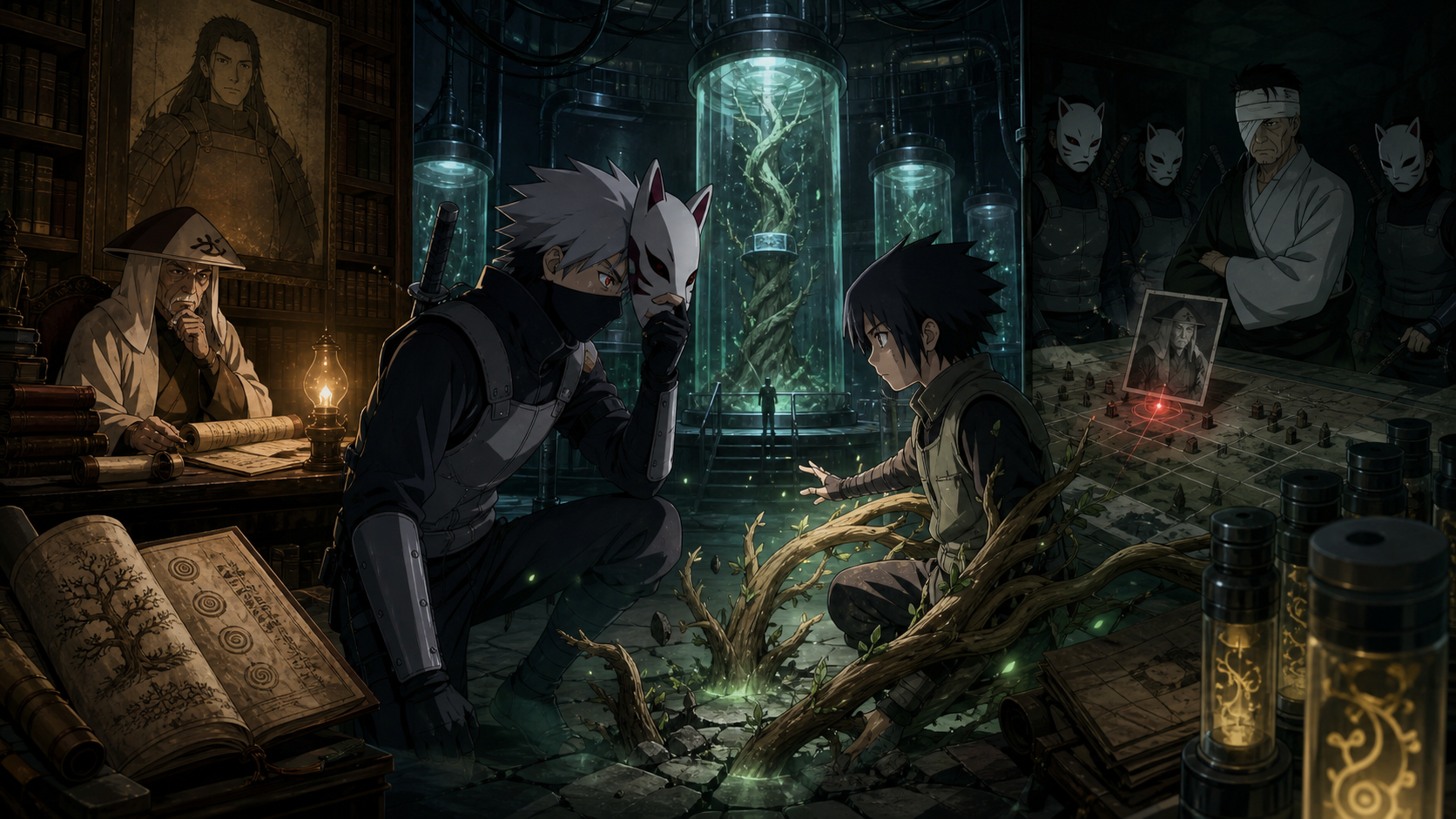
Hashirama’s Cells
A child’s Wood Style leads Kakashi from Root obedience into records of stolen bodies, missing children, and a village protecting secrets from itself.
Bottom line
“Hashirama’s Cells” brings Kakashi face to face with a boy whose body has been turned into classified evidence. During contact with Foundation, Kakashi sees the child use Wood Style, an ability associated with the First Hokage. The discovery sends him to Hiruzen’s library, where records reveal experiments involving Hashirama’s cells. The technique is not simply a rare gift emerging without context. Wood Style points toward a history of human experimentation, failed subjects, and institutional secrecy. Kakashi’s investigation matters because he does not accept the visible power as a complete explanation. The boy’s usefulness to Foundation cannot erase the question of what adults did to create that usefulness. A village that celebrates Hashirama’s legacy must also account for people who treated his cells as material and children as containers.
Kakashi encounters Foundation directly
ANBU and Foundation both operate through secrecy, masks, and claims of village protection. Their proximity can make different command cultures appear interchangeable.
Kakashi’s contact begins exposing how much Danzo’s organization conceals from ordinary oversight.
Parallel covert units are not the same institution
ANBU serves the sitting Hokage through an official command structure. Foundation answers to Danzo through deeper compartmentalization and an ideology built around suppressing the self.
Both systems deserve scrutiny, but collapsing them together would hide the specific control Danzo exercises over children in his care.
Foundation turns secrecy into culture
Classified information protects more than active operations. Secrecy becomes a way of deciding which people may know their own history and which leaders can avoid external review.
When concealment defines belonging, asking an ordinary question can be treated as disloyalty.
A boy uses Wood Style
Kakashi recognizes a technique associated with Hashirama Senju, the First Hokage. The sight contradicts what should be historically exceptional.
Recognition turns a combat observation into an ethical and institutional question.
Hashirama’s legacy changes the stakes
The First Hokage represents Konoha’s founding story, exceptional life force, and a technique believed lost with him. His cells carry both scientific possibility and political symbolism.
Anyone controlling a comparable ability gains prestige and strategic leverage, creating powerful incentives to ignore the method behind the result.
Rarity attracts possession language
Officials may speak of securing, controlling, or deploying Wood Style as though the technique exists separately from the child’s body. That language makes ownership sound administratively normal.
The ability cannot be removed from the person whose life bears every consequence of producing the ability.
The technique is evidence, not spectacle
Wood Style has practical power and enormous symbolic weight. Focusing only on rarity would reproduce the logic that values the ability more than the person producing the ability.
The first question should not be how Foundation can deploy him. The first question should be what happened to him.
The child has been assigned a function
Foundation trains members to suppress identity and serve Danzo’s objectives. A rare body becomes an asset inside that system.
Calling the boy useful describes what adults receive, not what the child needs or chose.
Foundation removes the name before the humanity
Reducing a child to a designation makes history, preference, family, and future easier to ignore. An operative identified through function can be replaced in reports even when no human life is replaceable.
Restoring personhood begins by recognizing that the institution’s label is not the whole self.
Training cannot create retroactive consent
The boy may become skilled, disciplined, and capable of making choices within Foundation. Later competence does not authorize what was done to his body before meaningful consent was possible.
Survival after coercion should never be rewritten as approval of coercion.
Kakashi notices an impossible detail
His intelligence includes the willingness to challenge a familiar category. Hashirama alone should possess the technique according to accepted history.
Curiosity becomes a form of resistance when secrecy depends on witnesses treating anomalies as none of their concern.
Hiruzen’s library holds partial memory
Kakashi searches institutional records for an explanation. Archives preserve knowledge that living officials may avoid discussing.
Records can reveal a pattern while still reflecting choices about what was documented, classified, or omitted.
Archives preserve facts and institutional bias
A file may list procedures, subjects, outcomes, and dates while describing children as material. Documentation can expose abuse and reproduce the worldview that permitted abuse.
Kakashi must read both the recorded facts and the language used to make those facts seem acceptable.
Missing records remain meaningful
Gaps may reflect destroyed evidence, compartmentalization, or decisions never committed to paper. Absence cannot prove that no wider program existed.
An archive provides a starting point for accountability, not an automatic boundary around accountability.
Hashirama’s cells became experimental material
The First Hokage’s extraordinary vitality creates medical and military temptation after his death. Tissue associated with healing and Wood Style is treated as transferable power.
Scientific possibility does not create ethical permission to use unwilling people.
Healing potential can coexist with abuse
Research involving extraordinary cells could produce legitimate medical knowledge under informed consent and careful oversight. The possibility of benefit does not excuse hidden trials on children.
Ethics distinguishes care from extraction even when both processes use similar biological material.
Military demand distorts research priorities
Wood Style can restrain tailed beasts and reshape battlefields, making replication strategically irresistible. National security language can push speed and secrecy ahead of safety.
Urgency does not make subjects less human or failed trials less dead.
Human experimentation sits behind the ability
The boy’s Wood Style is connected to trials whose failures cost lives. Success cannot retroactively justify subjects who did not survive.
An experiment remains abusive even when one result later becomes strategically valuable.
Failed subjects deserve individual remembrance
Calling children failures measures them against an experimental objective. The term says nothing about the value of their lives.
Each child had a body harmed by adult decisions, and ethical history must count those lives separately from whether Wood Style appeared.
Success language belongs to the experimenters
Researchers can point to one surviving subject as proof of technical achievement. The survivor may experience the same event as bodily violation, lost identity, or a childhood organized by other people’s goals.
Both perspectives are not equally entitled to define what happened.
Survivorship hides the scale of harm
Viewers meet the person who lived long enough to display Wood Style. Absent children can disappear behind the language of a successful subject.
Ethical accounting must include every life used to produce the visible outcome.
A survivor is not a successful product
The boy’s continued life belongs to him, not to the people who altered his body. Describing him as a result risks allowing experimenters to claim ownership over survival.
Personhood exists before and beyond Wood Style.
Survival creates needs rather than debt
The boy does not owe Konoha service because village-linked experimentation produced his condition. Continued life creates institutional duties of care, truth, choice, and repair.
Treating service as repayment would make the victim finance the response to his own harm.
Bodily difference should not determine destiny
Wood Style may remain part of his identity and future choices. The presence of rare power does not require a life inside covert operations.
A meaningful future must include the ability to decide how, whether, and for whom that power is used.
Foundation benefits from erased history
If operatives know only that a member has a useful technique, Danzo can deploy the outcome without answering for the origin.
Secrecy turns accountability into inaccessible background information.
Danzo inherits harm and extracts value
Even where Orochimaru conducted experiments, Danzo’s organization benefits from the surviving child and keeps him inside a coercive command system. Using the outcome creates present responsibility.
One actor performing a procedure does not absolve another actor who knowingly exploits the result.
Asset logic discourages recovery
Recovery could involve independent identity, relationships outside Foundation, and freedom to question orders. Each of those developments threatens Danzo’s control over a rare operative.
The institution therefore benefits when survival remains organized around usefulness rather than healing.
Hiruzen possesses institutional responsibility
The Third Hokage may not have ordered every experiment, but leadership creates duties to investigate, stop abuse, protect survivors, and preserve truthful records.
Distance from a laboratory does not eliminate responsibility once warning signs reach the office.
Knowledge creates a duty to act
Records in the Hokage’s library mean the village possesses some institutional memory of the program. Information without protection leaves survivors carrying the consequences while leaders retain only documents.
Accountability requires more than private disapproval. Harm must be interrupted, perpetrators constrained, and survivors given truthful options.
Leadership changes do not erase the obligation
Minato’s death returns Hiruzen to office, but the experimental history crosses administrations. A new or returning leader inherits unresolved duties along with authority.
Institutional repair cannot depend on whether the current Hokage personally initiated the abuse.
Kakashi reads beyond the mission brief
His assigned role does not require a moral history of Wood Style. He searches because the anomaly matters beyond immediate operations.
That choice keeps him from becoming only the efficient tool his reputation describes.
Investigation reconnects skill with conscience
Kakashi uses pattern recognition, memory, and access for more than eliminating a target. Intelligence becomes a way to notice someone else’s hidden harm.
The choice challenges the “cold-blooded” label without requiring a dramatic speech about compassion.
Questions can endanger a covert operative
Foundation depends on compartmentalization, and Danzo has political reach. Searching records may expose Kakashi to suspicion from people who treat oversight as interference.
Moral agency inside a secret system often begins with a question whose consequences are uncertain.
The boy mirrors Kakashi in uncomfortable ways
Both are highly skilled young operatives valued by secret institutions. Both have identities shaped around what their bodies can do for Konoha.
The comparison is not equivalence, but recognition may help Kakashi see the person behind Foundation conditioning.
Both boys are praised through utility
Kakashi is valued for precision and Sharingan use. The Foundation boy is valued for Wood Style and obedience. Adults can describe both arrangements as opportunities granted to exceptional children.
Praise does not cancel exploitation when the available paths have been narrowed by institutions.
Difference prevents a false equivalence
Kakashi retains a name, public history, teacher relationships, and some access to village authority. Foundation conditioning has stripped far more of those protections from the other boy.
Solidarity becomes stronger when shared pressure is recognized without erasing unequal degrees of control.
Masks conceal different kinds of coercion
Kakashi’s ANBU mask protects classified identity. Foundation’s system reaches deeper, training members to subordinate personal attachment and independent will.
Similar visual language can hide important differences in control.
Wood Style does not reveal character
A technique can show training and altered biology without proving loyalty, temperament, or moral purpose. Power should not become personality.
The boy must be allowed to develop a self that cannot be summarized by the First Hokage’s cells.
The episode turns lore into accountability
Hashirama’s cells explain abilities across the larger story, but explanation should not become neutral trivia. Every use carries a lineage of bodies, experiments, and choices.
Worldbuilding becomes more honest when the human cost remains attached to the mechanism.
Kinoe’s Wood Style is evidence of a hidden casualty system
Kakashi sees a technique associated with Hashirama in a child serving Foundation. The ability immediately points beyond talent toward transplantation, experimentation, and records someone has kept outside public oversight.
The correct question is not how powerful the boy might become. The correct question is what happened to every child whose body did not survive the same process.
Foundation erases identity before assigning value
Kinoe receives a code name, orders, and a function while his prior history remains inaccessible. The organization controls what he knows about his body and why he can perform Wood Style.
Without records, relationships, or informed choice, survival becomes institutional property. Danzō can claim the child owes service because Foundation defines both the injury and the rescue.
Hashirama’s cells become a resource after his death
The First Hokage’s body carries healing and regenerative potential, but later researchers treat that potential as material available for replication. Reverence for the founder does not extend to bodily consent.
The contradiction should disturb Konoha. A village can honor a leader in monuments while quietly distributing his tissue through experiments that kill unnamed subjects. Ceremony does not equal ethics.
The failed children need names rather than a survival rate
Experiment reports often count failures as numbers surrounding one viable result. Each failure was a person with a body, history, fear, and someone who may never learn what happened.
Kinoe’s survival cannot validate the method. Medical success requires consent, proportional risk, independent review, care after injury, and accountability when subjects die. None of those conditions exists here.
Orochimaru supplies expertise while Danzō supplies protection
Forbidden research needs laboratories, materials, subjects, guards, records, and officials willing to hide outcomes. One scientist cannot build the entire system alone.
Danzō benefits from the usable survivor and shields the chain that produced him. Responsibility follows funding, authorization, concealment, and later exploitation, not only the hands performing procedures.
Hiruzen’s knowledge creates a duty beyond disapproval
Archives and prior decisions show that village leadership knew Hashirama-cell experiments posed lethal danger. Ending one visible project without finding survivors or dismantling covert continuations leaves the work unfinished.
A Hokage must investigate laboratories, preserve records, protect subjects, prosecute responsible officials, and establish safeguards against recurrence. Quiet disagreement with Danzō cannot substitute for governance.
Kakashi recognizes a child shaped through usefulness
He sees discipline, obedience, lethal readiness, and a body carrying someone else’s legacy. Those features echo his own path through early promotion and ANBU.
The parallel should create care without assuming identical experience. Kakashi entered covert work after grief; Kinoe entered Foundation through bodily experimentation and identity erasure. Each deserves support fitted to the actual harm.
Investigating the truth puts Kakashi against command culture
His mission skills help him notice inconsistencies, locate records, and test what Foundation tells him. The same curiosity threatens organizations built around compartmentalized obedience.
An ethical covert unit needs routes for reporting unlawful orders and protecting whistleblowers. Otherwise loyalty becomes a demand to preserve institutional crimes from the village being served.
Wood Style should not determine Kinoe’s future
The ability may help restrain tailed-beast chakra and protect people, but rarity cannot decide his occupation, relationships, or lifelong availability to Konoha.
Survival creates needs before obligations: medical monitoring, truthful records, a name, education, community, and the right to refuse further procedures. The village owes repair before asking for service.
The episode turns founding mythology into a medical ledger
Hashirama’s power usually symbolizes extraordinary creation and village history. Here, that legacy appears through a child whose body carries the cost of secret research.
Lore becomes meaningful when the story asks who paid for replication, who authorized risk, who disappeared from the record, and who benefits now. Power without provenance is incomplete history.
Body-based power creates lifelong medical obligations
Kinoe’s cells, organs, chakra network, and development may carry risks nobody fully understands. The village cannot treat survival at one moment as proof that the experiment ended safely.
He needs independent examinations, records he can access, monitoring chosen with informed consent, and care that continues even if he leaves service. Medical support cannot be conditional on continued usefulness.
Secrecy prevents families from searching for the missing
Children used in forbidden research may have relatives or communities who received no truthful death notice. Classified files protect perpetrators while families remain trapped in uncertainty.
Accountability requires a careful identification process, notification, remains when available, and acknowledgment of what the village allowed. Privacy should protect victims, not erase them.
Kakashi needs evidence before confronting Danzō
Foundation controls personnel, records, and political leverage. One accusation from an ANBU operative can disappear unless the evidence reaches people beyond the same covert chain.
Kakashi should preserve copies, document Kinoe’s condition, identify laboratories, and secure witnesses before revealing the full investigation. Courage matters, but whistleblower survival depends on structure.
Hiruzen must choose oversight over personal trust
Long familiarity with Danzō cannot substitute for audits, enforceable limits, and independent review. Friendship, rivalry, and wartime history may make decisive action harder.
The Hokage’s responsibility exists precisely when trusted insiders become difficult to investigate. If one official can hide human experiments behind national security, the village has built authority without accountability. A survivor deserves a future that no laboratory, commander, or inherited technique can own.
RaeRae’s verdict
“Hashirama’s Cells” uses a rare technique to open an institutional wound. Kakashi could treat Wood Style as an exciting military advantage. Instead, he seeks the history that Foundation’s presentation leaves out. The records point toward experimentation whose human cost cannot be redeemed by one survivor’s usefulness.
The boy deserves to be read as a person living after adults altered his body, not as proof that their methods worked. Kakashi’s investigation also protects his own remaining moral agency. The operative known as cold-blooded still recognizes that unexplained power may be evidence of harm.
RaeRae’s call
Kinoe is not proof that the experiment worked. He is the surviving child of a hidden casualty system. Name the dead, preserve the records, protect the survivor, and follow responsibility through Orochimaru’s procedures, Danzō’s protection, and Hiruzen’s incomplete intervention. Wood Style can never become a lifetime deed to the body carrying it.
Episode details and viewing routes
- Official episode reference: Naruto Official episode guide
- Licensed episode route: Crunchyroll licensed episode page
What I am carrying forward
Kakashi has encountered a Foundation boy capable of Wood Style and investigated Hashirama-cell records in Hiruzen’s library. The ability is linked to human experimentation and a history concealed behind classified utility.
The boy remains under Danzo’s command, while Kakashi now knows enough to question the origin of his power. Episode 352 follows Orochimaru’s departure from Konoha and Kakashi’s pursuit of the rogue ninja.