
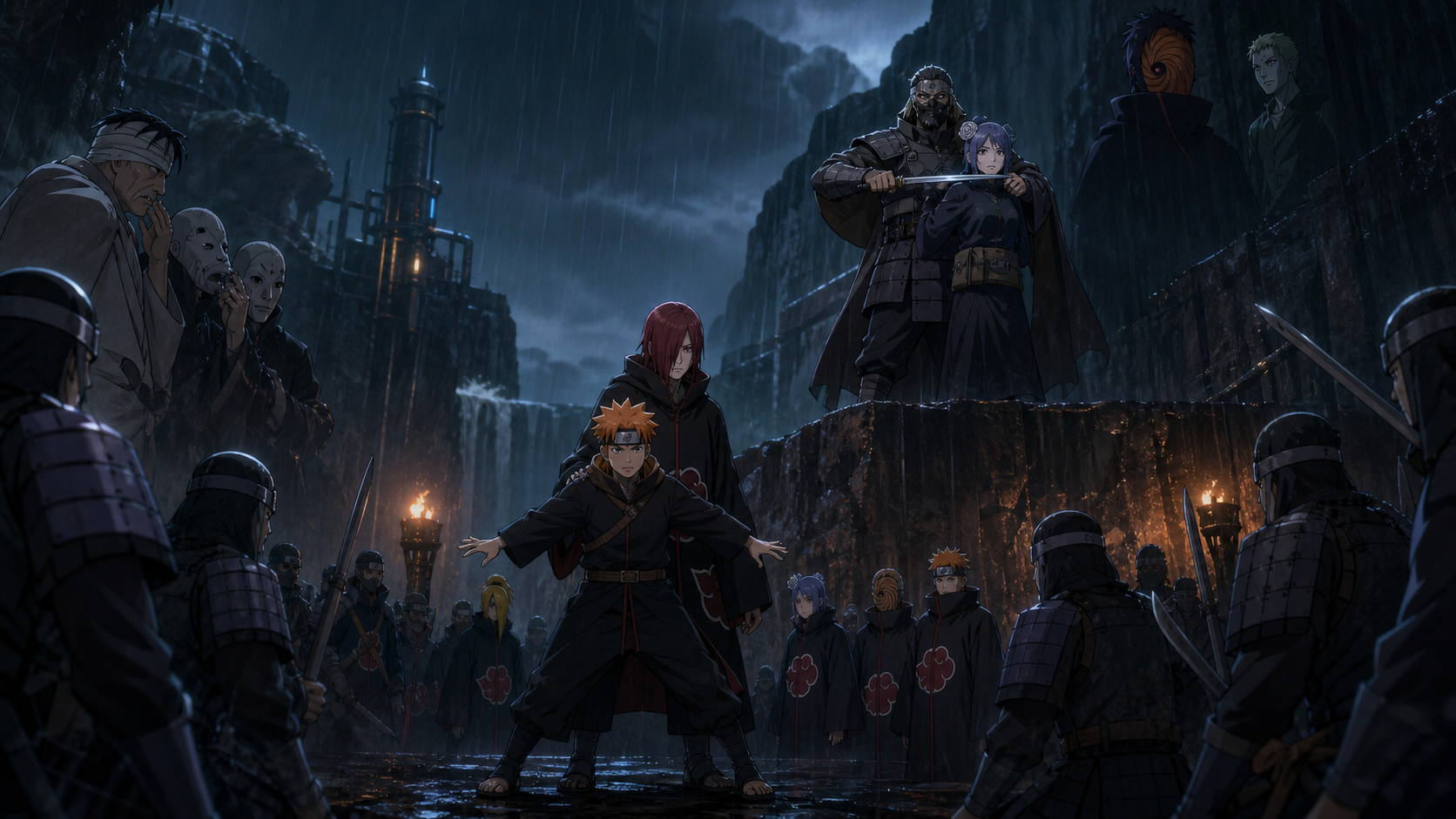
The New Akatsuki
Danzo weaponizes Hanzo’s fear, turning peace talks into the staged betrayal that kills one movement and clears space for another.
Bottom line
“The New Akatsuki” shows how political manipulation destroys the founders’ movement and then steals its name. Danzo tells Hanzo that Akatsuki intends to sabotage peace talks between the Hidden Rain and Hidden Stone. Hanzo accepts the lie, takes Konan hostage, and forces Yahiko into an impossible choice: kill Nagato or watch Konan die. Yahiko moves onto Nagato’s kunai, sacrificing himself before his friend can choose. Nagato’s grief erupts through the Demonic Statue, but the betrayal has already broken the organization’s center. Obito waits beyond the trap with a project designed to convert exactly this kind of loss into obedience. The later Akatsuki is not a stronger version of Yahiko’s dream. The new organization emerges after state violence, outside interference, and coerced grief destroy a movement rooted in consent.
The peace talks become the weapon
The possibility of negotiation draws Akatsuki into reach. A process associated with ending violence becomes the setting for planned violence.
That inversion matters because betrayal damages more than bodies. Betrayal teaches survivors to distrust the very practices that once offered another future.
Danzo manufactures an enemy for Hanzo
Danzo claims that Akatsuki plans to undermine talks between the Hidden Rain and Stone. The allegation reframes a popular peace movement as a security threat.
He does not need to defeat their ideals in public. He needs Hanzo to treat independent legitimacy as treason.
The lie attaches to an existing fear
Akatsuki’s support has grown beyond a small circle of friends. Hanzo can see civic influence that does not depend on his office.
Danzo supplies a story that turns political insecurity into permission for repression.
Danzo acts beyond the Leaf’s public face
His intervention serves a politics of control while avoiding transparent village accountability. Hidden operations let him shape another country’s future without defending the decision before either population.
Secrecy protects the actor, not the people forced to live with the result.
Root policy crosses a national border
Danzo treats the Hidden Rain as a board on which Leaf security interests can be arranged. Residents become variables in a strategy they never approved.
The intervention exposes a central contradiction in great-village politics. Leaders describe smaller countries as sovereign when convenient, then make covert decisions inside those countries when autonomy threatens preferred outcomes.
Peace between Rain and Stone threatens hidden agendas
A credible agreement could reduce conflict and give local organizers more influence over regional stability. Such progress would also narrow the space available to officials who build authority through permanent emergency.
Danzo’s lie protects more than one tactical interest. The lie preserves a system where unaccountable actors decide which peace efforts may survive.
Hanzo remains responsible for believing him
Danzo engineers the deception, but Hanzo chooses the ambush. Authority creates a duty to verify claims before using lethal force.
Fear can explain why the accusation feels credible. Fear cannot transfer responsibility away from the ruler who orders the trap.
Protecting the people becomes Hanzo’s justification
He frames Akatsuki’s destruction as necessary for the Hidden Rain. The language of public safety turns a political rival into an emergency.
Leaders can cause profound harm while describing every escalation as reluctant protection.
Hanzo abandons the legitimacy he wants to protect
A ruler secures authority through more than force. People also judge whether leadership can distinguish criticism from conspiracy and whether public promises mean anything.
By staging violence beneath the language of negotiation, Hanzo damages the trust required for future agreements. His attempt to eliminate a rival weakens the political ground beneath his own office.
Verification would have changed the moral field
Hanzo could have sought evidence, confronted the founders with the accusation, or used intermediaries trusted by both sides. None of those steps would guarantee safety, but each would recognize Akatsuki as people rather than targets already judged.
Skipping verification is part of the violence. The ambush begins when rumor receives more institutional weight than the lives placed beneath the accusation.
Konan is taken as leverage
The trap reduces a founder and skilled shinobi to a hostage in someone else’s forced choice. Her body becomes the mechanism used to control Yahiko and Nagato.
That coercion does not erase her agency or make her responsible for what the captors demand.
The captors target relationship itself
Hanzo knows the trio’s loyalty is central to Akatsuki’s strength. The ultimatum weaponizes care by making one friend appear responsible for another friend’s death.
This is not a fair decision under pressure. Every offered outcome has been designed by the people holding Konan.
The ultimatum distributes false guilt
Whichever friend appears to act can be left carrying responsibility that belongs to the captors. Nagato might blame himself for using the kunai, Konan might blame herself for being the hostage, and Yahiko might see self-sacrifice as the only way to protect them.
Coercion survives beyond the moment when victims internalize the roles assigned by an abuser.
Konan is not the cause of Yahiko’s death
The trap uses her threatened life, but Hanzo’s forces create the threat and Yahiko makes his own final decision within that confinement. Konan owes no apology for surviving.
Keeping that distinction visible matters because women in hostage narratives are often treated as narrative reasons for men’s pain rather than people who endure the same violence.
Nagato receives an impossible command
He is told to kill Yahiko to save Konan. Refusal appears to doom her, while compliance would make him the instrument of his friend’s murder.
No moral lesson should treat a coerced person as though those options arose naturally.
Yahiko moves before Nagato can choose
Yahiko drives himself onto the kunai in Nagato’s hand. His final action attempts to save both friends from the captors’ timetable.
The sacrifice belongs to Yahiko. The killing conditions belong to Hanzo’s forces and the deception that brought everyone there.
The kunai does not tell the whole truth
A still image could show Nagato holding the weapon and Yahiko dying against him. Context changes the meaning completely.
Editorial accuracy must keep coercion visible instead of allowing physical contact to become false moral authorship.
Yahiko entrusts peace to Nagato
His final faith places enormous emotional weight on a friend already trapped in horror. The request carries love, hope, and an almost impossible inheritance.
Nagato will remember the ideal through the worst moment of his life, making principle and trauma difficult to separate.
A final request can become an unbearable standard
Nagato hears responsibility for peace at the instant his emotional world collapses. Love makes Yahiko’s trust meaningful, while trauma can make any later failure feel like betrayal of the dead.
Healthy inheritance needs room for interpretation, support, and limits. Obito instead offers a rigid system that converts grief into mission and treats doubt as weakness.
Konan loses a friend while restrained
She witnesses Yahiko’s death without freedom to intervene. Her grief is not secondary to Nagato’s awakening or the future organization.
The episode’s political history also belongs to the survivor forced to watch others use her life as leverage.
Nagato’s grief reaches the Rinnegan
Shock and rage release power on a scale the attackers did not anticipate. The Rinnegan becomes a means of resistance against an ambush built around helplessness.
Power changes the immediate balance but cannot restore the choice stolen from the trio.
The Demonic Statue enters the battlefield
Nagato summons the statue connected to Madara’s larger design. Black receivers pierce his back as the technique channels overwhelming force.
The response defeats attackers while drawing Nagato physically closer to infrastructure prepared by people who see him as a future tool.
Power takes a visible cost from Nagato
The receivers pierce his body, and the statue’s force is not a clean extension of personal will. Survival becomes bound to pain and machinery connected to Madara’s plan.
That physical cost foreshadows a leadership built through distance, receivers, and substitute bodies. The path toward Pain begins with Nagato’s own body being used as a conduit.
Rage answers danger without resolving grief
Nagato’s attack protects Konan and punishes forces responsible for the ambush. Those immediate functions should not be confused with emotional repair.
Violence can end a present assault while leaving the survivor with loss, injury, fear, and a shattered understanding of political possibility.
Victory cannot undo the trap
Surviving forces or defeating enemies does not return Yahiko, repair trust, or make the peace meeting genuine. Tactical power arrives after political damage has landed.
The difference between winning a fight and recovering a future becomes painfully clear.
Obito benefits from a refusal he could not overcome
The founders rejected his doctrine while their relationships and movement remained intact. The ambush destroys the protective structure that direct recruitment could not penetrate.
He does not prove his worldview. He waits for other actors to make despair feel inevitable.
Waiting is part of Obito’s strategy
He does not need to stand at the center of every causal step. Surveillance lets him identify when grief has weakened resistance and when an old offer may sound newly plausible.
Distance also creates deniability. A manipulator can benefit from violence performed by others while presenting himself afterward as the only person honest about the world.
Rescue withheld can become coercive leverage
Obito possesses unusual movement, intelligence, and access, yet his project benefits from the founders reaching catastrophe. The episode invites scrutiny of what he wants to happen, not merely what he directly strikes.
Someone who waits for preventable devastation because devastation improves recruitment is not a neutral observer.
Manufactured catastrophe poses as evidence
Obito warned that their ideals would fail, then benefits when deception and violence attack those ideals. The result can be presented as prediction fulfilled.
A crisis deliberately encouraged by powerful people is not neutral evidence about human nature.
Despair becomes a political resource
Danzo uses fear to direct Hanzo. Hanzo uses fear to justify an ambush. Obito uses the resulting grief to make domination look like realism.
Different actors pursue different goals, yet every stage extracts value from pain rather than reducing the conditions that create pain.
The title marks a stolen succession
The “new” Akatsuki will retain the name while changing purpose, structure, and methods. Continuity of branding can hide a rupture in political meaning.
The founders’ dawn should not be retroactively defined by the darkness built after Yahiko’s death.
A name can survive while a mission dies
Symbols create familiarity and can make transformation appear continuous. Members, methods, and objectives may change beneath the same public identity.
Calling both organizations Akatsuki is historically accurate. Treating both as morally identical erases the rupture the episode works to show.
Konan carries institutional memory
Konan survives both the original purpose and the moment of destruction. Her later presence connects the organizations, but connection does not equal endorsement of every transformation.
She remembers the people, promises, and local work that existed before the name became global terror. That memory will matter when Naruto challenges Nagato’s conclusions.
Nagato’s ideology is altered, not revealed
The ambush does not uncover a violent truth that was secretly present all along. Trauma, betrayal, bodily injury, and Obito’s influence reshape how Nagato understands peace.
Change has causes. Recognizing those causes allows compassion without pretending that later choices carry no responsibility.
The original project deserved a future
Yahiko’s movement had risks, incomplete plans, and powerful enemies. None of those facts made destruction necessary.
The tragedy lies partly in unrealized possibility: neighbors had begun building a political structure that might have learned, adapted, and produced outcomes nobody controlling the ambush wanted to permit.
Danzō exports Konoha’s covert politics into Rain
He feeds Hanzō claims that Akatsuki threatens both leadership and regional order. The intervention is not a private grudge. A Leaf official uses secret personnel and misinformation to shape another country’s political future.
Rain civilians carry the risk while Konoha’s public leadership gains distance from the operation. Foreign policy conducted through deniable violence still belongs to the institution that trains, funds, and protects the operator.
Hanzō chooses fear over verification
Akatsuki’s popularity and contact with other nations challenge his monopoly on negotiation. Danzō’s warning works because Hanzō already sees independent legitimacy as a threat.
He could request evidence, meet with multiple delegates, include witnesses, or establish conditions that protect everyone. Instead, he stages a hostage trap. Manipulation matters, but the ruler remains responsible for choosing the convenient lie.
Konan’s capture weaponizes the founders’ strongest bond
The captors understand that Akatsuki’s power comes from trust among Yahiko, Nagato, Konan, and their members. They convert that trust into leverage by placing one founder’s life against another’s action.
The tactic attacks relationship while pretending the victims authored the choice. Konan does not cause the crisis by being loved. Hanzō and Danzō create the coercive structure.
Nagato is denied every legitimate option
Hanzō orders him to kill Yahiko while Konan remains restrained and armed forces surround the meeting. Refusal appears to cost Konan’s life; compliance appears to destroy the movement and his closest friend.
No result produced under that threat can be treated as voluntary. Nagato still experiences the aftermath as personal failure because coercion works partly by transferring guilt from the people who designed the trap.
Yahiko’s final movement protects Nagato from becoming executioner
He drives himself onto the kunai before Nagato can choose. The act saves his friend from performing the commanded strike, but it leaves Nagato holding the weapon and memory.
Calling the moment sacrifice cannot make the burden fair. Yahiko acts inside seconds created by armed adults who turned peace talks into murder. Responsibility remains with the architects.
Konan witnesses the death without power to intervene
She is bound, threatened, and forced to watch her friends navigate an ultimatum built around her body. Her grief includes the knowledge that captors used their love as machinery.
Later loyalty to Nagato should not erase her independent memory of Yahiko’s politics. Konan remains a founder who can distinguish the original movement from the organization despair will reshape.
The Demonic Statue answers grief with bodily extraction
Nagato summons overwhelming power, kills attackers, and survives the immediate trap. The rods entering his back and the damage to his body make the cost visible.
Power ends the encirclement without restoring Yahiko, freeing the movement from manipulation, or repairing Rain. The statue provides force at the exact moment grief makes force feel like the only remaining language.
Obito waits because collapse serves recruitment
He could have warned the founders, exposed Danzō, challenged Hanzō, or interrupted the hostage plan. Instead, he watches a catastrophe that proves his earlier prediction.
Withholding rescue becomes part of the manipulation. Obito needs Nagato to believe reality destroyed every peaceful option. The manufactured failure creates the despair that argument alone could not.
The new Akatsuki keeps the name while reversing the method
Yahiko’s group built legitimacy through service, transparency, local trust, and negotiation. Nagato’s later organization will use secrecy, concentrated power, fear, and tailed-beast capture.
The continuity of name makes the theft painful. Dawn becomes branding for a project whose methods contradict the people who created it. Remembering the original Akatsuki is necessary to judge what the successor lost.
A peace meeting needs safeguards before trust
The founders approach Hanzō because negotiation aligns with their mission. Good faith does not require arriving unprotected or accepting a venue controlled entirely by the stronger party.
Multiple delegates, independent witnesses, verified routes, communication checkpoints, and a refusal plan would not guarantee safety. Those measures would make disappearance harder to hide and prevent one hostage from becoming the only information channel.
Rain civilians lose political alternatives with Yahiko
Residents who trusted Akatsuki lose a leader willing to negotiate without surrendering local agency.
Danzō and Hanzō do more than kill one young man. They narrow the country’s political future, making violent centralization appear inevitable after deliberately destroying a credible peaceful movement.
Konan becomes the surviving witness to both organizations
She remembers the original Akatsuki’s service, openness, and shared leadership. She also lives through the trap, Nagato’s transformation, and the later organization built around Pain.
That memory gives Konan a perspective nobody else fully shares. Her choices should be read as political judgments formed across both eras, not passive loyalty to whichever man stands at the center.
RaeRae’s verdict
“The New Akatsuki” is most powerful when read as an account of engineered collapse rather than inevitable corruption. Danzo supplies the lie, Hanzo supplies state force, and the hostage trap converts friendship into a mechanism of pain. Yahiko’s death is a sacrifice under coercion, not proof that collective peace was foolish.
Nagato’s response is devastating because enormous power cannot return the agency stolen from the trio. Obito’s project moves closer only after direct persuasion failed. The later organization inherits a recognizable name, but inheritance is not moral continuity. A peace movement has been broken so that grief can be redirected toward control.
RaeRae’s call
Danzō supplies the lie, Hanzō chooses the trap, and Obito waits for grief to make recruitment easier. Konan did not cause Yahiko’s death by being loved, Nagato did not receive a free choice, and Yahiko’s sacrifice does not absolve the adults. The new Akatsuki inherits a name after power murders the original method.
Episode details and viewing routes
- Official episode reference: Naruto Official episode guide
- Licensed episode route: Crunchyroll licensed episode page
What I am carrying forward
Yahiko is dead after sacrificing himself during Hanzo’s hostage trap. Konan survives the coercion, and Nagato summons the Demonic Statue in grief and rage. Danzo’s deception and Hanzo’s decision destroy the original Akatsuki’s political center.
Obito now has the opening he wanted after the trio rejected him. The Akatsuki name will continue under a transformed purpose, while Nagato’s body and worldview carry the damage of this ambush. Episode 349 shifts into Kakashi’s postwar trauma and the political contest surrounding Minato’s appointment as Fourth Hokage.