
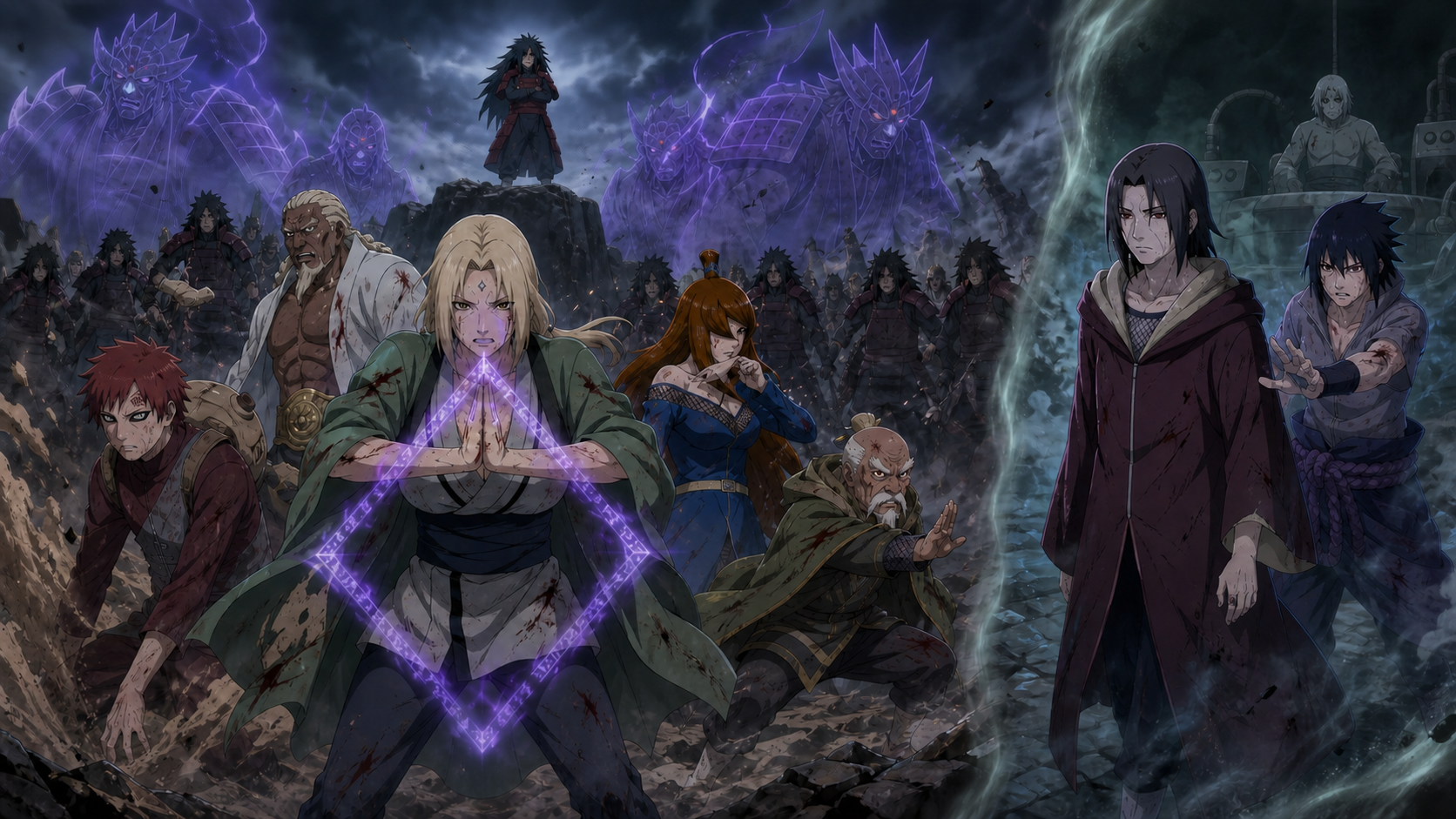
The Risks of the Reanimation Jutsu
Madara multiplies consequence-free bodies, Tsunade spends years of preparation, and Itachi proves that no command seal fully owns a person’s history or will.
Bottom line
“The Risks of the Reanimation Jutsu” shows why Edo Tensei fails as a fantasy of clean control. Madara can regenerate, multiply himself through Wood Style clones, and force the five Kage to spend living bodies against an opponent protected from ordinary consequences. Itachi creates a different risk: a reanimated person with enough awareness can resist the intended role, locate the caster, and use the technique’s own rules against him. Tsunade rejects Madara’s contempt for inherited leadership by activating the Strength of a Hundred Seal and fighting beside the other Kage instead of remaining behind a medical boundary. Sasuke abandons his direct route toward Naruto when he sees Itachi and follows the brother whose answers still reorganize every priority. Kabuto’s dead assets are not neutral tools. They carry histories, loyalties, knowledge, and wills that no command seal completely owns.
Madara turns one opponent into many
Wood Style allows Madara to create clones capable of attacking the five Kage simultaneously. The numerical advantage they assembled is reversed.
An immortal body with stolen Hashirama cells can reproduce combat pressure without dividing moral responsibility. Every clone still serves one person’s choice.
Five clones confront each Kage
Madara assigns multiple wood clones to every leader. The formation forces each Kage into a private survival problem.
Their greatest advantage was complementary coordination. Separating attention makes titles and specialties easier to overwhelm under relentless individual pressure.
The clones can use Susanoo
Madara arms the copies with Susanoo, proving that duplication has not reduced them to harmless distractions. Each clone carries formidable offense and defense.
The display turns chakra economics upside down. A living Uchiha would pay enormous strain for repeated ocular power; Edo Tensei keeps repairing the source.
The direction repeatedly places damaged Kage bodies in the foreground while fresh clones occupy the depth behind them. Scrapes, blood, labored breathing, and Tsunade’s active healing stay visible beside enemies who can rebuild after impact. That contrast keeps the fight from becoming a simple power showcase. Every exchange asks living people to spend something Madara no longer has to budget.
Edo Tensei rewards reckless scale
Madara can test excessive techniques without fearing permanent injury or chakra exhaustion in the ordinary sense. The Kage cannot answer on those terms.
Kabuto’s technique creates an unequal accounting system. Living defenders spend finite time and tissue while the reanimated attacker treats damage as delay.
Madara asks whether clones should use Susanoo
His mockery makes the Kage choose how they want to be humiliated. The question is not an offer of mercy.
He uses overwhelming choice to reduce leadership to spectacle. The Kage’s answer has to restore purpose rather than compete with his performance.
Tsunade leaves the medical boundary
Medical-nin doctrine normally places healers behind front-line fighters because preserving treatment capacity protects the entire team. Tsunade taught those rules for good reason.
Her decision to fight does not prove the rule was foolish. Madara has created an emergency where her full combat ability is necessary for anyone to survive.
The Strength of a Hundred Seal changes her role
Tsunade releases stored chakra accumulated through years of precise control. The seal supports extraordinary healing, endurance, and physical power.
Preparation makes the apparent exception possible. She can accept damage that would remove another medical ninja from the battlefield.
Healing becomes permission to take risk
Rapid regeneration lets Tsunade enter exchanges built around injury. She can strike through attacks rather than preserving an untouched body.
That advantage remains costly. Pain, chakra use, and battlefield judgment do not disappear because wounds close.
Madara reduces Tsunade to ancestry
He compares her unfavorably with Hashirama, emphasizing that she did not inherit his Wood Style. The comparison treats bloodline resemblance as the measure of worth.
Tsunade’s leadership comes from medical reform, survival, training, and responsibility. She does not need to reproduce her grandfather’s techniques to carry his values.
Misogyny sharpens the dismissal
Madara frames Tsunade as a weak woman as well as an inferior descendant. The insult tries to convert gender into proof before her actions can be judged.
Tsunade answers through capability without accepting his standard. Strength includes preserving lives and building systems, not only dominating a duel.
The Will of Fire is inherited differently
Hashirama’s body could create forests. Tsunade inherited a commitment to protect the village and later expanded medical practice around team survival.
Values do not require genetic duplication. An heir can honor a founder by correcting structures the founder left incomplete.
Tsunade breaks through Susanoo
Her physical strike damages the supposedly overwhelming defense and proves the Kage can create openings through coordinated pressure.
The moment does not erase Madara’s advantage. The moment denies his claim that current leadership has no meaningful strength.
Madara uses deception inside dominance
Wood clones and substitution let him exploit any Kage who assumes a successful hit reached the original body. Even overwhelming power still relies on misdirection.
That detail matters strategically. Madara wants opponents to think resistance fails only because he is stronger, hiding the mechanics they might learn to counter.
Tsunade survives impalement
Madara’s attack pierces her, but the released seal allows her to remain active. Her body demonstrates why she could leave the protected medical position.
Survival is not invulnerability. Every injury consumes stored chakra and brings the transformation closer to its limit.
The other Kage depend on her recovery
Tsunade’s healing supports more than personal aggression. Ōnoki’s injuries, the group’s endurance, and their capacity to coordinate all depend on medical judgment.
She fights as a healer rather than ceasing to be one. The roles combine because the crisis requires both.
Madara’s Hashirama cells expose Kabuto’s methods
The modified body carries stolen tissue from a rival whose power Madara already coveted. Kabuto treats the combination as proof of scientific achievement.
The result is effective and ethically bankrupt. Neither death nor historical importance granted permission for the reconstruction.
The title names more than combat risk
Edo Tensei seems attractive because dead fighters can regenerate and obey. The technique appears to move danger away from the caster.
Actual risk returns through knowledge, resistance, emotional ties, and the possibility that a summoned person may reach the person issuing commands.
Itachi keeps moving toward Kabuto
Released from direct control by Shisui’s eye, Itachi has chosen to stop Edo Tensei. His target is the caster rather than every reanimated fighter individually.
The decision treats the war as a system problem. Ending the source can release battlefields that no single fighter could visit in time.
Killing Kabuto would not safely end the technique
Itachi understands that simply killing the caster may leave the reanimations active. The release must be performed through the technique’s own hand signs.
That rule changes the objective from assassination to controlled capture and compulsion. Kabuto has to remain alive long enough to undo his work.
Genjutsu offers a route to release
Itachi plans to place Kabuto under genjutsu and force him to perform the cancellation. The method uses Itachi’s specialization while respecting the technical constraint.
Success still requires locating Kabuto, overcoming defenses, and preventing a fatal strike from anyone who does not know the plan.
Sasuke sees Itachi moving through the forest
On his way toward Naruto, Sasuke recognizes the brother he killed and later learned had protected him. A dead person interrupts the future Sasuke had selected.
The encounter proves why reanimation is strategically unpredictable. Personal history can redirect a living fighter before the caster gives another order.
Sasuke abandons the direct route
Naruto remains the declared target, but Itachi’s presence immediately takes priority. Sasuke follows because unanswered questions about his brother define the revenge aimed at the Leaf.
The choice shows that his certainty was conditional. One piece of living evidence reopens the entire conclusion.
Itachi refuses to stop
Itachi does not reward pursuit with the conversation Sasuke demands. Ending Edo Tensei could save thousands, and delay strengthens Kabuto’s war.
Urgency is real, but refusal also repeats Itachi’s habit of deciding what Sasuke can handle without giving him agency.
Sasuke demands answers from the person involved
The masked man supplied Sasuke with a version of Itachi’s history. Sasuke now has the rare chance to question Itachi directly.
His demand is legitimate even when battlefield timing is terrible. Secrets shaped his entire life, and other people repeatedly chose protection through deception.
The brothers move in the same direction for different reasons
Itachi runs toward Kabuto to stop reanimation. Sasuke follows to stop Itachi long enough for answers.
Shared movement does not yet mean shared purpose. Their temporary alignment begins through unresolved conflict.
Kabuto can sense the approaching threat
As Edo Tensei’s caster, Kabuto has awareness of the reanimated network and realizes Itachi is no longer behaving as intended.
The asset has become an attacker carrying intimate knowledge of both the technique and Kabuto’s habits.
Kabuto sees Sasuke as another opportunity
Sasuke’s presence brings the Uchiha body and eyes Orochimaru long pursued. Kabuto can interpret danger through the old laboratory desire for acquisition.
That appetite may prevent a clean retreat. The person who treats everyone as material keeps finding reasons to stay near threats.
Control produces false confidence
Kabuto built an army from powerful dead people and protected himself away from the main fronts. The arrangement looked safer than direct combat.
Itachi’s approach exposes the flaw. Distance matters less when a reanimated operative knows the command structure and retains strategic judgment.
Tsunade and Itachi answer inheritance differently
Tsunade carries Hashirama’s values without copying his body. Itachi’s body is copied into war while his will turns against the copier.
Both threads separate inheritance from possession. DNA, eyes, corpses, and titles cannot guarantee loyalty to the person holding them.
Sasuke’s eyes meet their original owner
Sasuke follows Itachi while seeing through Itachi’s transplanted eyes. The physical inheritance intensifies every unresolved question.
Vision connects them even as secrecy separates them. Sasuke needs interpretation more than additional optical power.
The Kage fight for a future beyond founders
Madara measures them against Hashirama and his own era. The five Kage refuse the premise that later generations exist only as weaker copies.
Their value lies in cooperation across villages, medical systems, and shared responsibility that founder-level combat never fully secured.
Edo Tensei weaponizes unfinished relationships
Sasuke follows Itachi, the Kage fight Madara, and entire divisions confront people they mourned. Kabuto depends on emotional shock while pretending the bodies are interchangeable tools.
The same relationships create resistance. Love, guilt, loyalty, and memory can disrupt commands as powerfully as they disrupt defenders.
Twenty-five Susanoo clones turn scale into contempt
Madara creates five opponents for each Kage and gives every clone a defense that once represented rare, intimate Uchiha power. Multiplication becomes a way to mock the leaders’ combined effort.
The tactic also exposes Edo Tensei’s central distortion. An undying body can spend chakra and spectacle without accepting the living cost that limits everyone facing it.
The Kage need roles before the clones separate them
Five simultaneous fights can break communication and force each leader into private survival. Madara benefits if specialties stop combining.
The Kage need signals, regroup points, medical priority, and permission to abandon a losing individual exchange for the shared objective. Leadership unity must remain operational after the formation is physically divided.
Tsunade’s seal changes capacity, not personhood
The Strength of a Hundred Seal releases stored chakra and lets her heal through damage that would stop another fighter. The transformation does not convert her body into communal property.
Other Kage can rely on her expertise while respecting limits she states. Exceptional recovery should expand options, not become an excuse for everyone else to assign her the most destructive risk.
Madara’s ancestry argument erases Tsunade’s actual labor
He measures her against Hashirama, dismissing medical innovation, village leadership, training, survival, and years of stored chakra because she does not reproduce her grandfather’s power.
Inheritance is not a contest in biological imitation. Tsunade carries values and failures forward through different work, and the difference is precisely what makes her leadership necessary.
Misogyny gives the dismissal another edge
Madara’s contempt targets her gender alongside lineage and strength, implying that a woman who cannot match his preferred male ancestor lacks legitimacy.
Tsunade does not need to prove every woman through one victory. The bias belongs to Madara. Her response can remain specific to her skill without turning representation into another impossible burden.
Breaking Susanoo depends on medical preparation
Tsunade’s strike looks like raw force, but the moment rests on years of chakra control, anatomical knowledge, stored reserves, and willingness to calculate damage.
The breakthrough is medical expertise expressed offensively. Calling it strength alone erases the discipline that lets her decide exactly what her body can spend.
Surviving impalement does not make the wound symbolic
Madara’s deception drives a weapon through Tsunade, creating blood loss, internal damage, and an immediate threat to the healer supporting everyone else.
Regeneration can close tissue while the team still faces reduced chakra and shock. The Kage need cover, assessment, and a plan that does not ask Tsunade to hide injury for morale.
Hashirama’s face is evidence of a research chain
Madara’s body displays stolen cells and Kabuto’s modifications, connecting the battlefield to Orochimaru’s experiments and decades of hidden biological theft.
The visible graft should trigger documentation, sample controls, and survivor-centered investigation. Spectacular power must not bury the question of whose bodies made the experiment possible.
Itachi understands the technique’s termination risk
Killing Kabuto might leave Edo Tensei active rather than safely releasing every controlled person. Itachi chooses a harder route because ending the operator is not the same as ending the system.
That distinction belongs in every emergency plan. Complex control techniques need shutdown knowledge, containment, and confirmation before force removes the only person who understands the release.
Sasuke changes direction because evidence appears
He sees Itachi moving through the forest and abandons the direct route toward Naruto. The choice reflects unresolved grief, but it also follows a witness central to the questions shaping his revenge.
Changing course is not automatically indecision. New evidence should change priorities when the original plan depended on missing truth.
Itachi cannot demand silence from the brother he shaped
He keeps moving and refuses to answer, repeating the habit of deciding what Sasuke may know for a supposedly protective purpose.
Urgency around Kabuto is real, but Sasuke’s demand has legitimacy. Itachi helped create the trauma, manipulation, and information vacuum that brought his brother here. Protection without explanation has already failed them both.
Medical power needs consent, reserves, and succession
Tsunade’s released seal lets the five Kage survive a fight designed to consume every living limit, but the formation cannot treat her stored chakra as a common pool without agreement. She needs authority to decide triage, refuse wasteful risks, and name the point where preserving one leader would endanger many wounded soldiers. The others need enough medical knowledge to recognize impairment and cover her without waiting for collapse. Katsuyu, field medics, and evacuation teams should receive direct status updates rather than learning the healer’s condition after communication fails. The battle also exposes a succession problem. If Tsunade becomes incapacitated, Konoha and the Alliance cannot lose medical command, political authority, and specialized knowledge at once. Deputies need records, delegated decisions, and access to contingency plans before crisis. Her exceptional body has allowed institutions to postpone that preparation. Respecting Tsunade means valuing what only she can do while building systems that do not require her to bleed indefinitely for everyone else’s continuity.
The same principle applies to Itachi’s plan. His unique knowledge of Edo Tensei makes him essential, but a safe release cannot exist only inside one reanimated mind moving toward Kabuto. Sasuke should learn the objective, expected genjutsu, failure conditions, and what to do if control changes. Information shared under pressure may slow movement for seconds while preventing another disaster built around one person’s secrecy. Both battlefields show brilliant individuals compensating for missing institutions. The risk is not brilliance itself. The risk is allowing everyone else to remain unprepared because one damaged body can still carry the answer. A responsible victory leaves knowledge distributed, bodies cared for, and authority clear enough that no leader, healer, survivor, or controlled dead person must become the single point holding an entire system together. That is the opposite of Kabuto’s technique, which concentrates every choice in one operator and calls dependence mastery.
RaeRae’s verdict
“The Risks of the Reanimation Jutsu” earns its title by showing control fail in more than one direction. Madara’s immortal modification creates grotesquely unequal combat, yet his autonomy also means Kabuto cannot treat him as ordinary inventory. Itachi has escaped direct command and is carrying the solution toward the caster.
Tsunade supplies the living counterargument. She inherits values through choices, preparation, medical reform, and willingness to share battlefield risk. Kabuto can copy bodies and Madara can mock descendants, but neither can manufacture the loyalty that makes inheritance meaningful.
RaeRae’s call
Edo Tensei rewards scale without living cost, but its greatest risk is the illusion that controlling the operator means controlling the ending. Protect Tsunade’s medical limits, document Hashirama’s stolen cells, keep the Kage connected, and let Sasuke demand answers while Itachi pursues a release that will actually free the dead.
Episode details and viewing routes
- Official episode reference: Naruto Official episode guide
- Licensed episode route: Crunchyroll licensed episode page
What I am carrying forward
Tsunade has activated the Strength of a Hundred Seal and joined the five Kage’s direct assault while continuing to provide medical support. Madara has multiplied the threat through Wood Style clones and Susanoo.
Sasuke has encountered reanimated Itachi and followed him toward Kabuto. Itachi intends to use genjutsu to force Kabuto to release Edo Tensei because killing the caster alone will not safely stop the technique. Episode 334 begins the brothers’ active team battle.