
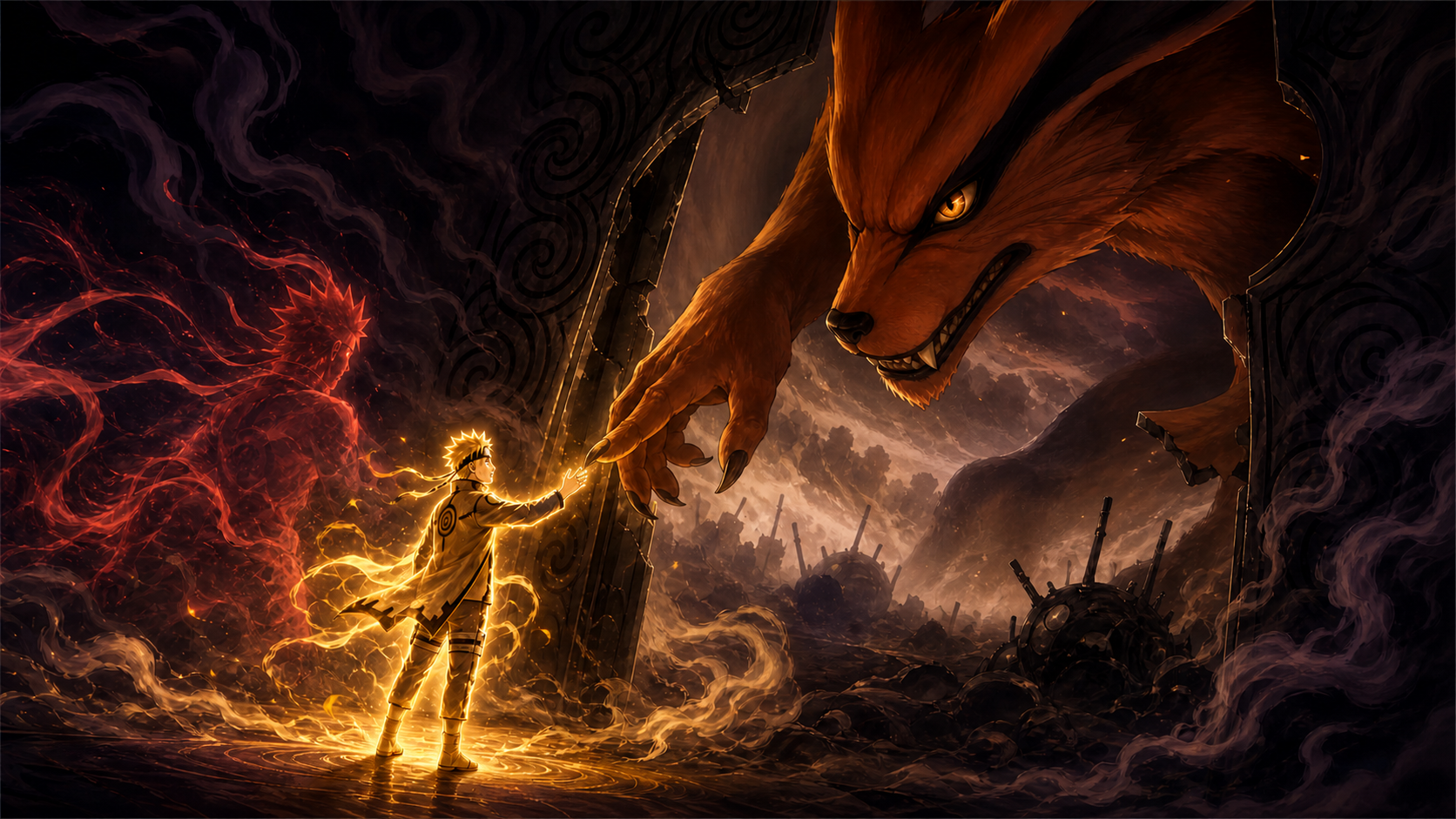
Kurama
Naruto keeps his promise to Son Gokū without winning everything, and Kurama answers that evidence by finally sharing his name and opening the gate.
Bottom line
“Kurama” makes trust concrete through names, promises, and imperfect victories. Naruto returns from Son Gokū’s inner space knowing where the black receiver is lodged and fights through the Four-Tails’ body to remove the rod. He keeps his promise, but the masked man still drags Son back into the Demonic Statue, proving that one broken control point does not dismantle the entire capture system. Son recognizes Naruto’s effort and leaves him chakra before disappearing. Kurama watches Naruto risk himself for freedom he cannot personally profit from, finally gives Naruto his name, and opens the seal’s gate. The moment works because Naruto has not won everything. Partnership begins after he proves that another being’s autonomy matters even when the outcome remains painful.
Naruto leaves Son’s inner space with a task
Son Gokū has identified the black receiver embedded in his transformed body. Naruto now knows that removing the rod can interrupt the masked man’s immediate control.
Conversation has produced actionable information. Respect becomes meaningful because Naruto carries what he heard back into danger.
The receiver is not easy to reach
Naruto remains trapped inside the Four-Tails while the controlled body moves and fights outside. The target sits within a giant, hostile form.
Knowing the location does not erase physical barriers. The masked man’s system protects its control point through the body being controlled.
Naruto uses clones across two spaces
Shadow clones let Naruto coordinate effort inside and outside the transformed beast. One perspective works toward escape while another pursues the rod.
The technique turns divided presence into cooperation with himself. Naruto’s signature skill becomes a way to connect information across layers of captivity.
Son gives precise guidance
Son cannot simply remove the receiver, but he can tell Naruto where to push and what the masked man’s restraint feels like.
The controlled being is not a passive rescue object. His knowledge is necessary for the rescue attempt to have any chance.
Cooperation begins before trust is complete
Son remains skeptical of humans, and Naruto has known him by name for only minutes. Neither fact prevents them from pursuing a shared immediate goal.
Trust can begin as limited coordination under clear terms. Emotional certainty does not have to arrive before useful consent.
Naruto fights through the transformed body
The Four-Tails’ scale and chakra place enormous pressure on Naruto. He has to create leverage without treating Son’s body as meaningless terrain.
The distinction changes his urgency. Naruto is escaping an attack while trying not to abandon the person trapped inside the attack.
The outside team preserves the opening
Kakashi, Guy, Killer B, and Gyūki continue holding off the masked man and the remaining jinchūriki. Their battle creates the time Naruto needs.
No private breakthrough exists outside collective support. Someone else is absorbing danger whenever a hero gets space to think.
B understands the liberation attempt
B and Gyūki know that tailed-beast cooperation cannot be manufactured through force. They protect Naruto’s effort because freeing Son weakens control and recognizes a fellow captive.
Their partnership offers the battlefield example Naruto wants to make possible elsewhere.
The masked man tries to maintain the network
The operator sends commands through the receiver and uses the other hosts to interrupt rescue. Losing one node would threaten both power and authority.
His response reveals dependence. A person claiming total control still needs rods, eyes, distance, and stolen bodies to keep that control functioning.
Naruto reaches the black rod
Naruto finally gets physical access to the receiver. The moment turns the episode from a promise about intention into a test of follow-through.
The rod represents an entire worldview in miniature: one person inserted into another body so that commands can replace consent.
Removing the rod requires more than strength
The receiver resists extraction because the control is tied into Son’s chakra and transformed body. Naruto has to pull while surviving the surrounding assault.
Determination matters, but positioning, information, clone coordination, and allied protection make determination effective.
Naruto keeps his promise
Naruto tears the receiver free. The direct link controlling Son through the reanimated host is broken.
The success belongs to a promise made after listening. Naruto does not free Son by guessing what freedom should look like; he follows the condition Son described.
Liberation is immediately incomplete
The masked man still has a broader contract with the tailed beasts through the Demonic Statue. Removing the rod does not erase every layer of captivity.
The episode refuses the comforting lie that one correct act can dismantle a system built through several mechanisms.
Son is pulled toward the statue
Before freedom can become physical escape, the masked man recalls Son into the Demonic Statue. The battlefield loses the Four-Tails form.
Naruto has succeeded and still has to watch the person disappear. Both truths belong in the accounting.
A painful outcome does not make the promise meaningless
The receiver is gone, Son experienced Naruto’s effort, and the masked man had to use another control layer. The action changed their relationship even though capture continued.
Judging only by possession would repeat the enemy’s logic. Freedom also includes whether Son’s will was heard and acted upon.
Son recognizes the difference
Son sees that Naruto did not abandon the promise when extraction became difficult. Naruto risked capture and exhaustion for an autonomy the war’s institutions rarely acknowledge.
Recognition does not erase Son’s history with humans. Naruto has simply added evidence that another kind of human relationship can exist.
Son leaves Naruto chakra
Before being taken, Son transfers a portion of chakra to Naruto. The gift is voluntary and carries the memory of their agreement.
Power arrives as a consequence of respect rather than the price demanded for rescue. Naruto did not make freedom conditional on receiving a reward.
The fist bump records consent
Their contact functions as an exchange both participants choose. The gesture contrasts with receivers, seals, and extraction techniques imposed without permission.
A small mutual action carries more relational meaning than the enormous forced transformations surrounding them.
The other tailed beasts notice
Son’s response gives the remaining beasts evidence about Naruto. They can observe a human keeping a promise to one of their own under battlefield pressure.
Trust can travel through community witness. Naruto does not need to repeat the same speech as if every being exists in isolation.
Rōshi’s relationship is not rewritten
Naruto’s success does not retroactively fix the distance between Son and Rōshi. Their decades together still ended without the mutual naming Son wanted.
New evidence should not erase old grief. Son can recognize Naruto while continuing to mourn what never developed with his host.
Kurama has watched every choice
Kurama witnessed Naruto apologize for the numbered label, accept Son’s skepticism, follow his instructions, and keep the promise without guaranteed victory.
The sequence answers Kurama more effectively than a demand for friendship. Naruto behaves like a partner before receiving partnership.
Kurama understands Naruto’s motive
Naruto did not free Son to claim the Four-Tails, add a permanent technique, or improve village leverage. He acted because control was wrong.
That motive challenges Kurama’s long expectation that humans approach tailed beasts only to secure usable power.
The seal remains between them
Naruto and Kurama still face the gate built into the Tetragram Seal. Physical architecture records the distrust and containment surrounding their relationship.
No emotional declaration can pretend the cage was never there. Progress requires changing how both of them relate across that boundary.
Kurama gives Naruto his name
The Nine-Tails finally identifies himself as Kurama. Sharing the name is an act only he can authorize.
Naruto gains no tactical statistic from the word. He gains the ability to address the person who has been beside him since birth.
The title marks a person replacing a label
The episode is titled “Kurama,” not “Nine Tails.” That shift completes the naming argument opened by Son Gokū.
A character previously defined by tail count enters the story through his chosen name. Language records the change before combat displays the power.
Naruto responds with recognition
Naruto accepts the name with the direct warmth that defines his strongest relationships. He does not turn the disclosure into a victory over Kurama.
The moment belongs to Kurama’s choice. Naruto’s role is to receive that choice without claiming credit for granting personhood.
Kurama opens the gate
The barrier inside Naruto’s seal is opened so their chakra can connect without the earlier struggle for extraction. The architecture of imprisonment becomes a threshold for cooperation.
Opening the gate carries vulnerability for both. Naruto trusts Kurama with access, while Kurama trusts Naruto not to reduce access to ownership.
Freedom inside a seal remains complicated
Kurama is still physically bound within Naruto, and the war has not created a neutral setting for either party. Their partnership develops inside a structure neither chose.
The episode does not need perfect freedom before meaningful consent can begin. Meaningful consent does need honesty about the structure still present.
Their chakra meets by agreement
Naruto and Kurama prepare to combine power through mutual decision. The same chakra once leaked through rage or was taken through force now moves through cooperation.
The visual transformation matters because the relationship underneath the transformation has changed.
B and Gyūki provided the living model
Naruto has watched B speak with Gyūki, accept warnings, share decisions, and transform without losing himself. Their partnership showed that another jinchūriki relationship was possible.
Kurama’s choice is not a copy. The example made a future imaginable while Naruto and Kurama still had to build their own reasons.
Naruto does not tame Kurama
The language of taming suggests a superior person domesticating a dangerous subordinate. That framework misreads what the episode earns.
Kurama chooses cooperation after evaluating Naruto. Naruto has not conquered his personality or removed his right to disagree.
Hatred becomes information, not destiny
Kurama’s anger came from real captivity, manipulation, and fear. Partnership does not require pretending those causes were irrational.
The change lies in refusing to let justified hatred decide every future relationship before new evidence can matter.
The battlefield still needs them immediately
The remaining reanimated jinchūriki, masked man, and shared ocular network continue attacking outside the inner world. There is no private recovery period after the breakthrough.
Naruto and Kurama have to translate trust into action while allies are still holding the line.
Power arrives with accountability
Kurama’s chakra can expand Naruto’s speed, reach, sensing, and destructive capacity. Greater ability also increases the consequences of careless choices.
Their partnership should improve judgment as much as output. Two minds communicating can decide where immense force belongs.
Episode 329 owns the full demonstration
This episode earns the name, open gate, and mutual connection. The next episode shows how the two-person team functions across the battlefield.
Keeping that boundary matters. Relationship change is the climax here; combat proof becomes the next chapter rather than swallowing the emotional event.
Son Gokū gives instructions before giving trust
He tells Naruto where the receiver sits and how to reach it because liberation requires cooperation. That practical guidance does not mean every grievance has disappeared.
The distinction matters. People can work together against immediate control while keeping skepticism, boundaries, and unresolved history. Naruto earns the next step by following the information rather than demanding emotional reassurance first.
Clones coordinate labor across inner and outer spaces
Naruto divides attention between Son Gokū’s internal world and the transformed body outside. The technique turns one promise into simultaneous tasks, each carrying risk.
The team beyond the inner space still protects the opening. B, Gyūki, Kakashi, and Guy make room for Naruto’s reach, so the liberation cannot be credited to willpower acting alone.
Removing the rod is a bodily intervention
The receiver is a control device, but extracting it still requires force applied inside another being’s body. Son Gokū’s guidance provides the consent and precision the attempt needs.
Naruto cannot treat success as permission to repeat the act on every host without communication. Each body, receiver location, and risk may differ. Rescue remains specific to the person being helped.
The statue interrupts freedom immediately
Naruto keeps his promise and breaks the receiver’s control, yet the Demonic Statue pulls Son Gokū away before liberation can become safety. The result is painful without making the effort false.
A promise can be fulfilled within the power someone actually has. Naruto removed the rod. He did not control every system surrounding Son Gokū, and honest grief should not rewrite that boundary.
Son Gokū’s chakra is a chosen gift
He leaves chakra with Naruto after recognizing the difference between another human demand and an action taken for his freedom. The transfer belongs to Son Gokū’s judgment.
Calling it a reward would narrow the moment into transaction. The fist bump records consent, memory, and a decision to remain connected even while the statue carries him away.
The other tailed beasts witness a new pattern
They see Naruto learn a name, accept correction, follow instructions, and keep a promise that does not benefit him through ownership. Observation gives them evidence separate from Kurama’s history.
No one has to trust Naruto because Son Gokū does. The shared moment creates possibility while preserving each tailed beast’s right to decide what the evidence means.
Rōshi’s failures do not disappear inside reconciliation
Son Gokū’s connection with Naruto should not be used to rewrite decades with Rōshi as secretly perfect. Host and tailed beast lived close while rarely using the language the other needed.
The missed relationship deserves mourning without blame simplified into one villain. Both lived inside a system designed around containment before partnership.
Kurama offers his name after reviewing behavior
He has watched Naruto’s choices across years, including demands, loss of control, forced chakra, shared danger, and protection offered to strangers. The name arrives after accumulated evidence.
That pace gives Kurama ownership of the transition. Naruto cannot award himself trust. Kurama decides when the relationship has changed enough to speak differently.
Opening the gate is not the same as ending the seal
Kurama removes the internal barrier and allows their chakra to meet by agreement, but the larger sealing structure and political conditions still exist. Freedom remains partial.
The scene can be celebrated without claiming every confinement has vanished. Partnership inside constraint is real, and the remaining constraint still deserves examination after the battlefield emergency.
Naruto recognizes Kurama instead of renaming him
He responds to the offered name with joy rather than turning the moment into a new title based on his own experience. Recognition means receiving the identity Kurama chose.
That simple exchange reverses the village habit of assigning labels according to utility. The relationship becomes personal because both participants can name themselves inside it.
An open gate changes responsibility for both partners
Kurama’s deliberate decision gives Naruto access to power on terms their relationship did not have before, but mutual agreement creates obligations rather than removing them. Naruto must keep listening when Kurama disagrees, share information that affects the risk, and avoid treating consent given during one battle as permanent access for every future need. Kurama also enters a partnership where Naruto’s body, friendships, and public responsibilities shape what shared action can cost. Neither participant becomes the other’s equipment. They need ways to refuse, renegotiate, warn, and recover after chakra use. B and Gyūki offer a living example, not a template that erases difference. Naruto and Kurama carry their own history of sealing, anger, extraction, protection, and gradual recognition. The village will also have to change. Officials cannot celebrate Kurama’s cooperation while keeping policies built on the assumption that tailed beasts are dangerous property. Postwar agreements should recognize names, mobility, privacy, representation, and the right to decline military use. Naruto’s bond may make those conversations possible, but he cannot speak for every tailed beast. The gate opens between two people. Ethical change begins when the institutions outside that space stop treating partnership as a more efficient form of containment. The immediate battle will test the new agreement through exhaustion, fear, and overwhelming force, but the quieter test comes later when nobody is watching. Will Naruto ask before drawing chakra? Will Kurama be heard when his answer complicates a mission? Will Konoha recognize him as a resident with choices rather than praise him only when he protects the village that imprisoned him again?
RaeRae’s verdict
“Kurama” delivers one of Shippuden’s most important relationship changes without making trust feel like a prize Naruto wins through persistence alone. Son Gokū supplies the condition for his own release, Naruto follows that condition, and the masked man’s remaining control prevents a clean rescue. The imperfect outcome makes Naruto’s motive easier to judge: he acted for Son’s freedom, not for applause or possession.
Kurama responds to evidence accumulated across years and concentrated in this choice. Giving Naruto his name and opening the gate do not erase the seal or the harm behind their history. The actions create a new agreement inside that history, which is more honest and more powerful than sudden forgiveness.
RaeRae’s call
Naruto keeps the promise he could control, Son Gokū chooses what to leave behind, and Kurama offers his name after years of watching action challenge harm. Celebrate the open gate without calling the seal gone. Partnership begins here because the chakra meets by agreement and both people remain larger than the power exchanged.
Episode details and viewing routes
- Official episode reference: Naruto Official episode guide
- Licensed episode route: Crunchyroll licensed episode page
What I am carrying forward
Naruto has removed Son Gokū’s black receiver and received a voluntary portion of his chakra. The masked man still recalled Son into the Demonic Statue, so the broader captivity remains active.
Kurama has finally shared his name and opened the seal’s gate, allowing his chakra to connect with Naruto by agreement. Episode 329 begins the full battlefield demonstration of Naruto and Kurama operating as a two-person team.