
The Results of Training
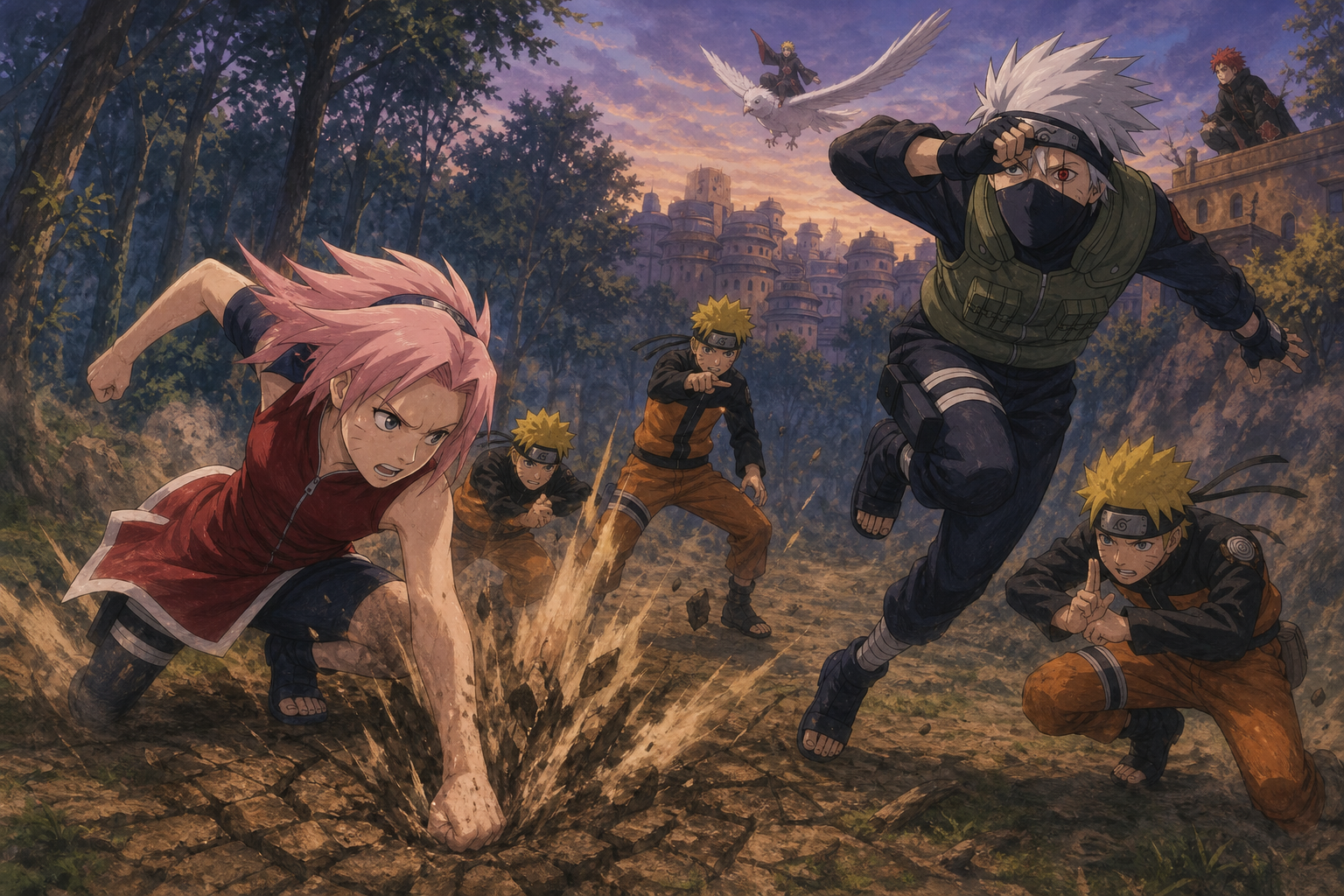
Naruto and Sakura prove their training changed how they fight while Deidara infiltrates the Sand and Gaara detects him.
Bottom line
Naruto Shippuden Episode 3 finally lets the returning Team 7 members prove that their time away changed more than their wardrobes. Sakura can turn the training field into rubble. Naruto can layer clones and transformations without immediately tripping over his own excitement. Kakashi has to uncover the Sharingan early because the children he once tested are now shinobi capable of forcing him to pay attention.
The episode also refuses to let that victory lap occupy the whole screen. While Naruto and Sakura demonstrate growth inside a controlled exercise, Deidara slips above the Hidden Sand and turns Gaara's village into a battlefield. Team 7 has a teacher who wants them to survive the test. Gaara has an enemy who wants to convert his body into an organizational resource. The crosscutting makes “results” feel less like a grade and more like the ability to function when nobody protects the lesson.
Sakura makes the ground answer
Sakura's first serious attack is the episode's clearest statement. She does not need Kakashi to politely acknowledge that Tsunade trained her. She drives chakra through her fist, ruptures the ground, and makes him move. The scale matters because Sakura spent so much of the original series knowing what should happen while lacking the force or confidence to change what was happening.
This is not merely “Sakura got strong.” Tsunade's technique depends on precise chakra control. The destructive result comes from discipline, not from abandoning the skill set that once made Sakura seem less spectacular than Naruto and Sasuke. Shippuden turns her old strength into the mechanism for a new one. That is better character development than handing her a power with no connection to the person she was.
The comedy around Kakashi's alarm does not erase the achievement. His reaction is the measurement. He knows what a direct hit would do, so he treats the terrain itself as dangerous once Sakura commits. Naruto's mixture of awe and fear is also honest. He remembers a teammate whose anger could hurt his feelings. He is meeting a kunoichi whose strike can reorganize the map.
Chie Nakamura's Japanese performance gives Sakura a steadier center here. The confidence is not a speech pasted onto the action. It comes through in the lack of apology before she commits. The character still has emotional edges, but she no longer waits for somebody else to establish whether she belongs in the fight.
Naruto finally uses chaos as a plan
Naruto's shadow clones have always produced spectacle. The important change is how he uses them. Earlier Naruto often treated more bodies as the whole strategy. Episode 3 lets him create pressure, conceal movement, and keep Kakashi solving several problems at once. The clones become decisions instead of confetti.
He still announces too much. He still lunges with the confidence of a boy who has never met a trap he could not personally inspect. Shippuden is right not to sand away those traits. Growth that requires a character to become unrecognizable is usually just replacement wearing a continuity badge. Naruto's improvement appears in the space between impulses: he recovers faster, combines techniques, and reads Sakura's movement instead of treating her as background support.
Junko Takeuchi keeps the familiar brightness in Naruto's voice while giving the attacks firmer weight. The performance does not pretend the time skip aged him into a different species. He sounds like Naruto with more experience behind the breath, which is exactly what the scene needs.
The clones also underline why rank alone misleads. Naruto remains a Genin on paper, yet Kakashi cannot dismiss his volume, stamina, or improvisation. The village's rank system records an interrupted exam history. The fight records current ability. Both facts matter, but only one of them is throwing punches at Kakashi.
Kakashi opens the eye
Kakashi revealing the Sharingan this early is the real evaluation result. He is not offering praise because the script needs a sentimental reunion. He is spending a serious tool because Naruto and Sakura have made casual control unsafe. The teacher's behavior is more convincing than any congratulatory speech.
Kazuhiko Inoue keeps Kakashi's calm intact, but the calm now bends under surprise. That distinction matters. Kakashi does not become incompetent so the students can look improved. He adjusts. A good teacher is not someone who remains forever above the class without effort. A good teacher recognizes when the old assumptions have expired.
The Sharingan also changes the emotional temperature. It carries the Uchiha history into a test where Sasuke is missing. Nobody needs to say his name every thirty seconds for the absence to operate. Kakashi's eye, Team 7's incomplete formation, and the original bell exercise all keep Sasuke present as structure rather than decoration.
That is one reason the rematch works. It is not a reset to happier days. Naruto and Sakura cannot reproduce the original team, and Kakashi cannot make the loss disappear by repeating an assignment. What they can prove is that grief and unfinished loyalty have not made cooperation impossible.
The training field is a protected institution
The bell test is dangerous, but its danger has rules. Kakashi is evaluating students, not harvesting them. Tsunade expects the participants to return. Konoha has placed the exercise inside a system that can stop, judge, and teach. That protection is easy to overlook because shinobi training normalizes violence.
Crosscutting to the Sand makes the protection visible. Gaara does not receive a warning, a rubric, or a teacher who will lower the stakes after sufficient growth. Deidara has already bypassed village defenses. The Kazekage's test begins over civilian roofs, and failure belongs to everyone below him.
This contrast is not saying Konoha is good and the Sand is foolish. Both villages train children for violence and both have histories of treating jinchuriki as assets. The difference in this moment is operational. Naruto and Sakura are being tested by an institution capable of caring whether they learn. Gaara is being targeted by an organization that cares only whether extraction succeeds.
Deidara turns infiltration into theater
Deidara's entry into the Sand is unsettling because it combines stealth with vanity. Sasori's sleeper-agent work opens the route, but Deidara wants the actual incursion to look like art. His clay bird lifts him above walls and guards, turning the village's defensive geometry into scenery beneath a performance.
The ability is tactically smart. Ground checkpoints mean little when an attacker can manufacture flight, vary the size of his creations, and carry explosives in shapes that resemble living things. The art language is not harmless eccentricity. It lets Deidara aestheticize consequences that other people must survive.
The village guards are not presented as total fools. Deidara has intelligence, an internal breach, altitude, and a technique designed for misdirection. Blaming individual sentries would let the institution escape too easily. The deeper failure is that one compromised insider can make layers of security behave like open doors.
The episode waits until Gaara notices the intrusion to puncture Deidara's confidence. That moment matters because it restores Gaara's agency. He is not merely the target named in an Akatsuki meeting. He is the leader watching his airspace and responding before the attacker completes the approach.
Gaara's readiness costs more
Naruto and Sakura prove readiness by forcing Kakashi to use the Sharingan. Gaara proves readiness by identifying a terrorist above his village. The parallel is almost cruel. All three are members of the same generation, but Gaara's office converts growth into immediate responsibility for thousands of people.
His sand can protect him automatically, yet the Kazekage cannot think only about his own body. Deidara's position above the village creates a hostage geometry: any large attack risks the people and buildings below. Power does not simplify leadership. It creates more ways for an enemy to make every available choice expensive.
Akira Ishida's restraint remains crucial. Gaara's quiet does not signal indifference now. It reads as concentration under public responsibility. The character once used violence to prove that he existed. As Kazekage, he has to use force without making everyone else's existence collateral damage.
That transformation is why Akatsuki's goal feels especially obscene. The village finally recognizes Gaara as a person and leader, while the organization arrives to reduce him to the One-Tail sealed inside him. The attack threatens his life, but it also attempts to erase the moral progress represented by his office.
What “results” actually mean
The title invites a simple answer: Naruto learned techniques, Sakura learned monstrous strength, and Kakashi is impressed. The episode offers something better. Training results are only valuable when they change behavior under pressure. Sakura commits without waiting to be rescued. Naruto coordinates instead of merely multiplying. Kakashi revises his assessment. Gaara detects the threat and moves toward responsibility rather than isolation.
There is no universal scoreboard for those changes. Sakura's promotion captures part of her development. Naruto's unchanged rank misses much of his. Gaara's office recognizes extraordinary political change while exposing him to extraordinary danger. The series keeps rank meaningful without allowing it to become truth itself.
This is also why the episode's pace works better than a recap of newly acquired powers would have. We learn through decisions. The ground breaks, Kakashi uncovers his eye, Deidara crosses the wall, and Gaara looks up. Each action forces the next person to update their understanding of the situation.
Fandom arguments worth sorting out
The most common complaint about early Shippuden Naruto is that his training seems unimpressive compared with Sakura's obvious transformation. Episode 3 supports the visual imbalance but not the conclusion that Naruto learned nothing. Sakura receives the larger reveal because her old combat limitations were larger. Naruto's development is distributed across stamina, sequencing, clone use, and cooperation. The series still has to prove whether that is enough, but “not a new fireworks label” is not the same as “no growth.”
Another argument claims Sakura's strength is just a copy of Tsunade. The technique is inherited training, but inheritance is normal in this world. Naruto's signature methods also come through teachers, scrolls, and the chakra sealed inside him. The meaningful question is what Sakura's discipline allows her to do with Tsunade's method and what choices she makes once she has it.
There is also a temptation to treat the Sand infiltration as proof that Gaara is a bad Kazekage. That reading confuses being attacked with causing the attack. The relevant questions are how the breach happened, what information Akatsuki possessed, and how Gaara responds once he detects Deidara. Leadership should be judged by decisions, not by the fantasy that competent leaders prevent every enemy from trying.
RaeRae's verdict
“The Results of Training” gives the time skip the demonstration it needed. Sakura's strike is satisfying because it grows directly from the control that defined her earlier potential. Naruto's clone work is satisfying because it shows the beginning of strategy without turning him into somebody unnaturally tidy. Kakashi's Sharingan is the receipt.
The Sand material keeps the episode from becoming a harmless reunion exhibition. Deidara is already inside. Gaara already has civilians beneath him. One side of the episode asks whether students are ready for harder work. The other asks whether a young leader can protect a village whose defenses failed before he entered the fight.
That is the real result: growth does not purchase safety. It gives people more choices when safety disappears. Naruto, Sakura, and Gaara have all changed. Now Shippuden is going to make them spend that change.
Sakura’s crater is chakra control made visible
The strike works because Tsunade taught Sakura to concentrate and release chakra at one exact instant. The spectacle grows from the precision that always distinguished her, which means the sequel develops an existing strength instead of assigning a disconnected replacement power.
Kakashi’s immediate retreat is the receipt. He does not praise her politely and continue reading. He changes position because the ground has become part of Sakura’s attack and a direct hit would end the exercise too quickly.
Comedy does not cancel the redistribution of power
Naruto’s alarm is funny, but it also registers that his mental picture of Sakura is obsolete. She is no longer the teammate he instinctively places behind the main exchange. Her movement can dictate where Kakashi goes and create the opening Naruto needs.
The joke belongs to changed relationships rather than humiliation. Sakura is allowed to be frightening because she is effective. Naruto’s reaction tells the audience that the old Team 7 hierarchy cannot simply resume after the time skip.
Naruto makes abundance serve intention
Shadow clones once functioned as his answer to nearly every question: produce more Narutos and hope momentum becomes strategy. Here, multiple bodies conceal movement, divide Kakashi’s attention, and coordinate with Sakura’s pressure.
He remains impatient and loud, which keeps the growth honest. Training has not polished away the temperament that makes him recognizable. It has created more useful choices between the impulse and the impact.
Kakashi’s Sharingan is stronger evidence than applause
Uncovering the eye means casual observation no longer provides enough information or safety. Kakashi spends a serious advantage because his students force him to update the test in real time.
His competence remains intact. That is essential. Naruto and Sakura look stronger because an experienced jonin adapts to them, not because the script makes their teacher forget how to fight for twenty minutes.
Sasuke remains present through the shape of the exercise
The bell test was built around a three-person team and a lesson about cooperation. Repeating it with two students leaves absence in the formation even when nobody says Sasuke’s name.
Kakashi’s borrowed Sharingan carries Uchiha history into the scene too. The rematch cannot restore the old team, but it proves unfinished grief has not made Naruto and Sakura incapable of building something together.
The training field makes danger accountable
Kakashi can stop the test. Tsunade expects everybody to return. Injuries would receive treatment inside a village that deliberately created this exercise to measure growth. Those safeguards are easy to miss because shinobi training makes violence ordinary.
Gaara receives no equivalent boundary. Deidara’s approach unfolds above homes and civilians, and failure belongs to the village rather than a score sheet. Crosscutting makes Konoha’s controlled danger look like the privilege it is.
Deidara makes altitude part of the breach
Ground defenses cannot easily answer an attacker whose clay manufactures flight and explosives together. The compromised insider opens the system; aerial movement turns walls and checkpoints into scenery beneath the actual route.
His insistence that destruction is art is not harmless flavor. It allows him to convert consequences experienced by other people into a performance centered on his own authorship. The village becomes material before its residents become opponents.
Gaara’s first task is protecting space beneath him
Automatic sand can defend his body, but the Kazekage must account for buildings and people below every exchange. Deidara’s position creates a battlefield where Gaara’s greater attack power could increase civilian risk.
Leadership therefore narrows the moves available to him. Becoming responsible for more people has not made him weaker. It has made every use of strength carry more information and more cost.
Being targeted does not prove leadership failure
Akatsuki brings insider access, intelligence, specialized flight, and an extraction objective centered on the One-Tail. Judging Gaara because a prepared organization attacks him would reward the attacker for choosing a difficult target.
The relevant evidence begins with what he notices and does next. Gaara detects Deidara before the approach is complete and moves toward the threat rather than retreating into the isolation that once defined his safety.
The title measures decisions, not inventory
Sakura’s new strength is the easiest result to photograph. Naruto’s sequencing, Kakashi’s revised assessment, and Gaara’s public responsibility are less reducible to one named technique.
Training matters when it changes behavior after conditions shift. Every major character in the episode is forced to update: the students coordinate, the teacher uncovers his eye, the infiltrator revises his approach, and the Kazekage looks up.
RaeRae’s full take
I enjoy Sakura breaking the field because the series finally lets her precision occupy physical space. This is not a random strength upgrade attached for applause. It is years of careful chakra control becoming impossible for the men around her to overlook.
Naruto’s growth is deliberately less tidy. I want more for him too, but I am not pretending clone coordination and better recovery are nothing because they do not arrive with a brand-new glowing label. Kakashi’s Sharingan says the pressure is real.
The Sand storyline keeps the celebration honest. Naruto and Sakura demonstrate readiness to a teacher who wants them to succeed. Gaara demonstrates readiness because an enemy is already above his people. Growth does not buy safety in Shippuden. It determines what somebody can do when safety has already failed.
RaeRae checkpoint: Sakura breaks the ground, Naruto makes chaos useful, and Kakashi opens his eye. Those are training results. Gaara looking up at Deidara is the bill arriving.
A teacher can become the final outdated assumption
Kakashi designed the original test and knows the habits Naruto and Sakura carried as children. That experience gives him an enormous advantage until he begins trusting it more than the evidence forming in front of him.
The students do not only need to demonstrate new abilities. They need to weaponize the version of themselves Kakashi expects to see. Sakura’s precision arrives through force he once would not assign her. Naruto’s familiar volume conceals more deliberate sequencing. Their history becomes useful once they understand that Kakashi is reading it too.
Gaara cannot separate the battlefield from the office
A genin can focus on defeating the opponent directly ahead. The Kazekage has to calculate what every attack means for rooftops, residents, defenses, and confidence in the village’s leadership.
Deidara exploits that burden by placing himself above civilians. Gaara’s growth gives him more power and more responsibility at the same time. Readiness is not freedom from constraint. It is the ability to make disciplined choices while an enemy manufactures constraints around everyone he protects.
Receipts and official routes
- Episode number, Japanese and licensed titles, Team 7’s survival exercise, Sakura’s strength, Deidara’s Sand infiltration, and Gaara detecting him: Naruto Official Site episode guide.
- Licensed episode route and English synopsis: Crunchyroll.