
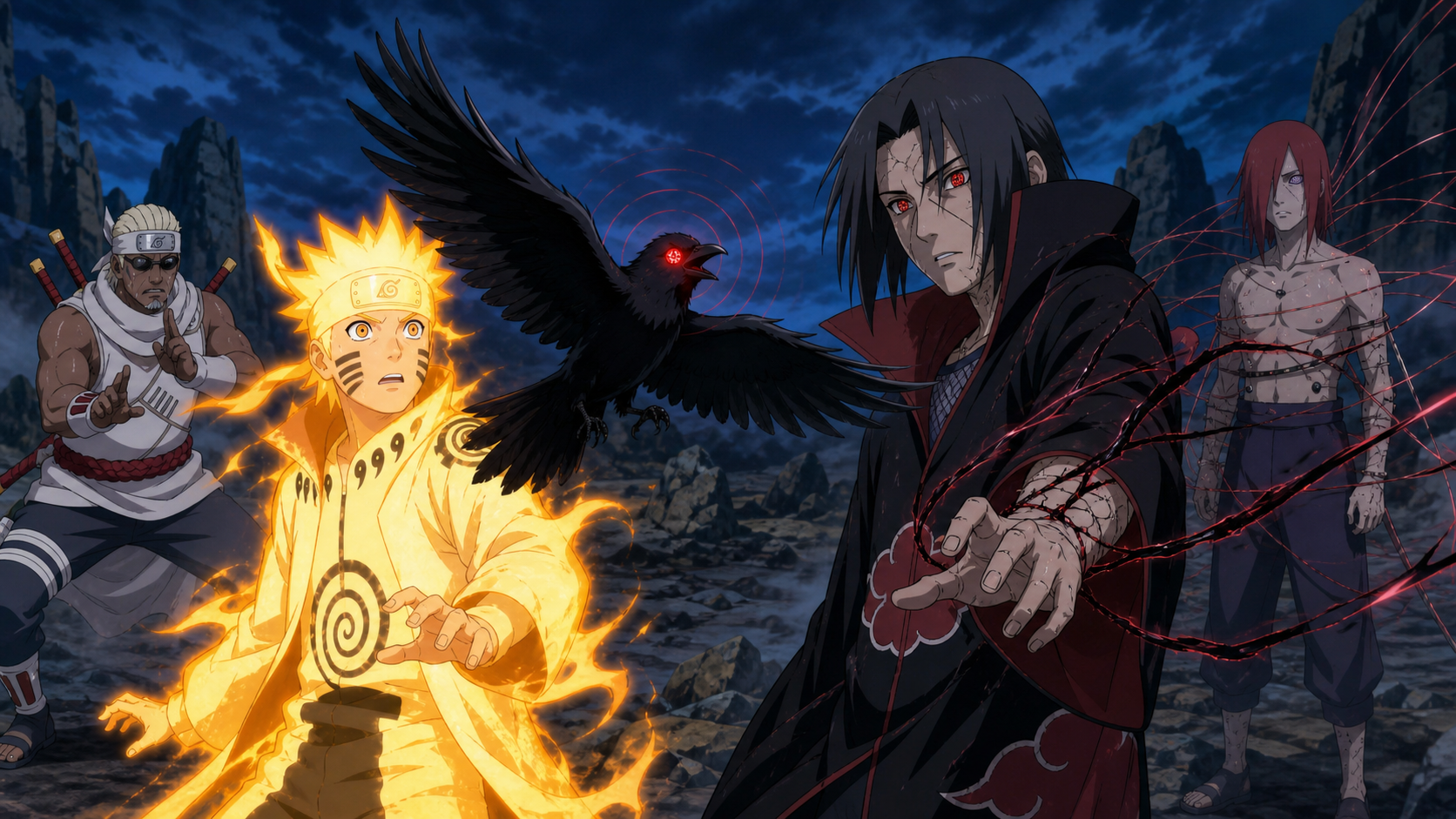
Contact! Naruto vs. Itachi
Naruto and Killer B meet reanimated Itachi and Nagato as a hidden Mangekyo crow turns Itachi’s coercive safeguard against Kabuto’s control.
Bottom line
“Contact! Naruto vs. Itachi” brings four people together under unequal control. Naruto and Killer B can choose their responses. Reanimated Itachi and Nagato can speak but Kabuto forces their bodies to attack. Then a crow carrying Shisui’s Mangekyō Sharingan emerges from Naruto and casts Kotoamatsukami on Itachi with the command to protect Konoha. The safeguard breaks Kabuto’s hold, yet the episode also reveals that Itachi originally planned to use the same invisible command on Sasuke. Freedom arrives through a technique designed to override another person. That contradiction makes the reunion more than a clever reversal.
Itachi and Nagato approach as conscious prisoners
The two reanimated men wonder whom Kabuto will force them to fight. Their awareness survives while bodily autonomy remains restricted.
The official routes establish the collision
Naruto Official catalogs “Contact! Naruto vs. Itachi” as record `01_742`. Crunchyroll lists Shippuden Episode 298 under watch ID `GR195QD16`, released January 31, 2013. The licensed summary identifies Naruto and Killer B fighting reanimated Itachi and Nagato while Itachi learns that Sasuke chose vengeance.
The episode’s true contact is informational. People separated by death and secrecy finally exchange consequences.
Recognition arrives before combat
Nagato senses a familiar presence, and Naruto recognizes both former opponents. The brief reunion carries history that Kabuto treats as tactical material.
Naruto should identify aloud that the men are being controlled. Allied records must distinguish hostile action from voluntary allegiance.
Kabuto targets both jinchūriki
Seeing Naruto and B together gives Kabuto a chance to capture the Eight and Nine-Tails. He commands an immediate attack.
The decision treats Itachi, Nagato, Naruto, and B as containers for useful power. Different techniques support the same extraction logic.
Killer B and Samehada answer the fireball
Itachi launches a large Fire Release attack, and B uses Samehada to cut through and absorb the flames. The sentient blade reacts to the heat.
B’s apology to Samehada is brief but meaningful. Partnership includes recognizing the experience of the tool that is also a living being.
Naruto and Itachi speak while fighting
Itachi clashes with Naruto under Kabuto’s command while asking about Sasuke. Conversation becomes the only remaining channel of agency.
Naruto answers with current facts rather than comforting fiction. Sasuke learned the truth and redirected grief toward vengeance against Konoha.
Itachi learns that his secrecy failed
Itachi asks how widely the Uchiha massacre’s truth has spread. Naruto explains that only a small group knows.
Itachi requests continued secrecy, still prioritizing Konoha’s stability and Sasuke’s reputation over public accountability.
The massacre cannot remain only Itachi’s secret
The Uchiha were killed through state violence, clan conflict, manipulation, and choices made under coercive conditions. A private promise between fighters cannot settle the historical record.
Surviving evidence should be protected, independently reviewed, and eventually disclosed with safeguards for living people.
Disclosure needs stages rather than one dramatic announcement. Investigators should first preserve orders, council records, mission logs, testimony, and burial evidence. Uchiha survivors and affected families need access before public institutions shape a commemorative story. Personal medical details can remain private while command responsibility enters the record. Konoha should also protect people who reveal evidence from retaliation. A village cannot ask citizens to trust history written by the offices whose decisions remain under review.
Sasuke’s vengeance is not a data point
Itachi hears that his brother chose retaliation after learning what happened. That outcome grew from years of deception and isolation.
Calling Sasuke irrational would erase the structure that shaped his choices. Understanding cause does not make every planned attack acceptable.
Nagato is denied even the conversation
Nagato wants clarification but Kabuto forces him to attack. His questions demonstrate awareness while his body demonstrates captivity.
Allied fighters should preserve verbal statements from reanimated people whenever possible. Coerced combat does not cancel testimony.
Summons widen the battlefield
Nagato deploys giant creatures while Itachi maneuvers above the ground. Naruto and B must defend themselves without treating every summon as an independent moral actor.
Containment should focus on breaking command pathways and protecting nearby units. Repeated attacks against regenerative summons waste chakra.
The multi-headed dog punishes repetition
Damage causes Nagato’s dog summon to multiply heads rather than collapse. Naruto’s instinct to hit harder increases the problem.
Tactical teams need permission to stop, observe, and change methods. Persistence without feedback becomes escalation.
B’s partnership protects him from genjutsu
Itachi catches B in illusion, but Gyūki can disrupt the chakra flow and wake him. Jinchūriki partnership becomes a cognitive safeguard.
The moment contrasts sharply with coercive control. Mutual recognition creates resilience that domination cannot reproduce.
Itachi activates the Mangekyō Sharingan
The visual trigger causes a crow to emerge from Naruto. Naruto did not know when or how the stored safeguard would activate.
Placing a living carrier and powerful eye inside another person without informed consent created medical, psychological, and strategic risks.
Shisui’s eye carries Kotoamatsukami
The crow holds Shisui Uchiha’s Mangekyō Sharingan and casts a command beneath conscious perception. The technique can redirect behavior without the target recognizing manipulation.
Such power requires the strongest possible custody rules. Good intentions do not make invisible mind control safe.
The rules should require multiple custodians, written purpose limits, independent authorization, and a record of every attempted activation. Targets need post-use disclosure whenever disclosure does not create immediate danger. Medical teams should examine neurological and chakra effects. No commander, clan, or research division should control the eye alone. A technique that changes choice without visible signs creates a special risk of abuse because victims may never know a decision was stolen.
The programmed order is to protect Konoha
Itachi designed the trigger around his own Mangekyō pattern and the instruction to protect the village. He expected Sasuke to transplant his eyes and eventually face Naruto.
The plan attempted to replace Sasuke’s judgment with an institutional command. Protection of Konoha was defined without Sasuke’s consent.
The safeguard activates on Itachi instead
Reanimated Itachi displays the matching eyes, so Kotoamatsukami targets him. The order conflicts with Kabuto’s control and releases his body from Reanimation Jutsu commands.
An accidental target produces a valuable outcome. That success does not prove the original plan was ethical.
The distinction matters because wartime success can turn a dangerous exception into celebrated precedent. Officials may argue that any coercive technique becomes acceptable when the result protects the village. A proper review asks whether less intrusive options existed, whether the target faced imminent harm, who defined protection, and how the command could be removed. The unexpected rescue should motivate research into restoring autonomy, not normalize secret programming.
Itachi regains agency under another command
Itachi can choose tactics again, yet the command to protect Konoha still structures his restored movement. His freedom is real and qualified.
The episode asks whether one overriding instruction can create autonomy. The answer remains incomplete.
Amaterasu turns against Kabuto’s plan
Freed Itachi uses black flames against Nagato and the summons, interrupting the forced attack. Kabuto loses control of one major asset.
Itachi should prioritize separation and sealing rather than assuming fire alone can stop a regenerating body.
Nagato remains trapped
Nagato’s body regenerates and Kabuto resumes the assault. One prisoner’s escape makes the other prisoner’s captivity more visible.
The team must fight Nagato’s techniques while remembering that Nagato is also a victim of the control system.
Kabuto wants Shisui’s genetic material
Learning that Shisui’s eye remains accessible turns Kabuto’s attention toward acquisition. A person’s body and inherited technique become research inventory again.
Custody decisions must protect the eye from Kabuto, Allied exploitation, and unauthorized copying.
Naruto was made an unwitting vault
Itachi trusted Naruto’s commitment to Sasuke but withheld the nature of what he stored. Trust in someone’s character does not replace consent to bodily risk.
Naruto deserves a full explanation, medical examination, and authority over any remaining foreign material.
That explanation should cover when the crow was implanted, what triggers were expected, which memories or perceptions the genjutsu altered, and whether Naruto could have refused removal. He should receive the information privately before command requests a report. If evidence from the crow remains, Naruto can consent to preservation or request destruction after learning the consequences. Being chosen as trustworthy does not make his body available for storage.
Shisui’s personhood must remain in the record
The eye is not merely a famous technique. The organ came from Shisui, whose death, intentions, and relationship with Itachi shaped the plan.
Any account should name him as a person rather than reducing him to Kotoamatsukami.
Itachi’s contingency planning carries fear
Itachi expected Sasuke might take his eyes, confront Naruto, and attack Konoha. The crow reflects careful foresight and profound distrust of open relationship.
Secrecy gave Itachi control over contingencies while denying others the chance to challenge his assumptions.
Naruto’s promise should remain relational
Naruto wants to bring Sasuke back through recognition and persistence, not erase his will. Kotoamatsukami offers a shortcut that contradicts that goal.
Saving someone cannot mean replacing the person who needs saving with an obedient version.
Konoha’s protection needs ethical limits
The phrase protect Konoha can justify defense, secrecy, surveillance, coercion, or violence depending on who interprets the command.
No village should receive unlimited moral priority over the people living inside and outside its borders.
The team needs a control-break protocol
Itachi’s escape proves Reanimation Jutsu commands can be disrupted. Headquarters should document the trigger, limitations, and observable effects without attempting reckless duplication.
Researchers should seek reversible methods that restore the subject’s own choice rather than install a replacement command.
A field protocol could combine sensory observation, verbal contact with the reanimated person, sealing barriers that slow commands, and experiments on the controller’s chakra link. Every attempt should have an abort condition and an independent safety observer. Freed subjects should confirm whether they control movement, speech, and technique selection before joining Allied operations. Agency cannot be inferred solely because their attacks now favor Konoha.
Medical staff need to examine Naruto
A crow emerging through Naruto’s mouth creates obvious airway and tissue concerns. Chakra residue and genjutsu effects may remain.
Naruto’s ability to keep fighting does not substitute for assessment. A field medic should document symptoms and schedule follow-up.
B deserves the complete tactical explanation
Itachi and Naruto share Uchiha history that B does not know. B remains responsible for Naruto’s safety and needs the operational facts.
Sensitive history can stay protected while the team explains the eye, command trigger, and current allegiance.
B should also be able to challenge Itachi’s plan. Expertise and reputation do not remove the need for questions from the teammate carrying immediate risk. Shared command works when crucial information moves laterally, not only from a celebrated strategist toward everyone else. B’s partnership with Gyūki gives him direct knowledge about consent, internal voices, and the difference between cooperation and possession.
Itachi and Nagato arrive as witnesses trapped inside weapons
Both men recognize Naruto and speak with awareness while Kabuto moves their bodies into combat. The scene refuses the easy comfort of calling them mindless enemies.
They can warn, remember, and react, yet they cannot stop their own hands. Allied reports should record coerced action separately from chosen intent. Reanimation turns a person into evidence of the crime being committed against that person.
Naruto and Itachi conduct a family reckoning during an attack
Itachi asks about Sasuke while throwing lethal techniques because Kabuto grants no private room for truth. Naruto has to fight, protect B, and explain what Itachi’s secrecy produced at the same time.
The absurdity is the point. Konoha forced the Uchiha catastrophe into silence, so the surviving conversation happens on an enemy-controlled battlefield where nobody has enough time and Sasuke is absent again.
Itachi cannot reduce Sasuke to a failed contingency
Learning that Sasuke chose vengeance shocks him because the plan depended on Sasuke accepting a carefully manufactured story. Sasuke instead learned enough truth to understand betrayal and not enough support to survive that knowledge safely.
His response is not a malfunction in Itachi’s strategy. Sasuke is a grieving person whose family, village, and brother all denied him informed choice.
Naruto should not promise to solve Sasuke alone
His loyalty matters because he refuses to abandon somebody everyone else has converted into a threat category. The promise becomes dangerous when Naruto treats relationship as personal ownership over Sasuke’s outcome.
Sakura, Kakashi, surviving Uchiha evidence, village leadership, and Sasuke himself belong in any honest path forward. Naruto can reach for him without becoming the only person responsible for repairing a state crime.
Nagato is present and still denied equal space
He shares reanimated captivity, recognizes Naruto, and carries direct knowledge of manipulation, war, and stolen bodies. The conversation keeps returning to Itachi and Sasuke while Kabuto uses Nagato’s body beside them.
That imbalance should be named. Nagato’s warnings, limits, and memories matter independently. A former enemy does not lose personhood because another tragedy currently holds Naruto’s attention.
Shisui’s eye is a person’s remains before it is a technique
Kotoamatsukami appears as extraordinary strategic power, and Kabuto immediately wants the genetic material behind it. That reaction repeats the system that turns Uchiha bodies into inventories.
The record should name Shisui, his relationship with Itachi, the conditions of his death, and the route by which the eye reached Naruto. Calling the eye an asset would erase the person whose body paid for every later use.
Naruto became a vault without informed consent
Itachi placed the crow inside him as a contingency aimed at Sasuke. Naruto did not understand what he carried, when the command would activate, or how the technique might affect another person’s mind.
The plan may have been designed to prevent catastrophe. Good intentions do not supply consent after the fact. Naruto deserves examination, disclosure, and the right to know whether any other hidden mechanism remains inside him.
The command to protect Konoha exposes the village’s moral shortcut
Kotoamatsukami was programmed to override Sasuke’s will in the name of village protection. The command assumes loyalty manufactured through mind control is preferable to confronting why Sasuke rejected Konoha.
A village preserved by erasing a survivor’s agency has not solved the original crime. Security needs limits precisely when leaders can describe coercion as prevention.
Itachi regains movement through another person’s order
The safeguard activates on him instead of Sasuke, freeing him from Kabuto while directing him to protect Konoha. The result is useful and still ethically tangled.
His choices return inside a command Shisui designed and Itachi programmed for somebody else. Freedom achieved through stronger control should never be described as uncomplicated liberation.
Killer B protects the conversation from becoming a duel
Samehada absorbs the fireball, B watches genjutsu risk, and his presence prevents Naruto from facing two reanimated legends alone. He also witnesses disclosures involving Konoha’s buried history.
Naruto owes him a clear explanation after the immediate fight. Partnership requires more than tactical rescue while one person keeps deciding which political truths the other is allowed to hear.
The multi-headed dog punishes spectacle without analysis
Repeated attacks multiply the summon, turning ordinary escalation into the enemy’s preferred response. The technique rewards observation, restraint, and coordinated sealing.
Units need a stop rule when damage produces more targets. A battlefield culture that measures courage by attack volume will feed the problem while quieter specialists search for the answer.
Amaterasu marks a change in control, not a clean victory
Itachi turns black flames against Kabuto’s plan once Kotoamatsukami disrupts the reanimation command. The reversal creates an opening and confirms that control can be broken.
Nagato remains bound, the summons remain dangerous, and the larger technique continues elsewhere. One freed fighter should become a source of method and warning, not an excuse to declare the coercion system solved.
The Alliance needs a control-break protocol
Shisui’s technique works because a rare hidden command happens to collide with Kabuto’s order. That cannot be the general rescue plan for hundreds of reanimated people.
Sealing teams, sensory units, medics, and intelligence staff should document every moment of regained speech or resistance. Patterns in triggers, range, memory, and command interruption may offer routes that do not require destroying the controlled body.
Itachi’s next choice must include accountability
Breaking free gives him the chance to act against Kabuto, but action does not erase the massacre, the lies told to Sasuke, or Naruto’s use as an unwitting container.
He can protect people and still answer for harm. The episode becomes stronger when redemption means telling the truth, changing behavior, and accepting that forgiveness belongs to the people affected.
RaeRae’s verdict
“Contact! Naruto vs. Itachi” turns a reunion into a study of controlled bodies. Kabuto’s domination is explicit, while Itachi’s contingency hides coercion beneath protection.
The crow saves the battle because the wrong target activates the right conflict. That irony should remain visible beside the spectacle.
RaeRae’s call
Itachi breaks Kabuto’s control because one hidden command collides with another, and that is useful without being clean. Shisui’s body, Naruto’s consent, Sasuke’s agency, and Nagato’s captivity cannot disappear behind the clever reversal. Freedom has to mean more than finding the strongest person who can issue the next order.
Naruto also deserves a full medical examination and a complete honest record of what Itachi placed inside him. Sasuke deserves truth without a command waiting to rewrite his mind whenever his answer frightens Konoha’s leaders again.
Episode details and viewing routes
- Official episode reference: Naruto Official episode guide
- Licensed episode route: Crunchyroll licensed episode page
What I am carrying forward
I am carrying forward Itachi’s restored movement, Nagato’s continuing captivity, Shisui’s right to remain more than an eye, and Naruto’s right to know what another person placed inside his body.
I am also carrying forward the question behind Kotoamatsukami: whether a village protected through invisible obedience has truly been protected. Naruto’s promise to Sasuke needs consent, truth, and relationship, not a command hidden behind someone else’s eyes.