
Power – Episode 3
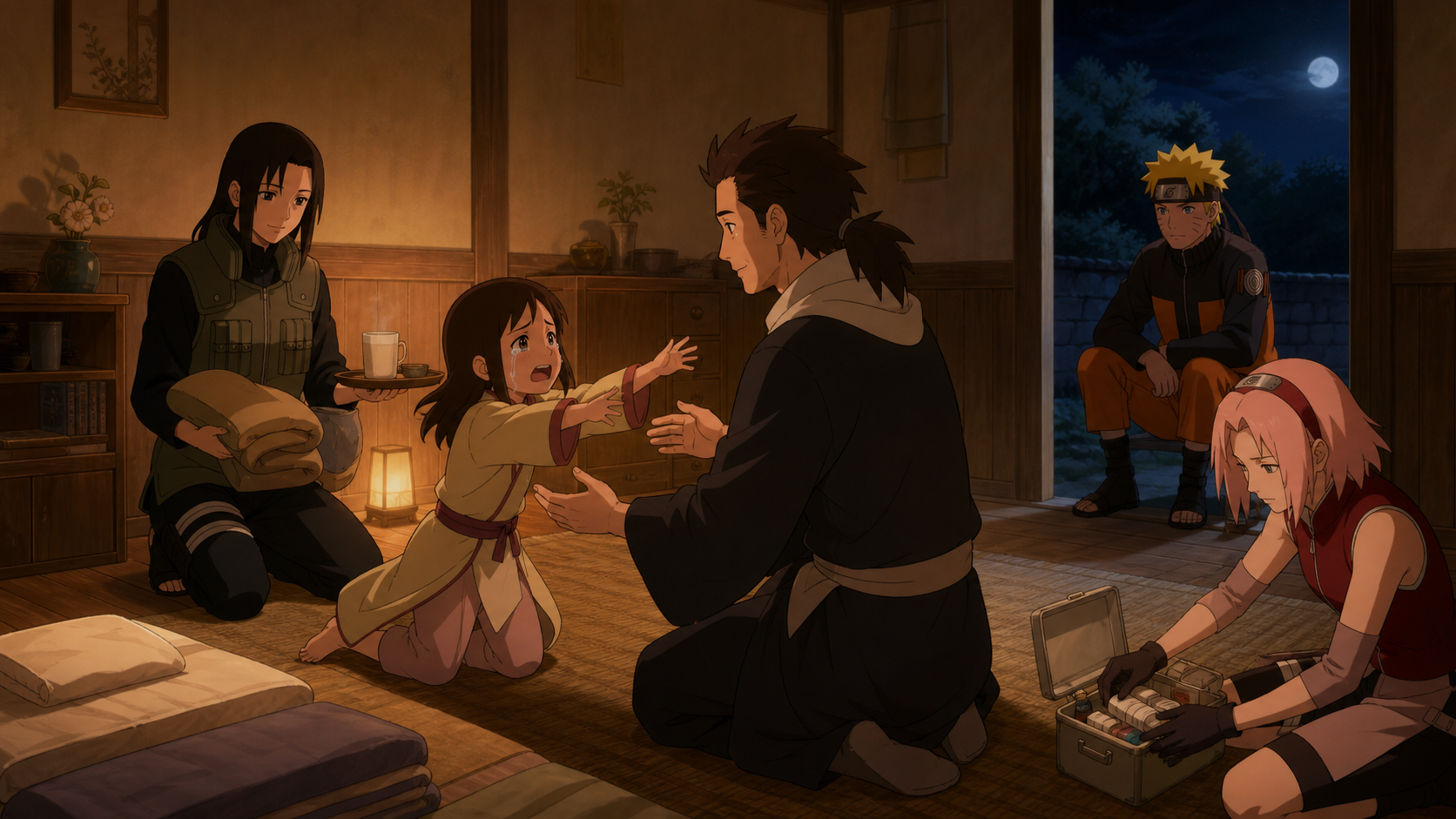
Miina’s nightmare reveals why rescue must continue through sleep, food, routine, promises, and adults who remain present.
Bottom line
“Power – Episode 3” pauses the investigation long enough to show what survival looks like after bedtime. Miina wakes from a nightmare and runs to Dokku. The other children cry for parents who cannot return. Shiseru opens her home, Naruto and Sakura stay overnight, and a group created by catastrophe begins testing whether daily care can become family. The episode refuses the idea that rescue ends when flames disappear. Safety has to be repeated through food, sleep, promises, play, training, and adults who remain present when grief becomes inconvenient.
The night gives Miina’s fear room to surface
Daytime movement can keep a child focused on instructions. Darkness removes those tasks and lets memory return. Miina’s nightmare shows that physical shelter has not convinced her body that danger ended.
Running to Dokku is evidence of trust. He has become the person she expects to respond when fear interrupts sleep. That bond deserves protection rather than teasing or pressure toward independence.
The official routes center the household
Naruto Official catalogs “Power – Episode 3” as record `01_736` in the six-part sequence. Crunchyroll lists “Power – Episode 3” as Shippuden Episode 292 under watch ID `GR8VJM01R`, released December 6, 2012. Both summaries emphasize Naruto and Sakura staying at Shiseru’s house while Dokku and Shiseru try to bring five grieving children together as a family.
That focus distinguishes this chapter from the combat escalation that follows. Quiet care is not filler inside the Power arc. Quiet care defines what every later battle is supposed to protect.
Shiseru opens a home, not a holding area
Shiseru offers rooms, food, familiarity with the village, and her own labor. A house becomes emergency shelter because a person agrees to make space.
That generosity needs material support. One household cannot absorb five displaced children, two visiting shinobi, security needs, and investigation traffic without supplies, money, and relief.
Dokku remains the children’s first anchor
Dokku rescued the children, crossed dangerous terrain with them, and stayed through confusion. They look to him before they understand any larger plan.
Adults should not use that attachment to make every difficult task his responsibility. Preserving his role means protecting him from exhaustion.
The children miss specific parents
Grief is not a general sadness that group activities can erase. Each child lost particular voices, habits, rules, stories, and forms of comfort.
Caregivers should learn names and invite memories without demanding them. A child who wants to speak should be heard. A child who wants silence should not be treated as refusing recovery.
A new family cannot replace the old one
Dokku and Shiseru can become parents without asking the children to stop loving the people killed in Tonika. Adoption and remembrance do not compete.
The healthiest new household will make room for photographs, anniversaries, recipes, stories, and questions about the dead. Belonging grows through addition, not erasure.
Naruto and Sakura stay overnight for practical reasons
Their presence adds security, medical support, and extra adults during a vulnerable night. Staying also tells the children that Konoha’s concern does not end after an interview.
The team should still establish boundaries. Off-duty conversation, sleeping space, weapons storage, and emergency roles need clarity inside a civilian home.
Sakura can observe without turning the house into a clinic
Sakura can notice nightmares, dehydration, untreated injuries, appetite changes, and panic responses. She does not need to medicalize every emotion.
Grief is not a symptom to eliminate. Medical support should address harm while leaving room for ordinary mourning.
Naruto learns that enthusiasm can serve routine
The children ask Naruto to keep a training promise. He initially needs prompting, then commits with the same energy he brings to missions.
Training becomes useful because the goal is connection, movement, and restored confidence rather than immediate combat readiness. The children get to do something with their bodies besides flee.
Shiseru joining training changes the atmosphere
Shiseru participates after finding the exercise interesting. Her choice prevents the activity from becoming a performance where adults watch traumatized children prove resilience.
Shared play lowers hierarchy. Caregivers can be learners too.
A promise to children needs a calendar
Naruto’s promise matters only if follow-through becomes visible. He should state when training happens, what equipment is needed, and who continues after Team Kakashi leaves.
One exciting session followed by disappearance can deepen abandonment. Continuity is part of honesty.
Training must remain optional
Some children may want to run, balance, or learn simple movements. Others may be tired, injured, frightened by shinobi techniques, or unwilling to participate.
Nobody should lose praise, food, or belonging for sitting out. Choice restores control.
Miina’s sensitivity needs gentle documentation
Miina appears unusually responsive to chakra, danger, and sound. Her nightmare may connect to memory, sensory ability, or the arc’s hidden mechanism.
Adults should record patterns without questioning her like a device. She is a child first and a source of information second.
The house needs a night protocol
Every child should know where Dokku, Shiseru, Naruto, and Sakura sleep, which door serves as the emergency exit, and what signal means wake up.
A lamp, water, spare bedding, and a predictable response to nightmares can reduce panic. Small systems make safety believable.
The adults need a private handoff
Dokku and Shiseru should tell Naruto and Sakura about each child’s needs without discussing sensitive details in front of the whole group. Overnight care requires enough information to respond well.
The handoff should include injuries, allergies, known triggers, comfort routines, and missing relatives. Privacy survives emergency.
Morning needs to be predictable
Nightmares can make dawn feel like relief and exhaustion at once. The adults should decide who wakes first, prepares food, checks the perimeter, and explains the day’s plan. Children should not wake to an empty room or discover that Naruto and Sakura left without warning.
A simple written or illustrated schedule can show breakfast, training, rest, interviews, and bedtime. Predictability will not remove grief, but predictability reduces the number of new uncertainties competing for attention.
Schooling should restart gently
Dokku was a teacher before becoming an emergency caregiver. Lessons can restore familiar structure, yet classrooms and assignments may also remind the children of classmates who died.
Education should begin with short, flexible sessions and room for movement or withdrawal. The goal is connection to learning, not proving that trauma caused no disruption. Hachō Village should supply books and space instead of expecting Dokku to recreate a school alone.
Sibling-like bonds need protection
The five children survived together and may now function like siblings. Officials should not separate them based only on age or administrative convenience.
Assessments should document who comforts whom, which children sleep near each other, and whether separation causes distress. Relationships are part of placement evidence.
Dokku and Shiseru need an honest conversation
Becoming a family cannot be implied around them without consent. They need to discuss affection, capacity, housing, danger, and what permanent caregiving would mean.
Love does not produce food, legal authority, or security by itself. A durable household needs resources and shared decisions.
The children should hear age-appropriate truth
Adults may want to protect them by withholding everything about Tonika and Kabuto. Total silence leaves imagination to build worse answers.
The children should know what has been confirmed, what remains unknown, and what adults are doing next. Each explanation can match age and readiness.
Meals become recovery infrastructure
A shared meal offers nutrition, routine, seating patterns, conversation, and a way to notice who cannot eat. Food can carry memories of home.
Caregivers should avoid turning appetite into a moral test. Trauma can make eating difficult.
Play does not disrespect the dead
Children may laugh during training and cry later the same night. Both responses belong to grief.
Adults should not read joy as forgetting or sadness as failure. Emotional movement is not betrayal.
Naruto’s own childhood changes how he watches
Naruto understands an empty home and adults who keep emotional distance. That history can make him attentive to the children’s loneliness.
He must still avoid assuming their experience matches his. Shared pain creates an opening for listening, not ownership.
Sakura sees the labor Naruto can miss
Naruto brings visible energy. Sakura can notice who washed clothes, prepared bedding, divided food, cleaned wounds, and soothed nightmares.
Naming that labor protects Shiseru and Dokku from becoming invisible support characters inside Naruto’s promise.
Security should remain quiet
Kabuto remains active, but a house full of guards and alarms can make children feel trapped. Security planning should use discreet watches, controlled routes, and low-noise signals.
Protection works best when daily life remains possible.
The watch schedule should include Naruto and Sakura without making either person solely responsible through the night. Fatigue weakens medical judgment and threat detection. Local guards who have passed the investigation screen can share perimeter duty while the visiting shinobi remain close enough to respond.
Visitors need the children’s permission
Officials, medics, investigators, and curious neighbors may all want access to Shiseru’s house. The household should keep a visitor log and let children decline nonessential meetings.
Being a survivor does not make somebody public property. Even supportive attention can overwhelm a child who has lost control over home, family, and movement.
The graveyard threat continues outside the home
Kabuto’s preparations do not stop while the household rests. Yamato and Sai still need to investigate, communicate updates, and prevent the safe house from becoming isolated.
The quiet episode gains tension because care and threat exist at the same time.
Family status needs legal follow-through
If Dokku and Shiseru choose permanent care, officials must establish guardianship, identity papers, schooling, health records, inheritance protections, and survivor benefits.
Calling them a family without those protections leaves affection carrying institutional risk.
The process should also identify living relatives without assuming blood connection automatically overrides the household the children now trust. Relatives deserve notice and assessment. Children deserve a voice in placement. A safe, loving attachment formed during crisis should count as evidence rather than inconvenience.
Dokku and Shiseru need conflict support
Two adults can care deeply and still disagree about rules, danger, discipline, or permanent responsibility. Emergency intimacy should not force immediate agreement.
A neutral support person can help them discuss roles without making the children fear another separation. Healthy family formation includes room for adult uncertainty handled away from the children’s hearing.
Tonika’s memorial should include children’s choices
The children may want drawings, names, objects, songs, or no public role at all. Adults should offer options rather than assigning symbolic performances.
Their grief does not belong to a ceremony organizer.
Memorial planning should also avoid asking one child to speak for all five. Leo, Miina, Faz, Lando, and Sora may remember Tonika differently. Separate contributions can sit together without being edited into one message.
The investigation owes the household closure
When Yamato and Sai confirm new information, somebody should translate the operational findings into language the family can use. The household needs to know whether return is possible, which areas remain unsafe, and what happened to missing people.
Closure may remain incomplete, especially while Kabuto escapes. Honest partial answers are still better than silence disguised as protection.
A nightmare is not a failed night
Miina wakes afraid, and the adults respond. That response is evidence the shelter works. Safety does not mean trauma never returns during sleep.
A successful night may include fear, comfort, water, changed bedding, and somebody staying nearby until breathing settles. Measuring recovery by uninterrupted sleep would make the child responsible for proving the house is safe.
Miina chooses Dokku because he kept returning
Trust grew through repeated action: fire, escape, travel, the ravine, meals, and presence. Dokku did not become her anchor through a title.
Adults should respect that attachment during examinations, interviews, and relocation. Allowing him nearby may help Miina remain oriented. Removing him for professional convenience can make necessary care feel like another threat.
Shiseru’s blanket is infrastructure in human form
The gesture looks small beside Naruto’s battles. A blanket answers temperature, privacy, comfort, and the body’s need for weight after panic. Shiseru notices what the room requires.
Care is full of these objects and decisions. Food, water, light, clean fabric, and a familiar voice turn a building into shelter. None should disappear because they lack jutsu.
Naruto protects the doorway without entering the moment
His restraint matters. He can guard the room and remain available without making Miina’s fear into a chance to display empathy.
Trauma-informed presence asks what distance helps the child. Naruto’s power is useful outside the intimate circle where Dokku and Shiseru already have trust. Protecting sometimes means refusing the center.
Sakura can support the body without diagnosing grief away
She should check breathing, injuries, hydration, sleep patterns, and any chakra response connected to Miina’s sensitivity. She should also recognize that mourning is not an illness.
The line matters. Medical attention can reduce harm while leaving sadness legitimate. A child does not need every tear converted into a symptom before adults take the tear seriously.
The other children hear every response
When Miina cries and adults come, Leo, Faz, Lando, and Sora learn something about whether their own fear will be welcomed. Even children who remain quiet are watching the household’s rules.
Caregivers can offer check-ins without requiring disclosure. Consistent response builds a shared expectation: nobody has to create a larger emergency to deserve comfort.
Family formation should not be decided during the softest scene
A tender night can make permanent guardianship feel emotionally obvious. Dokku, Shiseru, and the children still need time, information, resources, and legal support.
Love visible in crisis is meaningful. Permanence should be chosen after everyone can ask difficult questions without fearing that uncertainty will dissolve the current shelter. A household becomes safer when commitment is informed rather than assumed.
Naruto’s training promise needs a successor
He will leave when the mission changes. The children should know who continues the routine and when Naruto can realistically return.
A promise built around one visiting hero is fragile. Dokku, Shiseru, or a vetted local instructor can learn the games and movements. Continuity turns Naruto’s enthusiasm into something the household owns after he departs.
Play gives bodies a different memory of movement
The children have run from fire, crossed dangerous terrain, and watched adults fall. Training can let movement mean balance, laughter, choice, and mastery instead of escape.
That benefit depends on consent and pacing. Nobody should be startled by loud techniques or praised for pushing through pain. Play repairs possibility when the child can stop.
Miina’s sensitivity requires a firewall between care and intelligence
Investigators may notice that her distress predicts chakra activity. That possibility should not move her into testing, surveillance duty, or repeated exposure.
A caregiver and medic should control access to observations. The team can record naturally occurring patterns without creating danger to produce data. Miina’s value does not depend on whether the ability helps catch Kabuto.
The household needs resources without becoming a public spectacle
Food, bedding, repairs, schooling, and security cost money. Public fundraising can attract curiosity and expose the children’s location or histories.
Hachō and Konoha should provide quiet institutional support with clear accounting. Shiseru should not have to trade survivor privacy for supplies. Generosity is strongest when dignity is included in the delivery.
Dokku deserves a role that includes saying he is tired
The children depend on him, which can make rest feel like abandonment. Another adult must be trusted enough to cover bedtime, meals, and emergencies without forcing Dokku to remain half-awake nearby.
Caregiver endurance is not infinite simply because love is real. Scheduled relief tells the children that support can expand without their anchor disappearing.
The morning plan should explain adult departures
Naruto or Sakura may be called to danger before breakfast. Leaving silently to avoid waking the children can repeat the experience of adults vanishing without explanation.
A note, named substitute, and promised update preserve continuity. If timing changes, somebody should say so. Predictability is built through honest repair when plans fail, not through pretending plans never change.
Remembrance belongs inside ordinary household life
Parents and neighbors from Tonika should not appear only during memorial scenes. Recipes, phrases, songs, bedtime habits, and small arguments can remain part of the new home.
Grief lives beside chores and play. Letting names enter ordinary conversation keeps the dead connected without making every memory ceremonial. The children can belong here and still carry where they came from.
The quiet chapter defines the stakes of the remaining Power arc
Kabuto’s experiment may grow louder, but this room tells viewers what must survive. Five children need nights that become less frightening through repetition, not spectacle.
If later battles forget the household, power becomes empty animation. Every technique should be judged by whether the people in this house retain safety, truth, choice, and a future.
Quiet care is still power when a frightened child knows which adult will respond tonight.
RaeRae’s verdict
“Power – Episode 3” earns its quiet pace. Miina’s nightmare, the shared house, and Naruto’s training promise show recovery as repeated ordinary work.
The chapter also gives Dokku and Shiseru space to become more than rescue helpers. They are building a household under pressure, and that work deserves the same narrative respect as combat.
RaeRae’s call
Miina’s nightmare does not mean the rescue failed. The adults answer, Dokku remains her anchor, Shiseru makes a home, Sakura protects the body, and Naruto guards without demanding the center. Safety is the promise to respond again tomorrow night.
Episode details and viewing routes
- Official episode reference: Naruto Official episode guide
- Licensed episode route: Crunchyroll licensed episode page
What I am carrying forward
I am carrying forward the five children as individuals, Miina’s sensitivity, and the need for Naruto’s promise to continue after his mission moves on.
I am also carrying forward a firm rule: a new family should preserve the old families’ names and memories. Care adds belonging. Care does not demand replacement.