
Naruto’s Favorite Pupil
Konohamaru has the power. Shikamaru, Moegi, and Tsunade make him learn what that power must protect.
Bottom line
Naruto Shippuden Episode 234 gives Konohamaru the wartime assignment he does not want and absolutely needs. He wants a battlefield because Naruto has taught him to chase impossible goals. Tsunade gives him the village because sending a child to war would betray the future every adult claims to be protecting. Konohamaru spends most of the episode treating supply work, evacuation duty, and civilian protection as consolation prizes. By the end, Moegi and Shikamaru make him understand that those jobs are the point.
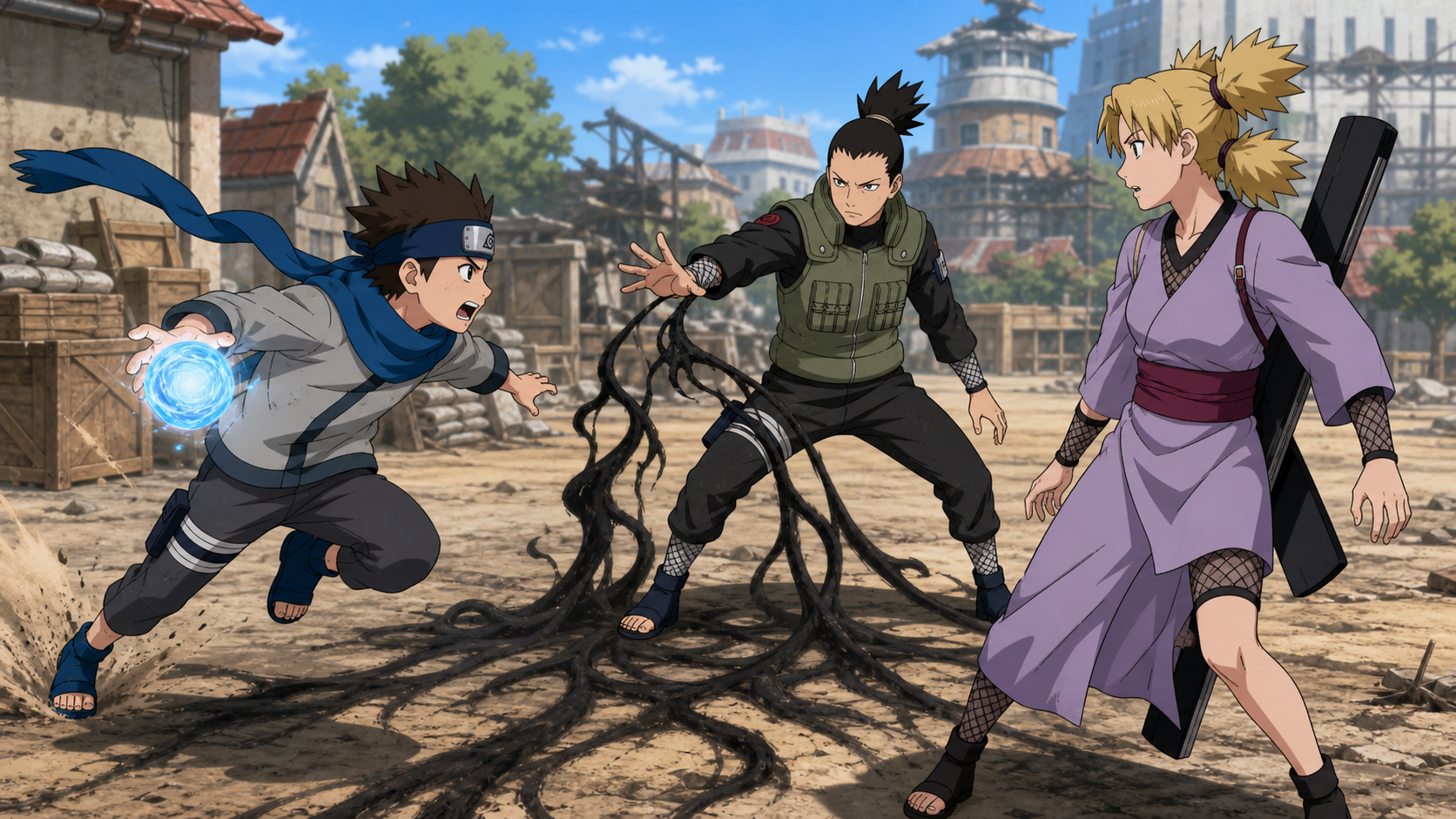
The episode also lets Konohamaru prove that his confidence is not empty. He has learned Fire Release: Ash Pile Burning, Multiple Shadow Clone Technique, and Rasengan. Temari can handle the first attacks, but the Rasengan forces Shikamaru to intervene. Power is not Konohamaru’s missing piece. Judgment is. A shinobi strong enough to hurt an allied jōnin still needs to know when the fight should never begin.
Konohamaru sees war preparation and wants a place
Konoha is preparing bodies, supplies, messages, and routes for the Fourth Great Ninja War. Konohamaru, Moegi, and Udon watch older shinobi receive assignments while Team Ebisu remains behind. The exclusion feels personal to Konohamaru. Naruto has left the village on a secret mission, adult fighters are moving toward history, and Hiruzen’s grandson is being told to wait.
Konohamaru does not want violence for the sake of violence. He wants proof that adults consider him useful. His age makes every refusal sound like another reminder that he lives under somebody else’s name. The same boy who rejected “Honorable Grandson” now rejects “too young” because both labels seem to decide his value before he acts.
Training proves that his power is real
Konohamaru trains with Moegi and Udon and demonstrates Fire Release: Ash Pile Burning. Asuma’s technique releases a cloud of chakra-infused ash that can ignite around a target. Konohamaru’s use is rougher, but the choice matters. He is learning beyond Naruto’s direct toolbox and beyond the Sarutobi image attached to his grandfather.
He also has shadow clones and Rasengan. Those techniques place him far beyond the helpless child who once followed Naruto with a scarf and a ridiculous ambush plan. The episode does not need to pretend he lacks talent. Konohamaru’s frustration grows because he can point to real ability while adults keep assigning him ordinary work.
Sakura gives Team Ebisu the job they dismiss
When Team Ebisu asks how they can help, Sakura sends them to carry and stack supply boxes. Konohamaru hears manual labor instead of wartime contribution. He wants a mission with danger, status, and a clear enemy. Boxes do not look heroic, so he treats the assignment as evidence that Sakura does not respect him.
That reaction misses how wars function. Medical teams cannot treat casualties without supplies. Fighters cannot stay deployed without food, tools, medicine, and replacement equipment. Somebody has to move every crate from storage to the correct unit. The episode places the unglamorous answer in front of Konohamaru before he is ready to accept the answer.
Shikamaru asks Asuma’s question again
Shikamaru gives Konohamaru a stone shaped like a shōgi piece and asks who Konoha’s “king” is. Asuma once used the same question to teach Shikamaru that the king means the village’s children and the future they represent. Shikamaru now passes the question forward instead of simply reciting the answer.
That teaching choice honors Asuma better than a speech would. Konohamaru needs to wrestle with the question because he is still defining protection as front-line combat. Shikamaru gives him a symbol small enough to carry and difficult enough to keep bothering him. The lesson becomes inheritance through thought, not copied wording.
Tsunade refuses to sacrifice another little brother
Konohamaru asks Tsunade for permission to join the front lines. She refuses and throws him out. Her reaction looks comic and severe until the episode connects him to Nawaki. Tsunade’s younger brother also dreamed of becoming Hokage. He entered war with that dream and died before he could grow into the promise.
Konohamaru resembles Nawaki in age, confidence, family legacy, and the exact title he wants. Tsunade cannot look at him without remembering what patriotic urgency cost her family. Her refusal is not a judgment that Konohamaru will never be capable. She knows capability does not make a child expendable.
A village that sends every child has already lost
War stories often flatter young characters by letting them prove adults wrong through combat. Naruto’s world has plenty of children carrying adult violence. Haku, Gaara, Itachi, Kakashi, and Naruto all show different consequences of that system. Episode 234 takes a rare step back and lets Tsunade say no.
Konoha still has responsibilities for genin. Evacuation, civilian safety, supply movement, and village defense matter precisely because the strongest adults are leaving. Protecting the home front is not a lesser war. The assignment prevents the next generation from inheriting ruins, hunger, or undefended families.
Temari becomes the wrong target at the right moment
Temari arrives from Sunagakure with an official message and concern about Konoha’s recovery after Pain’s assault. Konohamaru sees an accomplished allied jōnin and decides she can validate him. He introduces himself as Naruto’s favorite pupil and challenges her.
Nothing about the encounter requires combat. Temari is an ally performing diplomatic work. Konohamaru turns personal insecurity into an international incident because winning against her would feel like proof that Tsunade was wrong. That decision reveals the exact lack of judgment keeping him away from the battlefield.
Temari treats the first attacks like a lesson
Konohamaru uses Ash Pile Burning and shadow clones. Temari’s Sickle Weasel Technique scatters the ash and controls the field. Her experience shows in the distance she maintains, the speed of her response, and the lack of panic. She does not need to humiliate him. The gap between a talented genin and a veteran jōnin appears through clean counters.
Temari’s criticism of Naruto pushes Konohamaru past technique into anger. He cannot tolerate somebody dismissing the teacher who gave him a path outside his grandfather’s shadow. Loyalty is understandable. Turning loyalty into a Rasengan aimed at an ally is reckless.
The Rasengan changes everybody’s reading of him
Konohamaru charges with a real Rasengan. The attack proves Naruto trusted him with dangerous knowledge and that Konohamaru did enough work to master the technique. Temari’s expression changes because the loud child suddenly carries an attack capable of serious damage.
Shikamaru stops the strike with Shadow Sewing before contact. That intervention protects Temari and Konohamaru. Landing the Rasengan could injure an allied envoy, damage relations with Suna, and turn a childish challenge into a disciplinary crisis. Shikamaru does not erase Konohamaru’s achievement. He prevents achievement from becoming harm.
Temari gives praise without giving permission
After seeing the Rasengan, Temari acknowledges Konohamaru’s promise and says she will tell Gaara about Konoha’s next generation. Her praise matters because she has no family obligation to comfort him. She has tested his techniques and seen enough to recognize future strength.
Temari still does not say he belongs in the war. Potential describes what someone may become with time. Potential is not a deployment order. Konohamaru finally receives the recognition he wanted, but the recognition comes paired with the same message Tsunade gave him: someday.
Moegi names the king before Konohamaru can
Moegi reminds Konohamaru that genin must protect Konoha’s children and elders. Those people are the king. Her answer cuts through his obsession with rank because she has been doing the thinking while he has been chasing a dramatic test.
The scene also gives Moegi authority inside Team Ebisu. She is not merely the girl who follows Konohamaru’s adventures. She understands the assignment first and names the responsibility he keeps ignoring. Konohamaru accepts the answer because the answer connects Shikamaru’s riddle, Sakura’s supply work, and Tsunade’s refusal.
The future Hokage must protect ordinary people
Konohamaru wants to become Hokage and challenge Naruto for the title one day. The ambition survives his lesson, which is important. Maturity does not require him to stop wanting greatness. Maturity requires him to understand what the title serves.
The Hokage does not exist to win the most impressive fight. The Hokage organizes protection for children, elders, workers, families, and shinobi who may never receive a statue. Carrying boxes can serve that duty. Guarding evacuation routes can serve that duty. Staying behind when pride wants the battlefield can serve that duty.
Shikamaru has become the teacher Asuma prepared
Shikamaru once needed Asuma to explain the king. Now he recognizes the same confusion in Konohamaru and passes the question along. War has accelerated his growth from gifted strategist to adult responsible for younger shinobi. He does not enjoy every part of that responsibility, but he accepts the role.
His intervention during the Temari fight also demonstrates the lesson. Shikamaru protects an ally, stops a child from making a permanent mistake, and preserves the future relationship between two villages. No enemy falls. The king is still protected.
Tsunade sees Nawaki and chooses differently
When Shikamaru reports what happened, Tsunade remembers Nawaki. Both boys are grandsons of Hokage, both announce their own Hokage dream, and both carry the impatience of children who believe courage should make adults step aside. Tsunade could not save Nawaki from the machinery of war. She can refuse to feed Konohamaru into the same machinery.
That parallel gives emotional meaning to her harsh behavior. She is not coddling him. She is using authority to break a pattern that shinobi culture has normalized. Konohamaru may resent the protection today. He has to survive long enough to understand the gift.
Konohamaru confuses visibility with usefulness
Front-line combat looks like the place where history will recognize him. Crates, evacuation lists, and village guards disappear into the background even though every deployed unit depends on them.
His frustration is partly a problem of storytelling. Shinobi culture celebrates spectacular danger and leaves preventive labor without an audience.
Capability does not create an entitlement to deployment
Konohamaru can produce techniques that injure experienced opponents. That fact proves training, not readiness for every battlefield.
Command must consider age, judgment, team experience, mission necessity, and whether sending a child serves anyone beyond the child’s need for recognition.
Tsunade’s refusal interrupts a celebrated cycle
Konoha routinely turns gifted children into wartime resources, then memorializes sacrifice as proof of devotion. Nawaki’s death showed Tsunade what that praise cannot restore.
Keeping Konohamaru home refuses the belief that a sincere dream becomes more valuable when offered to war before it can mature.
Nawaki’s memory sharpens protection without making Konohamaru identical
The boys share age, family symbolism, and a Hokage dream. Konohamaru is not a replacement through whom Tsunade can rewrite her brother’s life.
Her grief provides warning, not ownership. She must protect the present child while allowing him to develop a future distinct from the one she lost.
Supply boxes contain other people’s survival
Konohamaru sees repetitive lifting. Sakura sees medicine, tools, food, and field capacity that must reach the correct place before casualties arrive.
One mislabeled or delayed crate can matter as much as one failed technique. Logistics becomes heroic when viewers remember the bodies waiting at the other end.
Temari is an allied envoy, not a graduation test
Challenging her places personal insecurity above diplomacy. She arrived carrying responsibility between villages preparing to fight together.
Konohamaru’s willingness to escalate after clean refusal proves why technical power cannot substitute for judgment. An ally does not become a target because defeating her would feel validating.
The Rasengan proves both achievement and danger
Mastering Naruto’s technique demonstrates discipline, chakra control, and trust between teacher and pupil. Directing it at Temari demonstrates how quickly achievement can become harm without proportional decision-making.
Shikamaru preserves the accomplishment by preventing its worst consequence. He does not deny the Rasengan is real; he refuses to let contact become the lesson.
Temari’s praise separates potential from permission
She can acknowledge Konohamaru’s future without endorsing his demand to enter war now. Respect does not require agreeing with the choice a younger person wants.
Her message to Gaara places him within Konoha’s promising generation, which is precisely the generation adults should ensure survives.
Moegi understands service before the self-declared future Hokage
She sees that children, elders, and civilians are not secondary to the battlefield. They are the reason the battlefield is supposed to matter.
Her clarity gives Team Ebisu an internal moral authority Konohamaru cannot claim through famous teachers or family names.
Udon deserves a defined responsibility too
The episode lets him worry from the edge while Moegi names the lesson and Konohamaru receives the growth. A team story should reveal what he understands, contributes, or fears.
Protecting the king belongs to all three genin. The future cannot become another stage built only for the loudest boy.
Shinobi childhood changes according to institutional need
Konohamaru’s demand also exposes how unevenly childhood operates. Villages describe gifted children as mature when missions need their labor, then invoke age when leaders decide a danger is strategically unnecessary.
Tsunade’s refusal is still correct. The wider system remains responsible for creating the expectation that a genin should prove worth through exposure to lethal conflict.
Konohamaru has grown up on stories of Hiruzen, Asuma, Naruto, and other people whose legitimacy was confirmed through battle. Adults cannot be surprised when he mistakes protection for disrespect.
Shikamaru passes down a question instead of inherited trauma
Asuma’s death could make the shōgi lesson a private relic Shikamaru guards. He chooses to use it, giving Konohamaru access to wisdom without requiring the boy to repeat the loss that taught it.
That is healthy inheritance. The next generation receives meaning, language, and responsibility while adults work to spare them the exact wound that produced the lesson.
Shikamaru becomes a teacher because he refuses to make suffering the admission price for understanding.
Village defense is not safe merely because it is behind the front
Keeping Team Ebisu in Konoha reduces exposure; it does not guarantee comfort. Enemy infiltration, sabotage, supply failure, panic, fire, and attacks on civilians can reach the home front.
Genin responsibilities therefore need serious planning, supervision, communication routes, and clear limits. “Stay behind” cannot mean adults leave children with vague instructions and call the arrangement protection.
Konohamaru may earn trust faster if leaders explain the actual stakes instead of presenting boxes as busywork.
A future Hokage must recognize labor without spectacle
If Konohamaru wants the office, he must learn to value people whose work prevents crisis: medics labeling supplies, workers repairing walls, caregivers moving children, clerks tracking resources, and genin carrying crates.
A leader who respects only fighters will starve the fighters and abandon everyone they claim to defend. The title requires attention to systems no monument will celebrate.
His lesson begins when he understands that serving the village is not a temporary substitute for heroism. It is the definition underneath heroism.
RaeRae’s final word on Naruto’s favorite pupil
Konohamaru has a Rasengan and exactly enough teenage confidence to turn an allied envoy into a personal exam. Shikamaru saves diplomacy with one shadow and excellent timing.
Tsunade sees Nawaki, but she does not ask Konohamaru to carry that ghost. She uses grief to choose protection where an older generation chose sacrifice.
Moegi answers the assignment before the future Hokage does. Children, elders, and ordinary villagers are the king. Carry the boxes, young sir.
Konohamaru leaves with the same dream, but a better standard for reaching it. Strength can win attention. Judgment decides whether that strength protects anyone. The village needs both, and growing up means learning why the quieter one is harder to prove before war makes the mistake permanent forever.
What landed and what did not
The strongest material connects Asuma’s shōgi lesson, Nawaki’s death, and Konohamaru’s Hokage dream. Three generations carry the same argument about what villages owe their children. Shikamaru and Tsunade respond from grief, while Moegi supplies the plain answer everyone else circles.
The Temari fight is exciting but pushes power scaling for drama. Konohamaru’s Rasengan creates a threat large enough to require Shikamaru’s intervention, yet Temari has survived far more dangerous battlefields. The scene works better as a judgment test than a claim that Konohamaru nearly defeated her. I also wanted Udon to contribute more than worry from the side. Team Ebisu’s lesson should belong to all three.
Final reaction
“Naruto’s Favorite Pupil” understands that children can be powerful and still deserve protection. Konohamaru’s techniques are real. His courage is real. His impatience is also real, and war would exploit all three before he had the judgment to survive the cost.
Tsunade protects him by saying no. Shikamaru protects him by stopping the Rasengan. Moegi protects his dream by teaching him what a Hokage actually guards. Konohamaru ends the episode with the same ambition and a better definition. He will challenge Naruto someday. First, he has to protect the people who make someday possible.
That final distinction keeps the episode from becoming a lecture against ambition. Naruto changed Konohamaru because Naruto took his dream seriously when adults saw only Hiruzen’s grandson. Konohamaru now has to take Naruto’s example seriously enough to learn the harder half. Recognition follows service. A title cannot replace the people, and a dramatic battle cannot replace the quiet work that keeps those people alive.
RaeRae’s call
Konohamaru’s power is real, and so is Tsunade’s duty to keep him from becoming another celebrated child casualty. Moegi and Shikamaru teach him that protecting ordinary people is the work his Hokage dream must serve.
Episode details and viewing routes
Naruto Shippuden Episode 234, “Naruto’s Favorite Pupil,” first aired in Japan on October 27, 2011. Naruto Official and Crunchyroll currently list the licensed English title as “Naruto’s Favorite Student.” The anime-original episode belongs to the Paradise Life on a Boat stretch and remains in Konoha while Naruto continues traveling.
- Official episode reference: Naruto Official episode guide
- Licensed episode route: Crunchyroll licensed episode page