
The Infiltrator
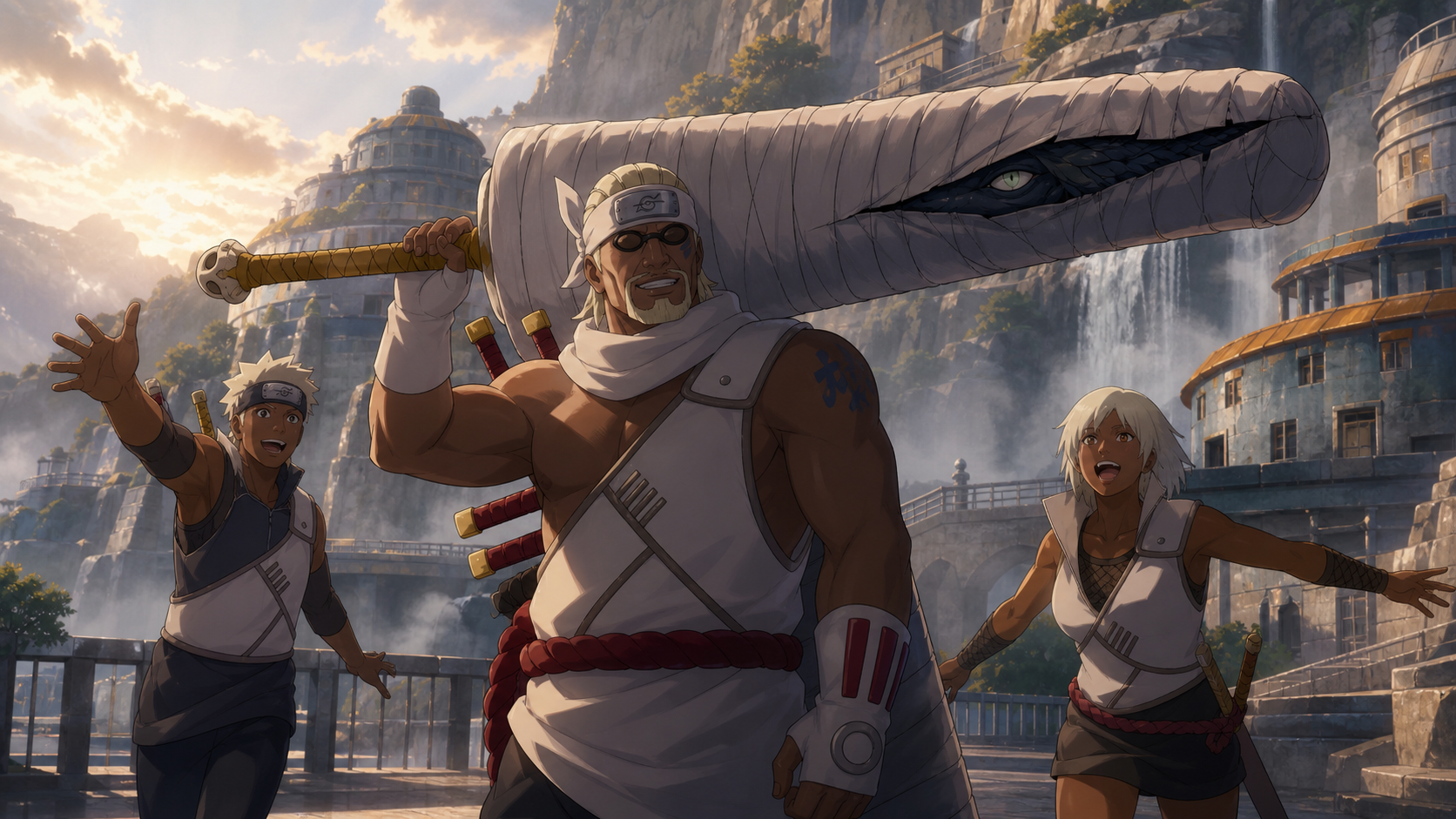
Bee brings Samehada home as a trophy, unaware that the Cloud is celebrating with Kisame already inside its defenses.
Bottom line
Naruto Shippuden Episode 217, "The Infiltrator," turns a joyful homecoming into an intelligence breach. Killer Bee returns to the Hidden Cloud beside the Fourth Raikage, Darui, and C. Omoi and Karui greet their teacher with tears, while Bee proudly carries Samehada as a trophy from his battle with Kisame.
Nobody in the Cloud realizes that Kisame survived. White Zetsu created a parasite clone that traded places with him during the fight, and the decapitated body belonged to that copy. The real Kisame concealed himself inside Samehada so Bee would carry an Akatsuki operative into one of the most protected villages preparing for war.
The episode also follows the Leaf aftermath. Sakura treats Naruto's poisoning, Team 7 retrieves Lee, Kiba, and Sai from the Land of Iron, and Sai reports Danzō's death. Naruto refuses to explain everything he learned from Sasuke, frustrating friends who have already suffered from separate plans and incomplete information. Across both villages, secrecy promises protection while creating the next danger.
Bee's homecoming gives the infiltration cover
Omoi and Karui are not performing a formal welcome. Their relief comes from believing Bee was captured and possibly killed. Seeing him return makes the village feel whole again, especially after the Five Kage Summit confirmed that Akatsuki is preparing for war.
That emotion is exactly what makes scrutiny difficult. Samehada arrives beside a beloved survivor, and Bee explains the sword as a prize claimed from an enemy. The object appears to confirm his victory. Questioning the trophy during celebration would feel like questioning Bee's competence or interrupting the relief of everyone who feared losing him.
Kisame enters through trust attached to another person. He does not defeat the Cloud's walls or disguise himself as an official. He lets the jinchūriki carry him through the gate.
Samehada chooses Bee for reasons Bee misunderstands
Samehada developed an appetite for Bee's chakra during the battle and turned toward him. Bee reads that behavior as the sword taking a liking to a stronger or more compatible wielder. The explanation fits what he experienced and flatters his confidence.
The sword is not a neutral trophy. Samehada has appetite, preference, and a long partnership with Kisame. Carrying the weapon home means importing an unfamiliar living system into Cloud security without isolation or examination.
Bee's misunderstanding is not stupidity. He has evidence that Samehada aided him, and Kisame appeared dead. The trap works because each visible fact supports the wrong conclusion. Good infiltration does not always hide every clue. Sometimes the clues are arranged into a believable story.
Kisame survives by letting a duplicate die publicly
The Raikage and Bee apparently decapitated Kisame together, producing the kind of decisive visual evidence that ends doubt. White Zetsu's parasite clone weaponizes that certainty. A body fell, looked correct, and received the finishing blow everyone expected.
The substitution also uses the chaos of combat. Bee's ink and the water environment create an interval in which Zetsu can exchange the real infiltrator for the copy. Kisame disappears into Samehada while his false body absorbs the consequences.
Akatsuki gains more than survival from the trick. The Cloud believes one dangerous operative has been removed, Bee feels ownership over the sword, and the enemy enters without triggering the fear an unexplained disappearance would create.
Tobi plans for the alliance's predictable response
Once Tobi declares the Fourth Great Ninja War, the villages will protect Naruto and Bee more aggressively. Capturing a jinchūriki becomes harder when guards, barriers, and allied intelligence focus on the final two targets.
Kisame's infiltration anticipates that response. Rather than attacking the tightened security from outside, Akatsuki places an observer inside before the full defensive structure forms. Samehada can remain near Bee while leaders discuss movement, hiding places, and military coordination.
The plan shows Tobi thinking beyond individual battles. Kisame's apparent death is acceptable because the false loss purchases access. White Zetsu's cloning ability, Samehada's bond, and Bee's confidence become parts of one intelligence operation.
The Cloud prepares for war with an enemy already inside
The Fourth Raikage meets the Lightning Daimyō to secure approval for participation in the Allied Shinobi Forces. The process demonstrates that even a Kage cannot simply commit national resources without political authorization.
That official preparation creates a sharp contrast with Kisame's silent arrival. Leaders are discussing armies, command, and inter-village cooperation while an Akatsuki operative listens from a weapon carried by their most valuable jinchūriki.
War planning naturally emphasizes visible scale: troop numbers, leadership, borders, and alliances. Episode 217 reminds viewers that one hidden observer can compromise those larger systems before the first army moves.
Omoi and Karui make the security failure human
Omoi and Karui have spent the summit crisis carrying anger and fear over Bee's disappearance. Their tears establish how much his safety matters beyond his strategic value as the Eight-Tails' jinchūriki.
Kisame exploits a reunion among teacher and students. That detail makes the operation uglier than a clever spy trick. The Cloud's affection for Bee becomes part of the route Akatsuki uses to reach him again.
Neither student is foolish for celebrating. Their response is emotionally appropriate. The failure belongs to a system that treats a battlefield trophy as harmless because the enemy attached to the trophy appears dead.
Bee's concert shows freedom and vulnerability together
Bee quickly returns to his own priorities and stages a rooftop performance. His concert is funny because military leaders are preparing for an unprecedented war while the jinchūriki at the center of their security problem wants an audience for his rhymes.
The performance also expresses the freedom Bee protects. He refuses to live only as a sealed weapon or guarded national asset. Music, ego, and comedy are part of the person the Cloud feared losing.
The Raikage's drop kick restores their familiar sibling rhythm, but the joke carries tension. Bee's independence makes constant surveillance difficult, and Kisame is already close enough to observe every argument about where the jinchūriki should go next.
Naruto returns with another secret
After Sakura administers the antidote, the group retrieves Lee, Kiba, and Sai from the snowy route. Their separate mission has ended, but the emotional division has not. Naruto has reached a new understanding with Sasuke and chooses not to explain the full exchange immediately.
His silence resembles the protective secrecy that failed across the previous episodes. Sakura concealed her assassination plan. Kakashi tried to reserve Sasuke's death as a teacher's burden. Naruto now carries the promised final confrontation as though sharing the truth would only expose his friends to danger.
The motive is compassionate, but compassion does not guarantee a healthy method. His friends have agency, history with Sasuke, and a right to understand decisions that may shape the coming war.
Sai reports what the village must know
Sai brings news of Danzō's death back to the Leaf. The report has institutional weight because Danzō left the village as acting Hokage and died after the summit while fighting Sasuke.
For Sai, the task also closes part of his Root history. Danzō trained him to suppress bonds, obey hidden orders, and treat information as controlled property. Reporting his former commander's death to the village places that secretive authority inside a public transition.
The episode does not turn Sai into a detached messenger again. He has just watched Sakura, Naruto, Kakashi, and Sasuke collide through choices shaped by withheld truth. Delivering the report becomes part of moving the Leaf out of Danzō's private control.
Two villages misunderstand what they have brought home
The Cloud welcomes Bee and unknowingly welcomes Kisame. The Leaf welcomes Naruto back without yet understanding the promise he made to Sasuke. Both returns look safer from the outside than they are.
The parallel is not morally equal. Kisame is an enemy infiltrator, while Naruto is protecting a painful personal decision. The shared structure still matters: hidden information travels inside trusted people, and community relief lowers the pressure to ask difficult questions.
Episode 217 uses homecoming to show that crossing a village gate does not end a crisis. Sometimes the most dangerous part arrives after everyone believes the journey is over.
Infiltration depends on a convincing surface story
Samehada as a trophy explains why Bee owns an enemy weapon. Kisame's false corpse explains why nobody expects pursuit. The sword's attraction to Bee explains unusual movement or attachment. Every suspicious fact receives a plausible answer.
That is the sophistication of Tobi's plan. The operation does not require perfect invisibility. The operation requires defenders to interpret visible evidence in the wrong frame.
The episode teaches an intelligence lesson the alliance will need: verification cannot stop at a familiar face, a body, or a victory story. Akatsuki has already demonstrated techniques capable of replacing people and turning living weapons into hiding places.
The Japanese performances balance celebration and dread
The Japanese performance for Killer Bee carries complete confidence through the return, which keeps the Samehada explanation believable from Bee's perspective. His rhythms make the sword sound like another outrageous addition to his legend rather than an object demanding immediate quarantine.
Omoi and Karui answer with open relief, making the welcome feel personal before the audience sees the danger inside the sword. Their emotion prevents Bee from becoming only a strategic asset and establishes what Akatsuki is violating by using his return as cover.
Zetsu's explanation has a disturbing practicality. The substitution is discussed as a successful operation rather than a miracle, reinforcing how disposable a parasite clone is within Akatsuki planning. The Raikage remains forceful across diplomacy, command, and comedy. His approval meeting carries national weight; his response to Bee's concert returns immediately to family irritation.
The tonal movement works because nobody announces that the episode has switched genres. Celebration, espionage, political preparation, and sibling comedy occupy the same return. The audience carries dread through scenes where the characters are allowed genuine happiness.
The infiltration begins with a victory everybody witnessed
Bee and the Raikage delivered a decapitation dramatic enough to satisfy every observer. The operation succeeds because certainty has a body, blood, and recognizable face.
Zetsu does not ask the Cloud to ignore evidence. He manufactures evidence strong enough to close investigation before Kisame crosses the village boundary.
White Zetsu converts disposability into strategic credibility
The parasite clone can die publicly because Akatsuki values the copy as a surface rather than a person. Its destruction makes the lie more persuasive than any escape story could.
A system willing to spend bodies gains access to performances defenders consider too costly to fake. The Cloud believes death because death ordinarily ends the person who pays it.
Samehada carries a history Bee has not interrogated
The sword aided him and responded greedily to his chakra, creating a plausible story about choosing a new wielder. Its years beside Kisame remain equally important evidence.
Bee reads present preference without investigating prior loyalty. A living weapon can desire his energy while still sheltering the partner whose body knows how to disappear inside it.
A trophy enters security through the hero attached to it
Samehada would attract suspicion if abandoned near a gate. Carried by Bee after a celebrated survival, the same object becomes proof that the enemy lost.
Trust moves from person to possession without a separate inspection. Kisame exploits affection for Bee, confidence in his strength, and the village’s need to believe its brother has returned safely.
Relief becomes a temporary intelligence blind spot
Omoi and Karui have grieved a disappearance they believed Akatsuki caused. Their teacher’s return restores a relationship before any military officer has time to turn celebration into quarantine.
Their joy is not foolish. Security fails when a system expects grieving students to provide suspicion at the exact moment every visible fact confirms reunion.
Bee’s autonomy remains worth protecting after the mistake
His unsupervised choices helped place Samehada inside the Cloud, and Kisame exploits the freedom Bee fought to reclaim. That consequence does not prove permanent confinement was ethically correct.
A mature response needs informed autonomy, inspection, and shared responsibility. Turning the breach into justification for ownership would reproduce the jinchūriki policy that taught Bee to escape.
The Raikage governs across family and state roles
He needs daimyo approval for national mobilization while managing a brother who stages concerts during wartime preparation. Neither relationship can be reduced to a command chart.
Kisame enters through the space where those roles overlap. Protecting Bee as family and protecting him as the Eight-Tails require different kinds of attention that institutional urgency keeps collapsing together.
Kisame chooses intelligence over immediate capture
Hiding beside Bee gives him proximity to the final jinchūriki, yet attacking immediately would waste access to alliance plans and reveal the false death.
The patience distinguishes infiltration from survival. Kisame accepts concealment after a spectacular battle because information about movement, command, and protection may be more valuable than one rushed attempt.
Naruto’s silence is not espionage and still creates vulnerability
He withholds the bridge promise to spare friends from a burden he believes belongs to him. The motive differs completely from Kisame’s hostile concealment.
The structural warning remains. Trusted people carrying hidden information can prevent a community from preparing for consequences already moving toward it, even when secrecy begins as care.
Sai’s report moves Danzō from shadow fact to public transition
Root trained Sai to compartmentalize knowledge under one commander. Reporting Danzō’s death returns consequential information to the village rather than allowing another private chain to control the aftermath.
The act does not erase Root’s conditioning. It demonstrates a different loyalty, where institutional survival requires shared facts instead of unquestioning silence.
Alliance scale increases the value of one hidden witness
Five nations can assemble armies, barriers, command structures, and protected routes. Kisame inside Samehada may learn where those systems intersect before any formation reaches battle.
Coordination creates strength and concentrates information. One infiltrator near the planning boundary can map vulnerabilities produced by cooperation itself.
Production choices let the sword become a suspense frame
The audience knows more than the Cloud, so Samehada changes every homecoming image. Bee occupies the warm center of the welcome while the wrapped blade carries a concealed threat into the same composition.
That dramatic irony allows ordinary gestures to become tense. A hand near the hilt, a shift in the wrapping, or a decision to keep the sword close can all serve Kisame without Bee noticing.
The reveal of the Zetsu substitution replays the earlier victory from a new angle. What looked final becomes staging. The episode changes the meaning of an already-seen death instead of inventing a completely separate escape.
The warm Cloud palette and open village space make Kisame's concealment feel even more invasive. He is no longer hidden in a hostile cave or underwater battlefield. He occupies the center of a community welcoming one of its own home, which turns visual safety into dramatic irony.
The Cloud and Leaf both mistake return for resolution
Bee reaches home with an enemy inside his sword. Naruto reaches homeward with a fatal promise inside his silence. Familiar people cross trusted boundaries while communities see survival and stop asking what returned with them.
The comparison does not equate motives. It asks whether love can remain curious enough to verify danger after relief begins.
Visible evidence needs context before becoming certainty
A corpse proves someone died, not necessarily who. A living sword aiding Bee proves appetite, not uncomplicated allegiance. Naruto’s presence proves survival, not emotional safety.
Episode 217 keeps rearranging correct observations into false conclusions. Intelligence requires testing the relationship among facts rather than celebrating each fact alone.
The real breach is interpretive before it becomes physical
Kisame has already crossed the gate, but success depends on defenders interpreting every sign through the victory narrative. Samehada moves because it likes Bee; the corpse looked right because Kisame died.
The village will not search for what its story says cannot exist. Infiltration gains its deepest cover when belief performs the guarding.
Trust needs procedure when emotion is carrying the evidence
Bee deserves the welcome he receives, and Omoi and Karui deserve the relief of seeing him alive. Neither emotional truth makes Samehada safe. A responsible system should preserve the reunion while examining the living weapon separately, because affection should never be forced to perform the work of security.
The failure matters beyond one careless trophy. The alliance is being built from villages with different histories, techniques, and standards for verification. Akatsuki already uses duplicates, transformations, possession, space-time movement, and living tools. Shared defense will require protocols capable of questioning a convincing body without treating every returning shinobi as a suspect forever.
Kisame succeeds inside that gap. The Cloud trusts Bee, Bee trusts his interpretation of Samehada, and everybody trusts the corpse. Each judgment is reasonable in isolation. Placed together, they create a path from battlefield defeat to the protected center of a village. The infiltrator does not overcome trust. He arranges trusted facts until they point away from him.
RaeRae’s final word on The Infiltrator
Bee brought home the sentient sword that spent an entire fight eating his chakra, and everybody accepted “it likes me now” as the security briefing. Sir, quarantine the shark luggage.
I understand why the Cloud relaxes. They saw Kisame lose his head, and Bee’s students are crying because their teacher returned from the dead. Zetsu built the lie from evidence designed to deserve trust.
The Leaf story makes the same warning quieter. Naruto is home, but the promise he carries will shape everybody who has not been allowed to hear it.
Five nations prepare armies while one enemy sits beside the person they most need to protect. Scale cannot compensate for a story nobody verifies.
RaeRae’s call
Kisame enters the Cloud because Zetsu manufactures a convincing death and Samehada arrives under Bee’s trusted victory. The strongest gate fails after interpretation declares inspection unnecessary.