
The Secret of Jinchuriki
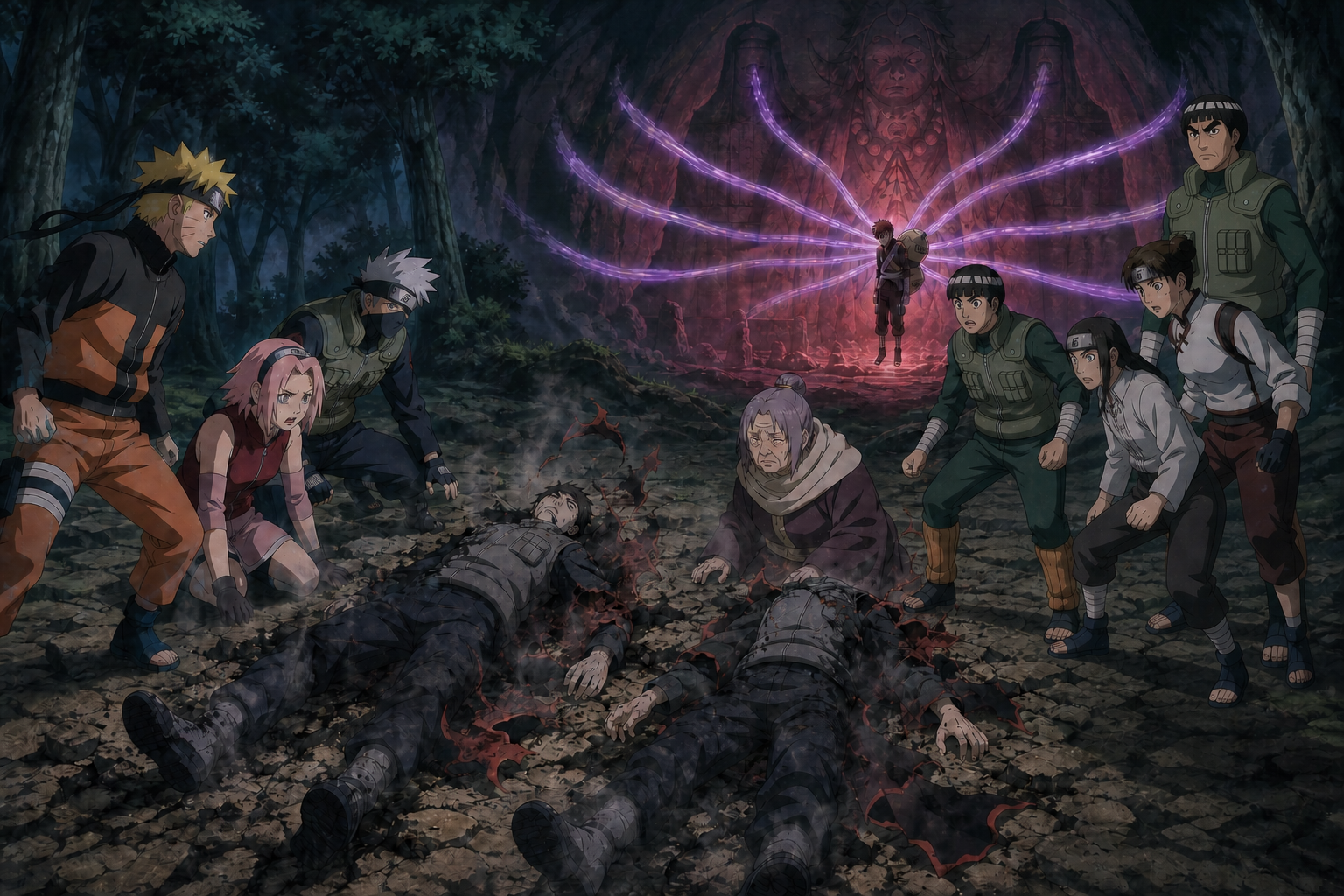
The defeated decoys reveal how Akatsuki spends other bodies for time as Chiyo explains why extracting Shukaku will kill Gaara.
The secret is a death sentence
Naruto Shippuden Episode 16 finally names the rule that has governed Gaara's captivity from the beginning. A tailed beast and its jinchuriki are bound so tightly that extraction kills the host. Chiyo does not deliver this as distant lore. She tells Naruto what Akatsuki's ritual means for the person he is racing to save.
The explanation changes the rescue without changing its destination. Naruto already understands Gaara as another person who grew up carrying a creature that made adults fear him. Now he learns that Akatsuki cannot take Shukaku and leave Gaara behind as an injured survivor. Their objective consumes him.
That is the secret in the title. It is not an advantage hidden inside a host. It is the lethal cost concealed by the language of vessels, weapons, and extraction. Once Chiyo says it plainly, every minute spent fighting a decoy becomes part of Gaara's danger.
The defeated enemies were never the real targets
Kakashi and Team Guy win their battles, but the bodies left behind expose the limits of that victory. The Itachi and Kisame they fought were techniques imposed on sacrificed shinobi. Akatsuki's actual members remained at the hideout, directing borrowed bodies while the sealing ritual continued.
The reveal is practical before it is philosophical. Neither rescue team has removed an Akatsuki member from the operation. They have spent chakra, absorbed injuries, and lost time against opponents whose deaths do not weaken the organization's core.
It also clarifies why the copies could resemble the originals without matching their full power. The technique reproduced identity and access to abilities through bodies that had only a fraction of the necessary chakra. The rescuers were fighting convincing surfaces designed to occupy them, not complete replacements.
Akatsuki built a defense where even defeat serves the plan. A fallen decoy tells the heroes they can advance, but only after the extraction has gained more time.
Akatsuki outsources the cost of battle
The substitute technique reveals an organization careful with its own people and careless with everyone else. Itachi and Kisame can contest two elite teams without placing their original bodies on either battlefield. The risk belongs to unnamed shinobi selected because Akatsuki considers them expendable.
That division of risk is not incidental cruelty. It is part of the structure. Powerful members preserve their chakra for the ritual while lesser bodies absorb attacks, pain, and death. The organization converts people into time.
Gaara is being used through the same logic at a larger scale. Akatsuki sees the power inside him and treats his life as packaging that can be discarded after removal. The substitutes carry techniques instead of tailed beasts, but both are valued only for what can be extracted or projected through them.
The episode therefore connects its two locations. The corpses in the forest and Gaara in the cave belong to one system. Akatsuki protects its hierarchy by forcing other bodies to pay every immediate cost.
Chiyo turns folklore into an emergency
For many people in the shinobi world, jinchuriki are discussed as military assets, village embarrassments, or frightening legends. Chiyo strips away those abstractions. If the tailed beast is removed, the host dies.
Her explanation gives Naruto information he was never properly taught about himself. The fact that he learns it during Gaara's rescue says something ugly about Konoha's protection of its own jinchuriki. Adults trained Naruto around danger while withholding a basic truth about what his bond with the Nine Tails means.
Chiyo is not comforting him. She is honest because the mission requires shared reality. Naruto needs to understand why delay cannot be accepted and why Gaara may already be near death.
The disclosure also deepens Chiyo's change. She once treated jinchuriki through the Sand's institutional language. Traveling beside Naruto forces her to explain the cost to someone who lives inside that category.
Naruto hears Gaara's fate as his own
Naruto does not receive Chiyo's lesson as neutral intelligence. Gaara's condition immediately reflects a possible future for him. Akatsuki is not pursuing a strange category of target elsewhere in the world. It is pursuing people like both of them.
This recognition intensifies Naruto's urgency without making it selfish. He wants Gaara saved because Gaara is Gaara, not merely because the rescue proves Naruto can survive. Their shared status lets Naruto grasp the isolation behind the title of Kazekage.
The episode also exposes the difference between empathy and equivalence. Naruto and Gaara carried different beasts, suffered under different villages, and made different choices. Naruto does not erase those differences. He recognizes the common decision imposed on them: other people decided their bodies should contain power before they could consent.
Learning the extraction rule makes that original violation ongoing. A jinchuriki's body remains a contested site long after the sealing ceremony ends.
Kakashi reads the diversion correctly
Kakashi's most important act after the battle is not celebrating the result. He identifies what the result means. The decoy was a diversion, so the team must treat its disappearance as evidence that the real operation has advanced.
That response protects the mission from a common trap. A difficult fight can feel important enough to deserve reflection, recovery, or pride. None of those reactions are available while Gaara remains inside the ritual.
Kakashi also understands that Akatsuki planned around emotional targets. Itachi could occupy Naruto and Kakashi through Sasuke's history, while Kisame could provoke Guy through their earlier encounter. The enemies chosen for each team were not random guards.
Recognizing manipulation does not recover the lost minutes. It prevents the manipulation from defining the next choice. Kakashi returns attention to movement, information, and the person waiting beyond the cave.
Team Guy's victory carries no relief
Team Guy corners Kisame's projection through coordination, endurance, and Neji's ability to free the others from the water prisons. Under ordinary conditions, defeating an opponent of that scale would justify relief. The substitute body makes relief impossible.
Guy, Lee, Neji, and Tenten discover that their battle was engineered to spend them. Their skills still mattered because the alternative was capture or death, but success did not damage the real Kisame.
This is a useful distinction between pointless labor and exploited labor. The fight was necessary for Team Guy's survival and for the route to reopen. Akatsuki exploited that necessity by arranging for another person to bear the final cost.
The team's response must be practical. They cannot reclaim the chakra or time already spent. They can only keep formation, share what they learned, and continue toward the hideout without mistaking exhaustion for completion.
The ritual turns distance into violence
Akatsuki members do not need to stand beside Naruto to harm him. The ritual cave, the substitute battles, and the sealed entrance create layers of distance between decision and consequence.
That distance protects the people with authority. The members maintaining the extraction can concentrate on Gaara while their technique makes remote bodies fight. Pain happens elsewhere, carried by people whose names the organization does not need to remember.
The setup resembles a chain of command stripped of accountability. A powerful person contributes chakra, a subordinate becomes a vessel, and a target loses time. Each layer lets the center claim distance from the blood at the edge.
Naruto's team breaks that design by tracing consequences back toward the cave. Understanding the decoys does not undo their deaths, but it reveals where the responsible system is located.
A host is a person before a category
The word jinchuriki is useful because it describes a real magical and political condition. It becomes dangerous when the category replaces the person.
Gaara's village once treated him as a failed weapon. Akatsuki treats him as a container worth opening. Both views begin with Shukaku and work outward, leaving Gaara's wishes until last or excluding them entirely.
Naruto reverses that order. He begins with Gaara, then understands the beast as part of the danger surrounding him. That is why Chiyo's information becomes motivation rather than fatalism.
The same principle applies to Naruto himself. Kurama's power affects his life, but it does not exhaust his identity. Any institution that speaks only about the beast will miss the child, teammate, rival, and friend carrying it.
Episode 16 makes this ethical point through mission stakes. Saving the jinchuriki means saving the person whom the category has repeatedly hidden.
Extraction weaponizes an existing bond
The sealing ritual does not create the connection between host and beast. It exploits a bond established by an earlier generation. Gaara's death would be the delayed cost of a decision made when Shukaku was sealed inside him.
That timing complicates responsibility. Akatsuki performs the extraction, but the hidden-village system created a body from which a tailed beast could be extracted. The villages and Akatsuki disagree over ownership while sharing the habit of treating enormous power as something that should be housed in a person.
Chiyo's knowledge comes from that older system. Her value now depends on what she does with it. Explaining the danger and helping the rescue does not erase her generation's choices, but it refuses to let silence protect them.
The episode gives inherited knowledge two possible uses. It can maintain the machinery that consumes people, or it can help the next generation reach someone caught inside it.
The rescue clock becomes personal
Before Chiyo's explanation, the team knew that Akatsuki was doing something dangerous to Gaara. After it, the clock has a specific endpoint. Completion of the extraction means death.
Specific stakes change tactical judgment. Rest, pursuit speed, chakra conservation, and the sealed cave entrance must all be measured against a life that cannot wait for ideal conditions.
Naruto's impatience therefore contains truth even when it needs Kakashi's discipline. He is right that delay is deadly. Kakashi is right that a team arriving broken or trapped cannot save anyone. The mission needs urgency shaped into sustainable action.
Akatsuki tries to split those qualities apart. Its decoys invite reckless expenditure, while its barriers punish slow progress. The rescuers need Naruto's refusal to accept Gaara's death and Kakashi's ability to turn that refusal into a route forward.
Bodies reveal the organization's hierarchy
The two substitute corpses answer a question the Akatsuki robes conceal: whose body is protected when the organization acts?
Itachi and Kisame appear equal to the people they imitate only at the level of face and technique. The substitutes do not share equal access to safety, information, or choice. Their bodies are the disposable foundation under the members' power.
Hierarchy often hides itself through symbols of unity. Matching robes make Akatsuki look like a circle of peers, but the ritual depends on other lives outside that circle. The organization can appear small and elite because its true labor and casualties remain offstage.
Episode 16 drags two of those casualties into view. Their identities may be unknown to the rescuers, yet the absence of names should not make the tactic morally clean. An unnamed person can still be coerced, used, and killed.
Knowledge creates responsibility
Once Naruto knows that extraction kills a jinchuriki, he cannot return to the simpler belief that Akatsuki merely steals monsters. The information will shape how he understands every future target, including himself.
Knowledge also creates responsibility for Chiyo. She has moved from assuming the Leaf would fail to giving its ninja the facts needed to act. Each disclosure binds her more closely to the rescue.
Kakashi bears another form of responsibility. He must decide how much of the danger the team can absorb while still reaching the cave. Knowing the clock makes every order heavier, not easier.
The episode resists the idea that truth automatically solves a problem. Truth removes excuses and false comfort. It tells the characters what their choices now mean.
That is why the secret matters. Naming the connection between beast and host makes Gaara's life impossible to treat as an optional addition to the mission.
Fandom arguments worth sorting out
One argument says the decoy reveal cheapens the fights because the real Itachi and Kisame were never present. The reveal is the purpose of the fights. Akatsuki wins time by making necessary combat consume the rescuers without risking its core members.
Another argument treats the substitute bodies as ordinary clones. They are sacrificed people carrying projected appearances and techniques. The ethical difference is central to the episode.
A third argument says Naruto should already know extraction can kill him. His ignorance fits a childhood defined by adults withholding information about the Nine Tails. Chiyo's explanation exposes that failure.
The final argument treats Gaara's situation as valuable only because it foreshadows danger for Naruto. Naruto's connection gives the audience a point of recognition, but Gaara's life is the immediate reason the rule matters.
RaeRae's verdict
“The Secret of Jinchuriki” turns two battlefield reveals into one accusation. Akatsuki spends substitute bodies to protect its members, then extracts a tailed beast without regard for the host who will die. The organization values power and treats the people carrying it as replaceable.
Chiyo breaks the silence around that system. Kakashi reads the decoys as evidence of a larger strategy. Team Guy accepts that a hard-won victory only reopened the route. Naruto hears that Gaara's captivity is not survivable if the ritual finishes.
The episode is transitional in movement but decisive in meaning. The rescuers now know exactly what delay costs. They also know that the enemies they defeated were people sacrificed to produce that delay.
The secret is not simply how jinchuriki die. It is how institutions hide the person inside a useful category until somebody insists on naming the life at stake.
The word secret protects the adults who withheld it
Naruto’s ignorance is not evidence that the extraction rule was unknowable. Adults in Konoha understood enough about tailed beasts to regulate his childhood, restrict information, and build policy around Kurama. They chose control without giving the child inside that control a complete account of his own danger.
Calling the rule a secret can make silence sound neutral. The silence protected institutions from difficult questions about consent, responsibility, and what Naruto was owed.
Chiyo gives Naruto information about his own body
She is explaining Gaara’s emergency, but the lesson belongs to Naruto too. Akatsuki’s target category includes him, and the same extraction logic threatens his life.
This is bodily knowledge he should not have had to receive from a former Sand elder during another jinchuriki’s rescue. The moment exposes how poorly secrecy served the person supposedly being protected.
Gaara’s office cannot protect him from being reduced to a vessel
Becoming Kazekage gave Gaara political authority and public responsibility. Akatsuki looks past both. The organization recognizes Shukaku and treats the leader carrying him as removable packaging.
That reduction matters because status is often offered as the cure for stigma. Gaara earned the village’s trust, yet the older structure remains available whenever somebody wants the power inside him more than the person he became.
The substitute corpses are evidence, not scenery
Once the borrowed faces fall away, two bodies remain. Their lack of narrative names does not turn them into neutral material. Somebody lived in each body before Akatsuki converted it into a remote battlefield.
The rescuers cannot restore those lives by feeling guilty for defending themselves. They can refuse the organization’s framing, record what happened, and understand that Akatsuki’s protected center depends on casualties kept at the edge.
Distance does not reduce Akatsuki’s responsibility
Itachi and Kisame were not physically present, but their chakra and intent directed the violence. The technique separates decision from injury without breaking the moral connection between them.
Power often uses distance to make consequences look accidental. Episode 16 closes that gap by placing the bodies beside the continuing ritual. The same people directing harm from safety are still consuming Gaara.
The rescue teams must grieve without surrendering the clock
Discovering the substitutes creates horror, confusion, and new tactical questions. Gaara’s condition permits no long pause for any of them.
Moving forward is not indifference to the dead. It is refusing to let Akatsuki extract a third life while the rescuers process the first two. Accountability will require memory after survival requires motion.
Naruto’s urgency needs Kakashi’s shape
Naruto correctly hears Chiyo’s explanation as an emergency. Kakashi correctly understands that panic can spend the team before the cave opens.
Their strengths are complementary when neither dismisses the other. Naruto keeps Gaara from becoming an abstract objective; Kakashi converts that moral refusal into pace, formation, and decisions the whole team can survive.
Chiyo cannot undo Sand policy, but she can stop repeating its silence
Her generation helped sustain a world where hosts were discussed as tools and children inherited consequences without explanation. Speaking now does not erase that history.
It does change what the next choice contains. Naruto can act with informed urgency, Sakura can understand the medical stakes, and Kakashi can plan around a deadline nobody is pretending away.
The episode links extraction to every earlier act of naming
Gaara was monster, weapon, failed experiment, Kazekage, and friend before Akatsuki called him a target. Each name tried to decide which part of him mattered.
Naruto’s insistence is simpler: Gaara is a person who must come home. That claim does not deny Shukaku. It refuses to let the beast become the only fact allowed to organize Gaara’s fate.
RaeRae’s full take
This episode makes me angry at more than Akatsuki. Naruto should not be learning the death condition attached to his own body while racing toward somebody else’s extraction. Konoha gave adults rules for handling him and left him without the truth needed to understand the threat.
Chiyo finally says the sentence plainly, and everything sharpens. Gaara is not waiting to wake up weaker after Shukaku is removed. The ritual ends with his death. The substitute bodies prove Akatsuki will spend any person it considers peripheral to keep that ending on schedule.
Kakashi and Team Guy did not fight pointless battles. They survived traps designed to make necessary resistance expensive. Now the only honest victory is reaching the cave while remembering every body Akatsuki tried to turn into a disposable container.
RaeRae checkpoint: The secret is not only that extraction kills a jinchuriki. The scandal is how many adults built policy around that truth while leaving the children carrying it uninformed.
Receipts and official routes
- Episode number, titles, the substitute-body reveal, the ongoing extraction, and Chiyo’s explanation of the jinchuriki bond: Naruto Official Site episode guide.
- Licensed episode route: Crunchyroll.