
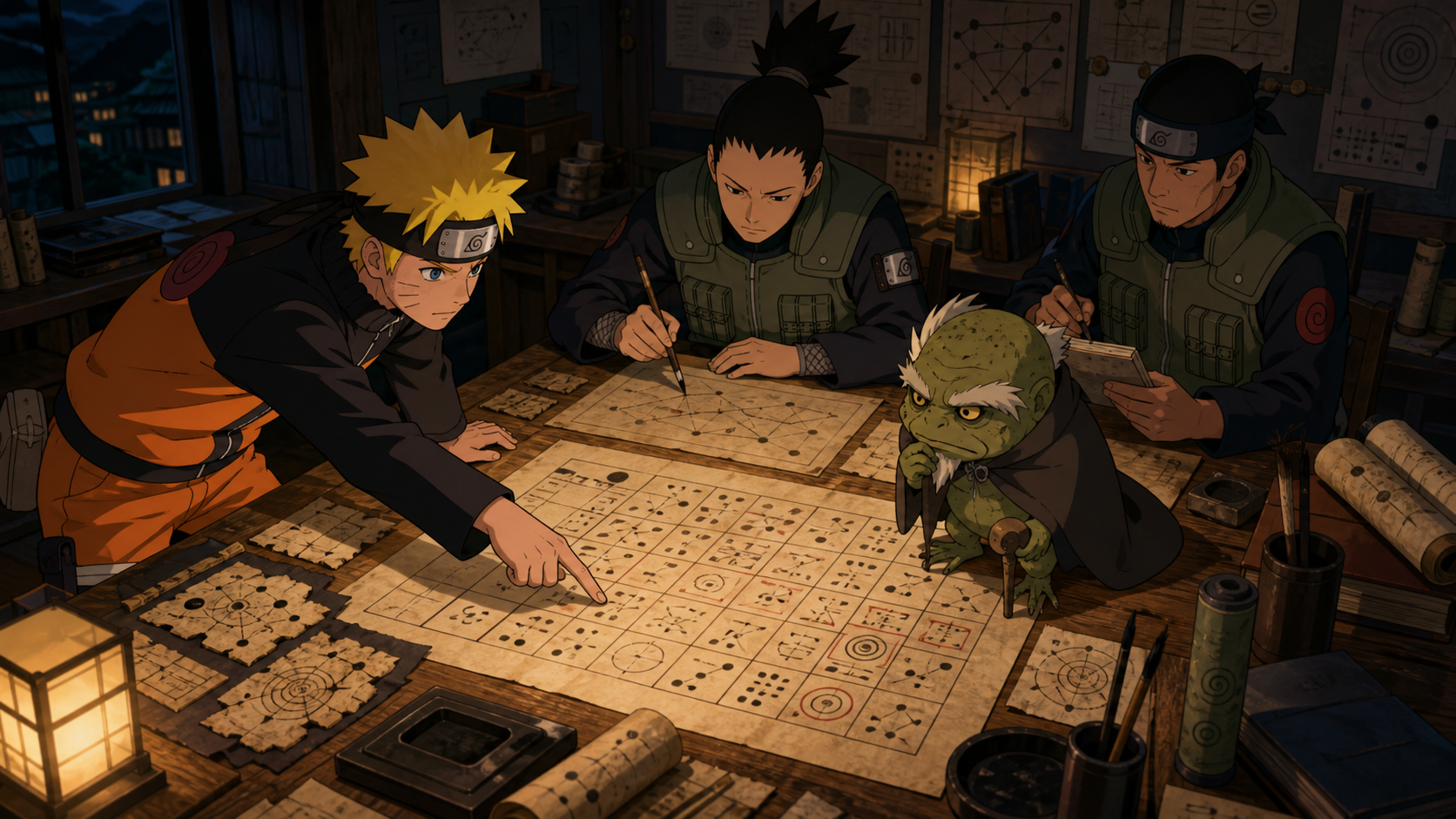
Decryption
Naruto’s personal knowledge unlocks Jiraiya’s final code, but reading the message only sharpens the mystery the village must still solve together.
What happens
Naruto joins the effort to decipher the coded message Jiraiya left behind. The intelligence team has technical skill, but Naruto provides the personal knowledge needed to understand how his master constructed the clue.
The group successfully produces a message and summons Fukasaku to interpret what it might reveal about Pain. Their breakthrough is real, yet incomplete. The decoded words do not solve the mystery of Pain's identity or explain how his multiple bodies operate.
Jiraiya has given them a direction rather than a finished answer. The living must now combine his final observation with their own investigation.
Naruto’s memory becomes intelligence
The previous episode allowed Naruto's memories of Jiraiya to exist as grief. Here, those same memories acquire practical value.
Naruto knows his master's habits, references, and patterns in ways a formal analyst cannot. Details that once seemed like ordinary pieces of their relationship become the key to a code designed under impossible pressure.
This does not reduce memory to usefulness. It shows that intimacy contains knowledge. Jiraiya trusted Naruto to recognize something because being known by a student had become part of his work.
Decryption requires more than expertise
The cipher team knows how to test symbols, sequences, and substitutions. Naruto does not replace that expertise.
Instead, he supplies context. A code created by a person carries the creator's preferences and assumptions, so technical method alone may not identify the intended reading.
The solution emerges through collaboration between institutional skill and personal familiarity. Neither side is treated as sufficient by itself.
Jiraiya writes for people, not machines
Jiraiya leaves his message under extreme conditions. He cannot explain every step or guarantee who will receive it.
The code therefore depends on a community of interpreters: analysts who can reconstruct the structure, Naruto who can identify the personal reference, and Fukasaku who can connect the message to the battle.
That design resembles Jiraiya's broader legacy. He rarely leaves one perfect doctrine. He leaves people with different pieces who must trust one another enough to assemble meaning.
A decoded sentence can remain a mystery
There is satisfaction in watching the symbols resolve, but the episode refuses a convenient leap from reading the message to understanding Pain.
Language can be clear while its implication remains uncertain. The group knows what Jiraiya wrote, yet still has to determine what kind of enemy would make that statement true.
This is disciplined storytelling. The code rewards work without pretending one clue can substitute for investigation.
Fukasaku carries the battlefield context
Fukasaku is summoned because he saw Jiraiya's final fight and understands the strange conditions surrounding Pain.
His presence connects the analysis room to the battlefield. Symbols on paper regain urgency when the witness who survived the encounter stands beside them.
Fukasaku also carries grief of his own. He is not merely a source being consulted. Like Naruto, he is trying to turn the death of someone he loved into knowledge that may protect others.
The message preserves Jiraiya’s final agency
Pain defeated Jiraiya physically, but the code proves Jiraiya continued making choices until the end.
He observed, formed a conclusion, selected a method, and trusted the people behind him to understand. The message cannot reverse his death, but it prevents the enemy from controlling the entire meaning of the battle.
Jiraiya's final agency survives through the work others are willing to do with it.
Naruto moves without leaving grief behind
Naruto's participation does not mean he has finished mourning. The episode instead shows grief becoming capable of action.
He can miss Jiraiya and still help decode the message. He can be wounded by memory while using memory to protect the village.
That coexistence matters. Recovery is not a clean handoff from sadness to productivity. Naruto moves forward with the loss still present.
Pain remains larger than one clue
The incomplete answer protects Pain's threat. Jiraiya uncovered something essential, but the enemy's structure is designed to confuse witnesses and divide information.
The village must continue examining bodies, chakra behavior, testimony, and the message together. A single discipline cannot solve an opponent built around distributed identities.
The investigation begins to mirror the enemy: many people, each holding part of one larger understanding.
Collaboration becomes Jiraiya’s counterattack
Jiraiya fought alone inside the Hidden Rain, but his final message refuses to remain solitary.
Naruto, the analysts, Fukasaku, and the village intelligence network extend the investigation beyond the moment of his death. Every person who adds context makes the clue more dangerous to Pain.
This is Jiraiya's counterattack after the battle. Not a hidden technique, but a chain of relationships capable of continuing his thought.
The incomplete answer creates the next responsibility
The group could treat partial success as failure because the mystery remains. Instead, the decoded message narrows what they must ask next.
Good intelligence often works that way. It does not eliminate uncertainty; it converts a vast unknown into a more precise problem.
Naruto now has both a clue and a reason to deepen the abilities Jiraiya began teaching him. Understanding Pain will require knowledge, but surviving him will require growth.
The first failed guesses are part of the work
A believable decryption does not begin with the correct answer glowing over somebody’s head. The team tests patterns, challenges assumptions, and discovers that apparently useful routes lead nowhere. Failure becomes evidence when analysts record why a method failed.
The episode respects that labor. Shikamaru is brilliant, but brilliance does not exempt him from uncertainty. The code was created under pressure by a person with private habits. Method needs context before the symbols can become language.
Naruto is an expert on Jiraiya even when nobody calls him one
Naruto lacks formal cryptography training. He possesses years of close observation: Jiraiya’s books, handwriting, jokes, habits, distractions, and strange priorities. That knowledge looks ordinary until the code depends on exactly those details.
Institutions often overlook relational expertise because nobody issued a certificate for knowing a person. Here, the official team cannot finish without the student who shared the road with the author.
The Make-Out Tactics reference keeps Jiraiya embarrassingly specific
Of course the key reaches back to Jiraiya’s writing. Even his final intelligence carries the fingerprints of the ridiculous man Naruto knew. Death does not clean him into a solemn monument.
That detail gives Naruto a painful advantage. The same habits that once caused annoyance now create access to a message no stranger could read. Grief turns irritation into precious evidence without pretending the irritation never existed.
Shikamaru knows when to hand authority to another person
His intelligence shows most clearly when he recognizes the limit of his own information. He does not force the puzzle to flatter him. He listens when Naruto identifies the personal route and lets that knowledge change the analysis.
Good leadership is not performing competence in every category. Good leadership places the right knowledge at the center when the problem changes.
The code team models a village Naruto can actually trust
Naruto grew up around adults who hid crucial truths about his body and family. This room works differently. People share evidence, explain uncertainty, test ideas, and allow him to contribute.
The process is imperfect, but Naruto is treated as a participant rather than a container or weapon. That procedural respect matters as much as the final phrase.
The message is short because Jiraiya’s body had no time
Viewers know the line is incomplete. The physical circumstances explain why. Jiraiya had to choose what could be recorded, encoded, and delivered while dying.
Every missing explanation therefore carries a bodily cost. The team is not solving a playful puzzle left at leisure. They are reconstructing thought from the last controlled movements of an injured man.
Fukasaku prevents the room from treating the clue like a game
A cipher can create excitement. Fukasaku’s presence restores the blood, fear, and sacrifice behind the marks. He watched Jiraiya reach the conclusion and pay for the chance to send it home.
The witness also limits speculation. Analysts can propose meanings, but battlefield facts decide which interpretations remain plausible.
The real one is not among them changes the category of the problem
The decoded message does not identify a hidden body sitting in the same room as the others. The line suggests that the visible Pains are not the controlling identity the village seeks.
That distinction redirects every later question. Investigators must stop asking only which body is strongest and begin asking who coordinates the bodies, where that person is, and how information travels between them.
Pain weaponizes distributed identity
Six bodies divide abilities, perception, and risk. An opponent can destroy one and still fail to reach the person directing the system. Witnesses struggle to describe one enemy because the enemy appears as several people.
Konoha answers with distributed intelligence of its own. Autopsy, code work, testimony, sensory knowledge, and personal memory combine across specialists. Pain’s structure is challenged by a community willing to share.
Jiraiya’s lonely infiltration becomes less lonely after death
He entered the Hidden Rain without a full team because secrecy and local control made ordinary support dangerous. That choice left him isolated during the fight.
The message breaks the isolation backward. Every analyst who continues his investigation joins the mission at the point where he could no longer move. Collaboration cannot save him, but collaboration can prevent his knowledge from dying alone.
Naruto’s grief sharpens observation instead of disappearing
He recognizes the key because memories remain close enough to hurt. The episode does not separate emotional life from intellectual work. Feeling gives certain details weight, and that weight helps Naruto notice what others miss.
Grief can disrupt attention, but grief can also make a person’s habits vivid. The important point is support, not demanding that every mourner become productive.
The decoded line creates responsibility without giving comfort
Naruto helps finish the sentence, yet the sentence does not explain why Jiraiya had to die or how Naruto should live afterward. Success in the room cannot answer the emotional question.
He receives a direction for the investigation while grief remains unresolved. That split is honest. Practical clarity and personal pain often move at different speeds.
Autopsy and memory belong in the same investigation
The captured Pain body offers physical evidence. Naruto offers relational context. Fukasaku offers eyewitness testimony. None should outrank the others by default.
Strong intelligence comes from testing whether separate evidence streams support the same explanation. The village needs anatomy, chakra analysis, language, history, and lived knowledge before reaching a conclusion.
Codes are social objects
A code is never only symbols. The sender imagines a reader, assumes shared references, and decides what an enemy might miss. Jiraiya builds Naruto and Konoha into the message by choosing a key connected to his own life.
That choice turns relationship into security. Pain can kill the messenger without automatically gaining access to the meaning.
The episode values the people who do quiet work before battle
No one in the analysis room defeats an enemy with a spectacular technique. They compare pages, examine marks, recall details, ask questions, and revise. Their labor gives future fighters a chance to survive.
Anime often celebrates the final attack while forgetting the people who made the target understandable. Decryption keeps those workers visible.
RaeRae reaction
I love that Naruto is essential to the decryption without suddenly becoming a cipher expert. His contribution comes from knowing Jiraiya as a person.
That choice honors both kinds of work in the room. The analysts need Naruto's context, and Naruto needs their method. No one gets to perform the breakthrough alone.
Fukasaku's arrival also keeps the code connected to grief. He and Naruto are not studying an abstract puzzle; they are reading the last deliberate act of someone they both lost.
“Decryption” gives the team an answer and then immediately shows its limit. That restraint makes Jiraiya's message feel more credible, not less meaningful. He did not leave them a miracle. He left them the next place to look, trusting that the relationships he built would carry the investigation farther than one person ever could.
The incomplete solution protects the story from fake genius
Decoding one sentence does not let the room leap to Nagato’s location, history, or full mechanism. The team earns a narrower question. That limitation makes the breakthrough credible.
Real investigation advances through reduced uncertainty. Progress can be meaningful before anybody holds the whole answer.
Naruto inherits a question, not a command
Jiraiya’s message tells Konoha where the mystery deepens. His larger life leaves Naruto another unfinished question about peace. Neither inheritance offers a script.
Naruto must combine evidence, memory, and his own moral judgment. A student becomes an adult by answering beyond the master’s last line, not by repeating the line forever.
Fukasaku turns knowledge into the next invitation
The toad elder can explain Sage Mode and guide Naruto toward training Jiraiya once completed. That route connects grief to growth without claiming power will cure grief.
Training becomes a way to prepare for the danger Jiraiya exposed. The reason remains protection, not proving that the death was worthwhile.
RaeRae’s final word on Decryption
Naruto does not walk into the room as a cipher genius. He walks in as the person who knew Jiraiya’s ridiculous habits well enough to recognize the key. That is exactly why the scene works. Technical expertise gets respect, personal knowledge gets respect, and neither side is asked to fake the other.
The decoded sentence is useful because the sentence changes the question. The visible bodies are tools or channels, not the complete enemy. Konoha now has to investigate the system behind the faces instead of celebrating a neat solution.
Fukasaku keeps every mark connected to the dying person who made the marks. Jiraiya’s last act was observation followed by trust. He believed somebody would receive the message, somebody would know him, and several people would be willing to finish the thought together.
That collective work is the real counterattack. Pain distributes power to make one identity difficult to reach. Jiraiya distributes knowledge across relationships so one death cannot end the investigation.
The book key protects a messy relationship from being cleaned up
Jiraiya’s published work is part joke, part craft, part personal obsession, and part evidence that his life extended beyond missions. Using a page reference as the cipher key keeps that mess inside the final act. He does not become a marble statue because he died bravely.
Naruto’s embarrassment and affection can occupy the same memory. The code works because he paid attention even when he complained. That is how real relationships leave usable knowledge: through repetition, annoyance, laughter, and details nobody expected to become important.
Konoha should learn from how much knowledge lived in one person
Jiraiya maintained networks, traveled widely, studied enemy movements, and carried historical context that few others possessed. His death exposes the danger of allowing crucial intelligence to remain dependent on one operative’s memory and private notes.
The village needs archives, shared contacts, succession plans, and debriefing practices that do not begin only after a disaster. Honoring an exceptional spy should include building a system that no longer requires exceptional isolation.
Naruto’s contribution changes how adults should understand him
He is often praised for stamina, loyalty, and combat instinct while adults assume the technical room belongs to somebody else. Episode 154 shows another intelligence. Naruto notices people closely, remembers patterns, and connects odd details when the problem matters to him.
That ability deserves cultivation rather than surprise. Education should help him organize relational knowledge, ask sharper questions, and communicate what he sees without forcing him to imitate Shikamaru’s thinking style.
The team earns trust by showing uncertainty plainly
Fukasaku does not pretend the decoded line solves everything. Shikamaru does not hide the failed routes to protect his reputation. Naruto can see what the village knows, what remains uncertain, and why the next investigation is necessary.
That honesty is especially important for someone raised around secrets. Trust grows when institutions admit the edge of their knowledge before asking a young person to risk his life based on their conclusions.
The real victory is a question precise enough to survive scrutiny
“The real one is not among them” removes several comfortable assumptions. The six visible bodies cannot be treated as six independent enemies. Killing one body may reveal little about the controller. Shared vision and coordinated abilities require a hidden explanation.
A precise question organizes later evidence. Autopsy findings, chakra receivers, Fukasaku’s testimony, and future observations can now be tested against one central possibility instead of collected as disconnected curiosities.
That process also carries Jiraiya’s intellectual habit forward. He entered hostile territory willing to revise what he believed as new evidence appeared. The people reading his code honor him by doing the same. They do not turn his last words into scripture. They use the words as a disciplined starting point, challenge each interpretation, and keep working until the explanation can account for every body, every ability, and the unseen person directing them. The episode also lets Naruto contribute before asking him to become stronger. That order matters. His value does not begin with Sage Mode or with the ability to defeat Pain. Naruto already changes the investigation because he listened, remembered, and understood a person the analysts knew mostly through records. Combat training will expand what he can do. The decryption room proves that attention, affection, and lived history are forms of competence. Konoha should carry that lesson. Young shinobi need opportunities to bring personal knowledge into decisions, especially when official files have flattened a complicated human life into ranks, missions, dates, codes, and strategic value.
RaeRae’s call
Naruto solves the personal part of Jiraiya’s code because intimacy is knowledge. The analysts turn that knowledge into evidence, and the unfinished answer points everyone toward the real enemy.