
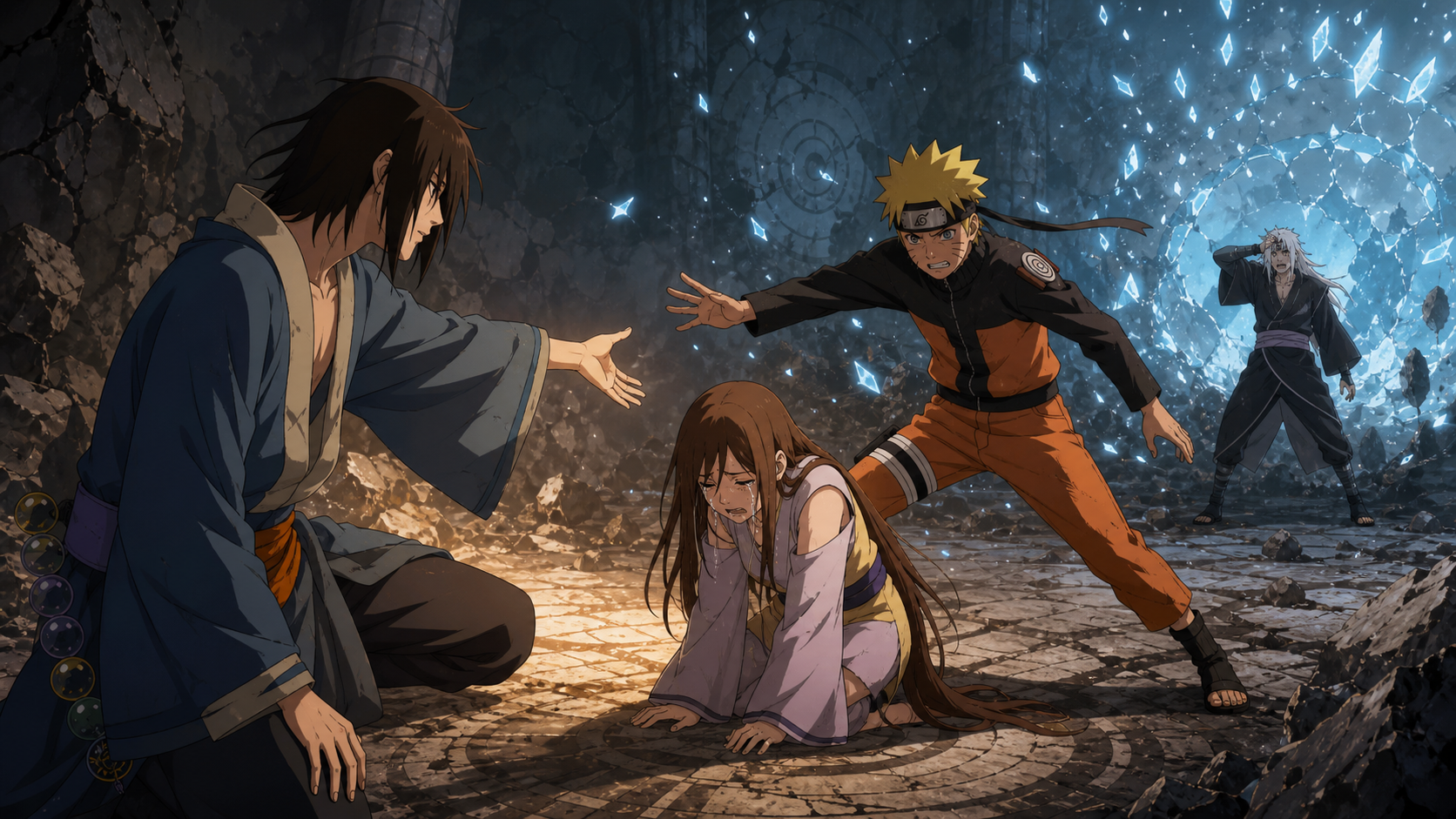
Master and Student
Shiranami forces Hotaru’s power against her rescuers, while Utakata proves that guidance protects a student’s agency instead of claiming it.
What happens
Shiranami controls Hotaru and forces her to use the Tsuchigumo forbidden jutsu against Naruto and Utakata. The power he wanted finally becomes visible, and he responds with exhilaration.
Hotaru experiences the same moment as devastation. She sees the technique she chose to preserve turned against the people trying to save her. The inheritance she hoped would prove her worth has become an instrument that removes her will.
Naruto and Utakata must survive the release while reaching the person inside it. The conflict resolves the arc's central question: mastery is not ownership of another person's power. It is the responsibility to help that person remain herself.
Shiranami celebrates what Hotaru mourns
The episode draws its sharpest contrast between Shiranami's joy and Hotaru's despair. They witness the same force, but they do not see the same event.
Shiranami sees successful activation. Hotaru sees herself made responsible for violence she did not choose. His excitement depends on erasing the difference between the technique working and the person carrying it consenting.
That difference is the moral center of the climax. Power can perform exactly as designed and still represent complete failure for the human being inside the design.
Control corrupts the meaning of inheritance
Hotaru accepted the seal because she wanted to protect En no Gyoja's legacy. Her choice was complicated by grief and pressure, but it remained tied to care.
Shiranami does not create that devotion. He hijacks it. By controlling Hotaru, he converts an inherited responsibility into access for himself.
The forbidden jutsu therefore becomes dangerous in two ways. Its destructive capacity threatens the village, while its symbolic weight gives manipulators a path into Hotaru's identity. She can be controlled because she was taught that abandoning the technique would mean abandoning the person she loved.
Naruto refuses to confuse the attack with the attacker
Naruto is targeted by the technique, yet he knows Hotaru is not choosing to attack him. That distinction sounds obvious, but fear often collapses it.
His own life has taught him how quickly people blame a vessel for the power placed inside it. He will not reproduce that judgment when Hotaru loses control.
Naruto's task is therefore larger than stopping an attack. He must resist Shiranami's framing, which treats Hotaru as nothing more than the source of the threat.
Utakata becomes a master through protection
Utakata has resisted Hotaru's request because the title “master” carries painful memories. To him, the relationship can become a claim: one person defining another, disciplining another, or using another's power.
Shiranami demonstrates the nightmare version of that role. He possesses knowledge, gives direction, and exerts control, but none of it serves Hotaru's growth.
Utakata answers with the opposite model. He moves toward Hotaru when her power is dangerous, separates her personhood from the technique, and accepts risk without demanding obedience. He becomes worthy of the title precisely because he refuses ownership.
Despair proves Hotaru is still present
Hotaru's grief is painful, but it also reveals that Shiranami has not rewritten her values. She is horrified because she still cares about Naruto, Utakata, and the consequences of the jutsu.
Her despair is not evidence that she has become the weapon. It is evidence that the person trapped inside the mechanism remains morally awake.
The rescue must reach that awareness rather than treating her as an empty container. Naruto and Utakata are fighting for the part of Hotaru that can still judge what is happening and choose what comes after.
The forbidden technique exposes the clan's failure
The Tsuchigumo clan preserved a power capable of devastating its surroundings, placed it inside a young successor, and then allowed that successor to become isolated.
Shiranami bears responsibility for exploitation, but the conditions that made exploitation possible were built long before he entered the cave. A system cannot call one person its heir and then leave her alone with every consequence of the inheritance.
The episode's spectacle should not hide that institutional failure. The seal is activated through Shiranami's cruelty, yet its availability reflects a history of adults protecting a legacy more carefully than its carrier.
Naruto and Utakata offer two forms of recognition
Naruto recognizes Hotaru as someone whose body has been made to carry dangerous power. Utakata recognizes the fear of a student whose relationship to a master has become entangled with control.
Those parallels are not identical, but together they let the two men see more than the crisis. Naruto understands public blame. Utakata understands private betrayal.
Hotaru needs both forms of recognition. She needs protection from the immediate technique and a relationship that proves guidance does not have to become possession.
Master and student is a promise about limits
A healthy master-student relationship includes instruction, but it also establishes limits on authority. A master should not own the student's future, body, or purpose.
Utakata's hesitation has always contained a valid fear: titles can conceal harmful expectations. The answer is not permanent distance. It is a different practice of the role.
By reaching for Hotaru while refusing Shiranami's model of control, Utakata shows that commitment can protect autonomy rather than erase it.
Shiranami loses because stolen control cannot replace a relationship
Shiranami knows how to trigger Hotaru’s seal, but he never understands the person carrying that power. He reads her grief as an opening, her loyalty as a weakness, and her body as equipment. That approach gives him access for a few ugly minutes. The same approach leaves him with nobody who will choose him once fear stops doing the work.
Utakata has spent this arc resisting the word master, yet he keeps returning when Hotaru needs him. The contrast lands without a speech about good teachers. One man demands obedience because he wants power. The other risks himself because a student trusted him with her safety.
Hotaru’s despair is not surrender
Hotaru watches the forbidden technique become the exact disaster her clan feared. Her horror makes sense. She carried that burden because she believed the inheritance still had meaning, then Shiranami used her devotion to turn the inheritance against innocent people.
The episode does not need to shame her for believing him. Manipulation works because the lie attaches itself to a real need. Hotaru wanted someone to recognize her duty without treating her like a walking bomb. Shiranami performed that recognition until he had enough control to stop pretending.
Naruto hears the word vessel and knows the whole insult
Naruto does not require a seminar on sealed power. He has lived inside the contradiction since childhood: adults feared what he contained, relied on what he could become, and often forgot to see the boy between those two reactions. Shiranami’s language exposes the same logic around Hotaru.
That recognition sharpens Naruto’s anger. He is not fighting because forbidden techniques are automatically evil. He is fighting because one person has stolen another person’s body and called the theft destiny.
Utakata finally accepts the work before the title
Utakata can reject formal mentorship all day, but Episode 151 measures him by what he does when Hotaru cannot protect herself. He returns. He reads the danger. He reaches for her through a situation that mirrors his own worst memory.
A teacher does not become legitimate by announcing authority. A teacher becomes legitimate by protecting a student’s ability to learn, choose, survive, and eventually disagree. Utakata performs that responsibility before he can comfortably name the bond.
The Six-Tails arc keeps bodily autonomy at the center
Every major conflict in this story turns on who gets to decide what happens inside a human body. Hotaru inherits a technique. Utakata carries Saiken. Their communities discuss containment and usefulness while both young people carry the physical consequences.
Shiranami represents the ugliest answer: the carrier should have no final say when somebody stronger wants access. Naruto, Utakata, and Hotaru push toward another answer, where dangerous power still requires consent, care, and shared responsibility.
Tonbei’s loyalty cannot excuse the system he preserved
Tonbei loves Hotaru and tries to protect her. Both facts matter. His devotion still operates inside a clan structure that placed catastrophic power in a child and left one aging retainer to manage the consequences.
Good intentions do not turn that arrangement into safety. If the technique survives, the next plan must involve more than secrecy, isolation, and hope that one loyal adult never fails. Hotaru deserves a life that is larger than guarding everybody else’s fear.
Team Kakashi earns space by handling the danger around the rescue
Naruto and Utakata carry the emotional center, but Sakura, Sai, and Yamato keep the wider crisis from swallowing that center. They manage attackers, movement, and the collapsing battlefield while the rescue narrows toward Hotaru.
This is what support should look like in a team story. Supporting characters do not need to steal the decisive emotional beat. Their work must make the decisive beat possible, visible, and believable.
Shiranami’s defeat does not repair the village
The immediate villain can fall without solving the conditions that made Hotaru vulnerable. The village rejected her. The clan turned her into a successor before building a durable care system. The forbidden jutsu remained valuable enough to attract exploitation.
If everyone celebrates and returns Hotaru to the same lonely fort, the danger has only changed names. Recovery requires a new arrangement, not a cleaner version of the old abandonment.
The title belongs to Hotaru as much as Utakata
Master and student sounds like an announcement about Utakata. The relationship only becomes real because Hotaru keeps asking for teaching and keeps defining what that bond means to her. Her desire is not a decorative reward for his growth.
She wants skill, recognition, and somebody who will remain present when the inheritance becomes frightening. Utakata’s answer matters because Hotaru’s question has carried the arc from the beginning.
Naruto does not rescue Hotaru by speaking over her
Naruto understands her pain, but the episode works best when that understanding leads to action instead of replacement. He cannot decide that Hotaru never cared about the clan legacy. He cannot erase her earlier choices because Shiranami violated them.
His job is to stop the coercion and help return the decision to her. Sympathy becomes respect when the rescuer refuses to claim the authority stolen by the villain.
The forbidden technique turns inherited pride into inherited debt
Hotaru receives the language of honor, duty, and succession. She also receives danger, isolation, and a problem created before she was born. Calling the burden an honor does not pay the cost her body carries.
Families and institutions love ceremonial language when the next generation is expected to absorb an old failure. Episode 151 tears through that ceremony and shows the actual bill.
Utakata’s past gives him knowledge without making him all-knowing
His experience with Harusame helps him recognize the terror of a trusted teacher reaching toward sealed power. That parallel does not give him perfect insight into Hotaru. Her clan, technique, and choices remain her own.
The useful lesson is smaller and more human: pain can teach someone which line must never be crossed again. Utakata uses memory to protect Hotaru, not to claim that their lives are identical.
The arc understands that loneliness is a security failure
Hotaru’s isolation is emotional, but the consequences are practical. A person starved for recognition has fewer witnesses, fewer people checking strange claims, and fewer safe places to test doubt. Shiranami does not invent every vulnerability. He walks into the empty space around her.
Community is not sentimental decoration when somebody carries dangerous power. Trusted relationships create verification, warning, and help. Abandonment makes manipulation easier.
Power leaves the body, but responsibility stays
Once the immediate crisis ends, adults cannot act as though removing or suppressing the technique settles every question. Hotaru has endured coercion, public fear, and the collapse of a family story that shaped her identity.
Healing will require honest information about what happened, choices about her future, and people willing to remain after the emergency stops being dramatic. Rescue is a beginning, not a receipt proving everybody did enough.
The final calm makes the next loss crueler
Utakata and Hotaru finally reach a place where the word student can hold warmth instead of pressure. The audience gets just enough room to imagine training, trust, and a less lonely road.
Then Akatsuki waits beyond that possibility. The turn hurts because the arc has done the relationship work first. Pain’s arrival is not merely a franchise plot handoff. The threat targets a future Utakata has only just allowed himself to want.
RaeRae reaction
Hotaru's despair is what makes this climax work. If the episode focused only on the size of the forbidden jutsu, Shiranami would control the meaning of the scene as completely as he controls the technique.
Instead, Hotaru's reaction tells us the release is not her triumph. The power may belong to her inheritance, but this use does not belong to her.
I also love that Utakata's answer to the master question arrives through action. He does not need a grand declaration before moving toward her. His willingness to remain present when her power becomes frightening is the promise she has been asking for all along.
“Master and Student” ultimately rejects the idea that teaching means command. Shiranami can force Hotaru's body to perform a technique, but he cannot become the person who guides her. Utakata earns that place by helping her recover the right to choose. The distinction is quiet beside the explosive jutsu, yet it is the real victory of the arc.
Hotaru deserves a future that is not organized around containment
The most meaningful outcome would not be a stronger seal or a more obedient successor. Hotaru needs education, relationships, travel, and ordinary choices that have nothing to do with guarding a forbidden technique.
A person can respect family history without allowing that history to consume every later decision. The clan legacy should become knowledge she carries, not the only identity she is permitted to have.
Utakata’s promise carries weight because he hates easy promises
He has spent the arc leaving before attachment can create another betrayal. Agreeing to guide Hotaru therefore costs him more than a cheerful mentor speech would suggest.
The promise asks him to remain accountable to another person. He is no longer only escaping the institution that hurt him. He is choosing what kind of authority he will become.
Naruto witnesses another possible relationship with sealed power
Naruto usually meets jinchuriki stories through fear, pursuit, and loss. Utakata and Hotaru briefly offer another possibility: people marked by dangerous power can teach one another without becoming weapons for a village.
That possibility is fragile, but fragility does not make the idea foolish. The brief bond exposes how much the shinobi world destroys when institutions hunt carriers instead of helping them build lives.
Pain arrives as the system’s final refusal
Utakata survives one abusive master and chooses to become a better one. Akatsuki responds by treating him as a target defined by the beast inside him. The timing makes the capture feel brutally deliberate.
He has just reclaimed personhood through relationship. Pain’s mission reduces him to collection, extraction, and organizational strategy.
RaeRae’s final word on Master and Student
Episode 151 closes this arc by making one distinction impossible to miss. Shiranami wants Hotaru’s power. Utakata wants Hotaru to survive the power. Both men understand the seal, but only one recognizes that knowledge creates responsibility toward the person carrying the danger.
Hotaru is not foolish because she wanted somebody to honor her inheritance. She was isolated by adults who handed her a catastrophe and called the burden duty. Shiranami exploited that isolation with language designed to sound like respect.
Naruto’s best contribution is his refusal to let vessel become a complete identity. He knows exactly how quickly a village can look through a child and see only the sealed force. His anger stays useful because he directs the anger at coercion instead of blaming Hotaru for being manipulated.
The new master-student bond should have opened a road. Utakata could have taught control without ownership, and Hotaru could have learned without surrendering her voice. Pain’s arrival turns that hope into another indictment of a world that keeps finding human containers more useful than human futures.
The ending refuses to let closure become comfort
The Six-Tails story resolves Hotaru’s immediate crisis, yet the closing movement refuses the easy version of victory. Shiranami loses control. The forbidden technique no longer threatens the region. Utakata accepts the bond Hotaru has requested. Those events should feel like the beginning of repair, because everyone finally has enough truth to build something safer.
Pain enters precisely when that safer future becomes imaginable. The cruelty is not only that Utakata faces a stronger enemy. The cruelty is that his capture interrupts a choice he made freely after years of running from authority, intimacy, and the memory of Harusame. Akatsuki does not merely take a jinchuriki. The organization takes a teacher before he can practice the kind of mentorship he needed as a student.
Hotaru may never know the full reason he disappears, which adds another wound to a story already shaped by adults vanishing without honest explanation. That absence should never be mistaken for proof that Utakata changed his mind. Episode 151 gives the audience the receipt before Pain arrives: he chose her. The tragedy belongs to the world that would not allow that choice enough time to become a shared life. That matters because a stolen future is still part of the violence, even when the final attack happens beyond Hotaru’s sight and outside her understanding for years afterward too.
RaeRae’s call
Shiranami treats knowledge as permission to control Hotaru. Utakata proves the opposite: knowing a student’s danger means protecting her choices, her body, and the future she still deserves.