
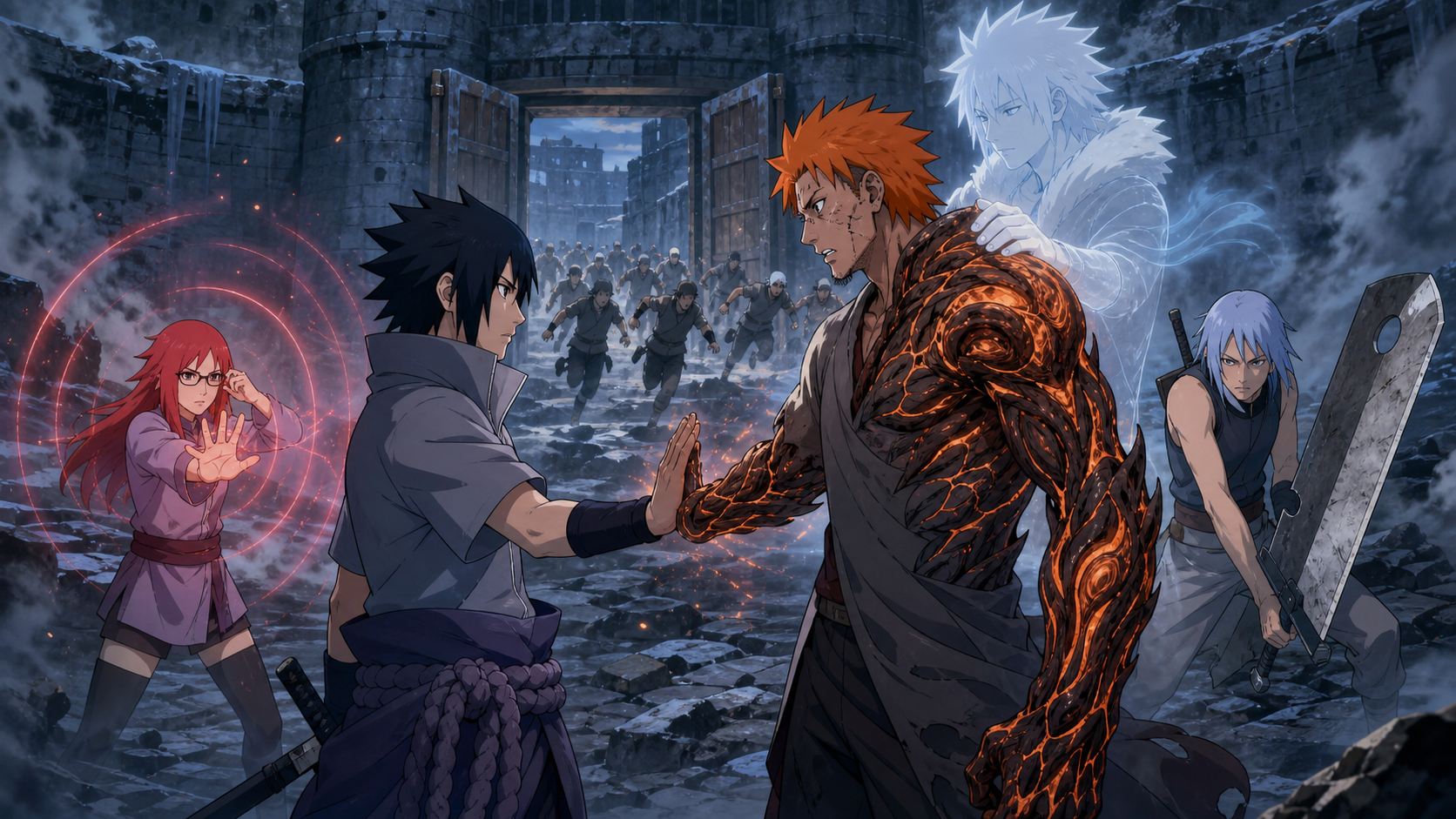
Formation!
Sasuke stops Jugo without killing him, invokes Kimimaro’s memory, and turns four separate agendas into the team called Hebi.
What happens
A riot spreads through the northern hideout as prisoners and experimental subjects escape confinement. Sasuke moves past the chaos to Jugo's cell, where the final recruit refuses freedom. Jugo would rather die alone than risk another transformed rampage.
That refusal matters. The locked door is not the only thing holding him. He believes isolation is the only ethical choice available because nobody except Kimimaro has reliably stopped his violent episodes.
Sasuke proves he can restrain Jugo without killing him. More importantly, his connection to Kimimaro gives Jugo a reason to listen. Kimimaro died while serving Orochimaru's effort to deliver Sasuke, so Sasuke stands before Jugo as both a reminder of loss and a possible continuation of trust.
Once Jugo agrees, Sasuke formally defines the team. Karin will track. Suigetsu brings swordsmanship and unusual water-body abilities. Jugo provides power. Sasuke leads them toward one objective: finding and killing Itachi Uchiha. The four-person unit takes the name Hebi.
Jugo has the right to refuse rescue
It is easy to see an open cell and assume the person inside should run. Jugo understands that freedom without support may place strangers in danger. His refusal is rooted in responsibility, shame, and fear.
Sasuke cannot ethically recruit him by pretending those concerns are irrational. He has to show that the team can interrupt a transformation and survive it. Restraint becomes evidence, not domination for its own sake.
Jugo's choice changes only after the situation offers something beyond a different unlocked door. Kimimaro once gave him relational safety. Sasuke's strength and connection to that memory suggest the possibility of moving without becoming an uncontrolled threat.
The decision remains risky, but it belongs to Jugo. He walks out because a new condition makes life imaginable, not because Sasuke claims ownership after opening the cell.
Kimimaro's legacy is complicated
Kimimaro cared for Jugo with patience the hideout never provided. He could calm him and saw a person beneath the transformation. That friendship was real.
Kimimaro was also devoted to Orochimaru, the man who exploited both of them. His death served a succession plan designed to place Sasuke's body under Orochimaru's control. Love inside an abusive system does not make the system safe.
Sasuke uses the connection carefully enough to reach Jugo, but he does not inherit Kimimaro's moral authority automatically. If Hebi treats Jugo as another weapon, the recruitment will repeat the northern hideout with better scenery.
The real tribute to Kimimaro would be giving Jugo support without demanding self-erasure. Whether Sasuke can do that while revenge controls his priorities remains open.
Hebi is a coalition, not a family
The four members join for different reasons. Sasuke wants Itachi. Suigetsu wants the legendary swords. Karin wants proximity to Sasuke and a future outside the southern hideout. Jugo wants a stabilizing connection after Kimimaro.
Those motives overlap enough for a mission, not enough for unconditional loyalty. Sasuke makes the objective explicit, which is healthier than Orochimaru's manipulation. Nobody is told that the team exists for their personal salvation.
Still, transparency does not remove the imbalance. Sasuke selected each member and controls the central route. His revenge defines the team's schedule and danger. The others will test how much disagreement the new leader actually tolerates.
The name Hebi links the group to the serpent Sasuke defeated and absorbed. He has escaped Orochimaru's body-transfer ritual, but his team still moves through the infrastructure, techniques, and survivors Orochimaru created.
RaeRae's reaction
Jugo saying he would rather die alone than leave is not cowardice. It is what happens when a person has been taught that his existence becomes safe only when confined. That belief is heartbreaking and completely rational inside his experience.
Sasuke's restraint works because he does not respond with pity. He proves he can stop the transformed body, then gives Jugo information connected to the one person he trusted. Strength and memory work together.
I remain uncomfortable with Kimimaro's devotion becoming a recruitment credential. Kimimaro died for Orochimaru's plan to claim Sasuke. The same chain of exploitation now helps Sasuke build a team. Shippuden is good when it allows those loyalties to stay messy.
The formal mission statement is a strong character beat. Sasuke does not pretend he gathered everyone for noble reform. He wants Itachi dead. The honesty lets Suigetsu, Karin, and Jugo evaluate the risk without a fake speech about destiny.
Hebi also mirrors Team 7 in ways Sasuke probably does not want to examine. Four specialists, one defined leader, constant friction, and members carrying separate pain. He left one team because its bonds challenged his revenge, then built another whose members could make the mission possible.
The difference is that Hebi begins transactionally. Nobody expects Sasuke to be emotionally available. That may reduce betrayal in the short term, but shared danger creates bonds whether the leader schedules them or not.
Formation! succeeds because it does not make the team feel finished. The roster is complete, but trust is not. Jugo has only just chosen the outside world. Karin and Suigetsu are already fighting. Sasuke has disclosed the target, not the emotional cost.
The northern doors are open, Orochimaru's subjects are scattering, and four survivors walk out under a new name. That is genuine movement away from captivity. It is also the beginning of a mission organized around another Uchiha wound. Freedom and obsession leave the hideout together.
A completed roster is not a completed team
My bottom line is that Episode 118 forms Hebi on paper while leaving every difficult relationship unfinished. Sasuke names the mission, assigns the broad purpose, and gathers the abilities he believes he needs. Suigetsu, Karin, and Jugo agree for reasons that do not begin or end with Itachi.
That arrangement is honest enough to move, but honesty about the target does not answer how the group handles injury, disagreement, retreat, privacy, or departure. A team becomes real through rules and repeated choices after the dramatic introduction.
Jugo’s refusal is an informed safety decision
He knows what happens when natural energy overwhelms control. People may die, and remorse will remain after the transformed state recedes. Staying inside the cell appears cruel from outside, yet confinement gave him one reliable way to reduce risk. Opening the door without support would transfer every possible consequence back onto him.
Sasuke therefore needs to offer more than freedom. He has to demonstrate restraint, create a crisis plan, and explain what the group can do when transformation begins. Jugo changes his answer because the conditions change.
Restraint becomes care only when Jugo helps define it
Sasuke can physically stop him, which proves the group may survive an episode. Strength alone cannot become the permanent plan. Jugo should name warning signs, preferred distance, grounding methods, and forms of restraint he considers tolerable while calm.
A plan made with him respects responsibility without turning symptoms into crimes. A plan imposed after every disagreement would make Hebi another prison. The difference lies in consent, proportional response, and ending restrictions when danger passes.
Kimimaro’s name opens the door and carries a warning
Kimimaro was the person who could reach Jugo during violent episodes. Mentioning him creates attention because the relationship earned trust over time. Sasuke cannot inherit that trust merely because Kimimaro died helping bring him to Orochimaru.
The same memory warns against devotion without limits. Kimimaro gave his health, future, and life to a master who treated sacrifice as useful. Jugo should not honor his friend by repeating the self-erasure that killed him.
Sasuke’s connection to Kimimaro is ethically uncomfortable
Kimimaro fought while terminally ill because Orochimaru’s plan required Sasuke’s body to arrive. Sasuke did not order the sacrifice, but his place in the succession gave the mission its purpose. Using that history to recruit Jugo risks turning another dead person’s love into leverage.
Sasuke needs to state the facts without claiming Kimimaro chose Hebi from beyond the grave. Jugo can decide what the connection means. Grief belongs to the survivor before it belongs to the mission.
Hebi’s members carry different relationships to Orochimaru
Suigetsu was confined and studied. Karin worked within the prison network while remaining useful enough to hold authority. Jugo supplied the biological foundation for cursed seals. Sasuke trained as the intended vessel and eventually suppressed the master. Each person survived a different position inside the same system.
Those differences will affect trust. Shared victimization does not erase harm one member may have helped inflict on another. The team needs enough honesty to discuss the hideouts without forcing everyone into one clean survivor story.
Sasuke recruits functions because functions feel safer than relationships
He needs a swordsman, sensor, and source of overwhelming power. Defined roles let him avoid asking whether he wants companionship after leaving Team 7. A function can be scheduled and measured. A relationship can challenge the mission.
The strategy may work initially, but shared danger creates emotional claims without permission. Suigetsu will complain, Karin will worry, and Jugo will attach meaning to Sasuke through Kimimaro. Sasuke can ignore those bonds without preventing them.
The team statement should include what Sasuke promises
He tells everyone the objective is killing Itachi. The members also need to know what support the leader offers. Will he help Suigetsu pursue swords? Will he respect Karin’s rest and boundaries? Will he help manage Jugo’s transformations? Will he protect them if the Akatsuki targets the group?
A mission where only followers name obligations becomes another hierarchy built around one person’s desire. Clear reciprocal terms would make Hebi a coalition rather than a private army.
Suigetsu needs a voice in tactical decisions
He joined after negotiating for Zabuza’s blade and continues testing Sasuke through humor and refusal. That friction can protect the group from silent obedience. A leader pursuing revenge needs somebody willing to say the plan is reckless.
Suigetsu’s confidence can become dangerous too. He may underestimate Jugo, provoke Karin, or treat a legendary sword as proof he can handle every opponent. Voice carries responsibility to listen when others identify his limits.
Karin’s sensory labor should shape the pace
Hebi’s search depends on her ability to distinguish chakra signatures across distance. Sasuke cannot set a schedule without asking how long she can sustain that work and what environments interfere. A sensor is not a map the team owns.
Her attraction to Sasuke makes the boundary harder because she may volunteer beyond safe limits. He should not accept every sacrifice simply because she offers. Leadership includes noticing when devotion distorts consent.
Jugo needs a life beyond being the emergency weapon
The team can easily reserve him for situations where ordinary strength fails. That role would repeat Orochimaru’s focus on the transformed body. Jugo also communicates with animals, observes environments, remembers Kimimaro, and understands his condition from inside.
Giving him ordinary tasks and decisions prevents crisis from becoming his only value. A person remains part of a team during calm hours, not only when somebody needs destructive power.
The riot exposes the unfinished responsibility around the hideout
Prisoners and experimental subjects are escaping while Sasuke recruits one person and leaves. Some may need medical help. Some may be dangerous. Others may have nowhere to go. Orochimaru’s fall removes command without repairing the institution.
Hebi cannot solve every consequence before departing, but the group can share records, release people safely, mark hazards, and prevent remaining staff from restoring the old system. Freedom for four people should not require forgetting everybody behind them.
The name Hebi keeps Orochimaru inside the new identity
Sasuke calls the group Snake after suppressing the serpent. The name may claim control over what once threatened him, but it also keeps the teacher’s imagery at the center. They leave the hideout carrying his techniques, research, networks, and survivors.
A renamed group cannot declare independence by itself. The members prove separation through how they use power, handle consent, and respond when usefulness conflicts with personhood.
Team 7 remains the shape Sasuke quietly repeats
Four members with distinct specialties gather around a leader and difficult mission. The arrangement resembles the formation Sasuke abandoned even though the emotional contract differs. He may reject Konoha while reproducing a team structure learned there.
The comparison does not mean Karin replaces Sakura, Suigetsu replaces Naruto, or Jugo replaces Kakashi. Hebi exposes how deeply the idea of coordinated difference remained with Sasuke. He still believes four people can do what one cannot.
Revenge gives the team clarity and makes every other need secondary
Killing Itachi is specific enough to organize movement. That clarity attracts people who want direction after captivity. The danger appears when injury, personal goals, or new information conflicts with the target. Sasuke has not shown whether the mission can pause for another member.
A stable coalition needs a process for renegotiation. Otherwise the clear objective becomes a command nobody can question once danger begins.
Formation should include the right to disband
Each member needs an exit condition. Suigetsu may leave after gaining the blade or helping locate Itachi. Karin may decide proximity to Sasuke is not worth the risk. Jugo may need safer treatment than travel permits. Sasuke may change the mission after learning new facts.
The ability to leave distinguishes chosen teamwork from captivity. A leader who punishes departure proves that the original consent had no durable meaning.
RaeRae’s final word on formation
I like Hebi because the group begins with friction instead of fake family language. Sasuke wants Itachi. Suigetsu wants swords. Karin wants several things, including Sasuke. Jugo wants enough safety to live outside a cell. Nobody needs to pretend those motives are identical.
Jugo’s choice deserves the most care. He did not refuse because he loved prison. He refused because freedom without a plan could turn strangers into victims. Sasuke earns movement by proving restraint and connecting to the one person who once helped him return from transformation.
Kimimaro’s memory opens the conversation, but Sasuke cannot spend that memory forever. He must build trust through present actions: listen, plan, protect, and let Jugo remain valuable when calm. Otherwise the cell has merely become a traveling team.
The roster is complete. The relationship is beginning. Hebi will become different from Orochimaru’s network only when every member can disagree, rest, keep a separate goal, and walk away. Formation is not four names under one leader. Formation is the ongoing proof that nobody became equipment when the door opened.
The first night outside the hideout matters
Freedom feels different after darkness, exhaustion, and uncertainty replace the adrenaline of escape. Jugo may worry about transforming while teammates sleep. Karin may keep sensing because silence feels unsafe. Suigetsu may test whether anyone controls his movement. Sasuke may treat rest as wasted time between him and Itachi.
The group needs a watch rotation, sleeping distance, water, food, and a plan for Jugo’s warning signs. Ordinary logistics reveal whether the mission respects bodies or expects everyone to run on revenge.
Food and supplies are part of the team’s moral structure
Several members have just left confinement or institutional control. They may not own clothes, money, medicine, or travel equipment. Sasuke has selected them for dangerous work and therefore carries responsibility for basic support. Freedom without resources can force agreement through dependency.
Shared supplies also create decisions about fairness. Suigetsu needs water, Jugo may need space and food after transformations, and Karin needs rest after extended sensing. Equal distribution is not always equitable distribution.
Hebi needs a rule against using another member’s body without consent
Orochimaru built the group’s shared history through bodily exploitation. The new team should name a direct boundary: no experiments, forced marks, unapproved healing bites, transformation triggers, or claims that emergency erases consent. A crisis may require immediate action to prevent death, but convenience does not qualify.
Stating the rule before danger gives every member language to object. Silence favors the strongest person and the most urgent goal.
Conflict between Karin and Suigetsu needs limits
Their insults can relieve tension, but hostility becomes dangerous when the team depends on rapid information. They should not interfere with equipment, conceal sensory warnings, provoke Jugo, or use captivity history as casual ammunition. Sasuke needs to set that boundary before a joke becomes sabotage.
Neither person has to like the other. Professional cooperation is enough. Respect can begin with accurate information and keeping hands off the other person’s body and tools.
Jugo’s choice should remain revisable
Agreeing to leave today does not bind him forever. Travel may worsen transformation, Sasuke may fail to provide support, or the Itachi mission may become more violent than described. Jugo needs permission to reconsider without being called unstable or disloyal.
A revisable yes is stronger than obedience because the team must keep earning participation. Sasuke cannot rely on one decision made inside a prison cell as permanent consent.
The mission statement needs a truthful spoiler about Itachi
Sasuke may not know the full history, but he knows Itachi is an elite Akatsuki member who massacred their clan and defeated him before. The recruits deserve that risk assessment. Saying only that the target is his brother would conceal the scale of danger.
Clear information does not require sharing every private memory. It requires enough fact for Suigetsu, Karin, and Jugo to decide whether their goals justify the fight.
The name needs proof
Hebi will be judged when one member becomes inconvenient. Suigetsu may want a detour, Karin may need rest, Jugo may refuse a fight, and Sasuke may learn a fact that changes the target. If the group can stop, argue, revise the plan, and continue without punishment, the new team formation has begun to escape the system that made every person useful or disposable.
RaeRae’s call
Hebi begins as a coalition of separate goals, not a family. The team becomes legitimate only if Sasuke’s clear mission includes reciprocal support and a real right to leave.