
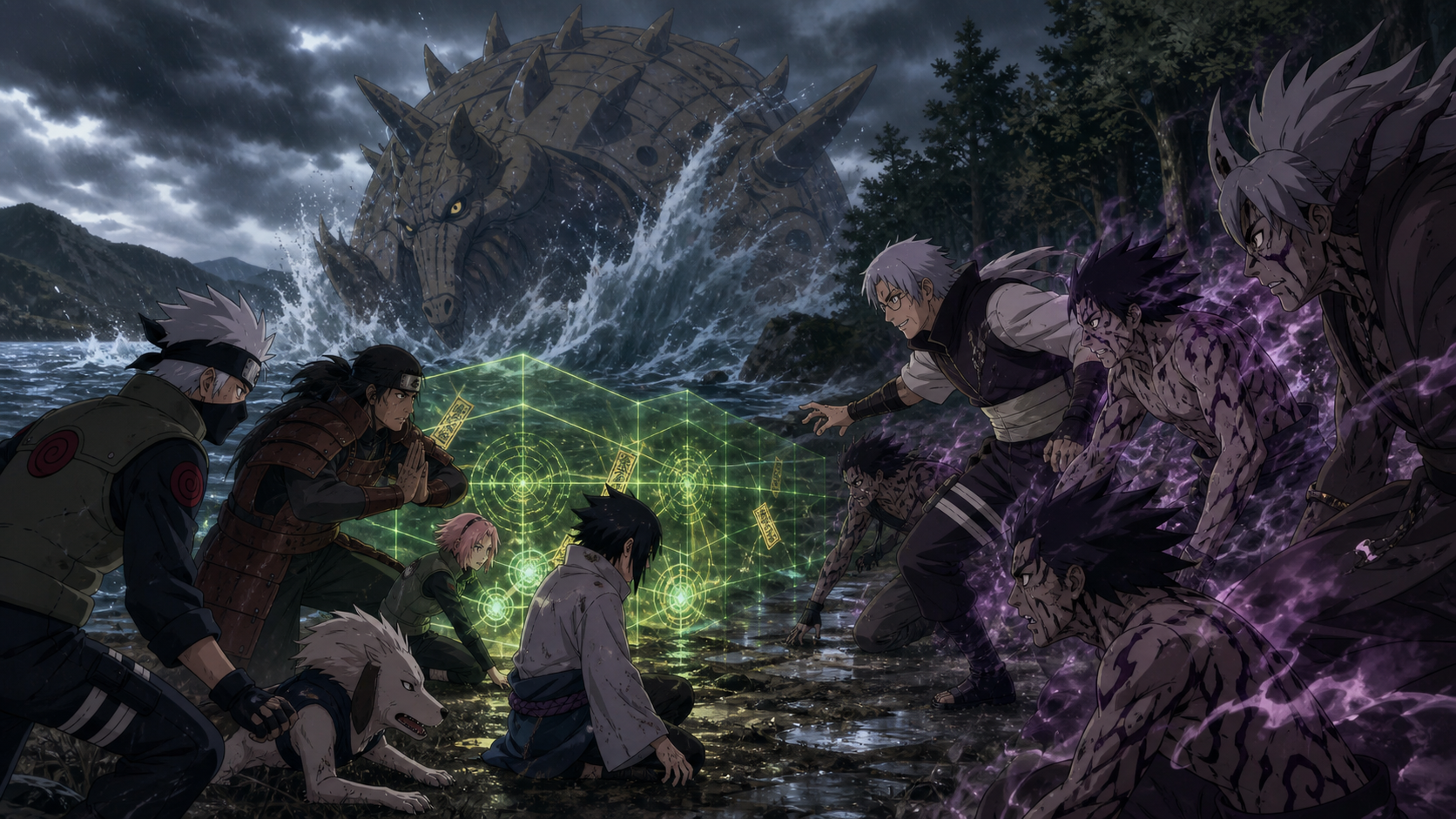
Counterattack of the Curse Mark
Kabuto comes for Yukimaru while the Leaf shinobi fight through curse-mark pressure and keep the Three-Tails contained.
Pressure from both directions
Counterattack of the Curse Mark forces the Leaf team to defend Yukimaru while the Three-Tails approaches the surface. The sealing specialists must keep the beast from emerging, but Kabuto uses that divided attention to launch a recapture attempt from the forest.
The danger is effective because neither threat can be ignored. If the team abandons the lake, the Three-Tails breaks free. If everyone faces the beast, Kabuto reaches Yukimaru. Protection becomes a question of formation rather than individual strength.
Kakashi and Yamato have to create a defensive line flexible enough to answer both directions. Sakura remains near Yukimaru because his physical condition matters as much as the enemy's distance. Kiba and Akamaru provide warning when the curse-mark fighters change their approach.
Kabuto refuses failure
Kabuto's determination to satisfy Orochimaru makes him especially dangerous. He is not trying to negotiate around the ruined plan. He intends to recover Yukimaru at any cost, even though the boy has already been pushed beyond his limits.
The curse-mark fighters embody that disregard. Their altered bodies turn people into extensions of a mission, much as Yukimaru's connection to the Three-Tails was treated as equipment. Kabuto surrounds one exploited child with others whose bodies have also been changed for power.
That parallel gives the counterattack a darker meaning. The Leaf is not only defending a strategic witness. It is holding a boundary against a system that converts vulnerability into obedience.
The seal cannot look away
The barrier team faces the worst kind of distraction: a crisis it can see but cannot leave. Their hands and chakra must remain committed while combat unfolds nearby. Breaking position to help Yukimaru could release the creature threatening everyone.
This is where trust between teams becomes essential. The specialists must believe Kakashi's defenders can hold the forest line. The defenders must believe the specialists will keep the lake contained. Neither group receives immediate proof, because each is too busy maintaining its own responsibility.
The Three-Tails rising behind the barrier keeps the scale honest. Kabuto may be the deliberate antagonist, but the beast remains an independent force responding to confinement, manipulation, and chaos.
RaeRae's reaction
I like how cleanly the episode creates a two-front defense. The Leaf cannot solve the problem by sending its strongest person toward the loudest threat. Every shinobi has to understand which failure only they can prevent.
Kabuto's persistence is frightening because it contains no concern for Yukimaru's survival. The boy's exhaustion does not make him pause; it makes the recapture feel more urgent before the asset becomes unusable. That language is exactly why Yukimaru cannot be returned.
The curse-mark attackers add visual pressure without replacing Kabuto's intelligence. Their transformed bodies are force, but he chooses when and where to direct it. He waits until the Leaf is divided by the Three-Tails and attacks the protected center.
Sakura's position matters to me. A rescue is not successful if Yukimaru is physically recovered and then treated as capable of endless sensing or chakra output. Keeping a medic beside him signals that his condition sets limits on the mission.
Kakashi and Yamato form a useful contrast. Kakashi reads the enemy's intention, while Yamato shapes a stable barrier around the people who cannot move freely. Their combined defense protects both Yukimaru and the sealing team's ability to continue.
Akamaru's early warning also deserves attention. In a storm filled with tailed-beast chakra, sensing a forest attack requires separating one kind of danger from another. The tracking team keeps the counterattack from becoming a complete surprise.
Counterattack of the Curse Mark shows the cost of Kabuto's loyalty to Orochimaru. Failure does not make him reconsider the harm. It makes him escalate. He brings transformed bodies against an exhausted child while a tailed beast rises behind them.
The Leaf's answer is collective refusal. Four specialists hold the lake. Defenders close around Yukimaru. A medic watches his condition. Trackers read the forest. No single action ends the crisis, but each prevents Kabuto from turning divided attention into possession.
The episode leaves the formation under enormous strain, yet it also reveals why the Leaf has a chance. Kabuto treats people as interchangeable tools. Kakashi's side assigns different people to different needs and depends on trust between them. The line around Yukimaru holds because everyone understands that protecting him and containing the Three-Tails are not competing missions. They are two parts of stopping the same exploitation.
The detail that matters
This battle works because no defender receives the luxury of one clean assignment. Kabuto's extraction attempt, the curse-mark fighters, Yukimaru's safety, and a tailed beast straining against containment all demand attention at once. That is Kabuto's preferred kind of battlefield. He does not need to defeat every Leaf shinobi fairly. He needs one opening wide enough to seize the child whose power he intends to exploit.
The pressure also exposes the difference between protecting Yukimaru and using him. The Leaf treats his fear and exhaustion as reasons to shield him. Kabuto treats both as weaknesses to press. After so much manipulation, the episode finally draws that moral line in plain sight while fists, claws, and chakra fly across it.
Kabuto chooses the moment when care looks inconvenient
Kabuto does not attack at random. He waits until the sealing team cannot leave the lake, the defenders are watching Isobu, and Yukimaru is physically depleted. Every protective obligation becomes another demand on Leaf attention. Kabuto sees care as a tactical weakness because people who value lives must divide their effort. He only needs to value the objective.
That calculation explains why his calm is more disturbing than the curse-mark transformations. The altered fighters make noise and create spectacle, but Kabuto built the situation. He knows exactly what another dose or forced chakra surge could do to Yukimaru. The risk does not trouble him. A damaged child remains useful if the damage creates one final response from the Three-Tails.
The curse-mark fighters show the future Kabuto offers
The attackers are not simply monsters arriving from the woods. Their bodies carry the result of a system that promises power while taking ownership. Skin, limbs, chakra, judgment, and identity become adjustable parts of Orochimaru’s program. Yukimaru is surrounded by a preview of what happens when usefulness becomes the only measure of a person’s value.
The Leaf team should recognize that parallel. Defeating the fighters is necessary, but treating them as disposable creatures would copy the same dehumanization from the other direction. Kakashi can stop lethal attacks while still understanding that experimentation shaped the people attacking him. Responsibility and victimhood can exist in the same body.
The sealing team cannot abandon its position for the obvious emergency
The four sealing specialists face a brutal assignment. They can hear combat, know Yukimaru is under attack, and probably want to help. Moving may break the barrier and release Isobu into the same battlefield. Staying can look passive from the outside even though maintaining the seal requires constant concentration and trust.
This is where team structure becomes more than a collection of powers. The specialists must believe Kakashi will defend the child. Kakashi must believe the barrier will hold while he turns away from the lake. Neither group receives continuous reassurance. Duty means preserving the part of the plan only their team can preserve, even when another danger feels more immediate.
Sakura needs authority, not a decorative medic role
Sakura should decide when Yukimaru can move, speak, or use chakra. That authority cannot vanish because Kakashi wants information or the barrier starts failing. Kabuto’s entire method depends on treating medical limits as obstacles to override. The Leaf proves a different ethic only when Sakura’s judgment can slow the mission.
She also needs to document signs of poisoning, withdrawal, chakra exhaustion, and neurological stress. Yukimaru may not know which symptoms come from fear and which come from Kabuto’s drugs. A careful medical record can guide treatment after the battle and expose what was done to him. Protection should create evidence, not merely distance from the abuser.
Kakashi must defend a person, not a possession
The formation around Yukimaru can resemble custody if nobody checks the language. Leaf shinobi stand between him and Kabuto because the boy faces immediate danger, not because Konoha has acquired him. Kakashi should explain every movement, ask whether Yukimaru can continue, and tell him who remains nearby. Information reduces the helplessness that armed protection can create.
If Yukimaru wants to call for Guren, the team should not dismiss the request as childish attachment. They can explain why shouting or another chakra surge might reveal his location. Respect does not require agreeing with every choice. Respect requires giving a reason and listening to the fear underneath the request.
Yamato’s barrier has to leave room for evacuation
A defensive wall that traps Yukimaru with the defenders would solve the wrong problem. Yamato needs exits, sightlines, and a route Sakura can use if the boy collapses. Curse-mark fighters may climb, tunnel, strike from above, or attack the structure itself. Stability comes from options rather than one impressive wall.
Wood Style can also separate attackers without forcing every clash into lethal combat. Partitions, restraints, and shifting pathways buy time while Kakashi identifies Kabuto’s real approach. Kabuto benefits when the Leaf spends all its energy on the loudest transformed fighter. A flexible defense preserves attention for the person directing the attack.
Kiba and Akamaru protect the gaps between visible threats
Kiba and Akamaru are useful because Kabuto’s plan depends on hidden movement. The forest gives attackers cover, and Isobu’s chakra muddies the sensory field. Scent, disturbed ground, and animal reaction can reveal a flanking route before a transformed body breaks through the line. Early warning matters more than a dramatic counterattack after contact.
The pair should keep checking whether Kabuto uses medicine, blood, or another lure connected to Yukimaru. A familiar scent could draw the child toward danger or make him believe Guren has returned. Kiba’s job includes identifying manipulation before Yukimaru has to resist the trap alone.
Hinata’s vision should follow Kabuto’s decisions
Hinata can see chakra networks and track motion beyond ordinary sight. The most important target may not be the largest curse-mark fighter. Kabuto chooses when the group advances, which opening receives pressure, and where the recapture team intends to withdraw. Watching him can reveal the shape of the whole attack.
She can also monitor the barrier and Isobu while the others face the forest. That overlap gives Kakashi warning if the two fronts begin affecting each other. The episode becomes dangerous when everybody assumes somebody else is watching the lake. Clear assignments prevent that silence.
Yukimaru should not have to prove that Guren matters
The rescue team knows Guren served Orochimaru and fought them. Yukimaru knows she protected him, lied to him, cared for him, and disappeared inside Isobu. His relationship contains contradictions that cannot be solved during combat. The Leaf does not need to approve of Guren before accepting that her survival matters to him.
That acceptance changes how they speak. Telling him they are saving Naruto while treating Guren as optional would make the camellia promise dishonest. Kakashi can say the team is searching for both without promising an outcome nobody controls. Truthful hope is kinder than a comforting lie with an expiration date.
Inside Isobu, every impact has a second meaning
Naruto and Guren may feel attacks against the beast as collapsing ground, pressure changes, or violent movement. The outside team cannot assume a strike remains outside. Even a successful defense may make escape harder for the people inside. That connection should keep the Leaf from celebrating every hit without checking the lake.
The trapped pair also needs to interpret vibrations carefully. A repeated pattern may be rescue. A sudden jolt may be Kabuto attacking the barrier. Running toward every sound could lead deeper into danger. Their partnership needs patience at the exact moment fear demands speed.
Kabuto mistakes escalation for control
Every time the plan fails, Kabuto adds force. He increases pressure on Yukimaru, deploys altered bodies, attacks a divided team, and pushes Isobu toward more chaos. The escalation creates movement but not actual control. More variables now exist than any one person can manage.
That failure matters because Orochimaru’s system sells domination as intelligence. Kabuto looks prepared, yet his preparation depends on people behaving like predictable tools. Guren changed sides. Yukimaru resisted. Naruto reached for an enemy. Isobu reacted as a living creature. The entire plan cracks wherever a person makes a choice.
The Leaf’s advantage is not moral purity
Konoha has its own history of using children, jinchuriki, forbidden techniques, and dangerous missions. The difference in this episode cannot rest on a claim that the village has never exploited anyone. The team has to create the difference through present behavior: listen to Yukimaru, respect Sakura’s limits, protect Isobu from needless harm, and refuse to turn Guren into a disposable enemy.
That standard keeps the episode honest. Good intentions do not prevent coercion. Procedures, accountability, and people willing to stop each other matter. Kakashi’s formation succeeds when every specialist can name a boundary the mission cannot cross.
The counterattack tests whether the last episode’s trust was real
Episode 108 asked the team to follow Yukimaru’s perception. Episode 109 asks whether that trust survives inconvenience. His knowledge helped when the route was unclear. His humanity becomes harder to honor when enemies attack and every second feels expensive. Respect that disappears under pressure was never secure.
The strongest answer is collective. Sakura protects his body. Kakashi directs defense. Yamato shapes safe ground. Hinata watches chakra. Kiba and Akamaru track hidden movement. The sealing specialists hold Isobu. Nobody asks Yukimaru to repay protection by becoming the weapon Kabuto wants.
RaeRae’s final word on the counterattack
I am not impressed by Kabuto’s loyalty. He sees a child shaking beside a tailed beast, knows exactly how that condition was created, and decides the real problem is losing access. The curse-mark fighters make his argument physical. Everybody around him becomes a body modified for somebody else’s ambition.
The Leaf team earns the episode by refusing that logic in practical ways. The medic stays with the child. The trackers watch the forest. The barrier team holds position. Kakashi and Yamato keep the defense flexible enough to protect people who cannot simply run. Care creates more work, and they do the work.
I want Yukimaru told what is happening. Do not whisper strategy over his head while using his senses. Tell him that Naruto and Guren remain missing, Kabuto is trying to reach him, and the team has a plan to keep him safe. Fear grows inside empty information.
The best outcome is not a triumphant defeat of every curse-mark fighter. The best outcome is denying Kabuto the one thing he believes pressure will always produce: ownership. Yukimaru remains a person with choices. Guren remains someone who can return and answer for hers. Isobu remains a living being rather than a prize. The counterattack fails when none of them behaves like Kabuto’s equipment.
A counterattack also needs an exit route
Kabuto does not need to hold the battlefield after reaching Yukimaru. He needs a corridor out. Kakashi should therefore watch the spaces the attackers avoid, the direction of their withdrawals, and any transport or concealment prepared beyond the first line. A defense focused only on the child’s position may win every visible clash and still lose him during the retreat.
Yamato can close corridors while leaving medical access open. Kiba and Akamaru can track anyone who tests the perimeter. Hinata can watch whether Kabuto places chakra markers or hidden reinforcements farther away. The team needs to defend the whole route between Yukimaru and safety, not merely the few feet around him.
The curse mark makes pain look like consent
Transformed fighters may appear eager, powerful, or proud of what their bodies can do. Those reactions do not prove the system respected their choices. Orochimaru’s marks alter capability while creating dependence, danger, and loyalty shaped by survival. The episode should let viewers see the threat without pretending visible enthusiasm erases coercion.
That context does not remove responsibility for attacking Yukimaru. The fighters still make choices inside constrained circumstances. Kakashi’s team can stop them, restrain them, and protect the child while refusing the easy claim that altered people are no longer human.
After the fighting, Yukimaru will need more than sleep
Rest cannot repair every consequence of repeated medication and forced chakra use. Sakura should plan toxicology checks, hydration, food, neurological observation, and a record of each episode of pain or disorientation. Somebody also needs to explain what happened without asking him to comfort the adults who failed him.
Recovery includes choice about visitors. Naruto may feel safe. Guren may feel necessary and frightening at once. Kakashi may represent protection and custody together. Yukimaru should control who enters the room whenever immediate medical safety allows.
The episode’s victory condition is restraint under pressure
Anybody can promise humane treatment before the enemy arrives. Episode 109 tests whether the promise survives a two-front attack, a failing barrier, and fear for missing teammates. Every shortcut suddenly sounds reasonable. Use Yukimaru once more. Strike Isobu harder. Ignore an injured attacker. Decide Guren’s fate without hearing her.
The Leaf succeeds by refusing those shortcuts while still acting. Restraint does not mean standing still. Restraint means choosing tactics that protect the vulnerable, preserve evidence, and leave room for people to make decisions after the emergency ends. That is a harder win than overpowering Kabuto, and the episode is better for demanding it.
RaeRae’s call
Kabuto attacks when protection becomes difficult because he believes care will crack first. The Leaf wins this episode only by keeping Yukimaru’s health, knowledge, fear, and choices inside the plan.