
Red Camellia
Yukimaru becomes Guren’s shield, and one red flower forces her to connect the child she loves with the mother whose life she took.
The child becomes the protector
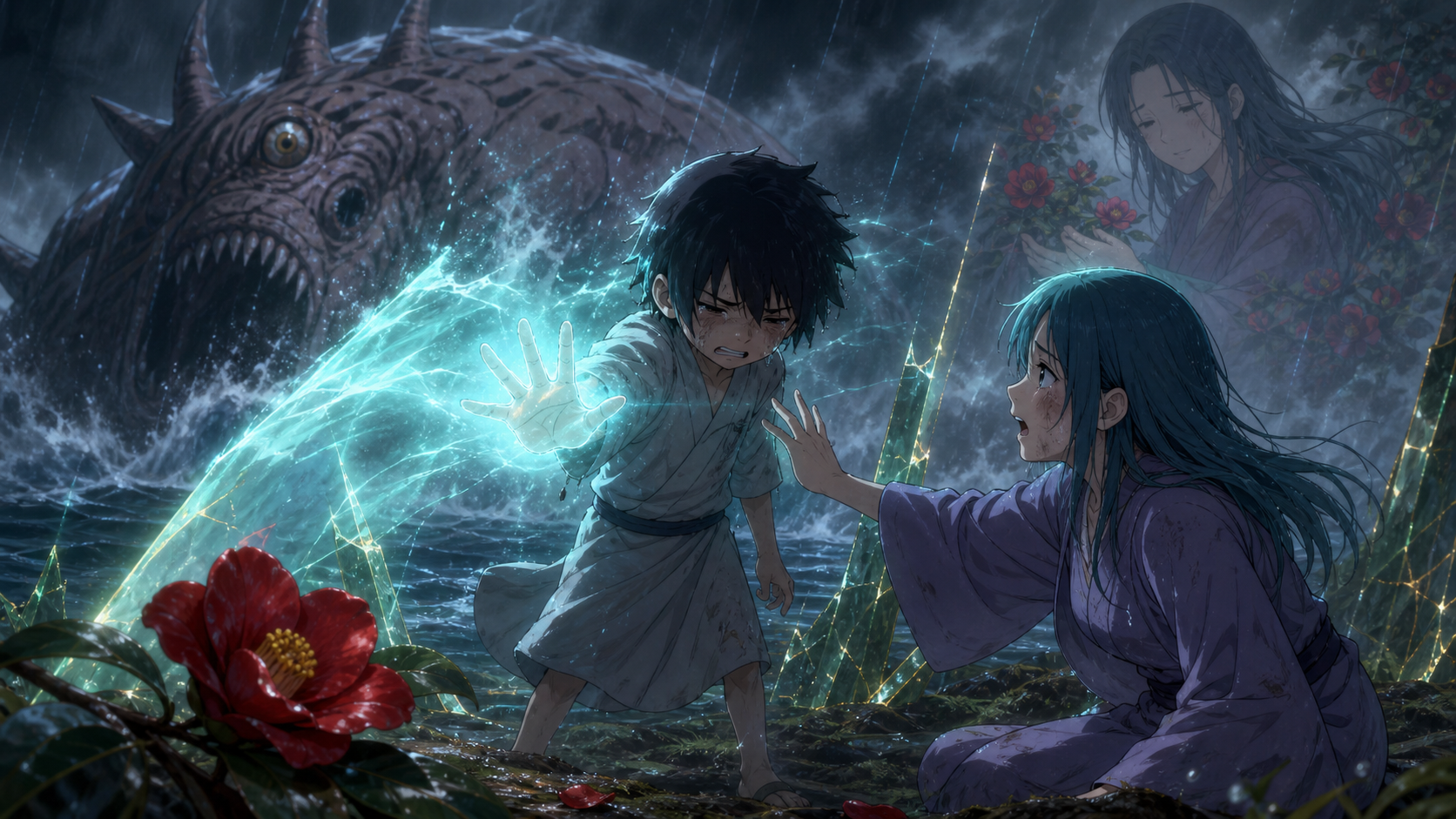
Red Camellia reverses the relationship at the center of the Three-Tails arc. Guren has spent the mission positioning herself as Yukimaru's protector. When the beast turns on her, Yukimaru pushes his power beyond its safe limit to protect Guren instead.
His choice is emotionally clear and physically devastating. Yukimaru does not calculate whether Guren deserves the risk. She is the person he fears losing, so he reaches for the only power he has been told makes him valuable. The adults around him created the conditions where love and self-destruction feel like the same action.
Guren cannot watch that sacrifice without confronting what her care has failed to prevent. She may want Yukimaru safe now, but she helped bring him to the lake, kept him inside Orochimaru's operation, and accepted a mission built around using his connection to the Three-Tails.
The red camellia opens the past
The red camellia carries memory into the storm. It connects Yukimaru's present devotion to the mother he lost and forces Guren to remember the part of that loss she caused. Her remorse is not abstract regret about serving the wrong master. It has a face, a child, and a consequence standing in front of her.
That past changes the meaning of every protective gesture Guren has made. Caring for Yukimaru cannot erase killing his mother. At the same time, the care is not false merely because it began inside guilt. The episode refuses the easy answer that one emotion cancels the other.
What matters now is whether remorse produces a different choice. Guren cannot repair the past, but she can stop participating in the machinery that threatens Yukimaru's present. His sacrifice removes her last excuse for treating obedience as protection.
Power without consent
Yukimaru's chakra has been described as a rare connection to the Three-Tails, yet the episode shows what that language hides. Every use exhausts him. Kabuto measures output while Naruto and Guren see a boy being pushed beyond his limits.
When Yukimaru chooses to use the power himself, the situation becomes more complicated but not safer. Choice made under terror and attachment is still shaped by the adults who left him no ordinary way to help. He should never have needed to hold back a tailed beast to prove what Guren means to him.
Naruto understands this instinct. He has repeatedly risked himself for acknowledgment and belonging. That recognition makes him especially unwilling to romanticize Yukimaru's collapse, even while respecting the courage behind it.
RaeRae's reaction
This episode hurts because Yukimaru's bravest act is also evidence of everyone's failure. He is the youngest person in the conflict, yet he becomes the shield between Guren and the Three-Tails because the adults around him cannot stop the beast or Kabuto's plan quickly enough.
Guren's remorse finally has nowhere to hide. She can no longer separate the mother she killed from the son she wants to protect. The red camellia turns memory into a demand: if she truly cares for Yukimaru, she has to choose him over Orochimaru when that choice costs her everything she thought gave her purpose.
I appreciate that the episode does not make forgiveness automatic. Realizing the truth is only the beginning. Guren still owes Yukimaru honesty, safety, and the freedom to decide what their relationship means after he knows what happened.
The Three-Tails remains terrifying, but the most important threat is the pattern of adults converting children into weapons. Kabuto does it openly. Guren participated while telling herself she could keep Yukimaru close. Even the Leaf's custody order risks repeating the same logic if it values his connection before his wishes.
The image of Yukimaru holding a cyan shield while a red flower survives in the rain captures the contradiction. His power is immense, yet he looks small beside the creature and the choices surrounding him. The camellia is delicate, but it carries the emotional weight Guren has avoided.
Red Camellia marks the point where Guren's loyalty can no longer remain divided. Yukimaru has shown exactly what she means to him. Now she must decide whether her answer will be another promise inside Orochimaru's plan or an action that breaks them both free from it.
The episode's deepest question is not whether Yukimaru can stop the Three-Tails for a few seconds. It is whether Guren can accept that protecting him requires surrendering control, admitting the truth, and choosing his future over the role she was given. Regret matters only when it changes what someone does next.
Official episode reference: Naruto Official episode guide
Licensed episode route: Crunchyroll licensed episode page
Yukimaru’s choice does not make the adults less responsible
He decides to shield Guren because losing her feels unbearable. That agency matters. The choice also occurs inside a crisis created by Orochimaru, Kabuto, Guren’s obedience, and the fight around Isobu. A child making a brave decision cannot absorb responsibility for the conditions demanding bravery.
Adults often praise sacrifice because praise is easier than admitting they left no safe alternative. Yukimaru deserves immediate care and a future where love does not require proving usefulness through pain.
Guren’s guilt is specific because the harm is specific
She did not merely participate in a bad organization. She killed Yukimaru’s mother and then became central to the child’s new understanding of home. The relationship contains care, concealment, and a history he has not been allowed to evaluate.
Remorse should name the act plainly. Vague sorrow would protect Guren from the full truth while asking Yukimaru to build attachment on missing information.
The red camellia connects beauty to blood without making guilt poetic
The flower is memorable because Guren used crystal style to create a gift, while the color recalls the violence surrounding Yukimaru’s family. The image can carry contradiction without turning murder into a beautiful tragedy centered on the person who caused it.
Yukimaru’s mother remains a person whose life and relationship with her son mattered. Her death should not exist only to deepen Guren’s character.
Guren cannot confess while Yukimaru is collapsing
Truth is necessary, but timing matters. A medical crisis is not the moment to unload guilt and ask a child for forgiveness. The confession would make Yukimaru manage Guren’s emotions while his body is failing.
First she must stop the immediate harm, help Sakura treat him, and create safety. Later, when he has strength and support, Guren can tell the truth without demanding a particular response.
Forgiveness belongs to Yukimaru and may never arrive
Guren can choose repair because repair is right. She cannot make good behavior a purchase price for absolution. Yukimaru may love her, hate her, need distance, ask questions, or hold several reactions at once.
A trustworthy future leaves those options open. Protecting him means accepting that his safest choice may not preserve the relationship she wants.
Naruto should recognize the danger of romanticizing self-sacrifice
He has repeatedly thrown his body between danger and people he loves. Watching Yukimaru do the same can feel noble because Naruto understands the impulse. That recognition should make him more urgent about creating alternatives.
Courage deserves respect, but a child should not learn that injury is the clearest way to prove belonging. Naruto can honor the act while telling Yukimaru he never has to perform it again.
Guren’s protection needs to become cooperation with people she distrusts
Sakura may be the person best able to stabilize Yukimaru. Kakashi may be able to stop Kabuto. Shizune can manage the barrier. Guren has information they lack. None can protect the child alone.
Cooperation will cost her control and expose her to consequences. That cost is precisely why the choice can demonstrate change rather than another private feeling.
Isobu is also being forced into the role of attacker
Yukimaru’s resonance and the barrier shape the beast’s movement while viewers see destructive force. Isobu’s danger is real, yet the situation keeps assigning violence to the creature while human planners remain outside the frame.
Ending the coercive link may protect Guren and the Leaf team more effectively than another attack on Isobu’s shell. The cause belongs in the tactical picture.
Kabuto benefits if Guren turns guilt inward instead of acting
Shame can freeze a person. If she becomes consumed by how unforgivable she feels, Kabuto keeps control of the present while she performs emotional punishment on herself.
Accountability requires action directed outward: stop the procedure, share the antidote or method, move Yukimaru to care, and help reduce Isobu’s panic. Feeling terrible is not repair.
The Leaf must not use the truth as leverage
Kakashi or Naruto may discover Guren killed Yukimaru’s mother. Threatening immediate disclosure to force obedience would manipulate the same vulnerable bond they claim to protect.
The truth belongs to Yukimaru, but delivery should prioritize his safety and support. The Leaf can hold Guren accountable without turning his grief into a battlefield tool.
The charm and camellia will mean something different after disclosure
Objects preserve memories, but new knowledge can change the memory attached to them. Yukimaru may keep, reject, break, or reinterpret the crystal flower. Guren must not demand that the gift continue proving love.
His choice about the objects can become one small area of control after adults controlled so much else. Nobody should preserve the symbol more carefully than the child carrying its meaning.
Medical recovery will take more than waking up
Yukimaru has endured repeated chakra strain and emotional terror. Stabilization should include rest, nutrition, monitoring, and protection from further testing. Psychological safety also matters without turning the child into a diagnosis.
Familiar people, truthful routines, and small choices can help. Recovery should not be rushed because the village wants information about Isobu.
RaeRae’s full take
Red Camellia hurts because Yukimaru’s love becomes the shield adults failed to provide. He saves Guren with the same power that has exhausted him, and everybody watching should feel ashamed before calling the moment beautiful.
Guren’s remorse is earned and incomplete. Killing his mother cannot be balanced by caring for him later. The care matters because it can change what she does now, not because affection edits the past.
I do not want an instant confession or forgiveness scene while Yukimaru can barely stand. Help him first. Stop Kabuto. Give Sakura the information she needs. Tell the truth later when the child can hear it without also fighting to keep Guren emotionally alive.
The red camellia should remain complicated. Guren created beauty with hands that caused terrible harm. Yukimaru gave meaning to the flower without knowing the whole history. His eventual choice about Guren and the gift belongs to him. Her redemption begins when she protects that freedom even if the freedom takes him away.
The child should not have to earn the right to remain loved
Yukimaru may believe shielding Guren proves he deserves her memory and presence. That belief grows from a life where adults valued unusual power more consistently than ordinary need. The act becomes heartbreaking because affection appears tied to performance again.
Guren’s response should separate love from usefulness. She needs to tell him that failing, resting, refusing, and needing help will not make him disposable. Then her behavior has to keep the promise when his power no longer serves the mission.
Guren’s guilt can tempt her toward another sacrifice
After seeing Yukimaru collapse, she may decide dying for him would balance the mother she killed. A dramatic death could protect him briefly while leaving the child with another loss, unanswered truth, and no adult carrying long-term repair.
Living accountability is harder. Guren must endure his anger, cooperate with former enemies, provide evidence, accept restrictions, and build safety without controlling whether he forgives her.
Naruto should not promise that pain will make Yukimaru stronger
Naruto survived isolation and found bonds, but survival does not prove the harm was necessary. Telling Yukimaru that suffering will create strength could comfort adults who failed him more than the child himself.
He can offer a different truth: the pain should not have happened, courage helped him survive, and future adults owe him conditions where survival is not the daily assignment.
Sakura can protect the boundary between emergency care and confession
If Guren begins revealing the past while Yukimaru is unstable, Sakura can stop the conversation and redirect attention to treatment. That boundary protects both of them from turning a medical crisis into an emotional verdict.
Later disclosure should include support chosen for Yukimaru, time to leave the room, and no demand for an immediate answer. Truth deserves preparation when the listener is a child learning that a trusted protector caused irreversible harm.
Yukimaru’s mother deserves more than symbolic remembrance
The camellia evokes her, but the story should preserve her life beyond the moment of death. What care did she give, what did Yukimaru remember, and what future was taken? Guren’s remorse becomes accountable when the victim remains a person rather than an image inside her guilt.
Yukimaru should receive truthful information about his mother from sources beyond Guren whenever possible. One person should not control the crime, confession, and memory.
The Leaf needs a policy for Guren that does not depend on Naruto’s sympathy
Naruto may argue for mercy after seeing her protect Yukimaru. Kakashi and Tsunade still need evidence, security, and a process distinguishing immediate cooperation from later accountability. One hero’s intuition should not become the whole justice system.
A fair response can consider coercion, assistance, harm prevented, information shared, and Yukimaru’s safety without pretending those factors erase earlier acts. Mercy becomes more trustworthy when rules make room for context.
Isobu’s force gives Guren an immediate chance to choose differently
She can use crystal to block the beast, shelter Yukimaru, open a route for Sakura, or attack the equipment controlling resonance. Each option directs power away from Orochimaru’s objective and toward a person’s survival.
The choice must happen before certainty. Waiting until she knows the Leaf will forgive her would keep Yukimaru’s safety conditional on her reward. Protection means acting while consequences remain frightening.
Kabuto may use the truth to destabilize Guren
He can remind her of the mother’s death, accuse her care of hypocrisy, or claim Yukimaru will reject her once he knows. Those statements contain pieces of reality arranged to preserve his control.
Guren should accept that rejection is possible without letting Kabuto decide what accountability means. The child’s future matters more than whether she receives the relationship she wants.
The camellia’s color should not settle the moral meaning
Red can suggest blood, love, warning, grief, or a living flower refusing to disappear in rain. The episode works because several meanings coexist. Turning the image into one neat symbol would flatten the people around it.
Yukimaru may see care where Guren sees guilt. Viewers may see both. The eventual truth will change the object again because symbols live through the knowledge people bring to them.
Guren has to help build a life where Yukimaru no longer needs her exclusively
Recovery should include doctors, teachers, peers, safe adults, ordinary routines, and choices unrelated to Isobu. A child with several dependable relationships becomes less vulnerable to anyone claiming that abandonment will follow disobedience.
Guren may remain important. Her success should not be measured by permanent dependence. Good care expands the child’s world even when expansion makes the caregiver less central.
The episode’s bravery belongs to truth as much as combat
Yukimaru’s shield is visible courage. Guren will need another kind: admit what she did without excuses, accept consequences, and keep protecting him if the truth removes affection. Naruto will need patience when rescue does not produce immediate trust.
Those quieter acts determine whether the dramatic moment becomes change or another wound surrounded by promises.
RaeRae’s final word on the red flower
I cannot call Yukimaru’s shield beautiful without also calling the situation a failure. He should never have needed to spend his body proving love to the adult who helped place him beside Isobu.
Guren’s guilt finally has a name, and names create obligations. She killed his mother. She cared for him later. Both facts remain. The second fact can shape the future without rewriting the first.
I want her to choose life and accountability instead of one grand sacrifice. Stop Kabuto, help Sakura, tell Kakashi the plan, and stay alive long enough to tell Yukimaru the truth when he can safely hear it. Then accept whatever relationship he chooses.
The red camellia can remain a gift, a wound, or both. Yukimaru owns that meaning. Guren’s task is not preserving the symbol. Her task is preserving the child’s right to grow beyond everybody who turned his power, grief, and love into parts of their plans.
Privacy is part of Yukimaru’s recovery
The people treating Yukimaru should also protect his story from becoming village gossip or a strategic briefing repeated without need. His connection to Isobu, his mother’s death, and Guren’s role are personal facts carrying danger.
Medical staff and commanders need relevant information, but curiosity does not create access. Naruto should not tell the story as proof of his own empathy, and Guren should not confess publicly to make remorse visible. Yukimaru deserves control over who learns the details after immediate safety is secured.
Privacy cannot hide accountability. Investigators still document Guren’s actions and Kabuto’s abuse. The boundary protects the child from becoming public evidence while allowing responsible adults to address crimes and prevent another experiment.
That protection gives Yukimaru one ordinary human right after adults turned every private wound into evidence, leverage, or strategy.
RaeRae checkpoint: Yukimaru’s shield is brave, but bravery does not make the crisis acceptable. Guren owes him action, truth, and freedom from the role of emotional rescuer. Love becomes protection only when the adult carries the cost.
Receipts and official routes
- Official synopsis, licensed title, and episode placement: Naruto Official Site episode guide.
- Licensed episode title, number, and current watch route: Crunchyroll.