
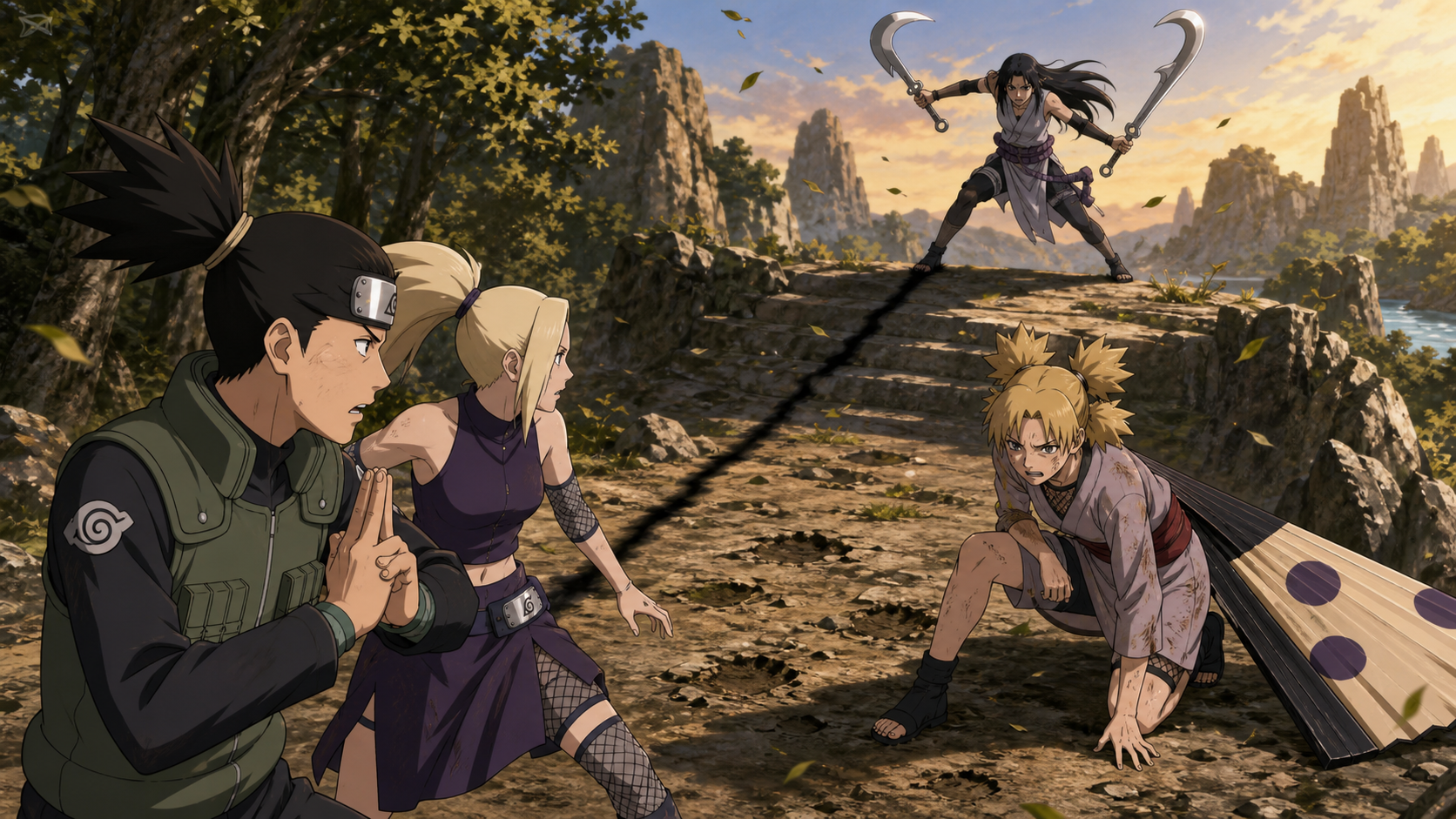
Sand Alliance With the Leaf Shinobi
Shikamaru waits for a battlefield map, sends paired Leaf cells to the isolated Sand siblings and returns their Sasuke-mission rescue before Gaara’s trap closes.
Naruto wants to charge toward Gaara.
Shikamaru tells everyone to sit still.
Naruto Episode 217, `Sand Alliance With the Leaf Shinobi`, turns waiting into the smartest move on the battlefield. The Four Celestial Symbols Men have chosen the route, planted the trail, divided the Sand siblings, and equipped each fighter with a weapon designed to drain or overpower the person following.
Running faster would only enter the trap sooner.
Shikamaru waits for Shino, Neji, and Hinata to map the fight. Then he sends each Leaf pair where it can matter.
This is how an alliance should work.
Less posing. More arriving before somebody dies.
Shikamaru Remembers Who Saved Them Last Time
Repaying the debt twice over is not bookkeeping. Shikamaru remembers the precise condition in which Sand found his team: separated, injured, and unable to finish fights alone. Returning help means preventing the Sand siblings from remaining in that condition, not merely matching one rescue with another.
His command style now carries the guilt of the earlier operation in useful form. He does not freeze because a past plan failed. He changes the structure that produced isolated battles and makes mutual support a rule rather than a hopeful outcome.
The flashback therefore supplies operational history, not nostalgia. Every pairing Shikamaru makes answers something he learned while believing Choji, Neji, Kiba, Naruto, and Lee might not return.
The episode opens with flashes of Leaf and Sand fighters standing together.
Then it returns to the Sasuke Retrieval Mission, when Temari saved Shikamaru, Kankuro saved Kiba and Akamaru, and Gaara saved Lee. The Sand siblings appeared at the exact moment each Leaf genin had run out of options.
Shikamaru remembers that debt.
He intends to repay it twice over.
That does not mean sprinting into unknown territory for dramatic symmetry. The last mission taught him what happens when a pursuit line breaks apart and every fighter faces an enemy alone.
This time, nobody moves alone.
Naruto Learns That Waiting Can Be a Strategy
Naruto experiences delay as personal failure because he imagines Gaara moving farther into danger with every breath. The feeling is accurate. The conclusion that speed automatically helps is not.
An uninformed charge would give the Four Celestials more people to separate and fewer Leaf shinobi available to reinforce the correct fights. Waiting concentrates risk in the scouts, who are equipped to gather information without announcing the whole force.
Shikamaru also needs Naruto's obedience specifically. Naruto is one of the team's strongest responders and the person most emotionally tied to Gaara. If he breaks formation, others will follow or spend time recovering him. Holding still becomes part of protecting his friend.
Shikamaru halts the main group.
Naruto objects because Gaara is ahead and Matsuri remains a hostage. Every minute feels like abandonment.
Shikamaru does not enjoy the delay either. He knows an ambush requires information before movement. Shino, Neji, and Hinata are already doing the dangerous work of finding enemies without exposing the entire rescue force.
Ino and the others remind Naruto that Shikamaru has a plan.
Naruto agrees to wait with all the grace of a kettle sitting on a bonfire.
That obedience matters.
Shikamaru cannot protect a team that treats every order as a suggestion.
The Enemy Leaves a Trail on Purpose
Footprints normally reduce uncertainty for pursuers. Here, they manufacture certainty. The Sand siblings can move quickly because the route appears obvious, which leaves less time to question why trained kidnappers failed to conceal it.
The one-on-one plan uses family loyalty as a sorting mechanism. Temari stays where her wind expertise offers the best matchup. Kankuro stays when a weapon demands his technical attention. Neither abandons Gaara; both create distance so he can continue.
Hoki does not have to overpower the siblings as a group. He turns their protective decisions into the separations his formation requires.
The Four Celestial Symbols Men did not make a tracking mistake.
They planted footprints.
They need Gaara, Temari, and Kankuro to follow the exact route leading toward their chosen terrain. Their strategy, `One Shinobi, One Kill`, assigns one attacker to isolate each extra pursuer while Hoki drives Gaara toward a location called the Reverse Scale Position.
The hostage brings Gaara onto the path.
The footprints keep him there.
The Sand siblings know the pursuit is a trap, but every separation still looks reasonable in the moment. One enemy blocks the route. One sibling stays to fight. Gaara continues toward Matsuri.
That is how a planned isolation works.
Nobody needs to make a foolish choice. The enemy only needs each person to make the necessary one.
Temari Meets a Wind User With Better Equipment
Kujaku's advantage lies in efficiency rather than superior judgment. Her swords collect, redirect, and strengthen wind that already exists. Temari produces large-scale force through chakra and fan technique. Equal-looking attacks therefore leave unequal costs behind.
That difference rewards patience. Kujaku can exchange blows until Temari's reserves fall, then increase pressure after the Sand fighter loses the ability to answer at full strength. The tool converts time into an ally.
Temari still demonstrates why she was the correct sibling to remain. She identifies the weapon's function under pressure and keeps Kujaku occupied long enough for the Leaf cell to reach her. Survival in an ambush is not less skilled because reinforcement completes it.
Kujaku attacks first with twin swords that control wind.
Temari counters with her giant fan and blows away the opening whirlwind. She decides to stay because she understands wind techniques better than her brothers do. She tells Gaara to keep moving toward his student.
At first, Temari looks stronger.
Then Kujaku explains the advantage built into her Weaknessless Soaring Shortswords. The blades alter and amplify surrounding wind while requiring very little chakra from their user.
Temari must generate her attacks through her own reserves.
Kujaku lets the tools carry more of the load.
The fight becomes an endurance problem. Temari can match skill, timing, and nerve, but her opponent's equipment changes the cost of every exchange.
Takumi Village built weapons for shinobi across the great nations. Kujaku now uses that craft to punish a Sand fighter for relying on the tools her village supplied.
The resentment has hardware.
Kankuro Calls the Garian Sword a Toy
Kankuro's mockery comes from genuine mechanical literacy. Puppetry teaches him to see joints, lines, angles, and control points. The segmented sword resembles a simple design he already understands.
Ryugan's chakra turns that familiar mechanism into a scale problem. Three heads can attack from separate directions while a single Crow must divide attention between defense and counterattack. Black Ant's absence removes the capture stage that normally converts Crow's pressure into a finish.
The fight warns against confusing recognition with mastery. Kankuro reads the engineering correctly and still underestimates the power moving through it.
Ryugan intercepts Kankuro with a three-bladed segmented sword.
Iron wire connects the pieces, letting them extend and move like a snake. Kankuro recognizes the principle immediately because it resembles a simple articulated puppet toy.
He insults the weapon and sends Gaara ahead.
Then the Garian Sword responds to Ryugan's chakra and transforms into a three-headed dragon.
The toy has opinions.
Kankuro fights with Crow, but Crow works best alongside Black Ant. One puppet attacks and drives a target into position while the other captures it. Without that pairing, Kankuro struggles to control three striking heads at once.
Ryugan turns Kankuro's early confidence into a disadvantage. Kankuro understood the mechanism, but not the amount of chakra the weapon could amplify through it.
Knowing how something moves is not the same as surviving what it becomes.
Suiko's Armor Eats Gaara's Sand Chakra
Chakra absorption attacks more than Gaara's offense. His automatic defense responds to threats whether he chooses a deliberate technique or not. Every spike and flail strike can force the sand to spend energy on his behalf, allowing Suiko to drain him through the instinct that normally keeps him alive.
Sand Coffin also becomes dangerous to the user. The closer Gaara wraps chakra-infused sand around the armor, the more surface Suiko has available to absorb. A signature finishing move turns into direct contact with the countermeasure.
The design confirms that Matsuri is not the objective. Her kidnapping exists to keep Gaara attacking through a matchup built to punish every attempt to reach her.
Gaara reaches Suiko, a large fighter carrying a spiked flail.
Gaara's sand defense handles the physical weapon. He traps Suiko in Sand Coffin and appears ready to finish the encounter.
Suiko emerges.
His armor absorbs chakra from Gaara's sand. The same material that normally protects and crushes now feeds the equipment built to counter it.
Suiko does not need to overpower Gaara's absolute defense in a clean contest. He needs Gaara to spend chakra every time he attacks or blocks.
This confirms the Four Celestials are not merely collecting fancy weapons and hoping for the best. They studied the target.
They want Gaara exhausted before he reaches the real destination.
Matsuri wakes nearby and realizes she is bait.
She calls for Gaara Sensei.
The title matters more than the enemy's word for him.
Neji and Hinata Find Three Battlefields
The two Byakugan users provide overlapping verification rather than one fragile report. They can compare direction, movement, and distance across separate routes. Shino then converts observation into communication through insects that do not require a shinobi to leave a scouting position.
His female kikaichu marker creates a scent trail for the colony, giving Shikamaru updates without shouting signals across enemy terrain. The technique is quiet, mobile, and difficult for fighters focused on visible opponents to notice.
Shikamaru's geometry check shows what leadership adds after information arrives. Three coordinates are not merely three destinations. Their relationship may describe the mechanism surrounding the destination none of them can yet see.
Neji and Hinata scan the terrain with the Byakugan.
They identify three separate active battle zones. Shino marks the information route with the scent of a female kikaichu, allowing his insects to track and carry the locations back to Shikamaru.
The scouts do not provide one obvious road.
They give him a battlefield map.
Shikamaru assigns Kiba and Choji to the western forest, himself and Ino to the northeastern hills, and Naruto and Lee to the northwestern forest. Each cell will reinforce one Sand battle.
Then Shikamaru notices something wrong.
The three sites do not form a straight pursuit line. Their placement may define a barrier.
He checks before committing everyone.
Shino finds no abnormal chakra in the basin, so no active barrier is visible yet. The teams advance, but the suspicion remains.
Shikamaru has learned to worry about the shape of a trap before it closes.
Temari and Kankuro Reach Their Limits
Kujaku reverses Temari's wind and prepares a killing strike.
Ryugan's three-headed dragon tears through Crow's options and corners Kankuro.
The Sand siblings did what the enemy expected. They separated to keep Gaara moving toward Matsuri, then discovered weapons constructed to exploit their fighting styles.
That does not make them weak.
It makes the ambush competent.
The Four Celestials prepared individual counters. Sand arrived with urgency and no intelligence. Skill can carry a fighter only so far when every exchange spends more chakra than the opponent does.
Then shadows and fangs enter the fights.
Leaf Shinobi Return the Favor
Shikamaru catches Kujaku with Shadow Possession before she can finish Temari.
Ino arrives beside him.
Kiba and Choji interrupt Ryugan's attack on Kankuro.
The rescues deliberately echo the Sand siblings' arrival during the Sasuke mission, but the roles have changed. Shikamaru once lay helpless while Temari destroyed Tayuya's battlefield. Now his shadow stops the blade above Temari.
Kiba once depended on Kankuro to defeat Sakon and Ukon. Now Kiba reaches the puppeteer before Ryugan can kill him.
The exchange is not a speech or a treaty document.
It is somebody showing up.
That is the strongest answer to the mistrust still sitting inside both villages. Mutual rescue turns a political arrangement into something people can believe.
Naruto and Lee Still Have to Reach Gaara
Naruto and Lee reach their assigned area and find that Gaara has moved farther ahead.
They continue after him.
Shino still sees no active chakra barrier in the basin, but Shikamaru's concern has not been disproved. An inactive mechanism can remain invisible until the target enters the final position.
Temari and Kankuro now have Leaf partners.
Gaara still faces Suiko while Hoki carries Matsuri deeper into prepared terrain.
Naruto promised to return Sand's favor.
He has not reached the person who needs it most.
Episode 217 ends with the alliance working exactly as Shikamaru designed it and the larger trap still waiting for its last piece.
Waiting protects Gaara more than panic does
Naruto’s urgency is love with nowhere to go. Gaara is walking into a trap while Matsuri remains captive, so stillness feels morally wrong. Shikamaru understands that the planted trail is designed to turn that feeling into predictable movement.
The pause is not indifference. Scouts are already exposed across the terrain, gathering the information that lets the main force arrive where it can save someone. Naruto’s hardest contribution for these few minutes is trusting a friend whose care looks quieter than his own.
The enemy wins its first advantage through logistics
Each Sand sibling meets a counter selected before the fight begins. Kujaku spends less chakra producing wind, Ryugan multiplies the angles Crow must cover, and Suiko converts Gaara’s automatic defense into fuel. The Four Celestials do not need greater courage when planning has already changed the cost of every exchange.
That matters because the episode does not confuse an ambush with a fair measurement of strength. Temari and Kankuro can read their opponents correctly and still lose ground. Preparation is part of combat, and the enemy owns it until Shikamaru’s map begins changing the conditions.
Temari’s endurance is not an unlimited resource
Temari has to create the wind Kujaku’s swords can gather and amplify. Matching one attack does not mean both fighters paid the same price. Every spectacular exchange pushes Temari closer to exhaustion while the weapon preserves Kujaku’s reserves.
There is no shame in reinforcement completing a fight she kept alive long enough to reach. Fandom loves the clean solo win, but alliances exist because capable people also encounter bad matchups, depleted chakra, and weapons built specifically to punish their specialties.
Kankuro’s correct analysis produces the wrong confidence
He recognizes the segmented mechanism because puppetry makes its joints and control lines familiar. Ryugan’s chakra does not invalidate that analysis. It expands a simple principle beyond the scale Kankuro prepared to manage with Crow alone.
Black Ant’s absence matters. Crow can pressure and defend, but Kankuro’s usual system relies on a second puppet to capture the target and convert movement into a finish. Three attacking heads keep forcing answers without giving him the control phase his style needs.
Gaara’s defense becomes the trap’s intake valve
Suiko’s armor is cruelly specific because Gaara’s sand reacts to danger on instinct. He cannot simply decide that defense costs too much. Every forced block gives the armor another opportunity to absorb chakra from the system that has protected his body since childhood.
The matchup turns safety into depletion and makes Matsuri’s cries more dangerous. Rushing harder to reach her means feeding the counter faster. The enemy has studied both Gaara’s technique and the bond likely to make him ignore its cost.
Three coordinates tell Shikamaru a fourth story
Neji, Hinata, and Shino report separate fights. Shikamaru studies their relationship and asks what shape those fights create together. Leadership begins after facts arrive, when somebody has to recognize the system connecting them.
Shino finding no active barrier does not make the concern foolish. A mechanism can remain dormant until Gaara reaches its center. Shikamaru carries the suspicion forward without allowing an unconfirmed theory to paralyze three immediate rescues.
The pair structure repairs the Sasuke mission in practice
The earlier retrieval line broke into isolated duels. Episode 217 answers with two-person cells, multiple scouts, and destinations chosen from verified positions. Shikamaru cannot rewrite his first command, but he can refuse to worship its suffering as the only form bravery can take.
Ino beside Shikamaru and Choji beside Kiba are not decorative partners. Each cell has another set of eyes, another technique, and another person capable of carrying information or an injured ally out. Survival is built into the assignment before the fight begins.
The alliance becomes real at the moment of arrival
Temari saved Shikamaru when he had no answer left. Now his shadow catches Kujaku above her. Kankuro rescued Kiba and Akamaru from Sakon and Ukon. Now Kiba and Choji interrupt the attack closing around him.
No treaty speech could express the relationship more clearly. Political alliances can remain paper agreements between villages. Mutual rescue becomes memory held by the actual people expected to trust one another the next time leaders ask them to cooperate.
RaeRae’s full take
I am with Naruto emotionally and with Shikamaru operationally. Every second feels stolen from Gaara, but charging down footprints the kidnappers deliberately left is not loyalty. It is volunteering to become the next piece in their formation.
Shikamaru’s growth works because the old failure remains visible inside the new plan. He remembers Temari’s arrival, remembers how close everyone came to dying, and designs against isolation. Guilt becomes useful only when it changes what we do with the next person’s life.
The episode calls this an alliance, but its best argument is smaller and warmer: somebody showed up. Temari and Kankuro once entered impossible fights for Leaf shinobi they barely knew. The Leaf teams now return that care before either sibling has to ask twice. Gaara is still ahead, and the largest trap is still waiting, but he no longer enters it with two villages standing separately behind him.
RaeRae checkpoint: Shikamaru does not repay Sand by recreating the desperate heroics that nearly killed his team. He repays Sand by building a rescue where nobody is supposed to fight alone.
Receipts and official routes
- Episode number, licensed title, the divided Sand battles, Leaf reinforcements, and Gaara’s continuing pursuit: Naruto Official Site.
- Japanese title, January 18, 2007 broadcast record, and TV Tokyo synopsis: TV Tokyo.