
Bringing Back Reality
Menma follows his music technique toward a devastated border village, helps Naruto build its defenses and takes an attack for him before a hidden mark turns rescuers against him.
Menma wants his memories back.
Neji would settle for one verifiable fact.
Naruto Episode 214, `Bringing Back Reality`, sends Naruto, Menma, Neji, and Tenten toward the Land of Rice Paddies to investigate the stranger's identity. They find a burned village, a political excuse for leaving it undefended, and more proof that Menma was never an ordinary traveler.
Then Menma risks his life for Naruto.
The villagers respond by finding a mark on his body and refusing to save him.
That is a brutal place to end an episode.
Menma's Music Points Toward the Hidden Sound
The lead is circumstantial but specific. Music can exist anywhere; chakra amplification through a wind instrument is specialized training. Pair that technique with the river's regional connection and the investigation has enough direction to justify travel without pretending it already has an identity.
Tayuya's example also explains why Tsunade treats the ability as a security concern. The last prominent Sound flute user Naruto encountered used music during a mission that nearly killed multiple Leaf genin. Similar technique does not prove shared allegiance, but ignoring the association would be reckless.
Assigning Neji and Tenten gives the group both observation and restraint. Neji can inspect chakra and movement, while Tenten can respond at range if the unknown intruder or Menma becomes hostile.
Tsunade has a lead.
Menma's ocarina technique resembles music-based ninjutsu associated with the Land of Rice Paddies, where Orochimaru established the Hidden Sound Village. Tayuya used a flute to control chakra during the Sasuke Retrieval Mission, so this is not a vague resemblance Naruto can dismiss.
The river where Naruto found Menma also connects to that region through its headwaters.
Naruto and Menma immediately ask to investigate. Tsunade approves and assigns Neji and Tenten to travel with them.
The official mission has two purposes. They must discover who Menma is, and they must capture the intruder who entered Konoha.
Tsunade also states the possibility Naruto does not want to hear. Menma may be an enemy spy.
Naruto points to everything Menma has done since arriving. He saved a baby, helped elderly villagers, and supported Naruto against an attacker.
Tsunade does not deny any of it.
She simply refuses to confuse kindness with a completed background check.
That is her job.
Neji Tests the Stranger Without Warning Him
The test is manipulative, but it answers a question ordinary conversation cannot. Menma may genuinely have no conscious access to training. His body still reacts to a falling teammate at shinobi speed. Neji creates a harmless emergency and watches what instinct reveals.
Menma's rescue works against the idea that hidden ability equals hostile intent. He exposes his speed to protect the person most openly suspicious of him. A spy trying to preserve cover might allow the fall or respond late enough to appear ordinary.
Neji does not call that proof of innocence because it is not. He updates the threat assessment: Menma is capable, difficult to read, and presently protective. Good intelligence can hold all three facts without forcing them into one verdict.
The team travels at a punishing pace.
Menma keeps up.
Neji suddenly loses his footing, and Menma moves fast enough to catch him. The save looks generous because it is generous. It is also exactly what Neji wanted to measure.
He fell on purpose.
Neji now knows Menma has speed and reflexes beyond those of an untrained civilian. He tells Tenten that Menma would make a troublesome opponent.
Naruto sees a man who caught a teammate.
Neji sees a trained stranger who concealed his ability until somebody appeared to be in danger.
Both observations are true.
Later, Menma reaches for his ocarina. Neji and Tenten stop him because the sound could signal an enemy. Menma does not become angry. He accepts that they have a reason to distrust him.
That acceptance makes the scene sadder.
Menma asks what happens if his forgotten self was a bad person. If he could be reborn, who would he become?
Naruto wants to answer with the Menma standing beside him now. Neji cannot let the present erase whatever may be waiting ahead.
A Village Burns Outside Everybody's Responsibility
The demilitarized designation creates safety for governments and exposure for residents. Each authority can say intervention belongs to somebody else or risks violating an agreement. Bandits understand the gap and turn political restraint into a reliable operating zone.
The casualty numbers show a community already past the first emergency. One-third dead means families, trades, and local knowledge have vanished. Half the survivors fleeing means the remaining people must defend damaged homes with fewer hands. Another raid does not need to destroy every building to end the village.
Fuki's silence gives the cost a face without turning trauma into a speech. She cannot tell Naruto that Menma saved her, and the adults around her have no reason to connect this stranger to the blond youth from before the attack.
The team smells smoke and finds a ruined village near the border.
Bandits have attacked a community beside a valuable gold mine. The village sits in a demilitarized zone, where political agreements leave no single territory willing to take responsibility. The feudal lord will not intervene.
The paperwork is very orderly.
The village is not.
One-third of its people have been killed. About half of the survivors have fled. The attackers may be rogue ninja from the Hidden Sound Village, and the villagers believe they will return.
The last raid stopped only because a terrible storm interrupted it.
Fuki, the child Menma saved before losing his memory, is among the survivors. She lost her parents and her voice. Her guardian looks at the Konoha headbands and sees more ninja arriving after ninja destroyed his home.
He tells them to leave.
His anger is not polite, but it is earned.
Neji Refuses a Mission They Were Never Given
Mission boundaries exist because intervention can start conflicts Konoha never authorized. If Neji attacks people rumored to be former Sound shinobi inside a disputed zone, the political consequences will not disappear because Naruto's motive was kind.
The team also has an active security target. Abandoning the intruder search to build walls could allow the person who entered Konoha to escape, report village defenses, or strike elsewhere. Neji's refusal protects the purpose Tsunade explicitly assigned.
Naruto's choice remains defensible because the danger is immediate and the village has no functioning authority to request aid through normal channels. The episode builds a genuine conflict between disciplined mandate and necessary intervention. Neither position becomes easy simply because Naruto's is warmer.
The villagers need protection.
Neji refuses.
That choice can look cold until we separate what he wants from what he is authorized to do. Tsunade sent the team to investigate Menma and capture an intruder. She did not order three Leaf shinobi and one unknown man to enter a border conflict involving rogue Sound ninja.
Neji is responsible for his team. He cannot let Naruto adopt every crisis they encounter and call it a mission.
Naruto stays anyway.
Of course he does.
Menma stays with him. He says working in the village may help recover his memory, an explanation Neji finds suspiciously convenient.
Neji and Tenten leave.
Naruto does not have a strategy for the politics. He has a village full of frightened people and two hands that can become several hundred hands.
For him, that is enough to begin.
Naruto and Menma Build the Village a Defense
Their plan uses construction to reduce the skill gap. Villagers cannot match rogue ninja technique for technique. A moat and controlled bridge force attackers into predictable movement, slow numbers, and give non-shinobi defenders a place to concentrate attention.
Naruto's shadow clones convert one volunteer into a work crew, but they cannot manufacture local commitment. A wall maintained only by visiting ninja will fail after the team leaves. The villagers need to understand the design, participate in it, and believe collective action is still possible.
Tenten's return shifts that belief because she represents the cautious side of the argument. Naruto was always going to help. When a teammate who left with Neji chooses to carry materials, the construction looks less like one reckless boy's impulse and more like a defense worth owning.
The village cannot defeat trained bandits in open combat, so Naruto and Menma change the ground.
They build a defensive wall along the creek. The river can function as a moat, while a temporary bridge creates one entrance the villagers can monitor and control.
It is simple, physical work with a clear purpose.
The villagers initially refuse to help. They do not trust shinobi, and Menma's presence gives them no reason to relax. Naruto keeps building. Menma keeps building.
Then Tenten returns.
She may respect Neji's reading of the assignment, but she cannot ignore what is happening in front of her. Once she joins the work, villagers begin joining too.
The wall matters, but the shared labor matters first. A community that had been waiting for the next attack starts making decisions again.
Naruto cannot repair the treaty that abandoned them.
He can hand somebody a tool.
Neji Was Still Following the Real Target
Neji's pursuit indirectly protects the building effort. The intruder has already demonstrated the ability to enter Konoha and escape Naruto. Leaving him free near a vulnerable settlement would make every wall less useful.
The encounter also brings the two mission interpretations back together. Naruto's improvised defense and Neji's authorized investigation are not separate stories. The same operative connects Menma's missing past, the Konoha intrusion, and the threat facing the border village.
Menma's music again improves Naruto's performance rather than launching an independent attack. His trained role appears to be support through sound, a clue about how a former group may have used him even though the episode stops before naming that group.
Neji did not simply walk away from everyone.
The intruder from Konoha appears, and Neji intercepts him. Capturing that man belongs to the mission Tsunade actually assigned.
This is why the episode does not reduce the disagreement to compassion versus cruelty. Naruto answers the emergency the mission failed to include. Neji pursues the threat the mission was designed to uncover.
They are protecting people from different sides of the same problem.
The fight brings Naruto and Menma back into danger. Menma plays his ocarina, channeling his music-based technique through Naruto's chakra network. Naruto becomes faster and stronger, just as he did in Konoha.
Menma's ability is useful.
It is also one more piece of evidence connecting him to trained shinobi.
Menma Takes the Attack Meant for Naruto
The injury tests present character more severely than Neji's staged fall. Menma knows the attacker is real and the blow can kill him. His response still arrives before self-protection.
The local examiner's limited experience emphasizes what abandonment costs. A serious injury in Konoha would bring trained medical ninja, supplies, and secure facilities. Here, treatment depends on one resident who describes his knowledge modestly and must work without institutional backup.
Finding the mark turns medical scarcity into moral triage. The examiner is not refusing a stranger in ordinary circumstances. He believes the limited skill and resources of a grieving community are being spent on one of the people who caused that grief.
The enemy strikes at Naruto.
Menma moves into the attack and takes the blow himself.
There is no time for him to calculate how heroic this will look. He sees Naruto in danger and responds. Once again, protection comes before self-preservation.
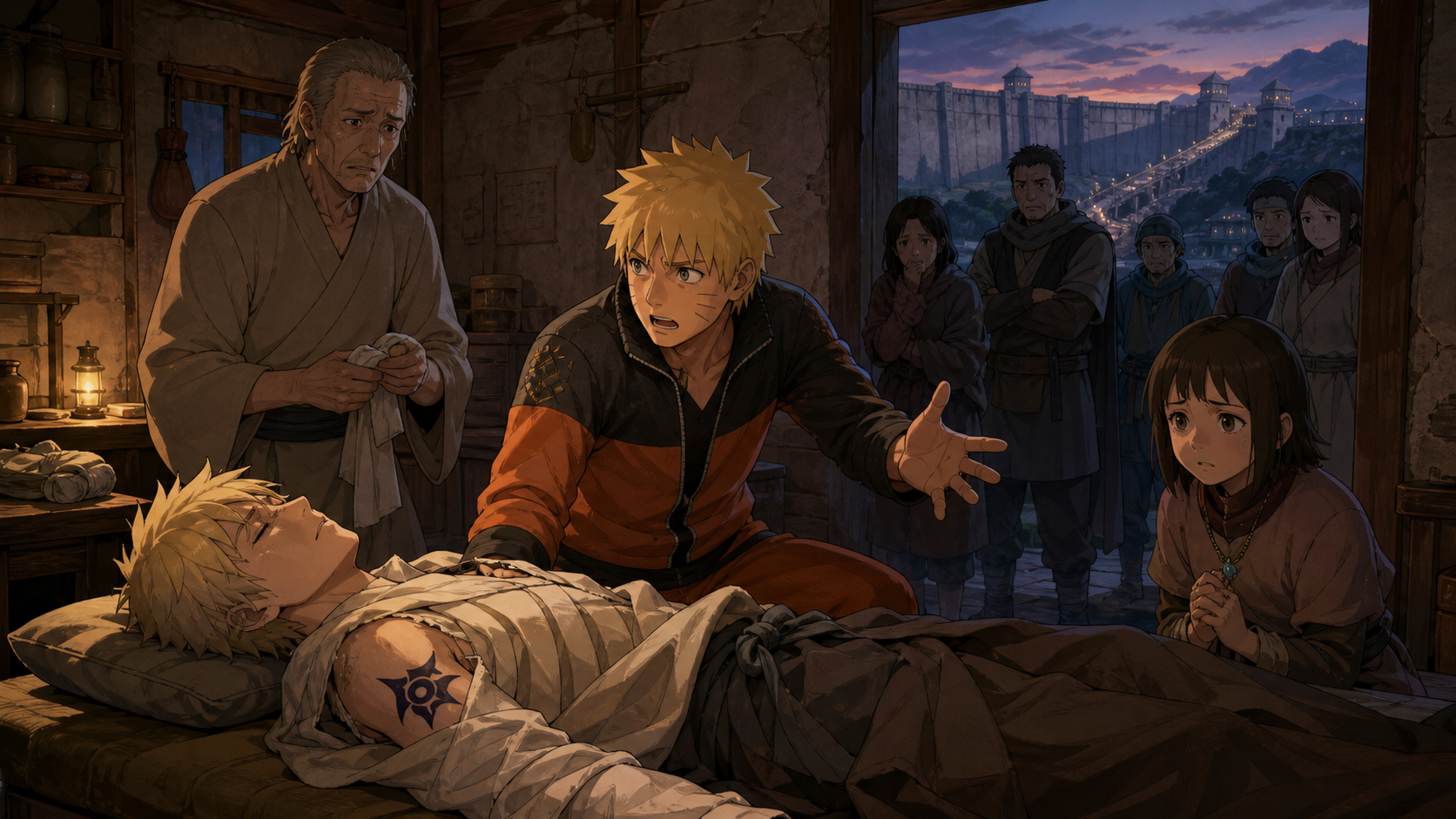
The villagers carry him inside.
A local man says he has played at being a doctor and may be able to help. In a village abandoned by formal authority, even medical care has become something residents must improvise.
He begins examining Menma.
Then he finds the mark.
Menma carries a sign identifying him as one of the people connected to the attack on the village.
The room changes instantly.
The wounded protector becomes an enemy in their eyes. The man refuses to treat him.
Naruto Judges the Choice Menma Just Made
Naruto pleads with the villagers.
Menma helped them build a defense. He saved Fuki. He has protected strangers again and again. He just took an attack meant for Naruto.
There must be a reason for the mark.
Naruto is not proving that Menma never harmed anyone. He cannot prove it. That missing certainty has followed them from Konoha Hospital to this room.
He is arguing that a person bleeding in front of them made a choice worth recognizing.
The villagers have their own evidence. They buried family members. They watched their homes burn. The mark belongs to the people responsible.
Asking them to ignore it would be cruel.
Letting Menma die without hearing the truth would be cruel too.
Episode 214 forces both realities into the same room and refuses to make either one comfortable.
The Past Returns Through Menma's Body
Menma traveled to the Land of Rice Paddies hoping his mind would return something.
His body answers first.
The speed, reflexes, music ninjutsu, and mark all point toward a life he cannot explain. None of them cancel the person Naruto has watched clean an apartment, comfort a child, fortify a village, and shield a friend.
Neji was right that the past required investigation.
Naruto was right that present choices matter.
Now the episode asks the harder question. What happens when those truths appear to accuse each other?
Menma needs treatment before anybody can answer.
Naruto can only beg the villagers to give him enough time to face whatever reality returns.
The music clue supports travel without proving allegiance
Chakra amplification through an instrument is specialized enough to justify investigating the Land of Rice Paddies, especially after Naruto’s experience with Tayuya. Similar technique does not establish that Menma served Orochimaru or belonged to the same unit.
Tsunade handles the distinction correctly. The river route and music form a lead, not a verdict. Sending Neji and Tenten gives the mission strong observation and ranged restraint while Menma’s risk remains unknown.
Neji’s staged fall measures reflex rather than motive
Menma catches him at trained speed, proving that the body retains shinobi capability. The rescue also works against immediate hostile intent because Menma exposes the very ability he might prefer to conceal in order to protect the teammate most suspicious of him.
Neither result settles identity. Neji updates the profile without forcing it into innocence or guilt: capable, difficult to identify, and currently protective.
The demilitarized zone protects policy while abandoning residents
Governments can claim that intervention risks violating an agreement or belongs to another jurisdiction. Bandits understand the gap and operate where every authority has a procedural reason to delay.
One-third of the village is dead and half the survivors have fled. The label may reduce state conflict while converting civilian homes into an undefended operating area. Orderly paperwork does not make the resulting exposure neutral.
Neji’s refusal protects a real mission boundary
Tsunade authorized investigation of Menma and capture of the intruder, not intervention in a disputed border conflict. Attacking suspected Sound-affiliated bandits could create consequences Konoha never approved and endanger the entire team.
Naruto’s choice remains morally intelligible because the danger is immediate and no responsible authority has appeared. The episode earns its disagreement by letting discipline and necessary aid each protect something real.
The wall turns skill difference into a terrain problem
Villagers cannot match rogue ninja technique in open combat. A moat, controlled bridge, and wall narrow movement, delay numbers, and give non-shinobi defenders a place to concentrate attention.
Naruto’s clones supply labor, but lasting defense requires local understanding. Tenten’s return helps transform one outsider’s impulse into a project residents begin to own and maintain.
Tenten’s choice connects caution with compassion
She can respect Neji’s reading of the assignment and still decide that carrying materials does not require pretending the village is invisible. Her participation keeps the conflict from becoming Naruto’s heart against Neji’s coldness.
A responsible team can disagree about authorization while finding bounded help that reduces immediate danger. Tenten provides that bridge before the same hostile operative brings both mission paths together.
Neji’s pursuit protects the improvised defense
The intruder already entered Konoha and escaped. Leaving him free near a vulnerable settlement could make every wall irrelevant. Neji continues the task most directly tied to identifying who Menma was and who still wants him.
When the fight returns to the village, the supposedly separate choices merge. Naruto addresses civilian vulnerability while Neji tracks the organized threat producing it.
Menma’s sacrifice is stronger evidence than the staged test
He knows the attack is real and moves into it before self-preservation. The choice does not depend on applause or an audience prepared to reward him.
Present action still cannot erase unknown history. It establishes that whatever the shoulder mark means, Menma is willing now to absorb lethal harm rather than let Naruto take it.
The healer’s refusal grows from scarcity and grief
A trained medical system is absent. Treatment depends on one resident with limited experience and supplies, serving a community already devastated by people carrying the same mark.
Refusing care is cruel to the bleeding person. Asking survivors to spend scarce resources on someone apparently linked to their attackers is not emotionally simple. The mark turns triage into a confrontation between past harm and immediate life.
Naruto argues for time rather than acquittal
He cannot prove Menma never participated in the attacks. He points to the rescued baby, Fuki, the village construction, and the blow Menma just took. Those choices deserve enough medical care for the truth to remain possible.
Keeping a person alive does not decide the later judgment. Letting him die ensures the mark becomes the only story anyone hears.
RaeRae’s full take
Episode 214 makes Neji and Naruto both right about different dangers. The past matters because Menma has trained reflexes, specialized music, and a hidden mark. The present matters because he keeps using those same reflexes to protect people.
The village’s anger is earned. Ninja destroyed families while governments hid behind a demilitarized label. I am still not accepting untreated death as a substitute for investigation, especially after Menma takes the attack meant for Naruto.
“Bringing back reality” is not recovering one convenient identity. It is holding the body’s evidence, the village’s evidence, and Menma’s current choices together until none has to disappear for the answer to feel clean.
RaeRae checkpoint: The mark deserves investigation. The sacrifice deserves treatment. Keeping both facts alive is the only way the village can learn which past actually returned.
Receipts and official routes
- Episode number, licensed title, journey to the Land of Rice Paddies, village defense, Menma’s sacrifice, and revealed mark: Naruto Official Site.
- Japanese title, December 21, 2006 broadcast record, and TV Tokyo episode synopsis: TV Tokyo.