
The Weight of the Prized Artifact!
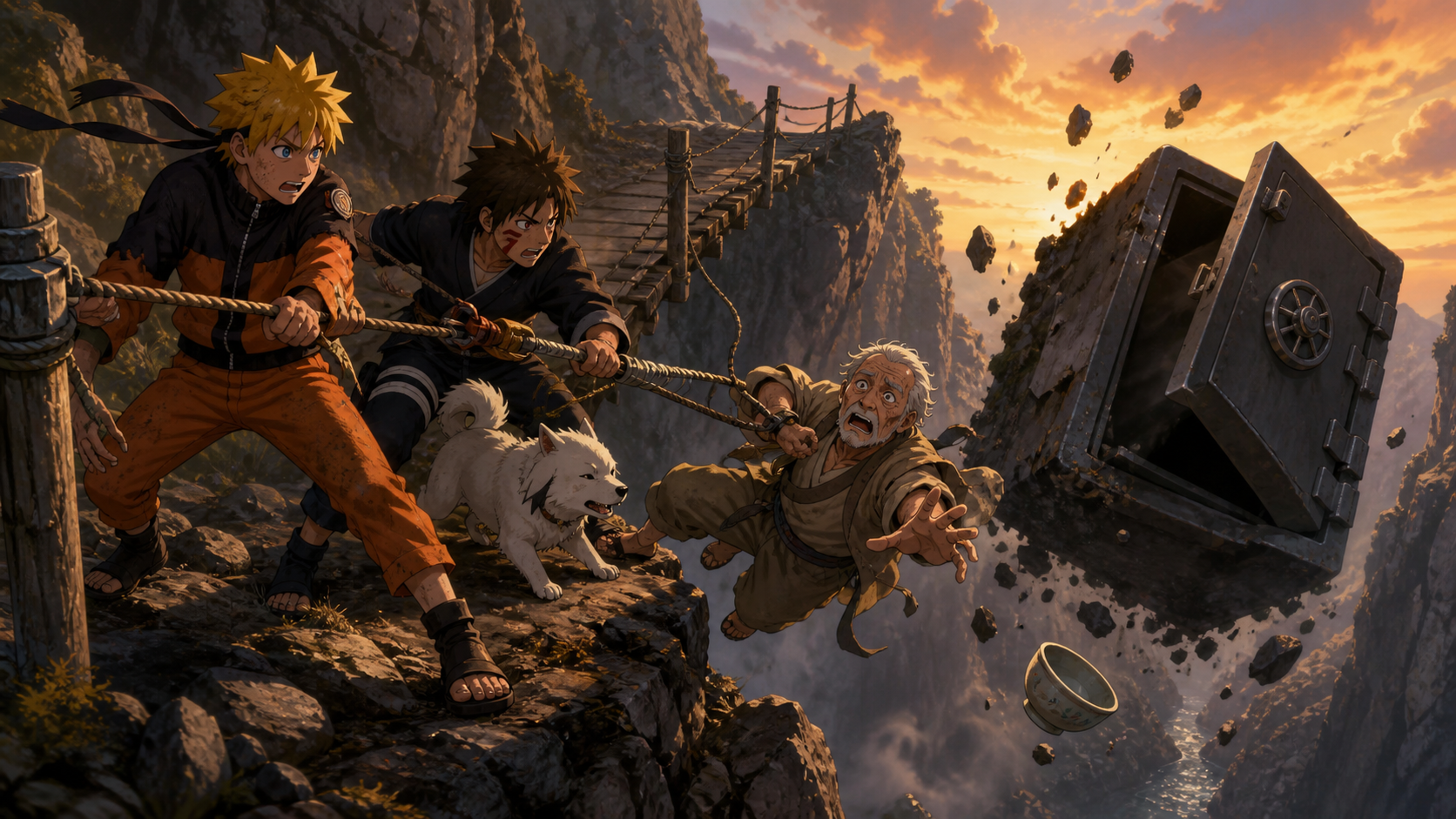
Naruto, Kiba and Akamaru escort an irreplaceable tea bowl for a client who values it above their lives, until a collapse forces everyone to choose the living maker instead.
Shinemon says a tea bowl matters more than human life.
Naruto would like to introduce that opinion to a Rasengan.
Kiba spends most of Naruto Episode 208 preventing the introduction.
`The Weight of the Prized Artifact!` sends Naruto, Kiba, and Akamaru on an escort mission with a national treasure called Kachō Fūgetsu, or the Beauty of Nature. The bowl could allegedly buy one or two mountains.
It travels inside a safe large enough to flatten the people carrying it.
The client considers that an acceptable workplace condition.
A Tiny Bowl Gets a Ridiculous Safe
The mission design contains more thought than Shinemon gives it credit for. Naruto is the visible defender, Kiba is the recovery specialist, and Akamaru gives the team a tracking method that does not depend on roads or eyewitnesses. Tsunade plans for theft before the group leaves. The actual weakness is the client, who treats security as a chance to advertise the object's price.
The oversized safe creates its own security problem. It tells every observer that something valuable is inside, slows the escort, and turns uneven terrain into a lethal hazard. Protection has become performance. Shinemon wants the treasure's importance to be physically obvious, even when discretion and a manageable container would serve the mission better.
Naruto and Kiba understand the contradiction immediately. They are being asked to guard a fragile bowl from thieves while the chosen transport threatens to crush the guards before a thief appears.
Tsunade describes the assignment as protected delivery rather than ordinary transport.
Naruto must guard the Beauty of Nature on its way to an exhibition. Kiba and Akamaru join as pursuit personnel in case anyone steals it. That division makes sense: Naruto can absorb attention around the object, while Kiba can follow a fleeing thief by scent.
Then they see the safe.
The tea bowl is small. Its container is enormous, heavy, and much more likely to kill a porter than the ceramic object inside it.
Shinemon greets them by insulting their intelligence.
When the safe starts to fall, Naruto and Kiba throw themselves beneath it. Shinemon orders them to keep it upright even if they die. Once the danger passes, he expresses no gratitude. Ninja accept mortal risk when they take a paid mission, he says.
Naruto reaches for Rasengan.
Kiba reaches for Naruto.
This pattern will repeat.
Shinemon Thinks a Contract Cancels Basic Humanity
Shinemon also confuses professional danger with unlimited consent. Shinobi accept missions whose risks can include death. They do not therefore agree that a client may invent hazards, ignore their advice, and spend their lives for convenience. The difference is not softness. It is the difference between necessary exposure and negligent command.
Naruto's anger is ethically clearer than Kiba's apologies, but Kiba performs the harder social job. He prevents a fight with the client, keeps the assignment active, and redirects Naruto without endorsing Shinemon's contempt. His restraint protects both the mission and Naruto from the consequences of assaulting the person they were hired to escort.
The pair therefore divide emotional labor as naturally as they divide combat roles. Naruto says what the situation deserves. Kiba makes sure they can still finish it.
Shinemon's argument sounds simple.
He paid Konoha. Naruto and Kiba accepted the mission. Protecting the artifact is their duty, and the possibility of death belongs to shinobi work.
The conclusion does not follow.
A contract can assign risk. It does not make the client's judgment sacred or turn workers into disposable packing material. Shinemon does not face a tragic choice between lives and the bowl. He creates unnecessary danger, refuses to help, and treats the genin's survival as an inconvenience after the object is safe.
Kiba keeps apologizing because somebody must keep the mission moving.
Naruto keeps offering direct customer feedback with his fist.
Neither boy likes Shinemon. Both continue protecting him.
That difference between service and approval will matter later.
Naruto Invents Express Bungee Delivery
The bungee plan is absurd, yet it establishes a method the episode will use again. Naruto and Kiba learn how to coordinate weight, momentum, and timing while Shinemon watches only the artifact. What appears to be disposable comedy becomes rehearsal for saving the same client during the collapse.
That payoff matters because their rescue is not luck. The boys adapt an improvised technique that nearly failed, remember what worked, and use it under worse pressure. Naruto's plans often begin as impulses, but he is capable of learning from the physical information a bad attempt provides.
Shinemon learns nothing from the recovery. He sees the safe return and counts the result as proof that his priorities were correct. Success protects him from examining the unnecessary risk, which makes the later loss of the bowl the only consequence loud enough to reach him.
The safe drops into a difficult location after another transport mistake.
The team can recover it by taking a long route, but the exhibition deadline makes that impossible. Naruto proposes a bungee jump.
Kiba is volunteered before he has time to discover the meeting where this decision happened.
The descent works badly, nearly kills them, and still recovers the cargo. Shinemon responds as if survival proves the risk was reasonable.
It does not.
Getting away with a terrible plan does not turn it into a good plan. This is a lesson Naruto himself usually needs, which makes watching him recognize it in someone else especially funny.
Shinemon repeats that ninja should expect to lose their lives on missions.
Naruto again offers Rasengan.
Kiba again saves the client from the escort team.
Shinemon Announces the Treasure to the Thieves
The scene turns the supposed security expert into the mission's information leak. Naruto and Kiba may be terrible liars, but they understand that strangers do not need an inventory. Shinemon values public recognition so much that silence feels like an insult to the bowl.
His cram-school excuse exposes more than cowardice. It shows that he has always understood life matters when the life is his. The artifact-above-humanity speech is a rule for employees, not a belief he has tested against his own fear. The thieves do not teach him empathy, but they briefly force him to hear the unequal contract he has been defending.
Naruto and Kiba still shield him after that hypocrisy becomes undeniable. Mission discipline means protecting a client who is actively making protection harder.
Suspicious men approach and offer to carry the safe.
Naruto and Kiba recognize the setup. They awkwardly insist that nothing valuable is inside, producing the least convincing lie two genin have ever attempted.
Shinemon corrects them.
He announces the national treasure, names it, and boasts that it matters more than human life.
The strangers immediately ask whether that means Shinemon will not mind dying for it.
He remembers an urgent cram-school appointment.
The hypocrisy lands without assistance. Shinemon believes other people should die for the bowl. When the same rule reaches his body, his schedule becomes very important.
Naruto and Kiba split up to protect him, fight the attackers, and keep the safe moving. What looked like a random roadside robbery connects to a larger gang that has tracked the Beauty of Nature.
The escort has become a pursuit mission exactly as Tsunade anticipated.
Akamaru Solves the Smoke Screen
The smoke screen confirms why Tsunade assigned Kiba. Naruto can create numbers and pressure, but extra eyes do not help inside visual cover. Kiba and Akamaru change the category of the problem. Instead of trying to see better, they make sight irrelevant.
Dynamic Marking is ridiculous enough to embarrass everyone involved, especially Shinemon. It is also precise fieldcraft. The thieves planned for ordinary pursuit and did not plan for a scent they would carry with them. Their own escape route becomes a trail.
Akamaru's contribution also prevents the episode from treating him as equipment attached to Kiba. He performs the decisive tagging action. The humans provide strength and tactics; the ninken supplies the sensory advantage that makes recovery possible.
The thieves fill the area with smoke and seal Naruto and Kiba's vision.
Kiba switches senses.
He and Akamaru can fight through scent, turning the cover against people who assume blindness means helplessness. Akamaru uses Dynamic Marking to tag the thieves with a smell they cannot easily hide.
Yes, the tracking method is urine.
No, Shinemon is not emotionally prepared when some of it reaches him.
The technique works. Even after the thieves escape with the safe, Akamaru can follow the marked scent. Naruto and Kiba pursue while Shinemon complains that he should have controlled the object himself.
He has spent the trip refusing physical labor while criticizing the people performing it.
Now he wants credit for an imaginary version where he did everything better.
Shinemon Finally Risks His Own Life
His decision to cling to the bowl is not pure courage. Pride, ownership, fear of public failure, and genuine devotion to his craft all collide in the same movement. For once, however, he does not ask a genin to take the first impact while he comments from safety.
Naruto and Kiba's apparent departure makes him confront the principle without an audience. There is nobody left to impress and no subordinate left to command. The treasure cannot comfort him, move the rubble, or make his terror less real. His admission that he wants to live is the first honest statement he gives the team.
The boys let the lesson land before revealing the rescue because immediate reassurance would allow Shinemon to keep pretending. A few seconds with his own rule are harsher than another lecture from Naruto.
The chase catches the thieves and divides into another series of fights.
Naruto and Kiba handle the gang while pursuing the leader with the artifact. Shinemon refuses to release the Beauty of Nature when the confrontation turns dangerous.
For the first time, he applies his stated value system to himself.
The terrain or structure collapses around him. Naruto and Kiba can save the bowl or save Shinemon, but the moment will not preserve both.
Shinemon orders them to forget him and protect the artifact.
Kiba says they should let the miserable client die like a dog.
Naruto agrees.
They leave.
Shinemon lies beneath the approaching collapse and hears his own words repeated back to him. A ninja risks death on a mission. The Beauty of Nature is more precious than life. If he is not dead, he should keep moving.
His theory sounds different when nobody else has to die for it.
Shinemon admits the truth.
He does not want to die.
Nothing in the world matters more than life.
Naruto and Kiba Save the Jerk
Naruto and Kiba did not abandon him.
They launch another bungee-style rescue and pull Shinemon away from death. The Beauty of Nature does not survive intact.
That choice is the episode's only acceptable answer.
Shinemon behaved horribly. He used the genin as shields, treated their lives as cheap, exposed the treasure to thieves through his own ego, and offered gratitude only when frightened.
They save him anyway.
Protecting a life is not a prize awarded for pleasant behavior. Naruto and Kiba do not need Shinemon to become lovable before deciding he should remain alive.
That makes their choice more convincing than a sentimental rescue. Shinemon has not earned affection, apologized, or promised to change before the collapse. The boys act because leaving a person to die would make his rotten value system their own. They refuse to become the shinobi he described, hired bodies who obey the object label and stop asking what a mission ought to protect. Their anger remains justified. Their duty remains human.
The mission loses the object and fulfills the principle beneath the job.
The Living National Treasure Can Make Another Bowl
Naruto and Kiba mourn the destroyed artifact.
Without the Beauty of Nature, the delivery failed. The exhibition has no centerpiece. A treasure supposedly worth mountains is gone.
Shinemon says he will make another.
The boys finally learn that their rude client created Kachō Fūgetsu. Shinemon is himself recognized as a living national treasure. His skill produced the masterpiece, and his survival preserves the chance to produce something greater.
The bowl is valuable because a living person shaped knowledge, patience, and judgment into it. Treating the finished work as more precious than Shinemon reverses the source of that value. A masterpiece can be mourned without turning the maker into packaging. Shinemon needed Naruto and Kiba to choose him before he could remember that his hands, experience, and next idea were not replaceable parts of the shipment.
That reveal changes the title.
The real weight of the artifact is not the safe, the price, or the mission contract. It is the belief that one finished object contains more value than the living person who can create.
Shinemon thanks Naruto and Kiba and gives the genin a grudging compliment. Then he prepares to make a new masterpiece.
He remains abrasive.
He is at least alive enough to work on it.
The safe advertises value while creating danger
A discreet container would protect the bowl from attention and let the escort move safely. Shinemon chooses a massive safe whose size announces expensive cargo, slows every route, and threatens to crush the people assigned to carry it.
Protection has become theater. The container makes the artifact’s importance visible because Shinemon wants others to recognize its status. Every security advantage is undercut by the need to perform value in public.
Mission risk is not unlimited consent
Ninja accept assignments where injury and death may be possible. That does not authorize a client to create unnecessary hazards, ignore professional judgment, and demand human sacrifice for convenience. Necessary exposure and negligent command are not the same contract.
Shinemon treats payment as ownership of the escort team’s lives. Naruto’s anger recognizes the moral failure immediately, while Kiba performs the less satisfying job of keeping the mission functional without agreeing that the client is right.
Kiba carries the mission’s emotional labor
He repeatedly prevents Naruto from attacking the person they must protect, apologizes enough to preserve cooperation, and redirects the team after each insult. Restraint here is not passivity. It prevents Shinemon’s behavior from turning into a failed assignment and disciplinary case.
Naruto says what everyone is thinking. Kiba makes sure the truth does not stop them from completing the duty underneath it. Both roles matter, even when only one gets the satisfying line.
The first bungee attempt becomes usable field data
The improvised recovery is dangerous, but Naruto and Kiba learn how weight, momentum, anchoring, and timing behave under pressure. When the later collapse leaves Shinemon trapped, they adapt the same method rather than inventing a miracle.
That payoff separates reckless luck from iterative problem-solving. A bad first plan can still teach something if the team studies what nearly failed instead of treating survival as proof the plan was good.
Shinemon’s public boasting defeats his own escort
Naruto and Kiba attempt an awful cover story, yet they understand the basic rule that suspicious strangers do not need a cargo inventory. Shinemon corrects them by naming the treasure, declaring its price, and explaining that it matters more than life.
He values recognition so much that secrecy feels disrespectful to the bowl. The thieves do not penetrate a sophisticated defense. The client supplies motive, target, and moral permission in one speech.
Akamaru changes the pursuit instead of seeing through smoke
Visual cover defeats extra eyes, so Dynamic Marking makes sight irrelevant. The thieves carry the identifying scent away with them and transform their escape route into evidence.
The joke should not hide Akamaru’s agency. He performs the decisive tagging action. Kiba interprets the trail, Naruto supplies combat pressure, and the ninken creates the condition that lets either human find the stolen safe.
Shinemon believes his rule only when other people pay
Asked whether he will die for the bowl, he suddenly remembers another appointment. Later, when collapse leaves nobody else available to absorb the cost, he clings to the artifact and finally confronts the standard in his own body.
His admission that he wants to live is not philosophical growth delivered in comfort. It arrives when the object cannot move rubble, share fear, or save him. The rule sounds different once the worker and client are the same person.
Naruto and Kiba save him before he earns forgiveness
Shinemon has not apologized, become pleasant, or promised reform when they return. They rescue him because human life is not a prize awarded for good customer behavior.
Letting him die would make his value system theirs. By choosing the unbearable person over the treasured object, they fulfill the humane principle the mission contract failed to state.
The maker is not packaging for the masterpiece
Kachō Fūgetsu matters because living skill, memory, patience, and judgment produced it. Treating the finished bowl as more valuable than Shinemon reverses the source of that value.
The loss remains real. A new work will not make the destroyed artifact identical or erase its history. Saving the maker preserves a future of creation rather than pretending objects are interchangeable.
RaeRae’s full take
Episode 208 gives us a client who makes every correct point unbearable by attaching it to contempt. Yes, a national treasure deserves careful protection. No, that does not make two teenagers disposable shock absorbers for a ridiculous safe.
Kiba deserves more credit than the episode gives him. He handles tracking, client management, Naruto management, and the constant work of keeping justified anger from wrecking the assignment. Akamaru then solves the smoke screen in the least dignified and most effective way available.
The final choice works because Shinemon is still a jerk when they save him. Human worth does not wait for likability. The bowl can be mourned. The living hands that made it still deserve to survive.
RaeRae checkpoint: If protecting an object requires treating people as replaceable packaging, the mission has already misunderstood why the object was valuable.
Receipts and official routes
- Episode number, licensed title, Beauty of Nature escort, theft, collapse, and Shinemon’s identity as its maker: Naruto Official Site.
- Japanese title, November 2, 2006 broadcast record, and TV Tokyo episode synopsis: TV Tokyo.