
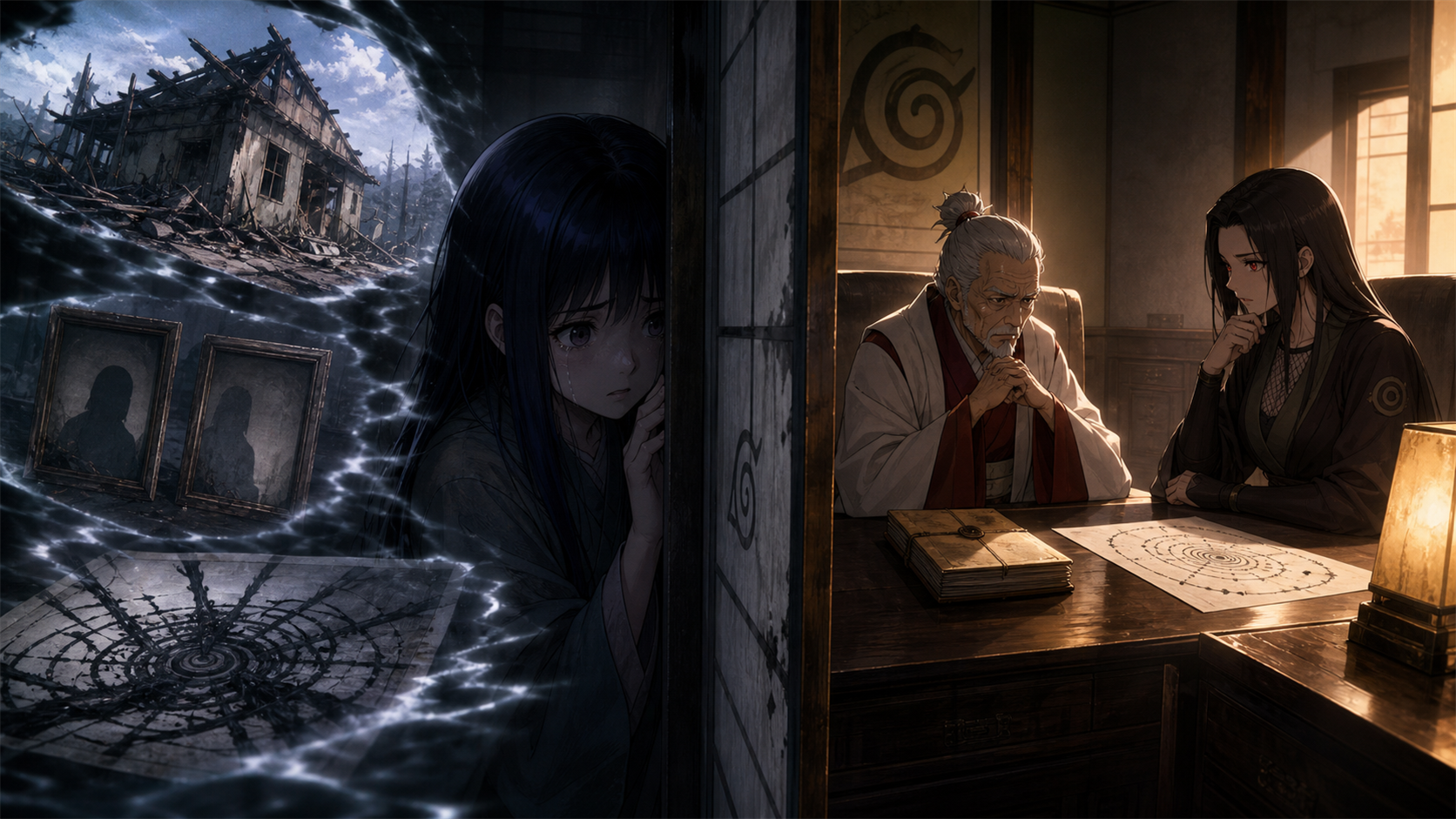
Kurenai’s Top-Secret Mission: The Promise with the Third Hokage
Kurenai explains the promise that made her Yakumo’s private teacher, while the girl’s memories and sealed records turn incomplete truths into an accusation against the Third Hokage.
Yakumo believes the Third Hokage murdered her parents.
She has reasons.
They are not proof.
Naruto Episode 205, `Kurenai's Top-Secret Mission: The Promise with the Third Hokage`, finally explains how Kurenai became Yakumo's private teacher. It also shows how classified files, half-heard conversations, and adults who refuse to explain themselves can turn grief into a complete conspiracy.
Before anyone reaches that accusation, Kurenai has to escape a clan full of genjutsu specialists.
Episode 205 Facts
Episode: 205 of the original Naruto anime
Licensed title: Kurenai's Top-Secret Mission: The Promise with the Third Hokage
Japanese title: 紅の極秘任務~三代目との約束~ (Kurenai no Gokuhi Ninmu: Sandaime to no Yakusoku)
Japanese broadcast: October 5, 2006
Arc: Yakumo Kurama Rescue Mission
Classification: Anime-original filler
Unkai became acting head of the Kurama clan after Murakumo died; he is not Yakumo's father. Hiruzen says the dangerous power must be eliminated if it awakens. Episode 205 does not establish that he ordered Yakumo killed, and it ends on Yakumo's accusation about her parents rather than confirming it.
The identity of the destructive force inside Yakumo belongs to the later resolution. This episode provides incomplete statements, suspicious records, and genuine grief without supplying the final answer.
Kurenai Refuses to Return Yakumo to Her Clan
The attackers wear the Kurama clan emblem.
They tell Kurenai to hand over Yakumo and dismiss the kidnapping as an internal family matter. Kurenai rejects the premise. The Third Hokage placed Yakumo in her custody, and a clan claim does not erase that responsibility.
The attackers catch Kurenai in an illusion.
At least, they think they do.
Kurenai lets them see the victory they expect, then reverses the trap. They wake inside her genjutsu while she carries Yakumo away.
This is why Hiruzen selected her. Kurenai does not overpower a genjutsu clan with a louder attack. She reads the illusion, controls what the casters think they achieved, and leaves while they are still congratulating themselves.
The teacher who said she does not deserve another student's life is risking her own for Yakumo again.
Kurenai also rejects the idea that a family dispute sits beyond village responsibility. The Kurama clan belongs to Konoha, Yakumo belongs to its head family, and Hiruzen assigned Kurenai direct custody. “Internal matter” becomes a phrase the attackers use to remove outside accountability while taking a person who has not agreed to leave.
Her reversal of their group illusion demonstrates control rather than raw superiority. She gives the attackers the sensory confirmation they expect, lets confidence hold them in place, and exits with Yakumo. The rescue works because Kurenai understands what genjutsu users want to believe about their own success.
Naruto Runs Straight Into the Giant Bean Plant
The rescue group reaches the outer attackers.
Naruto charges first and gets swallowed by a giant beanstalk illusion. He knows the enemy specializes in genjutsu. He has already been trapped by Kurenai on the road. None of this information reaches his feet before they sprint into the next technique.
Shino supplies the correction.
The illusion manipulates human senses, but his insects do not process the trap the same way. They interrupt the caster and create an opening. Kiba follows the target through scent, uses Man-Beast Clone with Akamaru, and drives the attack home with Fang Over Fang. Guy finishes the exchange with Severe Leaf Hurricane.
Naruto remains asleep until Sakura releases the illusion.
Everyone else wins the fight while he dreams about vegetation.
The comedy makes a useful tactical point. Team 8 does not rely on one sensory channel. Shino's insects, Kiba's nose, and Hinata's Byakugan give the team several ways to challenge a world an illusionist has rewritten.
Kurenai helped build the worst possible students for a genjutsu clan to fool.
That tactical diversity is a teaching result even when Kurenai did not create each inherited ability. She trained the team to combine independent sensory systems. Insects can interrupt a human-focused illusion, scent can follow a body hidden from sight, and the Byakugan can separate chakra position from projected image.
Naruto supplies a useful control case. He charges through the visible scene, gets caught again, and remains trapped after the physical opponents fall. Sakura's release confirms that defeating the caster does not always repair every affected perception automatically.
Unkai Makes Kurenai's Senses Betray Her
Yakumo identifies the final opponent as Unkai, the man who took control of the Kurama clan after her father died.
Unkai is not another disposable attacker.
He traps Kurenai in an illusion she cannot release through the usual method. Blood appears. Pain registers. His hidden attack keeps advancing while he demands that she surrender Yakumo.
Kurenai refuses.
Naruto arrives and throws himself between them, then falls for the technique too. Hinata activates the Byakugan and finds Unkai above the position Naruto is attacking. Her direction gives Naruto a target beyond the false image.
That rescue matters for more than the fight.
Kurenai told Team 8 that they were only subordinates and that her contribution to their growth meant nothing. Hinata uses the ability Kurenai encouraged her to trust in order to save Kurenai from a superior illusionist.
The lesson comes back to protect the teacher.
Unkai's technique is dangerous because ordinary release fails while false blood, pain, and a hidden physical position reinforce one another. Kurenai cannot solve it alone despite being the strongest genjutsu specialist present. Hinata supplies the external observation the illusion denies her.
The rescue does not diminish Kurenai's skill. It proves that expertise still benefits from a team capable of checking reality through a different channel. Her resignation rejects precisely that support.
Yakumo Thinks Kurenai Hated Her
Once the group breaks away, Naruto asks Yakumo directly whether she resents Kurenai for sealing her power.
Yakumo says Kurenai hated her. In her version of the relationship, Kurenai never wanted her to become a genjutsu practitioner and destroyed the dream to make sure she could not.
Naruto points to the evidence standing nearby.
Kurenai just risked her life to save her.
That does not automatically make the seal right. Protection can become control, especially when the protected person receives no honest explanation. It does prove that hatred is a poor account of Kurenai's behavior.
Kiba pushes the same demand from the other side. He wants the truth about Yakumo and the resignation. Kurenai can no longer keep both groups of students in separate boxes.
She begins at the Kurama clan's decline.
One Child Inherited an Entire Clan's Expectations
The Kurama clan once held real influence in Konoha through genjutsu.
Then it stopped producing chunin and jonin. Status faded. The family needed a prodigy if it wanted its old position back.
Yakumo appeared with extraordinary talent.
She was also the only daughter of the head family, so every private wish became clan policy. Her parents and relatives treated her potential as the answer to generations of decline.
Yakumo wanted to satisfy them.
Her health prevented formal entry into the Academy. The rejection crushed her because it felt larger than one school decision. If she could not become a shinobi, she believed she had failed her parents and the clan before her training began.
Her father Murakumo appealed directly to the Third Hokage.
Hiruzen recognized both the power and the risk. He assigned Kurenai as Yakumo's private teacher because she was Konoha's best genjutsu specialist.
That arrangement gave Yakumo hope.
It also placed Kurenai between the child, the clan, and the village.
Each party defined success differently. Yakumo wanted a shinobi life. Her parents and clan wanted restored status. Hiruzen needed Konoha protected from an uncontrolled ability. Kurenai had to teach a child while evaluating a danger the child understood as her only value.
No training relationship can remain ordinary under those conditions. Every improvement pleases Yakumo and may alarm the village. Every restriction protects health or safety and may sound like proof Kurenai never believed in her.
Yakumo Heard the Third Hokage Say the Power Must Be Eliminated
Yakumo overheard a conversation between Kurenai and Hiruzen.
Kurenai said the power might remain dormant for a long time. Hiruzen warned that the dam would eventually break. When Yakumo's ability poured out, it could threaten the entire village. At that point, he said, they would have to eliminate it.
Yakumo heard adults discussing her as a future threat.
Then Kurenai sealed her power.
The conclusion seemed obvious. The Third Hokage ordered the seal because Konoha intended to eliminate Yakumo if containment failed.
Naruto refuses to believe Hiruzen would order such a thing.
The wording leaves an important gap. Hiruzen says the threatening power must be eliminated. Yakumo hears that she must be eliminated. When a child has been taught that her value and her ability are the same thing, the distinction is almost impossible for her to imagine.
The adults bear responsibility for that ambiguity even if Yakumo misidentifies the antecedent. They discuss her future danger within earshot, seal the ability afterward, and provide no explanation capable of separating person from power. “It” becomes whichever object fear makes most plausible.
Naruto's faith in Hiruzen gives him a reason to reject murder, but personal trust is not documentary proof. Yakumo needs evidence about the fire and the seal, not another Leaf shinobi telling her the Hokage was a good man.
The Classified Autopsy Turns Suspicion Into Certainty
Yakumo's parents died shortly before her private training began.
A sudden fire consumed their home in broad daylight. Both parents were jonin, which makes their failure to escape hard for Yakumo to accept. The official investigation found no foul play.
Then Konoha classified and sealed the autopsy reports.
That secrecy destroys the reassurance.
Classification may protect techniques, suspects, or information about Yakumo's ability. It also prevents the surviving child from checking the event that reorganized her life. The village asks her to accept “no foul play” while withholding the material that supposedly supports it.
Two jonin dying in a daytime household fire already feels improbable to Yakumo. Sealed reports do not create the suspicion, but they make official reassurance impossible to test. Kurenai's later refusal adds another institutionally approved silence to the same pattern.
Yakumo combines the fire, the hidden reports, Hiruzen's warning, and Kurenai's seal into one story. The Third Hokage ordered her parents killed, suppressed the evidence, and placed Kurenai close enough to neutralize the surviving heir.
Episode 205 ends with that accusation.
It does not prove it.
That distinction matters. Yakumo is not lying. She is building the only explanation that seems to connect facts nobody will discuss with her. The adults created a vacuum and grief filled it.
Kurenai Protected Yakumo's Body but Not Her Trust
Kurenai kept her promise to Hiruzen in the most visible sense.
She guarded Yakumo. She fought her own clan. She carried the girl through hostile genjutsu and refused every demand to surrender her.
The promise is harder than following an order. Hiruzen is dead, the original danger remains classified, and nobody can tell Kurenai exactly what loyalty should look like now. Handing Yakumo to the clan would betray the child. Treating the seal as a permanent solution would betray her too. Kurenai must judge what protection requires after the authority who assigned the mission can no longer answer for it. Her resignation avoids that judgment by making guilt her only rule.
She failed at another part of protection.
Protection without explanation can succeed physically and fail relationally. Kurenai keeps Yakumo alive, stops the clan extraction, and contains an ability Hiruzen considered dangerous. Yakumo still experiences those actions as captivity, betrayal, and evidence of a murder conspiracy.
That does not mean every classified detail should have been handed to a sick child during a crisis. It means secrecy needed a plan for later truth, review, and trust repair. Kurenai accepted permanent villainy instead.
She never gave Yakumo enough truth to understand what the seal targeted or why the village feared the awakening. She accepted the role of villain because blame felt easier than reopening the danger.
The result is a child who believes her teacher hated her and her Hokage murdered her family.
Naruto Episode 205 does not settle whether secrecy was once necessary.
It shows what that secrecy costs after the emergency ends.
Kurenai can defeat Unkai's illusion.
She cannot reverse the story Yakumo has lived inside for a year without finally telling her the truth.
“Internal family matter” is an attempt to remove witnesses
The Kurama attackers use clan membership as authority to take Yakumo without outside review. Kurenai refuses because family connection does not cancel the village’s duty to protect a person who has not agreed to leave. The phrase does political work: it asks Konoha to treat abduction as private administration.
That does not make Konoha’s earlier confinement automatically just. It establishes that the clan cannot answer questionable village control by claiming a stronger ownership right. Yakumo needs independent protection from both institutions while the facts are examined.
Team 8 defeats genjutsu through independent reality checks
Shino’s insects do not process the illusion through the same human senses. Kiba and Akamaru follow scent when sight becomes unreliable. Hinata reads chakra position through the projected image. Sakura releases the lingering technique after the physical exchange ends.
Kurenai did not give these students their inherited abilities, but she taught them to coordinate channels that fail differently. That is the worst possible team for an illusionist who needs one false sensory story to control everybody at once.
Naruto shows why knowledge of danger is not the same as discipline
He already knows the clan specializes in genjutsu and has just escaped Kurenai’s binding. He charges into the visible threat anyway and gets swallowed by another illusion. Information never reaches behavior before his feet move.
The sequence is funny because the rest of the group handles the fight while Naruto dreams about a beanstalk. It is also a useful distinction: recognizing a threat category does not create a response plan. Naruto needs teammates whose habits interrupt the danger his impulse keeps entering.
Hinata’s sight rescues the teacher who taught her to trust it
Unkai gives Kurenai false blood, pain, and a target in the wrong position. Her usual release cannot break the reinforced experience. Hinata locates the real caster above the projected image and gives Naruto a coordinate he can attack.
The rescue does not diminish Kurenai’s expertise. It demonstrates why experts still need external verification. Her student supplies the channel Unkai’s illusion denied her, and the lesson Kurenai tried to erase through resignation returns as protection.
Yakumo’s hatred theory fails against behavior but not against harm
Kurenai risks her life, refuses the clan demand, and carries Yakumo through hostile territory. Hatred cannot adequately explain those actions. Naruto is right to challenge it.
Care does not make the seal harmless. A person can love someone and still control, frighten, or injure them through decisions made without truthful participation. Kurenai’s protection disproves indifference; it does not settle whether her method was justified.
The Third Hokage’s sentence contains a fatal pronoun
Hiruzen says the dangerous power may need to be eliminated. Yakumo hears that she may need to be eliminated. Adults who define a child primarily through ability cannot expect her to perceive a clean separation between person and power.
If Hiruzen meant the force rather than the girl, the distinction needed to be explained directly and repeatedly. Classified ambiguity leaves fear to select the object. Yakumo’s conclusion is not proof of an execution order, but it is a predictable consequence of the language and secrecy surrounding her.
Naruto’s faith in Hiruzen cannot substitute for records
He knew the Third Hokage as a protector and refuses the murder accusation. That relationship matters, yet “I knew him” cannot answer why two jōnin died in a daytime fire or why the autopsy reports were sealed.
Yakumo deserves evidence capable of surviving outside Naruto’s trust. The village must explain who classified the files, what danger disclosure posed, what the investigation actually found, and who can review the finding now that Hiruzen is dead.
Sealed autopsy reports make reassurance impossible to test
The official conclusion says no foul play. The supporting material is inaccessible to the surviving child whose life the deaths transformed. Even a legitimate classification decision destroys confidence when no later review or disclosure plan exists.
Secrecy does not merely hide answers. It changes the rational weight of every other fact. The fire, the overheard warning, Kurenai’s seal, and her refusal to explain become one conspiracy because the institution removes the documents that could separate them.
Kurenai inherited a promise without inheriting an accountability process
Hiruzen is gone. Kurenai still guards Yakumo, but the authority who defined the mission cannot answer questions about scope, review, or end conditions. A promise becomes dangerous when loyalty requires permanent obedience to a dead decision.
Kurenai must interpret protection in the present. That means defending Yakumo from extraction, reassessing the seal, involving Tsunade, and opening enough of the record for trust repair. Resignation avoids the judgment rather than honoring the promise.
RaeRae’s full take
Episode 205 builds Yakumo’s accusation carefully enough that dismissing her as irrational would be lazy. She hears adults discuss eliminating “it,” loses two jōnin parents in an unexplained fire, finds the autopsy sealed, and watches the same teacher restrict her power without a full explanation. Of course the pieces lock together in the worst possible shape.
That shape is still an allegation, not proof. Naruto’s affection for Hiruzen does not disprove it, and Yakumo’s grief does not prove it. The next responsible step is evidence, not another adult demanding trust while protecting the documents from inspection.
Kurenai keeps saving Yakumo’s body while surrendering the relationship to silence. Her promise to Hiruzen cannot remain more important than the living student standing beside her. If the mission was protection, truth and review now belong inside it.
RaeRae checkpoint: Classified silence does not leave an empty space. It gives grief, fear, and half-heard words permission to write the explanation nobody else will provide.
Receipts and official routes
- Episode number, licensed title, Kurama clan confrontation, Kurenai’s mission, Hiruzen’s warning, and Yakumo’s accusation: Naruto Official Site.
- Japanese title, October 5, 2006 broadcast record, and TV Tokyo episode synopsis: TV Tokyo.