
Multiple Traps! Countdown to Destruction
Shikamaru discovers Gennō’s true target beneath the Hokage Monument, and the Konoha 11 combines timing, sight, strength and trust to stop the final payload.
Gennō spends thirty years designing a trap for Konoha.
Naruto ruins the premise by bringing friends.
The old trapper steals blueprints to empty the village, returns them to recall its shinobi, and exposes thousands of paper bombs to keep everyone staring at the streets. His real target is the plateau behind Konoha. Break the narrow fault lines beneath the Hokage Monument, and the mountain will bury the village.
It is a magnificent final plan.
It is also a treasure hunt built for one dead child and solved by eleven living ones.
Episode 201 closes the Konoha Plans Recapture Mission by revealing that Gennō changed the ending before anyone reached it.
Episode 201 Facts
Episode: 201 of the original Naruto anime
Licensed title: Multiple Traps! Countdown to Destruction
Japanese title: 多重トラップ 崩壊のカウントダウン (Tajū Torappu, Hōkai no Kauntodaun)
Japanese broadcast: September 20, 2006
Arc: Konoha Plans Recapture Mission finale
Classification: Anime-original filler
The subtitles call the Hokage Monument the Great Stone Faces or Mountainside Images. All three names refer to the same carved plateau above Konoha. Episode 202 is a top-five-battles special and does not continue this mission.
Shikamaru explicitly labels the treasure-hunt interpretation conjecture. The disabled Academy connection, defective monument charges, lack of casualties, Gennō's final memory, and Naruto's resemblance to his son support it strongly, but nobody receives a complete confession explaining every modification.
Shikamaru Finds the Target Behind Every Diversion
Shikamaru reconstructs Gennō's moves in order.
The stolen blueprints trigger an S-Level alert and send Konoha's forces outside. Gennō moves freely through an understaffed village. He returns the plans and exposes evidence of his survival, pulling those forces back. Then the Konoha 11 discovers a massive bomb network and devotes every available eye to walls, streets, and buildings.
The paper bombs are not the final attack.
They are crowd control for shinobi.
Gennō chooses the moment when Konoha's fighters return because he wants them inside the destruction zone. Shikamaru looks toward the Hokage Monument and recognizes the one structure nobody is searching.
The mountain is not background anymore.
It is the weapon hanging over the village.
Shikamaru reaches that conclusion by asking where returning shinobi become useful to the enemy. The visible bombs kept defenders scattered across current streets. The final trap needs them gathered under one mass capable of killing the whole force at once. The monument supplies scale and position without requiring Gennō to plant explosives inside every home.
The recall itself becomes part of the trigger conditions. Gennō does not merely exploit troop movement. He designs the earlier emergencies so Konoha chooses when to place its defenders beneath the plateau.
The Hokage Monument Has Fault Lines
Gennō shows Naruto the charges inside the plateau.
The rock behind the carved faces is extremely hard, but narrow structural lines run through it. Apply force at those weaknesses, and the formation can split. Gennō revisited Konoha several times across thirty years to study the geology and perfect the bomb placement.
If the plateau collapses, earth and stone will bury the village below.
That plan explains the bizarre scale of everything before it. Thousands of visible charges make the hidden monument system feel impossible because nobody imagines a second network after finding the first. The returning shinobi create the highest possible casualty count. Naruto's presence gives Gennō a hostage trapped inside the mechanism.
Gennō claims the room will trigger if Naruto leaves. Defeating him does not solve anything if the exit activates the bombs.
The trap attacks every obvious response.
Naruto answers with the option Gennō never values enough.
He trusts the others.
The geology also shows thirty years of revision. Gennō did not know every weak line during the original Kagerō operation. He returned repeatedly, studied erosion and repairs, and built a new system around the stone that existed in the present. The monument plan is not simply an old weapon switched back on.
That makes his later claim of professional pride more credible and more disturbing. He spent decades refining a method after the village that ordered his first infiltration no longer existed. The project became personal long before terminal illness imposed a deadline.
Naruto's Complaints Were Never Rejection
Gennō remembers Naruto badmouthing his peers at Ichiraku.
Naruto admits they argue. His friends irritate him. He irritates them right back, often with impressive efficiency.
They are still his friends.
They are shinobi who will protect Konoha with him.
That distinction matters because Gennō treats irritation as distance. Naruto treats it as ordinary life among people who will show up when the mountain starts exploding.
Hinata noticed Naruto leave without explanation and searched for him with the Byakugan. Shikamaru identified the monument as the likely target. Kiba and Akamaru arrive first with Fang Over Fang. Shino's insects close around Gennō.
Naruto does not summon help.
His relationships notice his absence.
That is stronger.
Hinata's search is not limitless detection across an entire region. She observes that Naruto leaves without explanation and uses the Byakugan urgently while Shikamaru independently narrows the likely target. Awareness of a teammate creates the search condition; specialized sight completes it.
Gennō heard Naruto complain at Ichiraku and interpreted conflict as weakness. He missed the difference between irritation and abandonment because the son he lost no longer had a living peer network to complicate his memory. Naruto's friends can annoy him precisely because they remain close enough to keep returning.
Every Capture Finds Another Trap
Gennō refuses to go quietly.
He uses substitution before Shino's insects can hold him and stages another explosion. Shikamaru predicts the escape and catches him with Shadow Strangle.
When Chōji approaches, contact triggers a smoke screen that breaks the shadow restraint.
Gennō reaches another monument switch and tries to activate it. Nothing happens. The team already removed that charge and the other triggers they found.
Naruto tells him the truth plainly. Gennō may be an extraordinary trapper, but the Konoha 11 works better together than he works alone.
The old man responds with Rockslide Genjutsu.
The monument appears to collapse. Konoha disappears under stone. For a moment, the team believes it failed.
Shikamaru catches the illusion and orders everyone to release it.
Gennō's traps keep manufacturing conclusions. The team survives by refusing to accept the first ending it sees.
The illusion uses the catastrophe everyone already fears. Once the team knows the plateau can collapse, their own expectation supplies the panic. Shikamaru does not need to prove the mountain is structurally safe. He notices the collapse arrives through perception rather than the physical cues a real rockslide would create and orders release before fear controls the next move.
Gennō repeatedly pairs a physical mechanism with a false interpretation. A corpse certifies death. Returned plans certify recovery. Disabled bombs certify safety. Genjutsu certifies failure. The Konoha 11 wins by separating what happened from what the event was meant to make them conclude.
Ino Feels the Cost Inside Gennō's Body
Gennō summons the giant eagle and appears ready to escape.
Ino uses Mind Transfer.
She breaks the technique almost immediately, not because Gennō overpowers her mind, but because entering his body exposes the pain he has hidden. His insides are in terrible condition. He has been fighting through an illness severe enough that simply remaining alive is remarkable.
The revelation changes the countdown.
Gennō is not planning for a future after Konoha. He built the operation around a body already running out of time.
Ino's technique makes terminal illness impossible to hide behind performance. She feels the internal damage directly and withdraws before the pain overwhelms her. The discovery does not turn Gennō into a harmless patient, but it explains why negotiation has no ordinary leverage. Arrest, reputation, and future consequences mean less to someone who expects to die within the operation.
His illness also raises the risk of accidental escalation. A plan dependent on precise timing, substitutions, genjutsu, and controlled defects is being executed by a body failing under strain. Even softened mechanisms cannot guarantee safety when their operator may collapse at the wrong moment.
Naruto defeats him in close combat, but the old man says the trap is not over.
The eagle was never an escape mount.
It is the final delivery system.
The Third Hokage's Face Holds the Last Trigger
Paper bombs hang from the eagle's feet.
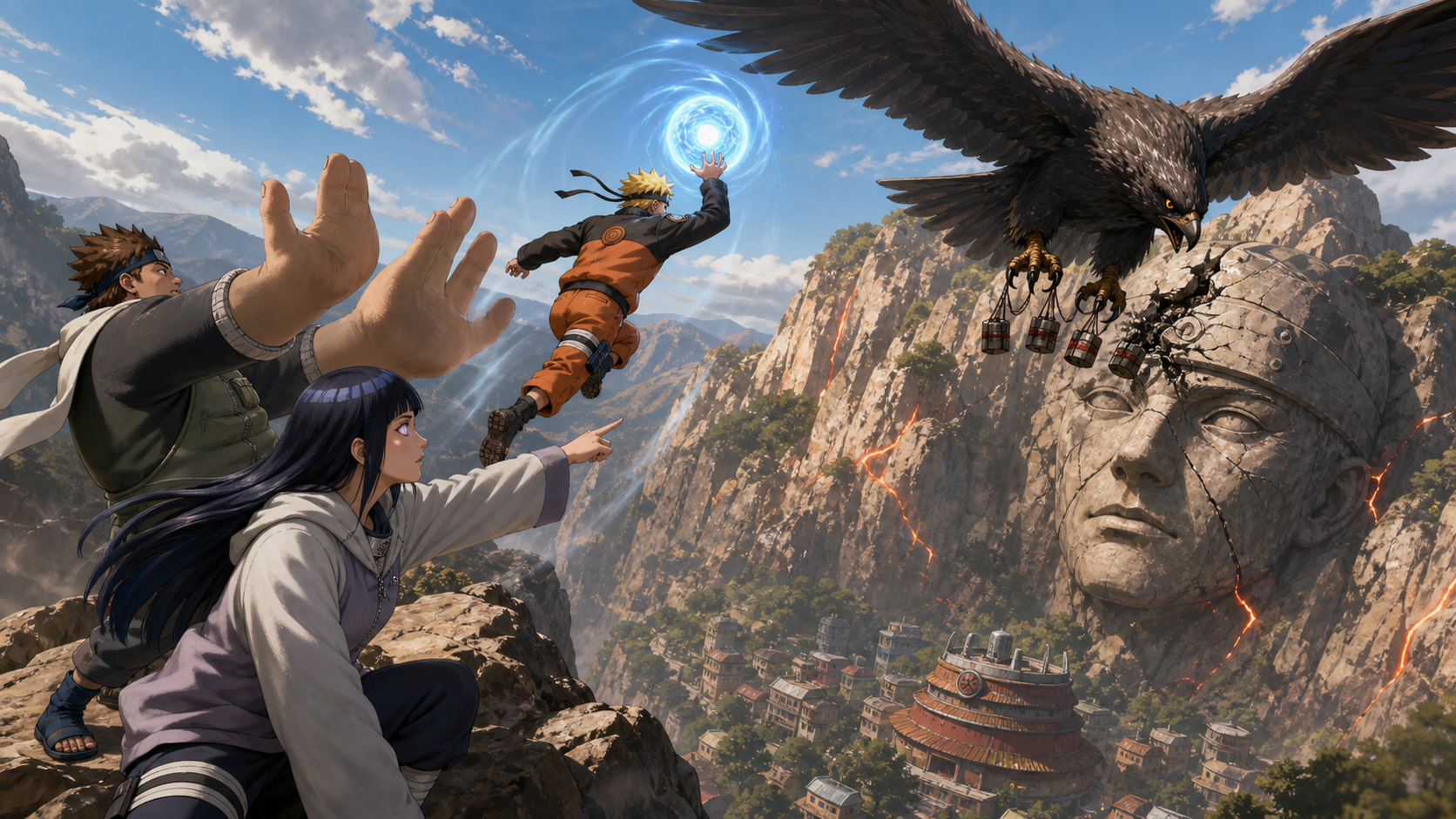
It dives toward a repaired crack in the Third Hokage's stone face. Gennō strengthened and altered that location during earlier work, installing a distinct trigger where the rock remained more fragile. A blast there should ignite the monument network and start the rockslide.
The bird evades long-range attacks.
Naruto decides to meet it with Rasengan before impact.
Chōji expands both arms and launches him into the air. Hinata tracks the eagle with the Byakugan, tells Naruto when to wait, and calls the exact moment to strike.
Naruto misses on the first pass when the bird vanishes upward.
Hinata redirects him.
The Rasengan destroys the incoming threat.
Naruto makes the final hit, but the save belongs to the chain. Shikamaru identifies the site. Hinata reads the flight. Chōji provides reach. Naruto supplies force.
Long-range attacks fail because the eagle changes altitude and angle. Chōji converts his body into a launch system, Hinata converts visual prediction into timing, and Naruto converts that timing into contact. None of the three can replace the others at the decisive moment.
The Third Hokage's face gives Naruto's strike an institutional meaning without making the monument more valuable than the people below it. Hiruzen died protecting Konoha's residents. Naruto destroys the payload because he chooses the same living community, not because carved stone deserves sacrifice.
The sequence also corrects the mission's earliest mistake. Konoha began by splitting the rookies into narrow assignments, asking some to inspect plans while others searched buildings or chased suspects. Gennō exploited every isolated task. At the monument, nobody is working inside a sealed role. Information, timing, strength, and nerve move through the group as quickly as the threat does.
Gennō designed a trap against a village full of individuals.
Konoha answers as a team.
The Dangerous Trap Was Deliberately Broken
Gennō dies after the danger passes.
He says he failed to leave his name in history, but he had fun. His final memory is not a battlefield or professional triumph. It is his son proudly beating him during a treasure hunt.
The photograph he showed Naruto was not a grandson.
It was his son, a young shinobi killed when Konoha attacked Kagerō Village thirty years earlier.
Shikamaru examines the mechanisms again. The Academy trigger contained a loose connection. Even a perfect bullseye would not have activated it. Defective bombs were mixed through the monument network. A full attempt likely would have produced cracks, not a village-burying collapse.
Konoha suffers no casualties.
That outcome does not prove Konoha was never in danger. The team encounters live paper bombs, a trapped plateau, combat substitutions, smoke charges, genjutsu, a terminal operator, and an airborne final payload. Gennō compromised key mechanisms, but he still created a multi-stage system whose participants did not know which parts were safe.
Defective charges reduce intended lethality. They do not control every secondary collapse, fire, panic injury, or mistake during disarmament. The distinction keeps Shikamaru's interpretation humane without rewriting the mission as a harmless game.
Gennō returned with revenge in mind, but meeting Naruto changed the operation. Naruto resembled his son closely enough that the old man rebuilt destruction into a treasure hunt. The clues were difficult. The danger looked real. The ending was quietly disabled.
Shikamaru calls that interpretation conjecture.
The evidence makes it very good conjecture.
A Treasure Hunt Is Not an Apology
The softened traps do not make Gennō's choices harmless.
He manipulates Naruto's affection, uses children as unwitting participants, terrorizes a village, steals a corpse, and forces young ninja to handle live explosives without knowing which mechanisms are defective.
His grief explains the shape of the game.
It does not excuse making everyone play.
What changes is the final judgment of his intent. Gennō could not complete the revenge he planned after seeing his son in Naruto. He still needed someone to find the work, understand it, and beat him before he died.
That need remains selfish. Gennō could have disclosed the network, explained Kagerō's history, or asked Naruto to complete a real puzzle without placing civilians inside it. He chooses the one form of communication that preserves his control and professional mystique until the final breath.
Naruto receives evidence of care through the weakened traps, but he never receives a clean apology. The treasure hunt is the closest Gennō can come to changing course without admitting that revenge stopped making sense.
Naruto and Chōji return to their original legal theory: people who love Ichiraku cannot be evil.
The others point out that Gennō may not have liked ramen at all.
Naruto answers that nobody eats something they hate every day.
For once, the ramen defense contains evidence.
The Konoha 11 ends the mission with a harder lesson. Future enemies will not weaken their own traps. Orochimaru will not turn an invasion into a game because one boy reminds him of family.
They promise to stay ready and protect Konoha together.
Gennō's last treasure was not the village under the mountain.
It was proof that the next generation could find what his generation buried.
The final target is the one Konoha never treats as infrastructure
The Hokage Monument looks symbolic, permanent, and separate from the streets below. Gennō reads it as load, elevation, stone composition, and fault lines. He turns civic identity into a geological weapon by asking what happens when the background falls forward.
That reframing is why the thousands of street bombs work so well as distraction. Once defenders find explosives inside homes and businesses, searching more walls feels like the responsible response. The mountain remains unexamined because everybody thinks of it as a landmark rather than a structure capable of failure.
Gennō’s plan requires Konoha to make correct decisions
The stolen blueprints send forces outward. Their return calls those forces home. The visible network spreads investigators through the village. Each response is sensible, which allows the trapper to predict where trained bodies will stand when the plateau falls.
His control does not come from making Konoha foolish. It comes from understanding procedures well enough to arrange the evidence those procedures will prioritize. Shikamaru breaks the sequence by asking which reasonable decision creates the best condition for the attacker.
Friendship notices absence before the hostage can ask for rescue
Naruto does not send a message from the monument. Hinata notices that he left strangely, Shikamaru narrows the true target, and the others converge because his behavior differs from the person they know. Gennō heard Naruto complain about these same people and mistook friction for weak attachment.
Real relationships contain irritation without requiring abandonment. Naruto can call Shikamaru lazy, argue with Kiba, embarrass Hinata, and still be missed within minutes when something is wrong. The rescue proves closeness through attention, not politeness.
Rockslide Genjutsu attacks the team’s shared expectation
Once everyone understands the monument can collapse, Gennō no longer needs a physical blast to create the experience of failure. The illusion supplies the image their fear already expects. Panic could scatter the team, trigger careless movement, or persuade them that further action is pointless.
Shikamaru interrupts the manufactured conclusion. The mountain appearing to fall is not enough; a real collapse should produce physical signs beyond the visual event. His release order keeps the team from behaving as though defeat has been proven merely because it looks complete.
Ino discovers why ordinary deterrence cannot reach Gennō
Mind Transfer exposes a body already collapsing under terminal illness. Arrest, long punishment, damaged reputation, and future opportunity carry less leverage when the operator expects no life after the mission. His deadline is biological as well as tactical.
That knowledge explains urgency without reducing danger. A failing body executing a delicate multi-stage plan introduces more uncertainty, not less. Even if Gennō weakened crucial connections intentionally, pain or sudden collapse could interrupt the control he believes he still possesses.
The eagle interception is a chain, not Naruto’s solo win
Long-range attacks cannot reliably catch the bird. Chōji creates altitude, Hinata supplies tracking and timing, and Naruto delivers the Rasengan. Remove any link and the payload reaches the repaired crack in the Third Hokage’s face.
The sequence pays off the entire mission’s team structure. Separate specialties were easy for Gennō to occupy with different traps. At the final moment, information and action travel across teammates without delay. The Konoha 11 stop acting like eleven assignments and become one response.
Defective bombs show changed intent, not guaranteed safety
The loose Academy connection and weakened monument charges strongly suggest Gennō redesigned mass murder into a dangerous treasure hunt after meeting Naruto. They do not make the operation safe. Live bombs remain mixed with defective ones, civilians never know the rules, and secondary collapse cannot be perfectly controlled.
Shikamaru calls his reading conjecture because the physical evidence supports compassion without granting certainty. That distinction matters. He can recognize the old man changed course while refusing to rewrite terror, manipulation, and forced participation as harmless play.
Gennō preserves control even while abandoning revenge
He could reveal the network, explain Kagerō’s history, and ask Naruto to solve a puzzle without placing a village beneath it. Instead, he weakens mechanisms secretly and lets everyone believe the catastrophic threat remains active. The form of communication still serves his pride as a trapper.
His care appears through what fails to explode, not through an apology Naruto can evaluate. That is emotionally legible and morally insufficient. Grief helps explain why he needs the treasure hunt. It does not give him the right to recruit thousands of unwilling players.
RaeRae’s full take
Episode 201 lands because the answer is neither “Gennō was evil” nor “the sweet old man never meant it.” He came back for revenge, met a boy who resembled his dead son, and changed the ending without surrendering the ego that required everyone to admire the trap.
The Konoha 11 wins by doing what his memory cannot. They argue, coordinate, notice absence, revise conclusions, and move as a living group. Gennō built the hunt for one child preserved in a photograph. Naruto arrives with ten relationships still capable of answering him.
I can accept that the broken connections are his closest attempt at mercy. I will not call them an apology. The village survives because young ninja solve a deadly performance they never consented to enter. Care that refuses honesty can still hurt everybody it claims to spare.
RaeRae checkpoint: Gennō knows how to control every route except the one created when eleven people trust each other faster than he can revise the trap.
Receipts and official routes
- Episode number, licensed title, Hokage Monument target, team interception, defective charges, and Gennō’s final memory: Naruto Official Site.
- Japanese title, September 20, 2006 broadcast record, and TV Tokyo episode synopsis: TV Tokyo.