
The Mysterious Curse of the Haunted Castle
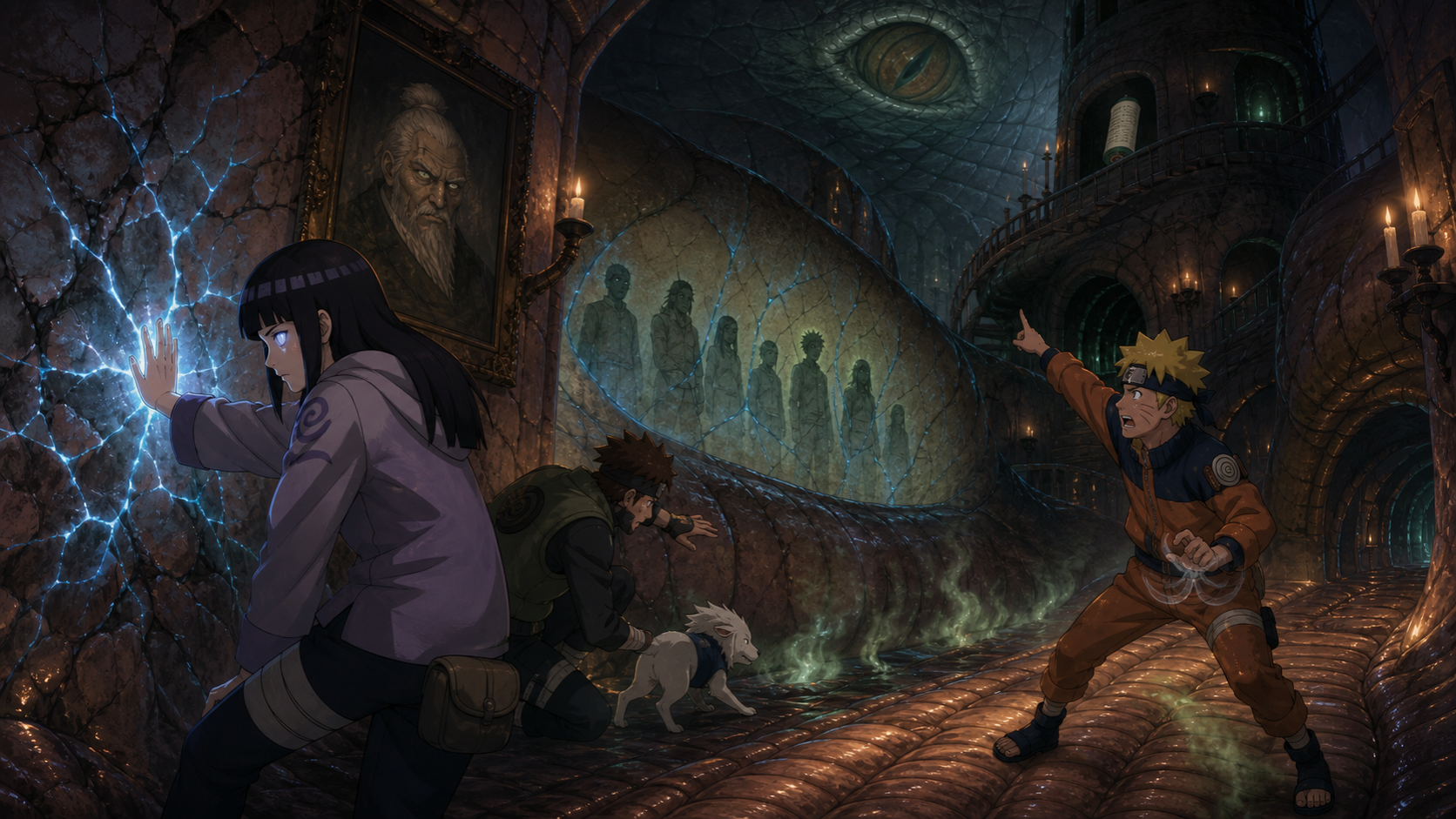
A vanished traveling party leads Naruto, Kiba, and Hinata inside a haunted castle that is really a giant chameleon trapped by a fifty-year-old command.
Naruto is afraid of ghosts.
Tsunade sends him to Broken Neck Pass, where seven people vanished beside the ruins of a castle destroyed fifty years ago.
Then it rains.
Then an intact castle appears where no intact castle should exist.
Then the door opens by itself.
Naruto would like the mission reassigned to anyone with less imagination.
Episode 194 builds a proper haunted-house mystery and resolves it with one of the stranger summoning ideas in the original anime. The castle is alive. Its hallways are organs. Its walls contain chakra. A giant chameleon has spent half a century pretending to be architecture because its dead master never released the command.
The ghost is not the monster.
The ghost is trying to end the haunting.
Episode 194 Facts
Episode: 194 of the original Naruto anime
Licensed title: The Mysterious Curse of the Haunted Castle
Japanese title: 怪奇 呪われた幽霊城 (Kaiki Norowareta Yūreijō)
Japanese broadcast: July 19, 2006
Mission name: Lady Daimyō Search Mission
Classification: Standalone anime-original filler
Lady Kayo is the wife of the Land of Honey's daimyō, not a princess, and all six attendants travel with her. Seven people disappear and all seven survive. Episode 195 begins the separate Third Great Beast story, so its dojo rivalry and impersonation plot do not belong anywhere in this castle.
The standalone structure gives Hinata and Kiba room to solve a mission through specialized evidence rather than waiting for Naruto to overpower the mystery. Every major breakthrough comes from comparing what their senses detect against what the castle wants them to believe.
Seven People Disappear in the Fog
Lady Kayo travels from the Land of Honey toward her family in the Land of Candy.
She has six attendants with her. Storm clouds gather, dense fog covers the pass, and the entire party disappears. Searchers find the abandoned palanquin but no bodies, footprints, or explanation.
Tsunade assigns a tracking team.
Kiba and Akamaru can follow scents. Hinata can search across distance and through barriers with the Byakugan. Naruto is, according to Tsunade, Naruto.
The lineup is more deliberate than the joke suggests. Missing-person work demands proof that survives fog, walls, false rooms, and erased tracks. Kiba and Akamaru can follow scent where sight fails. Hinata can identify chakra circulation inside objects that should have none. Naruto brings endurance, clones for rescue labor, and enough force to open an exit after the team understands where to strike.
None of them alone can solve the castle. Kiba can find a hidden person but not explain the living walls. Hinata can map the structure but cannot carry seven victims through acid by herself. Naruto can destroy rooms all night and accomplish nothing if he attacks the summon instead of the contract.
Hinata tries to name his good qualities and freezes under pressure.
Naruto is more concerned about ghosts.
Tsunade dismisses the idea and gives them the location: Kubisaki Pass, also translated as Broken Neck Pass. Shizune remembers that the capital of the old Land of Necks stood there before the Kubisaki clan fell fifty years earlier.
Tsunade treats ruined castles as ordinary mission scenery.
Naruto knows a warning label when he hears one.
A Castle Appears Where Ruins Belong
Rain begins when the team reaches the pass.
An enormous castle stands beside the road.
Kiba did not expect a functioning residence. Hinata sees a possible clue. Naruto sees shelter designed by a murderer with excellent curb appeal.
The front door opens without assistance.
Inside, lamps burn and a complete meal remains warm. Seven places wait at the table, matching the exact size of Kayo's missing party. A portrait of a severe man seems to move its eyes.
The table is bait built from information. Shiromari has already swallowed Kayo's group, so the false castle can reproduce a meal arranged for seven and make the room look interrupted rather than predatory. The warmth encourages new travelers to stay. The exact count quietly tells Hinata that the missing people are not merely connected to the building. Their presence has become part of its performance.
A cold ruin warns visitors away. Shiromari offers light, food, shelter, and the familiar shape of human safety because those details help the old order continue.
Naruto notices the movement.
Kiba calls him a scaredy-cat.
This is unfair because the painting absolutely moved.
Hinata connects the place settings to the mission and proposes a search. The group splits up, which is legally required in every haunted building and sensible in none of them.
Naruto immediately regrets agreeing.
Three Tracking Skills Read the Same Lie
The castle tries to tell each teammate a different story.
Kiba and Akamaru follow a human scent into a room that appears empty. The smell proves somebody is present even when the architecture hides the body.
Hinata discovers a history of the castle dated fifty years earlier. The final entry belongs to Kōza Kubisaki, called Gosa in some English subtitles. Enemy forces surrounded his home, slaughtered his people, and left him certain he would die before nightfall.
Kōza vows that his castle will consume every person who enters.
The building repeats the threat aloud.
Naruto gets attacked by moving furnishings and apparitions. Hinata encounters a figure wearing Kōza's face. None of the phenomena behave like an ordinary trap, but they are too physical to dismiss as nerves.
The team reunites and starts comparing evidence.
That matters more than deciding who was frightened first.
Naruto's fear does not make him useless. He notices the portrait, reacts to sounds the others dismiss, and stays alert because he expects danger everywhere. The comedy exaggerates his panic, but fear and observation overlap. Kiba's confidence creates its own blind spot when he treats every warning as Naruto embarrassing himself.
Hinata keeps the investigation grounded. She reads the old record, connects the place settings to the victims, and separates historical testimony from whatever voice now animates the castle. Her quiet method turns scattered horror props into a timeline.
The Dead Soldiers Are Being Digested
Naruto trips over old armor.
Some pieces carry the Kubisaki crest. Others belong to the army that attacked the castle. The dead from both sides remain inside the same structure.
An apparent corpse of Kōza begins to melt.
Kiba notices a sour smell. The floor and walls secrete a corrosive liquid. What first looked like supernatural decay behaves more like digestion.
Hinata activates the Byakugan.
Chakra flows across the entire wall.
The wall moves.
She strikes it with Gentle Fist and confirms that the structure is living tissue rather than stone. Naruto recognizes the sensation from his encounter inside the giant toad Jiraiya summoned during the search for Tsunade.
They are standing inside a stomach.
The castle did not surround them when they entered.
It swallowed them.
The stomach recognition is one of the episode's best continuity uses. Jiraiya once summoned a giant toad stomach around Itachi and Kisame, and Naruto experienced the texture, movement, and containment from inside. A strange earlier battle becomes field knowledge nobody could have included in a standard mission briefing.
Naruto does not identify Shiromari by species or technique. He identifies the function of the room. Once the team stops asking what kind of ghost moves walls and asks what living body has walls that digest people, the entire mystery reorganizes itself.
Shiromari Has Been Obeying for Fifty Years
Kōza used Summoning Jutsu during the fall of the castle.
The creature was large enough to swallow the fortress and everything inside it. Afterward, it transformed its body into a perfect replacement, complete with rooms, lamps, portraits, food, books, and stairs.
The summon is Shiromari, a giant chameleon with transformation abilities detailed enough to imitate architecture indefinitely.
Kōza died before releasing the contract.
Shiromari kept following his final order.
Eat anyone who enters.
For fifty years, travelers seeking shelter have walked into the body of an animal trapped inside another person's vengeance.
That changes the center of the story. Shiromari is dangerous and must be stopped, but he is not freely choosing a new victim every night. He is performing an old command after the commander, war, nation, and purpose have all disappeared.
Loyalty has become a prison with gastric acid.
Summoning contracts usually look reciprocal because shinobi call a creature for a limited task and the creature returns afterward. Shiromari's case exposes what happens when command outlives communication. Kōza cannot revise the order, acknowledge surrender, or recognize that the war ended. The contract preserves his worst moment with perfect obedience.
Shiromari still harms innocent travelers, so the team cannot treat loyalty as innocence and walk away. They also do not need to punish the creature as if it invented the grudge. Breaking the contract protects future victims and ends the service binding Shiromari to a dead country. The same act delivers safety and release.
The Missing Party Is Part of the Wall
Shiromari begins dropping the castle disguise.
Lady Kayo and her attendants appear embedded in the living wall. The creature has gathered them with its other victims and is returning toward its original form.
Kiba uses Man Beast Clone and Fang over Fang to tear into the interior. The attack creates space but does not cancel the summoning or release the captives.
Shiromari speaks through the castle.
By order of Kōza, it must eat everyone who enters.
The team needs the mechanism holding that order in place.
A summoned creature requires a contract scroll. Destroying the scroll should return Shiromari to his own world.
Hinata searches with the Byakugan and locates it high above them in the tower.
The castle is collapsing into muscle and acid. Reaching the tower should be impossible.
Then Kōza appears again.
The Real Ghost Does Not Want Revenge
Naruto assumes the apparition is another image created by Shiromari.
Hinata stops him.
This Kōza looks different from the hostile imitation. He does not attack. He gestures for them to follow and leads them directly to the hidden contract scroll.
The episode never turns the moment into a laboratory proof of ghosts. The team understands it as Kōza's spirit.
His anger created the order. Fifty years have changed what he wants.
Kōza has watched Shiromari serve long after every human reason for the service ended. The summon protected his castle, punished intruders, and remained separated from its own world because a dying man could not imagine a future beyond revenge.
The spirit does not ask the Leaf team to defeat his servant.
He asks them to release him.
That change gives Kōza responsibility without pretending his final order caused no damage. He cannot restore the people Shiromari consumed or reclaim the decades stolen from the summon. He can lead the living team to the control he created and stop demanding that loyalty continue paying for his death.
The distinction between Shiromari's hostile imitation and the final apparition matters. The imitation repeats the anger stored in the castle's function. The spirit breaks that repetition by guiding the team toward an action the order forbids. Hinata recognizes the difference because she watches behavior, not merely the face.
Hinata Finds the Door and Naruto Makes It
Naruto tears the contract scroll.
Shiromari begins returning to his own world. That creates a new problem: Kayo, her attendants, and the Leaf team are still inside him.
The acid grows stronger as the body changes.
Hinata scans the wall and identifies a point thin enough to break. Naruto produces shadow clones, forms a Rasengan, and tears open the escape route.
Kiba and Akamaru help move the victims. All seven missing travelers escape with the team before Shiromari disappears.
The rescue belongs to all three specialties.
Kiba proves people remain inside the false rooms and tracks the physical threat. Hinata discovers the living chakra network, locates the scroll, recognizes the helpful spirit, and finds the exit. Naruto identifies the stomach, destroys the contract, and supplies the force needed to break free.
Naruto was not assigned merely because he is Naruto.
He is the person who has already survived being swallowed by a summoned building.
That is niche experience, but it counts.
The order of operations protects the captives. Destroying the contract too early would begin Shiromari's return before the team knew where Kayo was or how to escape. Attacking the wall first would injure the summon without ending the command. Hinata locates the control and later the weak point; Naruto applies force only after the target becomes clear.
It is a cleaner team victory than many louder filler fights. Nobody receives a surprise upgrade. Existing abilities become useful because the characters share information and change the question.
The Curse Ends as an Act of Mercy
The team looks back on the ruined pass after the rescue.
Kōza died wanting revenge against everyone who crossed his threshold. His spirit ends by guiding strangers toward the one object that can undo his command.
The change does not excuse fifty years of victims.
It stops another fifty.
Shiromari finally returns home. Kōza releases the castle, the war, and the loyal creature he kept bound to both.
Naruto feared that a ghost would chase him through the halls.
The ghost had been waiting for someone brave enough to open the door.
The seven place settings turn hospitality into evidence
A warm meal in an abandoned castle should feel comforting, but the exact number matches Lady Kayo and her six attendants. Shiromari is not decorating randomly. The transformed body has absorbed details from the missing party and uses their interrupted meal to lure the next visitors deeper. Safety looks convincing because the predator can reproduce what safety looked like to earlier victims.
Splitting up rewards the castle’s control of information
Kiba, Hinata, and Naruto each receive a different fragment: human scent in an empty room, a fifty-year-old record, moving images, corrosive surfaces, and hostile voices. Alone, each clue can be dismissed as nerves or illusion. The investigation advances only when they reunite and compare what separate senses detected. Haunted-house logic survives by keeping witnesses from building one shared account.
Naruto’s fear makes him noisy but also alert
Kiba treats every warning as another embarrassment, even after the portrait moves. Naruto’s imagination exaggerates danger, yet it also keeps him watching the details everyone wants to normalize. Fear is not expertise, but confidence is not proof. The team needs Kiba’s scent, Hinata’s disciplined observation, and Naruto’s unwillingness to accept impossible architecture as ordinary shelter.
Digestion reorganizes the mystery
Sour odor, dissolving bodies, corrosive liquid, living walls, and chakra circulation stop looking like unrelated curses once Naruto recognizes a stomach. His earlier experience inside a giant summoned organ supplies functional knowledge nobody could have predicted in the briefing. He does not need the species name first. Identifying what the room does gives the team the right question: what summoned body swallowed them?
Shiromari is dangerous without being the author of the grudge
The chameleon has consumed travelers for decades, so the team must stop the harm immediately. It is also trapped inside Kōza’s dying order after the master, war, clan, and purpose disappeared. Obedience does not erase victims, and victimhood does not make the summon safe. Breaking the contract addresses both truths by ending the attacks and releasing Shiromari from an instruction he can no longer renegotiate.
The contract preserves one man’s worst moment
Kōza issues the command while surrounded, bereaved, and certain he will die. The summoning structure turns that temporary fury into fifty years of automatic policy. No later reflection, surrender, or changing circumstance can reach it because the commander is gone. Durable authority without a review or release mechanism makes one crisis decision govern people Kōza never knew.
The helpful spirit accepts responsibility through action
Kōza cannot revive the consumed travelers or return Shiromari’s lost decades. He can lead the team to the scroll maintaining his command. The final apparition differs from the castle’s hostile imitation because behavior changes: instead of repeating vengeance, it guides strangers toward release. Remorse becomes meaningful when it dismantles the control that harm still uses.
Destroying the scroll first would not be enough
Lady Kayo and six attendants remain embedded inside a body preparing to disappear. The team must locate the captives, end the contract, identify a weak exit, and move everyone before acid and transformation close the route. Correct sequencing keeps liberation from becoming another disaster. A solved mechanism is not a completed rescue until every missing person reaches the road alive.
Each teammate owns a distinct part of the solution
Kiba and Akamaru prove hidden people remain inside and help move them. Hinata identifies chakra in the walls, finds the scroll, distinguishes the spirit’s changed intent, locates the captives, and marks the exit. Naruto recognizes the stomach, tears the contract, and supplies the Rasengan force. Nobody receives a surprise power. Existing skills become decisive because the team shares their evidence.
The case needs a recovered-victim and pass-safety review
All seven survivors require medical examination for acid exposure, dehydration, confinement, and trauma. The route needs warnings until investigators confirm Shiromari is gone and no secondary summoning effect remains. Records should name the original command, the contract’s duration, and the release. Calling the castle merely cursed would hide the mechanism and leave future travelers unable to recognize a similar trap.
RaeRae’s full take
Episode 194 lets Naruto be terrified of ghosts and still carry the one piece of experience that cracks the case. He knows what being inside a summoned stomach feels like. That is an absurdly specific résumé line, but today it pays.
The real horror is not a dead man walking through the halls. It is an order that kept working for fifty years after the person who gave it could no longer change his mind. Shiromari becomes a prison, a weapon, and the architecture hiding both.
Kōza’s spirit does the only useful thing regret can do this late: he shows the living where the control is and lets them break it. The dead stop demanding loyalty. The summon goes home. Seven travelers get to leave the castle as people instead of décor.
RaeRae checkpoint: The ghost is not maintaining the curse. The contract is. Ending the haunting means releasing a summon trapped inside somebody else’s final rage, then getting every living victim out before the walls disappear.
Receipts and official routes
- Episode number, licensed title, missing first lady and entourage, and castle on the main road: Naruto Official Site.
- Japanese title, Kubisaki ruins, Naruto-Kiba-Hinata team, moving portrait mystery, and July 19, 2006 broadcast record: TV Tokyo.