
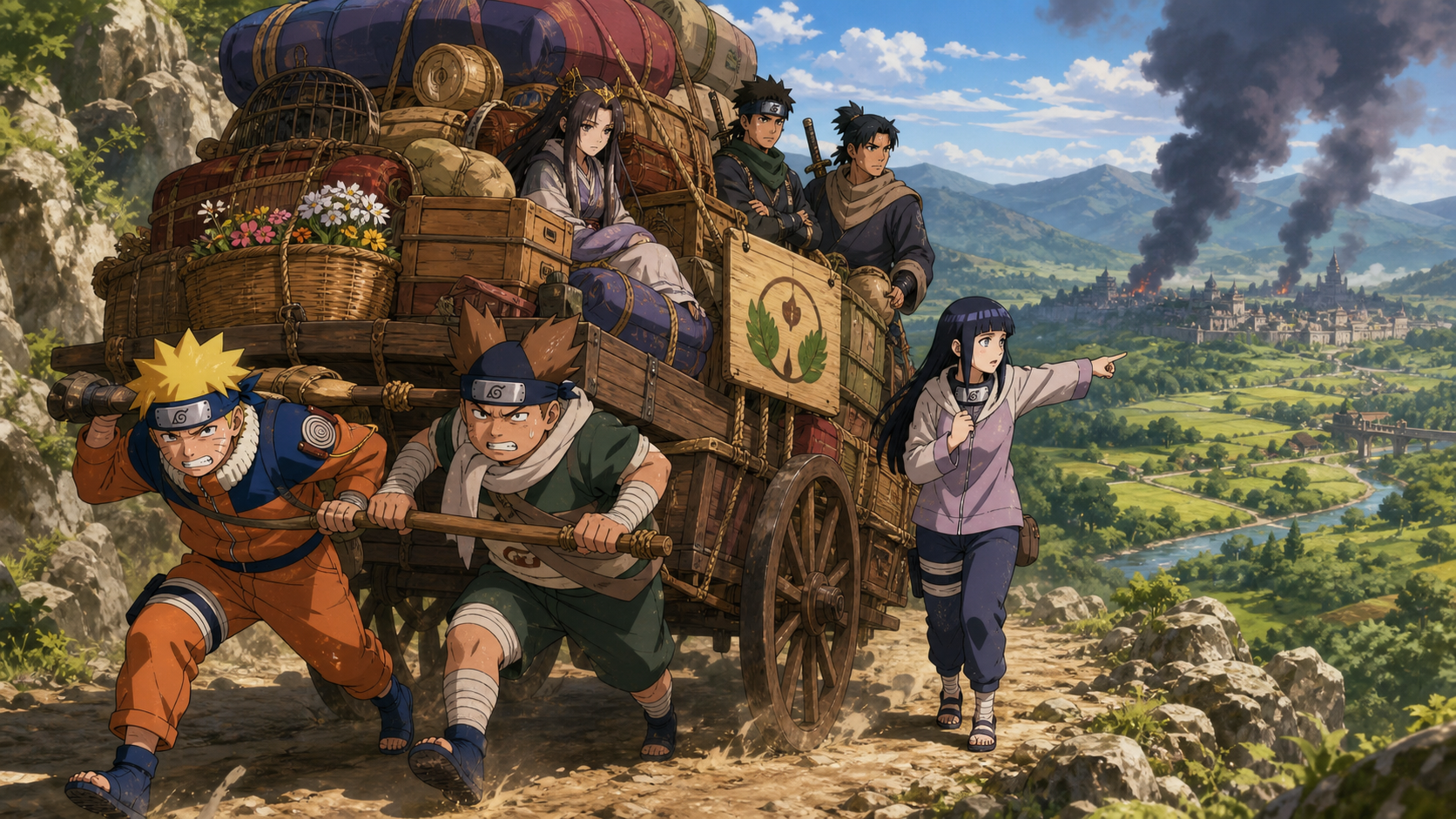
Open for Business! The Leaf Moving Service
Naruto, Hinata, and Chōji are hired as guards but treated as movers while a disguised princess hides the coup driving her caravan from home.
Naruto thinks he has a D-rank merchant escort.
The merchants think they hired movers.
Three of the “merchants” are actually a princess and her bodyguards fleeing a coup.
Nobody tells the Leaf team that last part.
Episode 187 opens as a comedy about an improvised squad carrying luggage. By the end, the Land of Greens is burning, corrupt officials are dead, and one flower ninja is fighting alone because secrecy has left the people hired to help him completely unprepared.
The moving-service sign is funny.
The political evacuation behind it is not.
Episode 187 Facts
- English title: Open for Business! The Leaf Moving Service
- Japanese title: 開業!!木ノ葉引越センター
- Original Japanese broadcast: May 31, 2006
- Story position: First episode of the five-part Peddlers Escort Mission
- Leaf team: Naruto, Hinata, and Choji, with no formally assigned leader
- Hidden identities: Princess Haruna, Kikunojou, and Yurinojou
- Declared mission: D-rank protection from mountain bandits
- Actual crisis: A political evacuation during the Janin coup in the Land of Greens
The episode builds danger from a contract that does not describe the work. The Leaf team can plan for ordinary bandits or protect a displaced head of state from specialized assassins. It cannot do both intelligently while being told only the cheaper version.
Three Brothers Buy a Country
The Janin brothers prepare to overthrow the Land of Greens.
They view the small country as a stepping-stone. Half its public officials have already accepted bribes. Once the signal comes, the brothers expect to walk into the castle and call themselves feudal lords.
The plan does not require a popular uprising or a military campaign.
It requires enough insiders to decide personal profit matters more than the government they serve.
That makes the coup administrative before it becomes military. Bribed officials open paths, suppress resistance, and hand legitimacy-shaped access to three criminals. The Janin exploit institutions rather than conquering every defender at the gate.
At the Leaf, Tsunade believes the assignment is much simpler. A group of merchants needs protection from mountain bandits after leaving the Land of Greens. Most experienced ninja are already deployed, leaving Naruto, Hinata, and Choji as an awkward combination with no obvious leader.
Shizune worries about the team composition.
Tsunade worries about making a respectable impression.
The country's ruler once helped cover gambling debt she created, which may be the most Tsunade reason possible for treating a minor escort request as personal business.
Tsunade's personal gratitude raises the mission's priority but does not improve its intelligence. She remembers a trustworthy ruler and peaceful country, so the request feels safe. Familiarity becomes a blind spot when nobody verifies whether the political conditions she remembers still exist.
Tsunade Remembers a Peaceful Country
Tsunade describes the Land of Greens as small, quiet, and easygoing.
She remembers a young princess and two boys who protected her. Both boys once promised to marry Tsunade, because childhood judgment is unreliable and apparently the future Hokage was collecting proposals during debt relief visits.
The memory matters beneath the joke.
Tsunade associates the country with generous leadership, safety, and children growing up under loyal protection. She does not know that the ruler has fallen or that those same children are now escaping through a peddler caravan.
Naruto is thrilled just to leave the village. Everyone else has returned from adventures while he has been trapped doing odd jobs. A merchant escort may not sound heroic, so he plans to improve the future story by claiming he defeated a thousand bandits.
Hinata correctly identifies that as lying.
Naruto has no idea the actual mission will soon need no exaggeration.
The Important Item Is a Moving-Service Sign
The team meets the caravan outside the Land of Greens.
Three travelers introduce themselves as Kikusuke, Yurinoshin, and Shun. Momiji and other genuine peddlers travel with them.
Naruto presents his Leaf headband as proof of identity. Hinata remembers that Tsunade supplied one additional item.
Momiji produces a sign advertising the Leaf Moving Service.
That is all the peddlers need to hear. Naruto, Hinata, and Choji are now movers, regardless of how often Naruto explains that trained ninja were hired for protection.
Choji gets caught first. Momiji compliments his strength, and he begins carrying heavy goods to impress her. Naruto argues with Shun, who orders him to move faster and mocks him for complaining instead of helping.
The comedy gives the refugees perfect cover.
It also keeps the Leaf team physically occupied. Naruto and Choji are spending energy carrying goods rather than establishing formations, scouting the route, or learning who needs priority protection. The sign does more than create a misunderstanding. It quietly degrades security.
Nobody questions why a sickly, irritable young merchant travels with two attentive cousins. Everyone is too busy watching the Leaf ninja haul merchandise.
“Shun” Does Not Believe in Kindness
The travelers use dowsing rods to locate underground water.
Kikusuke explains that the technique comes from generations of inherited knowledge. He describes the Land of Greens as a warmhearted mountain country where people love nature and treat travelers well.
Then he calls it paradise in the past tense.
Shun supplies the opposite view. Peace made the country's people soft. Trusting others in a dangerous age is ridiculous. Kindness created an opening for anyone willing to exploit it.
Naruto hears an unpleasant person insulting his own home.
The audience is hearing Princess Haruna describe the betrayal that forced her to run.
Her judgment is harsh because it is fresh. Public officials accepted bribes. A ruler known for generosity lost his castle. The country that trusted people became easy prey for men who consider trust a weakness.
Haruna has not merely adopted cynicism as a personality.
She is using it as armor.
The armor protects her from expecting rescue, but it also makes honest cooperation look like weakness. If trust created the coup, then withholding information feels prudent. That conclusion leaves every ally less capable and repeats the isolation that allowed betrayal to spread.
Black Smoke Breaks the D-Rank Illusion
Naruto and Hinata see black smoke rising from the direction of the Land of Greens.
Naruto leaves to investigate while Hinata and Choji keep the sight quiet to avoid alarming the caravan. The secrecy lasts about thirty seconds because Momiji trades the information for food.
Haruna and her protectors understand what the smoke means.
The coup has reached its final stage.
Near the border, Naruto encounters two ninja who can conceal their presence and cut through his clones. They say their targets are traveling in his direction and threaten death to anyone prowling near the route.
Naruto escapes using shadow clones and returns with a warning.
The Leaf team notices the central contradiction. Why would skilled ninja from the Land of Greens pursue ordinary merchants who are not even citizens of that country?
They build a reassuring answer. Perhaps the caravan only shares the target's route. A detour should remove the civilians from the battlefield.
It is reasonable.
It is also exactly wrong.
The team's reasoning fails because the refugees control the premise. Naruto, Hinata, and Choji assess risk using the claim that every traveler is an ordinary merchant. A conclusion can be logical and still be useless when essential facts were removed before the reasoning began.
The Janin Do Not Trust Their Own Traitors
Inside the captured castle, the Janin discover that the former feudal lord accumulated little personal wealth.
He governed without lining his pockets. The brothers treat that restraint as an opportunity. They plan to squeeze the country until it produces the fortune its previous ruler refused to take.
Their collaborators arrive expecting payment.
Renga gathers them in one place and kills them.
His logic is brutally consistent. Anyone who betrayed one ruler for money can betray another. He used their corruption to enter the castle, but he will not tolerate the same corruption near his own throne.
The coup rewards betrayal by eliminating the betrayers.
Renga's purge also announces what his new government will become. He cannot build durable administration because he treats cooperation as evidence of future treachery. The officials deserve accountability for selling their ruler, but killing every collaborator leaves rule based on fear rather than trust.
That scene validates Haruna's fear without proving trust itself is foolish. The officials did not lose because the old ruler trusted them. They lost because they sold responsibility and assumed the buyer would respect a deal built on treachery.
The Janin now hunt the escaped princess before she can request foreign military aid.
She is already inside the caravan Naruto protects.
The Merchants Finally Drop Their Cover
Away from the Leaf team, the three disguised travelers speak openly.
Shun is Princess Haruna. Kikusuke is Kikunojou. Yurinoshin is Yurinojou. The two flower ninja have protected Haruna since childhood, exactly as Tsunade remembered.
They know the pursuers are targeting them.
They still do not tell Naruto, Hinata, or Choji.
Kikunojou decides to leave the caravan and delay the Janin alone. Yurinojou will remain with Haruna while the peddlers continue toward safety.
The choice is loyal and strategically terrible.
Kikunojou may believe secrecy protects Haruna if he is captured. At this point the Janin already know the princess escaped, know her direction, and have encountered Naruto near the caravan. Concealing the truth no longer hides the route from the enemy. It hides the threat from allies.
The Leaf team was hired to protect the caravan. Its members have already encountered the enemy and changed the route. Telling them the truth would allow a coordinated defense.
Instead, Kikunojou relies on the same private sacrifice that keeps allies uninformed until rescue becomes harder.
Naruto notices his absence. Yurinojou offers a vague excuse, and Naruto decides Kikunojou must have taken a bathroom break.
The distance between the real danger and Naruto's understanding could not be wider.
That bathroom explanation is funny because it measures the cost of compartmentalization. One protector has left to fight a coup assassin alone, while the hired combat team assumes he needed privacy behind a bush. Nobody can respond to a sacrifice they do not know is happening.
Kikunojou Faces Ruiga Alone
Kikunojou intercepts Ruiga and identifies himself as Haruna's protector.
His Flower Ninja Art turns petals into shuriken, explosive traps, and layered illusions. The techniques are elegant without being gentle. Kikunojou can conceal lethal force inside the visual language of his peaceful country.
Ruiga sees through the genjutsu and survives the explosive flowers.
He begins a water technique that gathers and controls liquid around the battlefield.
Episode 187 ends before the outcome.
Stopping there preserves the real cliffhanger. Kikunojou has revealed his techniques and commitment, but Ruiga has begun a counter Naruto's team cannot see. The caravan moves on with no idea that its hidden contract is already collecting a fatal price.
Naruto's team continues hauling a caravan under the impression that a detour solved the problem. Haruna continues hiding behind the name Shun. Kikunojou fights one of three unknown enemies without backup.
The mission did not become dangerous because the Leaf sent a strange team.
It became dangerous because everyone with essential information decided the hired protectors did not need it.
Naruto, Hinata, and Choji may be an improvised squad, but their abilities cover scouting, defense, replication, and heavy support. The concealed client never gives those abilities a chance to become a plan. Kikunojou's solo stand is brave. It is also the predictable result of a protection arrangement built without informed protectors.
The moving-service joke therefore names the problem better than anyone realizes. The Leaf team is treated as labor: useful hands expected to carry whatever the client places in front of them, without enough information to judge where the real weight sits.
Episode 188 has to make that hidden truth impossible to avoid, but the coup and escape will continue through Episode 191.
The D-rank label hides a head-of-state evacuation
Naruto, Hinata, and Chōji accept an escort priced and staffed for ordinary bandits. The concealed client is a princess fleeing specialized assassins after a coup. Those are not interchangeable risks. Rank controls personnel, intelligence, supplies, authority, and contingency planning. Withholding the real mission does not merely keep Haruna’s identity safe. It prevents her protectors from building the defense she needs.
The moving-service joke exposes how the team is being used
The sign turns trained ninja into convenient labor while the caravan decides what information they deserve. Carrying goods burns time and stamina that should support scouting, formations, and route analysis. Naruto and Chōji laugh and complain, but the misunderstanding establishes the contract’s deeper problem. The Leaf team is treated like muscle expected to carry whatever the client places before it without seeing where the dangerous weight sits.
Tsunade’s personal memory creates a blind spot
She remembers a peaceful country, a generous ruler, and children protected by loyal attendants. Gratitude for old help raises her interest, but nostalgia substitutes for current intelligence. Nobody verifies whether the ruler still controls the castle, whether the request came through a secure channel, or why merchants leaving that country suddenly need Leaf protection. Familiarity makes the assignment feel safer at the exact moment political conditions have changed.
The Janin coup succeeds through administration before combat
The brothers buy officials, open institutional doors, and suppress resistance from inside. Their plan demonstrates why a peaceful country is not automatically a secure one. Trust needs records, oversight, divided authority, and consequences for corruption. The old ruler’s kindness is not the flaw. Officials choosing private payment over public duty create the opening.
Renga murders collaborators because betrayal cannot build trust
The bribed officials expect payment and discover the buyer never respected them. Renga’s logic is cruel and consistent: people who sold one ruler may sell another. Their deaths do not restore justice, but they reveal the bargain they accepted. A government seized through corruption cannot become stable merely because the new ruler kills the witnesses to his own method.
Haruna’s cynicism is armor with operational costs
She has watched trusted officials sell her father’s government, so kindness now looks like weakness and disclosure looks like another invitation to betrayal. That reaction makes emotional sense. It also isolates her from Naruto, Hinata, and Chōji, who have already accepted danger on her behalf. Trauma explains why she withholds trust. It does not make the resulting protection plan effective.
Black smoke should trigger a mission reassessment
Smoke over the client’s country, hostile ninja on the route, and threats tied to travelers ahead destroy the ordinary-bandit premise. The team reasons that the caravan may merely share the target’s path, then changes route. That conclusion is rational only because the refugees continue controlling the facts. A reassessment requires direct questions, identity verification, and a new threat model, not reassurance built on information everyone knows is incomplete.
The improvised Leaf squad has useful coverage
Hinata can scout with the Byakugan, Naruto can multiply force and probe threats, and Chōji can provide defense, transport, and heavy support. The absence of a formal leader is a weakness, but it is not fatal if duties are assigned clearly. The concealed clients never allow those abilities to become a coordinated plan. Secrecy wastes the team’s strongest advantage before the real fight begins.
Kikunojou’s solo sacrifice protects secrecy more than Haruna
Leaving alone feels loyal because he personally absorbs the danger. The enemy already knows a princess escaped, knows the route, and has encountered Naruto near the caravan. Silence no longer hides the evacuation from the Janin. It hides the attack from allies. Kikunojou begins a battle without backup while the people hired to protect the group believe he stepped away for an ordinary reason.
The flower techniques reflect the country Kikunojou defends
Petals become blades, traps, and illusions. The style preserves beauty without confusing beauty for harmlessness. Kikunojou embodies a peaceful country capable of defense, which directly challenges Haruna’s claim that kindness made the Land of Greens weak. The failure was not gentleness. It was corruption, poor safeguards, and information kept inside too few hands.
The client owes informed cooperation, not every secret
Haruna does not need to reveal her identity to the whole caravan. She does need to tell the contracted team enough to protect her: priority person, number and abilities of pursuers, political stakes, safe destination, and rules for separation. Confidentiality can be compartmentalized. Total concealment turns trained allies into bystanders who cannot recognize the moment the mission changes.
RaeRae’s full take
Episode 187 starts with Naruto yelling that ninja are not movers and ends by proving the joke more accurate than he knows. His team is carrying cargo, exhaustion, and political risk selected by people who refuse to explain any of it.
Haruna’s distrust is earned. Half her government took bribes, her home is burning, and assassins are following her. Still, secrecy does not become wisdom just because betrayal made openness frightening. The enemy already understands the mission better than the Leaf team does.
Kikunojou’s stand is brave, elegant, and avoidably lonely. Loyalty should not require making rescue impossible. If you hire protectors, let them protect. Otherwise you did not build a security plan. You rented witnesses for the consequences.
The contract failure follows the team into every next decision. Without a named protected person, confirmed destination, or honest threat briefing, even a sensible detour can move Haruna closer to danger. The episode leaves that debt open on purpose. Episode 188 will not introduce the crisis. It will reveal the crisis the refugees already knew they were carrying.
RaeRae checkpoint: The Leaf team can guard merchants or evacuate a princess during a coup. It cannot intelligently do both while the people in danger keep selling them the cheaper story.
Receipts and official routes
- Episode number, licensed title, merchant escort, black smoke, and unidentified attackers: Naruto Official Site.
- Japanese title, merchant-cover assignment, concealed targets, and May 31, 2006 broadcast record: TV Tokyo.