
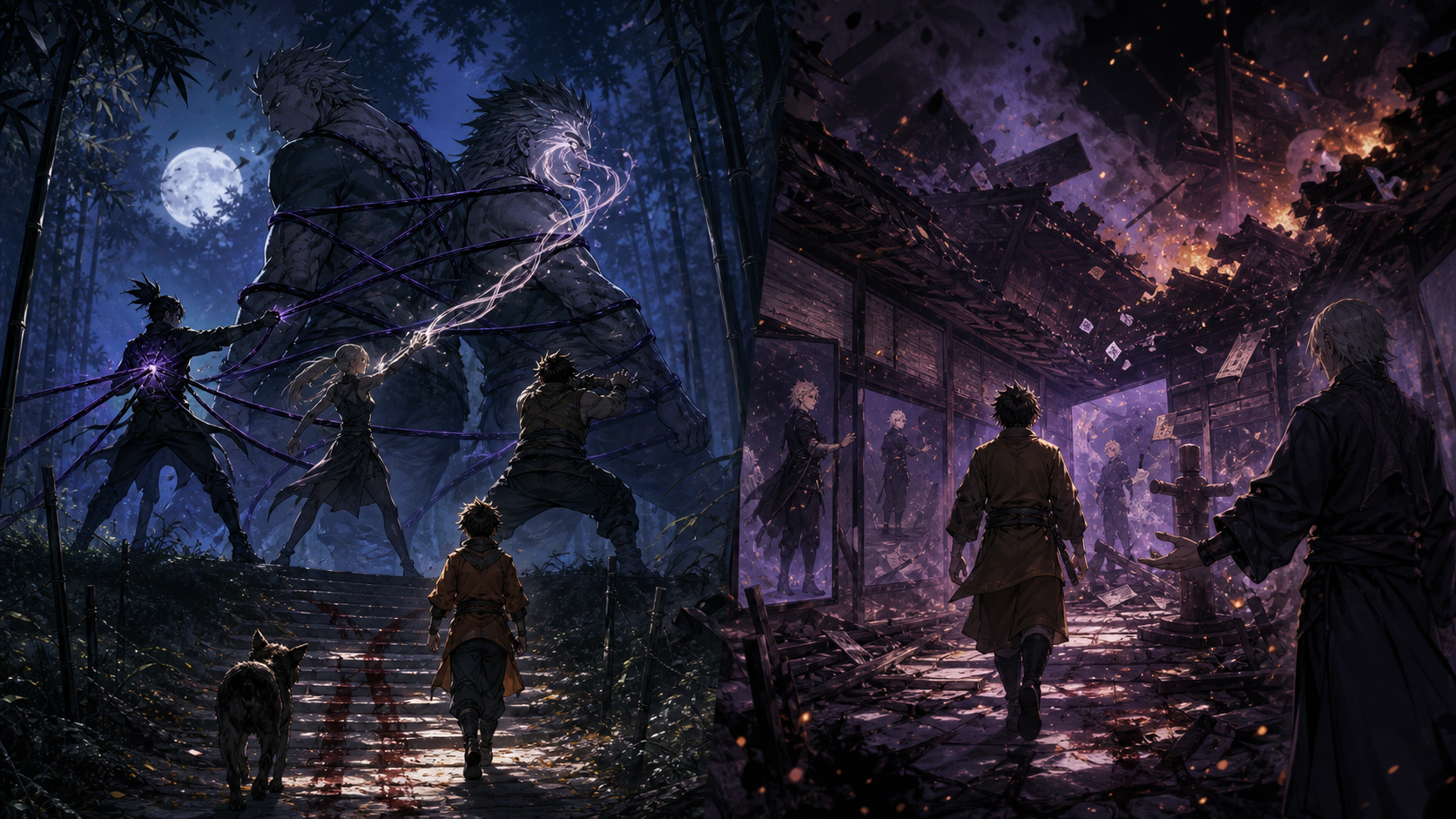
A New Formation: Ino-Shika-Cho!
Team 10 controls the brothers through three interlocking roles while Mizuki turns an Academy instructor-testing hall into another disposable trap.
RaeRae Reacts
Episode 145 finally gives Fujin and Raijin a problem that cannot be solved by swatting harder.
Team 10 does not arrive with a bigger punch.
They arrive with roles.
Shikamaru controls movement, Ino takes control of one brother, and Choji locks down the other. The formation changes the fight because each person does something the others cannot.
That frees Naruto and Pakkun to continue after Mizuki.
Iruka, meanwhile, follows a blood-marked trail into a building used to test Academy instructors.
Mizuki fills that building with illusions, decoys, and explosive tags.
One team proves what training can build.
One former teacher proves that learning a technique and deserving authority are very different things.
Tsunade Sends the Right Reinforcements
Shikamaru, Ino, and Choji did not wander into the fight by coincidence.
Tsunade sent them.
That detail makes their arrival more than a dramatic save. The Hokage has assessed a physical threat that overwhelmed Naruto and assigned a team built around restraint and coordination.
The brothers are fugitives, not targets who need to be killed. Capturing them requires control.
Team 10 has the correct tools.
Shikamaru can stop movement without matching strength. Ino can redirect a body from within. Choji can occupy space and apply force without relying on Naruto's speed-based attack pattern.
Tsunade does not send three random available genin.
She sends a formation with a chance to change the rules.
Naruto Accepts the Handoff
Team 10 tells Naruto to leave Fujin and Raijin to them.
Naruto actually goes.
Please appreciate the growth involved in that sentence.
He has every reason to take the handoff personally. The brothers blocked his attacks, destroyed his clones, ruined his Rasengan attempt, and nearly killed him. Earlier Naruto might have stayed just to prove he could beat them.
Instead, he recognizes that Iruka is still alone with Mizuki.
Winning the mission matters more than winning his fight.
Naruto leaves with Pakkun and returns to the original pursuit.
That decision is teamwork too. Trusting capable allies to finish their part allows him to serve the part only he can reach in time.
Shikamaru Stops the Bodies
Shikamaru catches the brothers with Shadow Imitation.
The technique bypasses the durability problem completely.
It does not care how many punches Fujin and Raijin can absorb. It attacks their freedom of movement by binding their shadows to Shikamaru's actions.
That gives the team a controlled starting position.
It also carries a limit.
Shikamaru cannot hold two men with that much physical power forever, especially while his teammates set up techniques requiring proximity and concentration.
His job is not to win alone.
It is to create the exact seconds Ino and Choji need.
This is the difference between Naruto's clones and Team 10's formation. Naruto multiplied effort. Shikamaru organizes it.
Ino Attacks the Mind
Ino uses Mind Transfer on one of the brothers.
Now Team 10 has influence inside the opposing formation.
Fujin and Raijin are frightening because their strength works as a pair. They can cover one another, break restraints, and turn any close-range exchange into a disaster.
Mind Transfer changes one of those bodies from a threat into a possible restraint against the other.
The technique is risky. Ino's own body becomes vulnerable, and any damage to the body she occupies can return consequences to her.
Shikamaru's hold creates the safe entry.
Choji's pressure prevents the remaining brother from reaching her unprotected body.
Ino is not standing behind the boys while they do the real fight.
Her technique is the hinge that makes the brothers' own power usable against their partnership.
Choji Handles the Physical Weight
Choji engages the brother Ino does not control.
This is the role that requires someone willing to enter the danger zone.
Shadow Imitation creates stillness. Mind Transfer creates internal control. Neither technique supplies a durable physical barrier if the restraint breaks.
Choji does.
His clan techniques and natural strength make him the teammate capable of grappling a giant opponent long enough for the formation to settle.
He does not need to prove he is stronger than both brothers.
He needs to hold one job while Shikamaru and Ino hold theirs.
That discipline is the real strength of Ino-Shika-Cho.
No member has to become every answer.
The New Formation Changes the Fight
Team 10 completes the sequence by combining control, possession, and physical restraint.
The brothers who ignored Naruto's attacks can no longer rely on durability because the team is not trying to damage them first.
They are controlling choices.
Shikamaru decides where movement stops.
Ino compromises coordination from inside.
Choji prevents raw force from resetting the board.
The formation is new for this generation, but the clan partnership carries history. Their techniques were never meant to look impressive in isolation and then politely wait while the next teammate takes a turn.
They fit together.
The episode title earns its excitement because the combination answers a specific failure from Episode 144.
Three distinct people outperform a field full of identical clones.
Iruka Follows a Blood-Marked Trail
Away from the brothers, Iruka pursues Mizuki by following blood on bamboo leaves.
The trail appears useful because Mizuki left the previous fight injured.
It is also exactly the kind of clue Mizuki can manipulate.
Iruka knows his former colleague uses traps, yet the urgency of catching him keeps the pursuit moving through terrain Mizuki selected.
Pakkun and Naruto are trying to close the distance, but Iruka remains ahead of them.
Every marker pulls him farther into a confrontation designed around his expectations.
Mizuki knows Iruka will follow evidence of weakness.
He also knows Iruka wants to stop him before more people get hurt.
The blood becomes bait because it looks like progress.
The Academy Testing Building Is a Cruel Choice
Mizuki draws Iruka into a building used to evaluate Academy instructors.
Of course he does.
Their conflict began in the Academy, where both men held responsibility for children and only one of them honored it.
The testing site represents standards Mizuki should never have passed in character, regardless of his technical ability.
Now he uses the building as a private stage for revenge against the instructor who became everything Mizuki pretended to be.
Iruka teaches children because he understands how badly a neglected child can need one adult to care.
Mizuki used that need to manipulate Naruto.
Putting their fight inside an instructor testing facility makes the contrast impossible to miss.
Technique qualified Mizuki on paper.
His choices disqualified him everywhere that mattered.
Prison Gave Mizuki Time To Practice
Mizuki boasts that he became stronger and learned new techniques while imprisoned.
That is not the rehabilitation report anyone wanted.
The prison contained his body without interrupting his grievance. He treated confinement as training time and emerged with more ways to deceive the same people he already blamed.
He uses hazy genjutsu, decoys or puppet-like misdirection, and prepared traps to keep Iruka attacking false information.
This is a smarter version of the man from Episode 1.
He still prefers another body or image to absorb the first strike.
He still wins time by making his target believe the wrong story.
Only the tools have improved.
Iruka cannot rely on familiarity because Mizuki has spent prison turning familiar habits into weapons.
Mizuki Makes the Building Part of the Trap
The testing site is not merely a location.
Mizuki rigs it with explosive tags.
Once Iruka commits to the interior, Mizuki can destroy the structure rather than defeat him through a clean exchange. The building becomes another disposable object used to carry consequences Mizuki does not want to face directly.
He escapes and detonates the tags with Iruka still caught in the danger.
That tactic matches his entire history.
Naruto was disposable when Mizuki wanted the Scroll of Seals.
Fujin and Raijin are disposable muscle during the escape.
The Academy facility is disposable once it traps Iruka.
Mizuki calls his new techniques strength.
Most of them are elaborate ways to leave someone else inside the blast.
What Changes After Episode 145
Tsunade's reinforcements take responsibility for Fujin and Raijin.
Naruto trusts Team 10 and leaves with Pakkun to catch Iruka.
Shikamaru binds the brothers with Shadow Imitation.
Ino uses Mind Transfer to control one of them.
Choji physically engages the other.
The three complete a new Ino-Shika-Cho formation.
Iruka follows a blood-marked trail into an Academy instructor testing building.
Mizuki uses genjutsu, decoys, and other prison-developed techniques to mislead him.
Their shared childhood remains part of Mizuki's manipulation, not proof of loyalty.
Mizuki rigs the building with explosive tags.
He destroys it while escaping, leaving Iruka in the blast area.
Tsubaki has not joined the pursuit yet.
Tsunade sends reinforcements matched to the actual mechanism
Fujin and Raijin resist ordinary force and follow external direction. Team 10 brings restraint, mind transfer, and physical control in a coordinated package rather than another person assigned to hit harder.
Good reinforcement arrives with role clarity
Shikamaru coordinates, Ino redirects, and Choji manages physical weight. Each technique has a defined place in the sequence, reducing duplicated effort and accidental interference.
Naruto accepts the handoff instead of defending pride
He shares the field and continues toward Mizuki. Leaving a fight to capable peers is not abandonment. It is trust combined with mission focus.
The handoff should include everything Naruto learned
Durability, appetite, Mizuki’s influence, and the brothers’ attack patterns are operational knowledge. A receiving team should not have to rediscover danger through injury.
Shikamaru stops movement before anyone attempts control
Shadow Possession creates a stable window. Sequencing matters because Ino’s consciousness will become vulnerable once she leaves her own body.
The technique gives Shikamaru responsibility for everyone’s position
He must monitor chakra, terrain, Ino’s body, Choji’s approach, and the brothers’ resistance. Leadership here is attention distributed across people, not issuing one command.
Ino enters a manipulated mind
Mind Transfer aims to redirect Fujin, but he is already subject to Mizuki’s food-based influence. The encounter places two forms of control over the same person.
Tactical necessity does not erase autonomy concerns
The brothers present immediate danger, so nonlethal control may be justified. The team still needs to minimize duration and protect the person whose body becomes contested ground.
Ino’s own body requires active protection
While her consciousness is elsewhere, she cannot defend herself normally. Team formation means treating that vulnerability as shared responsibility rather than the private cost of her technique.
Choji handles weight without becoming disposable muscle
His strength lets him engage Raijin and stabilize the formation. His judgment, recovery status, and communication matter as much as the amount he can hold.
The retrieval mission should change how Team 10 measures sacrifice
Choji nearly died and Shikamaru carried severe guilt. A new formation must avoid repeating the belief that success depends on one teammate staying until collapse.
Coordination turns three limits into one workable answer
Shikamaru cannot hold forever, Ino cannot remain safely transferred without protection, and Choji cannot manage both brothers alone. Their timing makes each constraint manageable.
Inherited formation becomes living practice
Ino-Shika-Cho carries family history, but tradition works only because the current children communicate and adapt. A name cannot substitute for rehearsal or consent.
The brothers need an exit from Mizuki’s influence
Winning this exchange should lead to stable nutrition, individual assessment, and separation from people who trade food for violence. Recapture without reform rebuilds the same lever.
Naruto and Pakkun keep the pursuit connected to evidence
Pakkun’s scent work prevents Naruto’s urgency from becoming directionless. Tracking is not secondary labor. It turns emotion into a route that can be communicated.
Iruka marks the trail with his own blood
The signal shows resourcefulness while revealing how injured and alone he is. A trail created through bleeding should trigger medical urgency, not admiration without concern.
The Academy testing building is a deliberately cruel destination
Mizuki chooses a place tied to Iruka’s work, Naruto’s childhood, and the village’s evaluation of children. He wants old relationships present while he proves new power.
Institutional spaces carry memory
A classroom or testing hall can hold rejection, recognition, fear, and belonging. Turning that space into a trap weaponizes more than walls.
Prison gave Mizuki time to practice
His expanded techniques raise questions about supervision, materials, communication, and whether forced labor created opportunities for secret training.
Confinement without rehabilitation can refine resentment
If a facility offers punishment, idle grievance, and exploitable contacts, release or escape may return a more capable threat. Security requires more than walls.
Mizuki uses the building as part of his technique
Traps, sight lines, familiar rooms, and emotional associations shape Iruka’s movement. Like Orochimaru’s hideout, architecture becomes force before the attacker strikes.
Iruka needs to stop seeking proof the old colleague survives
He can remember friendship and still accept that current behavior requires boundaries. Protection does not depend on Mizuki validating Iruka’s memories.
Naruto’s arrival risks reopening the original betrayal
Mizuki exposed the Nine-Tails secret and tried to manipulate Naruto at this same stage of life. Returning to an academy trap may activate anger that feels like tactical clarity.
Pakkun can help keep the pursuit communicative
He should relay location, assess Iruka’s condition, and signal reinforcements if Naruto charges ahead. A tracking partner also serves as a connection back to the larger response.
The episode contrasts team formation with isolated grievance
Team 10 wins through shared roles. Mizuki tries to prove himself through domination of bodies and space. One model expands what people can do together; the other consumes everyone around one person’s resentment.
Formation requires consent before minds and bodies become positions
Ino, Shikamaru, and Choji inherit techniques designed to interlock, but family tradition should not make participation automatic. Each teammate needs the ability to name physical limits, refuse unsafe timing, and understand the contingency if another technique fails.
Trust grows when agreement is explicit rather than assumed from a clan name.
Recovery-aware deployment protects the formation itself
Choji’s recent medical crisis and Shikamaru’s leadership trauma affect stamina, judgment, and confidence. Checking those conditions is not weakness management. It is part of deciding how long the formation can hold and when another team must take over.
A plan built on outdated assumptions about readiness can turn coordination into another emergency.
Ino needs a safe return route to her own body
Mind Transfer should include a protected location, a teammate watching respiration and injury, and an agreed signal for forced withdrawal. If Fujin resists or external force breaks concentration, Ino’s recovery becomes the immediate priority.
Power that crosses bodily boundaries demands careful exit planning.
The brothers need communication they can understand
Simple instructions, visible food schedules, and consistent caregivers may reduce the confusion Mizuki exploits. Treating Fujin and Raijin only as enormous threats guarantees that force remains the village’s primary language with them.
Containment can protect the public while still recognizing cognitive needs.
Naruto’s pursuit needs a time and distance limit
Pakkun can track Mizuki, but scent does not guarantee the route is safe. The pair should know when to mark a location and wait for Iruka or reinforcements rather than entering another prepared space alone.
A trail is useful precisely because it lets others join.
The academy trap requires preservation after rescue
Explosive placements, transformed objects, blood markers, and entry routes can reveal Mizuki’s planning and whether anyone supplied him. Securing the building protects students and gives investigators evidence beyond his eventual capture.
Familiar space should not be reopened until every hidden hazard is cleared.
Victory should end with coordinated care
Team 10 needs medical review, Ino needs assessment after mind transfer, and the brothers need stabilization that does not return immediately to hunger-based control. Iruka’s wounds and emotional exposure also deserve treatment.
A formation proves its value by how many people leave safely, not only by whether an opponent stops moving.
Coordination keeps strength from becoming isolation
Every teammate remains visible inside the formation. The plan works because no one person has to become the entire answer or absorb every consequence alone.
RaeRae’s full take
Episode 145 earns the formation moment because Team 10 does not arrive as three copies of Naruto. Shikamaru stops movement, Ino redirects a mind, and Choji handles physical force. Their differences create the answer.
I also need the show to remember what these techniques cost. Ino’s body becomes vulnerable. Choji recently nearly died. Shikamaru still carries the retrieval mission. Coordination should distribute risk, not hide sacrifice inside a famous team name.
Mizuki chooses the academy because he wants old pain to witness him. Team 10 offers the counterargument: strength does not need one person at the center. It can be shared, timed, and built around keeping everyone present.
RaeRae checkpoint: Ino-Shika-Cho works because three different abilities share one plan. Formation should distribute risk, protect each vulnerable teammate, and leave nobody proving worth through collapse.
RaeRae's Verdict
“A New Formation: Ino-Shika-Cho!” understands the difference between having several abilities and building a team.
Shikamaru, Ino, and Choji do not queue up for separate hero moments.
Each technique makes the next one possible.
Their coordination frees Naruto to pursue the mission instead of feeding more clones into a fight designed to waste them.
Mizuki represents the rotten opposite.
He learned more techniques in prison, but every new skill serves the same isolated obsession. He uses illusion to confuse, decoys to absorb risk, and explosives to erase the building after it serves him.
Team 10 becomes stronger by depending on one another.
Mizuki becomes more dangerous by treating everything around him as disposable.
The episode leaves Iruka inside the result of that difference.
Receipts and official routes
- Episode number and licensed title: Naruto Official Site.
- Japanese title, synopsis, and July 27, 2005 broadcast record: TV Tokyo.
- Streaming availability varies by region; use the licensed route maintained in the episode directory.