
Pure Terror! The House of Orochimaru
Orochimaru’s hideout studies appetite and converts predictable impulses into isolation, and the team helps by splitting itself three ways.
RaeRae Reacts
Episode 139 turns Orochimaru's hideout into a machine that studies people.
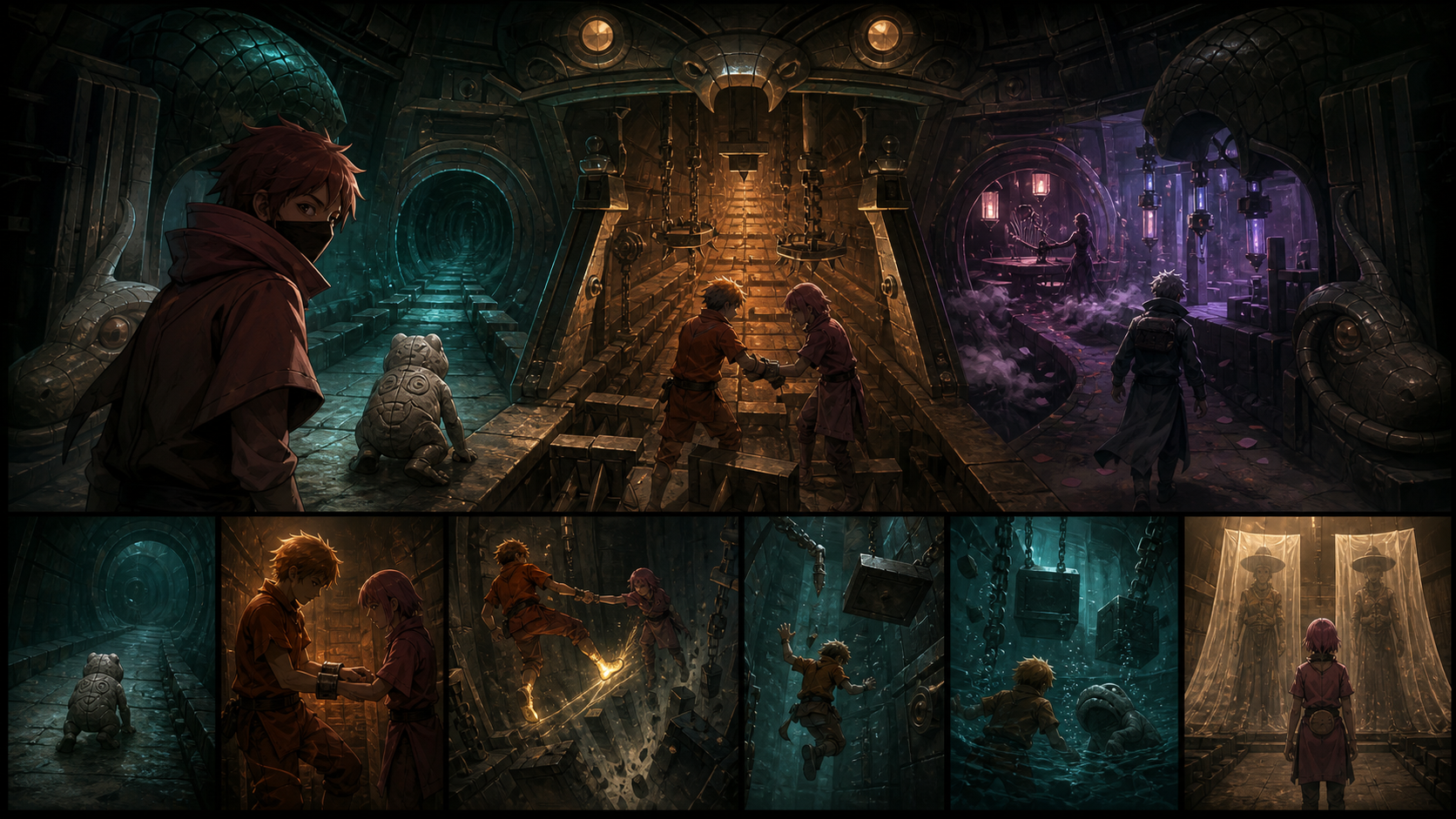
Naruto rushes toward Sasuke and triggers mechanical traps.
Jiraiya follows perfume and music toward a woman waiting to entertain him.
Sakura keeps moving because Naruto tells her not to waste the opening he created.
The building does not need Orochimaru standing in every corridor.
It already thinks like him.
The team helps by making the classic dungeon mistake: they split into three routes inside the enemy's custom-built trap house.
What could possibly go wrong?
Everything with spikes, gates, water and fake Kabuto, apparently.
Sasame Reaches the End of Her Route
Sasame brings Naruto, Sakura and Jiraiya to the hideout entrance.
Jiraiya sends her back because the danger has moved beyond what she should carry.
Sasame is emotionally compromised, injured and tied to the people inside. Bringing her deeper would give Orochimaru more ways to control the team through Arashi.
Sasame has already provided the location.
The trained Konoha shinobi now own the infiltration risk.
The young person who supplied the lead does not also become the disposable scout.
Gamakichi Gets the Scout Job
Jiraiya summons Gamakichi to enter first.
Sakura's reaction to the talking young toad supplies the joke, but the tactic is sound. Gamakichi is small, mobile and less obvious than three human intruders walking through the front entrance.
He can identify immediate danger without announcing the full team's strength, though a summoned creature still carries the risk.
Using Gamakichi is smarter than using Sasame because he has a direct contract connection to Jiraiya's side and useful mobility.
It is not the same as proving the entrance safe.
Orochimaru's defenses are built to let targets move deeper before closing.
The Hideout Makes Them Work for Every Step
The group follows Gamakichi through winding stairways and long corridors.
The architecture destroys easy orientation.
Turns make it harder to judge distance from the exit. Repeated walls erase landmarks. Narrow routes limit formation and force the team into single-file movement.
This is a base designed for someone who expects betrayal and enjoys controlling access.
A visitor never knows whether the next room contains a person, a trap or another passage meant to exhaust attention.
Every route feels like possible progress toward Sasuke, keeping Naruto moving when caution says the building is steering him.
Three Tunnels, One Bad Decision
The team reaches three tunnels.
Jiraiya takes the right path, Naruto and Sakura take the middle, and Gamakichi takes the left.
Splitting covers more ground.
It also gives the hideout exactly what it wants: smaller groups that cannot support each other when a route seals.
Jiraiya uses a rough method to choose direction, but no falling pole can reveal which tunnel contains the target or which trap was designed for the person entering it.
The team has no map, reliable interior intelligence or visible rendezvous point. This is gambling with extra steps.
Naruto and Sakura Put On Their Forehead Protectors
Naruto and Sakura fasten their Konoha forehead protectors before taking the middle route.
The gesture marks the shift from searching to entering active enemy space as Leaf shinobi.
Sasuke left his scratched protector beside Naruto at the Valley of the End.
Now the two teammates still carrying Konoha's symbol enter the system he chose.
They are not sneaking out as unauthorized friends anymore.
They carry an official mission and responsibility to return information.
The protectors remind us what Naruto and Sakura represent if Orochimaru captures them.
Naruto Triggers the First Traps
Projectiles rain into the corridor after Naruto triggers a mechanism.
He survives, then catches another line and activates more of the structure.
The sequence is funny because Naruto has the trap awareness of someone speed-running toward a visible ramen coupon.
It is dangerous because the hideout chains mechanisms together.
Avoid one set of weapons, move into the next trigger and discover the ceiling or gates were waiting for the reaction.
Sakura reads the corridor more carefully, but she cannot prevent every activation while also helping Naruto escape confinement.
The traps punish urgency and teamwork at the same time.
Gates Separate Before People Do
Heavy gates crash down and pin Naruto between sections of the corridor.
Sakura helps free him instead of continuing alone immediately.
That response matters because the architecture keeps trying to redefine partnership as a liability. Every rescue creates another moment when the person helping becomes vulnerable.
Orochimaru's spaces teach the same lesson he sells to recruits: other people slow you down.
Naruto and Sakura answer by continuing to help anyway.
They may be moving through the traps badly, but they refuse the emotional logic behind them.
The hideout can divide their position.
It has not yet convinced either one to abandon the other.
The Floor Opens Under Sakura
Sakura triggers a floor trap and drops.
Naruto catches her hand and channels chakra into his feet to anchor himself.
The rescue shows practical control beneath his usual chaos. He uses the wall or floor contact to turn chakra into grip while holding Sakura's weight.
Naruto pulls her back to safety.
Then his own position fails and he falls into the lower chamber.
He saves the other person and treats whatever happens to him afterward as acceptable.
That instinct is heroic.
It is also why Tsunade told Jiraiya to bring him home alive.
Naruto Tells Sakura to Keep Going
Naruto tells Sakura he will catch up and orders her to continue.
Sakura has to choose whether staying beside the opening helps him or wastes the only route still available.
She trusts his promise and moves forward alone.
That is not the same helpless waiting we saw during the retrieval mission. Sakura does not freeze until Naruto solves everything.
She accepts that he handled the rescue and takes responsibility for the objective ahead.
The choice is still dangerous.
Orochimaru's hideout has now separated a genin from both stronger teammates.
Trust keeps the mission moving while increasing the personal risk.
Naruto Lands in the Lower Trap
Naruto falls into a chamber built to become more dangerous after entry.
Obstacles and bamboo-like stakes limit movement. Water begins turning the space into a drowning trap, and heavy barriers prevent an easy climb back to Sakura.
Raw strength does not solve the mechanism quickly enough.
The trap punishes Naruto's confidence that he can always catch up after sacrificing position.
He kept Sakura moving.
Now the mission continues without his protection while he fights the building itself.
Gamakichi's separate route eventually brings the small toad into the same danger, creating a reunion nobody wanted in a room filling with water.
Jiraiya Follows Perfume and Music
Jiraiya takes the right tunnel and notices perfume.
Then he hears zither music and finds Kotohime waiting to entertain a guest on Orochimaru's orders.
This trap barely has to try.
Orochimaru's people know a legendary Sannin entered the base and present the exact distraction most likely to make Jiraiya pause.
The encounter may contain information, but it also separates Jiraiya from the students Tsunade placed under his protection.
Jiraiya is experienced enough to suspect the lure.
He is also predictable enough to approach it.
The hideout turns personality into a map.
Sakura Walks Into the Worst Room Alone
Sakura reaches a large chamber and encounters apparent versions of Kabuto and Orochimaru.
These are the two people most connected to Sasuke's immediate danger.
They are also opponents Sakura cannot reasonably defeat alone at her current level.
The scene weaponizes exactly what brought her into the hideout. She wants proof about Sasuke, and the people who can provide it appear after the traps strip away her support.
Whether every face is genuine matters less in the moment than the isolation.
Sakura has reached the information target.
She has no safe way to extract the information or herself.
The House Is Orochimaru's Real Technique
This space expresses how Orochimaru operates better than another speech could.
He builds long routes toward promised answers.
He separates companions.
He studies desire.
He lets targets believe each choice remains their own while narrowing the available exits.
Naruto, Sakura and Jiraiya walk into different traps because each follows a recognizable impulse.
The building does not defeat them through one unbeatable weapon.
It gives each person enough rope to isolate themselves.
What Changes After Episode 139
Sasame leads the team to the hideout and is sent back for safety.
Jiraiya summons Gamakichi to scout.
The group reaches three tunnels and splits routes.
Naruto and Sakura enter the middle tunnel as Leaf shinobi.
Projectile, gate and floor traps separate them.
Naruto saves Sakura from falling and drops into the lower chamber.
Sakura trusts him to catch up and continues alone.
Water begins turning Naruto's chamber into a death trap.
Jiraiya follows perfume and zither music to Kotohime.
Sakura encounters apparent Kabuto and Orochimaru.
The battles and disguise reveal belong to Episode 140.
Sasame reaches the limit of what her guidance can safely provide
Bringing the team to the hideout fulfills the immediate route promise and increases danger to her. She should not be expected to enter every corridor simply because her information proved useful.
Gamakichi receives the scout job for a reason
His size, mobility, and ability to report make him better suited to reconnaissance than three humans walking first into traps. Jiraiya uses a summon as a partner with a defined task rather than disposable bait.
The hideout controls visitors before an enemy appears
Stairs, corridors, branches, doors, and concealed mechanisms dictate movement. Architecture becomes part of Orochimaru’s power by making intruders separate, hurry, and doubt their own route.
Every trap is also information about the builder
Mechanical weapons, false floors, and compartmentalized passages reveal planning, resources, and expectations about attackers. A reconnaissance team should document patterns, not merely survive them.
Three tunnels turn uncertainty into a command problem
Splitting may increase coverage, but it reduces mutual support inside unknown terrain. The decision needs rendezvous points, time limits, and a withdrawal signal. Courage cannot replace communication.
Naruto and Sakura put on their forehead protectors deliberately
The gesture marks a transition from travelers gathering rumors to shinobi entering an enemy facility. It also identifies their village if captured. Symbols carry resolve and operational consequence together.
Naruto triggers traps because urgency outruns observation
He wants Sasuke close enough that every hallway feels like delay. The house exploits that urgency. A trap does not need to overpower Naruto if it can make him move before thinking.
Sakura’s caution is operational value
She notices mechanisms and tries to slow the pace. Her role is not simply correcting Naruto’s personality. Different attention styles keep teams alive in engineered spaces.
Gates separate bodies before fear separates judgment
Physical barriers interrupt line of sight and force quick decisions. Orochimaru’s facility turns isolation into a repeatable process rather than an accidental event.
The floor opening under Sakura tests Naruto’s priorities
He moves to protect her and becomes the person who falls. The instinct is loving. Good teamwork also needs procedures that do not require one child to trade places with another in danger.
Naruto tells Sakura to keep going because the mission still has an objective
His instruction prevents both teammates from becoming trapped in the same space. Sakura must decide whether trust means obeying him or refusing to leave him behind.
Continuing alone is not proof Sakura needs nobody
She advances because stopping may waste Naruto’s sacrifice and because Sasuke could be near. Independence under forced separation is different from a well-supported solo assignment.
Naruto’s lower trap converts force into helpless waiting
Rising water and sealed space give him little target to punch. The design attacks his preferred problem-solving language and makes time the threat.
The house punishes teams for becoming predictable
Naruto charges, Sakura follows the objective, and Jiraiya investigates sensory cues. Each habit becomes a route the facility can manipulate. Adaptation requires recognizing how the environment reads them.
Jiraiya follows perfume and music into a tailored distraction
The trap uses his known appetites rather than raw force. Experience does not eliminate vulnerability when a person treats a recurring weakness as harmless personality.
An adult guardian must manage his own exploitable patterns
Jiraiya brought Naruto and Sakura because supervision was the condition of the mission. Allowing an obvious lure to separate him from them undermines the safety structure Tsunade required.
Kotohime’s performance is part of the facility’s defense
Hospitality, art, and flirtation create a softer doorway into danger. The tactic works because threats do not always announce themselves through weapons.
Sakura reaches the worst room without adequate backup
The mission’s most junior medic walks alone into a space associated with Orochimaru. Her courage is undeniable. The separation represents a planning failure, not a rite she needed to prove herself.
The house is Orochimaru’s real technique
Before he uses a jutsu, the facility has divided the team, exploited habits, controlled information, and placed each visitor in a different crisis. Systems can exercise power more efficiently than a single attack.
Hidden rooms suggest hidden people and records
A hideout may contain prisoners, test subjects, recruits, medical material, and evidence. Destroying everything blindly could harm victims or erase information needed for accountability.
Reconnaissance requires an evidence plan
The team should know what can be copied, carried, marked, or reported without compromising escape. Seeing horror is not enough if no trustworthy record leaves the building.
Orochimaru’s space treats bodies as movable components
Corridors route people, traps immobilize them, and rooms assign functions. The architecture mirrors his larger worldview: individuals are resources placed where his design needs them.
Sasuke’s possible presence raises the risk of mission drift
If Naruto or Sakura sees him, the intelligence objective may collapse into immediate retrieval. Jiraiya should have established contact rules before separation made supervision impossible.
Separation needs an automatic regrouping rule
When gates divide the team, everyone should know whether to continue, retreat, mark the route, or wait. Without a shared rule, each person makes a different emotional decision and the hideout controls the result.
Procedures created before panic preserve agency when communication disappears.
Sakura should not have to choose between Naruto and the objective alone
Moving forward may honor his instruction. Searching for him may honor the duty to a teammate. Both choices carry risk, and the mission left a genin to resolve that conflict without contact from her supervisor.
Adult planning should reduce impossible choices instead of praising whichever sacrifice follows.
Naruto’s chamber requires conservation as well as escape
Rising water invites frantic force, but wasting oxygen and chakra could shorten his survival window. He needs to test surfaces, track the water rate, and signal if possible.
Staying calm is not passive. It is technical work performed while fear demands motion.
Evidence inside the hideout may identify victims elsewhere
Names, supply routes, medical notes, and transfer schedules could reveal people who need rescue beyond Sasuke. Preserving those records may protect more lives than destroying one room.
The team needs a chain of custody so intelligence remains credible when reported.
Jiraiya’s distraction creates a supervisory debt
Once he realizes the lure separated him, his priority should be reestablishing contact rather than proving he can defeat the person responsible. Guardian duty outranks pride.
Competence includes recovering quickly from one’s own mistake and naming it honestly afterward.
The facility should be mapped for safe withdrawal
Every turn deeper creates an extraction problem. Marks, summoned scouts, or a written route can prevent the team from surviving an encounter only to become trapped on the return.
A mission is not complete until people and evidence leave the danger zone.
Finding Sasuke would create a protection question, not permission for combat
He may be injured, guarded, unwilling to return, or positioned as bait. Naruto and Sakura need a way to communicate without immediately triggering the same physical struggle that failed at the valley.
Contact should widen choices rather than force an instant verdict.
Survival is part of the evidence
Naruto, Sakura, Jiraiya, and Gamakichi each hold a different piece of the hideout’s design. Regrouping lets those observations become a usable map instead of four isolated memories.
RaeRae’s full take
Episode 139 makes the building the villain before Orochimaru enters the room. The hideout separates people, exploits habits, hides evidence, and turns every familiar instinct into a route deeper inside.
Sakura moving forward alone is brave, but I refuse to call forced isolation empowerment. Naruto is trapped below, and Jiraiya follows a lure tailored to a weakness he treats as a joke. Adult supervision only works when the adult manages himself.
This is supposed to be reconnaissance. The team needs routes, records, and a safe exit more than another dramatic sacrifice. A house designed around control is defeated first by refusing to let it decide how the team thinks.
RaeRae checkpoint: Orochimaru’s hideout wins by separating people and exploiting predictable habits. Good reconnaissance depends on communication, evidence preservation, and an adult guardian who manages his own vulnerabilities.
RaeRae's Verdict
“Pure Terror! The House of Orochimaru” is an episode about bad formation choices inside very good enemy architecture.
Sending Gamakichi ahead makes sense.
Splitting into three routes does not.
The hideout exploits every reason the team believes separating might work faster.
Naruto wants Sasuke now.
Jiraiya follows a personalized lure.
Sakura refuses to waste Naruto's sacrifice and keeps going.
None of those motives is random.
That is why the traps work.
By the end, Naruto is fighting water, Jiraiya is entertaining a setup and Sakura stands alone before the faces she came to find.
Orochimaru may not be waiting in every room.
His method is everywhere.
Receipts and official routes
- Episode number and licensed title: Naruto Official Site.
- Japanese title, synopsis, and June 15, 2005 broadcast record: TV Tokyo.
- Streaming availability varies by region; use the licensed route maintained in the episode directory.