
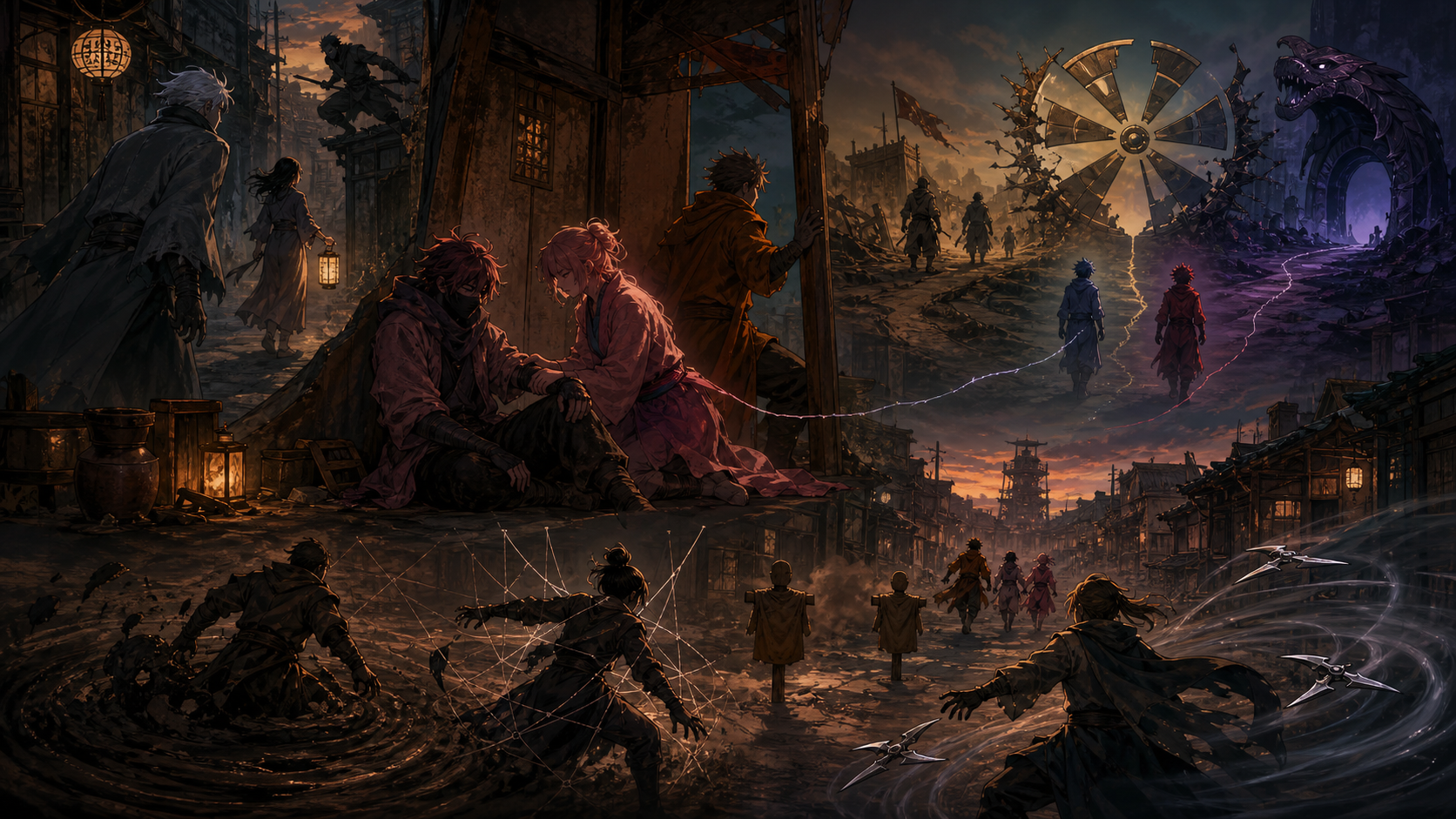
A Town of Outlaws! The Shadow of the Fuma Clan
War broke the Fuma clan’s stability, then Orochimaru sold exploitation as restoration to shinobi desperate for purpose and status.
RaeRae Reacts
Episode 137 introduces the Fuma clan as the kind of community Orochimaru knows how to harvest.
War wrecked their position.
Poverty split survivors between crime and desperate dreams of restoration.
Then Orochimaru offered purpose, status and a place for their techniques.
That offer sounds different when you are starving.
Sasame searches for her cousin Arashi because he left with the clan's hopes on his shoulders and stopped sending word.
Naruto and Sakura recognize the shape immediately.
Someone they love followed Orochimaru for power.
They are chasing the silence left behind.
The Town Shows What War Leaves Behind
Naruto, Sakura and Jiraiya enter a town ruled by open intimidation.
Violence breaks out without anyone expecting reliable authority to stop it. Former shinobi survive as criminals. Businesses operate around people who can punish questions with a blade.
It is what happens when a small country loses stability and trained fighters no longer have honorable work, public support or a system willing to absorb them.
Konoha treats missing-nin as individual traitors.
The Land of Rice Paddies shows how political collapse can produce entire groups of people with nowhere legitimate to take their skills.
Orochimaru sees opportunity in that wreckage.
Jiraiya Follows the Hostess Lead
Jiraiya stays in the questionable part of town and pays hostesses for information about Hidden Sound.
For once, the women and alcohol connect to an actual intelligence method. People working around travelers, criminals and local power brokers hear rumors that formal officials never receive.
A hostess tells him about someone who knows the Hidden Sound stories.
Jiraiya follows the lead into an alley.
The setup still exposes the risk in his habits. A contact can sell information to both sides, and an outsider flashing money announces that he wants something badly.
Jiraiya gets the meeting.
He also walks directly into an ambush.
Hanzaki Is a Warning, Not Just a Thug
Hanzaki attacks Jiraiya after falling from shinobi work into banditry.
He is dangerous, but the more interesting point is what he represents.
Training did not disappear when the clan lost status. The techniques remained inside people who still needed food, protection and belonging.
Without a stable structure, those skills became tools for extortion and survival.
Orochimaru's recruitment pitch works in the same gap.
He can call exploitation employment.
He can call experimentation recognition.
He can make people like Hanzaki and Arashi believe serving him is the only path that treats their abilities as valuable.
That is how predators turn abandonment into loyalty.
Naruto and Sakura Find the Wounded Stranger
Away from Jiraiya, Naruto and Sakura find the masked ninja from the previous episode injured and staggering near the outskirts.
Attackers are already closing in.
Naruto acts before he has a full explanation and pulls the stranger out of danger.
That instinct is predictable and mostly admirable. Somebody wounded needs immediate help, and waiting for a complete biography could get them killed.
The danger is assuming rescue creates trust.
They know the stranger attacked or confronted them earlier. They are operating inside Orochimaru's territory. Injury can be genuine and still lead into a trap.
Compassion should begin the response.
Caution still needs to finish it.
Three Pursuers Bring Clan Techniques
Kamikiri, Kagero and Jigumo attack with specialized tools and techniques.
Their methods include earth concealment, spiders, wind manipulation and bladed equipment designed to control movement from several directions.
The variety matters because the Fuma clan still possesses real shinobi knowledge.
These are not random street criminals holding knives badly.
They coordinate, use terrain and force Naruto and Sakura to divide attention while protecting an injured person.
The fight also gives Sakura a chance to work beside Naruto rather than waiting behind him. She engages, reads the pressure and helps create the opening they need.
The mission has already become more dangerous than a quiet information search.
Substitution Beats Showing Off
Naruto and Sakura use substitution to escape with the stranger.
That choice is smarter than turning the roadside into a prolonged contest.
They do not know the attackers' full strength, how many reinforcements are nearby or whether the stranger can survive more delay. Winning every visible exchange would not complete the mission.
Getting the wounded person into shelter creates time for treatment and questions.
Naruto often treats retreat as failure.
Here, the team uses deception to preserve the person and the information both sides want.
That is ninja work, not cowardice.
Sometimes the best fight is the one your enemy thinks already ended.
Sakura Treats the Wound
Inside shelter, Sakura examines and treats the stranger's injury.
The moment connects directly to Tsunade's lesson about medical support.
Sakura has not completed medical training, but she already understands that protecting a person continues after the attackers disappear. Bandages and ointment can matter as much as a kunai when the objective is survival.
Naruto gets pushed outside while treatment requires privacy.
His embarrassed realization about where he grabbed the stranger during the rescue adds a predictable joke.
The useful part remains Sakura's role.
She is beginning to occupy the space between combat and recovery that the retrieval squad desperately lacked.
The Stranger Is Sasame Fuma
The masked ninja identifies herself as Sasame of the Fuma clan.
Her age and condition change the shape of the threat without making her automatically trustworthy.
Sasame is another young person moving through dangerous territory because the adults and institutions around her failed.
She does not command the clan forces pursuing her.
She is trying to reach someone who left with them.
That explanation lands hard with Naruto and Sakura because it sounds painfully familiar.
They came looking for Sasuke.
Sasame came looking for Arashi.
Orochimaru sits at the center of both disappearances.
War Broke the Fuma Clan
Sasame explains that war devastated the small country and the Fuma clan suffered with it.
Some members became thieves.
Others held onto the belief that the clan could rise again if someone found enough power and recognition.
That split avoids a simple good-clan, bad-clan story.
People respond differently when a shared identity collapses. Some protect whoever remains. Some exploit neighbors. Some become vulnerable to anyone promising restoration.
The Fuma did not wake up one morning and decide Orochimaru looked trustworthy.
They reached a point where his offer competed against hunger, humiliation and disappearance.
He designed the offer for exactly that moment.
Orochimaru Sells Restoration
Orochimaru's representative approaches Fuma shinobi with praise for their techniques and a promise that service can restore the clan's standing.
The pitch flatters before it consumes.
Orochimaru rarely begins by saying he wants bodies, bloodlines and experiments. He tells a recruit that other people failed to recognize something exceptional.
Sasuke heard a version built around Uchiha revenge.
The Fuma hear one built around clan revival.
Both offers transform grief into a reason to enter his control.
The victim believes the arrangement is temporary and strategic.
Orochimaru believes the victim is inventory.
Arashi Carries the Clan's Hope
Sasame's cousin Arashi leaves with other clan members because people see him as their best chance at revival.
That expectation burdens one young shinobi.
If Arashi succeeds, he restores honor and stability.
If he questions Orochimaru, he risks looking like the person who abandoned the clan's only opportunity.
The burden resembles Sasuke's belief that avenging the Uchiha belongs to him alone.
Both boys reduce their future to a duty owed to dead or suffering relatives.
Both become easier to manipulate because failure feels bigger than personal loss.
Orochimaru does not need honest loyalty when obligation can do the same work.
The Silence Is the Warning
Arashi stops sending word.
Sasame searches because silence is the only evidence she has that the promise of revival went wrong.
No official messenger explains what happened. No clan leadership provides a safe rescue. She has to enter the same network that swallowed him and hope she can follow what remains.
Naruto and Sakura understand why she cannot simply accept the absence.
They also know, after Sasuke, that reaching someone does not guarantee the person will return willingly.
The parallel gives them empathy.
It should also give them caution.
Arashi may no longer be the cousin Sasame expects to find.
What Changes After Episode 137
The team enters a town controlled by criminals and fallen shinobi.
Jiraiya follows a hostess lead about Hidden Sound and faces Hanzaki's ambush.
Naruto and Sakura rescue the injured masked ninja from three pursuers.
They use substitution to escape rather than prolong the fight.
Sakura treats the stranger's wound.
The stranger identifies herself as Sasame Fuma.
War and poverty fractured the Fuma clan.
Orochimaru recruited members by promising to value their techniques and restore the clan.
Sasame's cousin Arashi left as the clan's hope and stopped sending word.
Sasame's betrayal and the renewed attack belong to Episode 138.
The town shows what a hidden-village economy leaves outside its walls
Lawlessness is not presented as random moral failure. War, collapsed authority, displaced shinobi, and scarce work create a place where force becomes currency. The setting expands the cost of the shinobi system beyond famous villages.
Civilians live inside consequences they did not authorize
People running inns, shops, and streets must navigate armed groups whose conflicts began elsewhere. An intelligence mission cannot treat them as background. Their safety and knowledge deserve respect.
Jiraiya follows a social network official maps cannot show
The hostess knows rumors, reputations, and who might possess better information. Her labor produces intelligence because people talk where they feel ordinary. That expertise should be recognized rather than reduced to a joke about Jiraiya’s habits.
Information gathering carries obligations to the source
A person who names a local contact may face retaliation if the inquiry becomes visible. Jiraiya’s experience should include protecting people whose knowledge helps Konoha, not merely extracting a useful lead.
Hanzaki represents shinobi labor after institutions collapse
He has skills built for missions but no stable village structure offering accountable work. Banditry is still harmful. The path toward it reveals how readily military training becomes predation when communities discard trained people.
Fear of Jiraiya changes the encounter faster than law does
Hanzaki backs down after recognizing a legendary Sannin. Personal reputation provides immediate control where formal authority is weak. That solution is efficient and fragile because safety depends on which powerful individual happens to arrive.
Naruto and Sakura leave the tavern because patience has limits
Jiraiya’s method looks unserious to two children desperate for Sasuke. Their frustration makes sense. Separating from the adult guardian also recreates the exposure this mission was supposed to prevent.
The wounded stranger should be approached as a person before a clue
Naruto sees someone pursued and intervenes. Sasame may know the Sound, but immediate care cannot depend on whether the information proves useful. Aid loses its ethics when survival becomes payment for testimony.
Naruto protects first because abandonment remains personal
He recognizes the position of someone alone while danger closes in. That instinct is one of his strengths. He must pair it with threat assessment so a decoy cannot use compassion to endanger Sakura.
Sakura’s medical response makes training goals concrete
She evaluates and treats the wound with the knowledge currently available. The action previews why medical study matters to her future. Care creates field value that striking harder cannot replace.
Consent still matters during emergency treatment
Sasame is frightened, injured, and surrounded by strangers. Explaining what Sakura is doing preserves dignity where circumstances allow. Medical competence includes communication as well as technique.
The three pursuers bring a clan conflict into public space
Kamiri, Jigumo, and Kagero use inherited skills while chasing a vulnerable relative. Clan identity does not automatically create solidarity. Shared lineage can become another structure through which desperate factions control one another.
Substitution rewards judgment over spectacle
Naruto and Sakura survive by reading the attack and using a basic technique effectively. The exchange fits a reconnaissance arc because the goal is not to prove dominance. Staying alive and protecting the witness matter more.
The Fuma techniques reveal knowledge that must be recorded
Each attack gives the team information about range, coordination, and local capability. A disciplined unit carries those observations forward instead of treating combat as an isolated victory.
Sasame’s name changes the moral landscape
Learning she belongs to the Fuma clan complicates the chase. The pursuers are not anonymous bandits, and Sasame is not merely a traveler. Family collapse is operating through every side of the encounter.
War broke the clan before Orochimaru recruited from it
The Fuma lost position and livelihood through larger conflicts. Orochimaru did not create the vulnerability. He found people whose institutions had failed and offered restoration on terms he controlled.
Restoration is persuasive when humiliation has become inherited
A clan told that former status can return may overlook the cost of service. Pride is not foolish by itself. Predators weaponize pride by presenting exploitation as the only route back to dignity.
Arashi carries collective hope on one young body
Sasame believes her cousin can restore the family. That expectation may feel loving, but it gives Arashi responsibility no individual should bear. Clan survival becomes another performance standard attached to a child.
Sasame’s search mirrors Naruto’s without becoming identical
Both pursue someone drawn into Orochimaru’s network. Naruto seeks a friend; Sasame seeks family and the hope attached to him. Shared urgency can build trust, but different histories still require listening.
The mission now contains a rescue story it was not assigned
Helping Sasame may align with investigating Orochimaru. It can also expand scope beyond safe capacity. Jiraiya needs to decide openly which objectives the team can responsibly carry.
Orochimaru builds power from communities already abandoned
He offers laboratories, affiliation, and promised advancement to people left without stable futures. The offer is predatory, but simply condemning recruits misses why it works. Prevention requires alternatives with material credibility.
Konoha should learn from the Fuma rather than congratulate itself
A powerful village may view clan collapse elsewhere as local weakness. Konoha also leaves traumatized children under-supported and sends minors into lethal missions. Institutional stability does not guarantee institutional care.
The silence around the Sound is evidence
People avoid direct answers because fear, dependency, and surveillance shape what can be said. Missing testimony is not an empty data point. It tells Jiraiya how dangerous open inquiry may be.
Protecting Sasame means protecting her after the questions end
If she identifies routes, relatives, or Sound activity, that information may make her a target. Jiraiya’s team needs to consider safe lodging, confidentiality, and what happens when Konoha leaves the region.
A source is not protected merely because she survives the scene in which she becomes useful.
Mission drift should be named before it becomes another sacrifice test
The team entered to investigate Sasuke’s location. Sasame’s request adds Arashi, the Fuma clan, and a local conflict. Each concern may be legitimate, but adding objectives without adding people or time recreates the conditions that broke the retrieval squad.
Compassion needs planning if it is going to remain compassionate under pressure.
Sakura’s medical skill also gives her intelligence
A wound can reveal weapon type, attack direction, treatment delay, and whether a story matches the body. Sakura’s care therefore contributes evidence while serving the injured person.
That dual role requires restraint. Treatment should never be threatened or withheld to obtain cooperation.
The Fuma need more than a heroic relative
Even if Arashi returned powerful enough to defeat enemies, one person could not rebuild employment, trust, governance, and safety for an entire clan. Making him the answer concentrates hope until exploitation becomes easier.
Recovery needs community capacity instead of another exceptional child carrying everybody’s future.
Konoha’s report should include conditions, not only enemy locations
Recording poverty, displacement, collapsed authority, and recruitment pressure would help leaders understand why Orochimaru’s network keeps finding people. A map of hideouts identifies symptoms. A map of vulnerability begins to explain the system.
Intelligence becomes more useful when it recognizes human conditions alongside military targets.
RaeRae’s full take
Episode 137 works because the outlaw town is not just a colorful obstacle. We see what happens when war breaks livelihoods, trained shinobi lose accountable work, and Orochimaru arrives offering dignity to people powerful villages already forgot.
Sasame deserves help before she becomes useful as a source. Sakura treating her matters, and Naruto’s instinct to protect her matters. The team still needs Jiraiya to manage scope, sources, and the risk of turning compassion into another reckless chase.
The Fuma did not wake up wanting exploitation. Orochimaru found a cracked community and sold restoration. If Konoha wants to stop networks like his, defeating agents is not enough. Somebody has to make a livable alternative arrive first.
RaeRae checkpoint: Orochimaru recruits through fractures war and abandonment already created. Stopping him requires protection and credible futures, not only defeating desperate people who accepted his offer.
RaeRae's Verdict
“A Town of Outlaws! The Shadow of the Fuma Clan” works because Orochimaru does not create desperation from nothing.
He finds desperation already living in a country damaged by war and offers it a uniform.
The Fuma clan has techniques, history and pride, but lacks security.
Orochimaru turns that absence into recruitment.
Sasame and Arashi mirror Sakura and Sasuke without becoming exact copies. One person leaves believing power can repair a clan. Someone who loves them follows after the messages stop.
Naruto and Sakura want to help because they know that silence.
They should also know that love makes people vulnerable to bad bargains.
Sasame has told them why she is searching.
She has not yet proved what she will do when finding Arashi requires sacrificing the people who helped her.
Receipts and official routes
- Episode number and licensed title: Naruto Official Site.
- Japanese title, synopsis, and June 1, 2005 broadcast record: TV Tokyo.
- Streaming availability varies by region; use the licensed route maintained in the episode directory.