
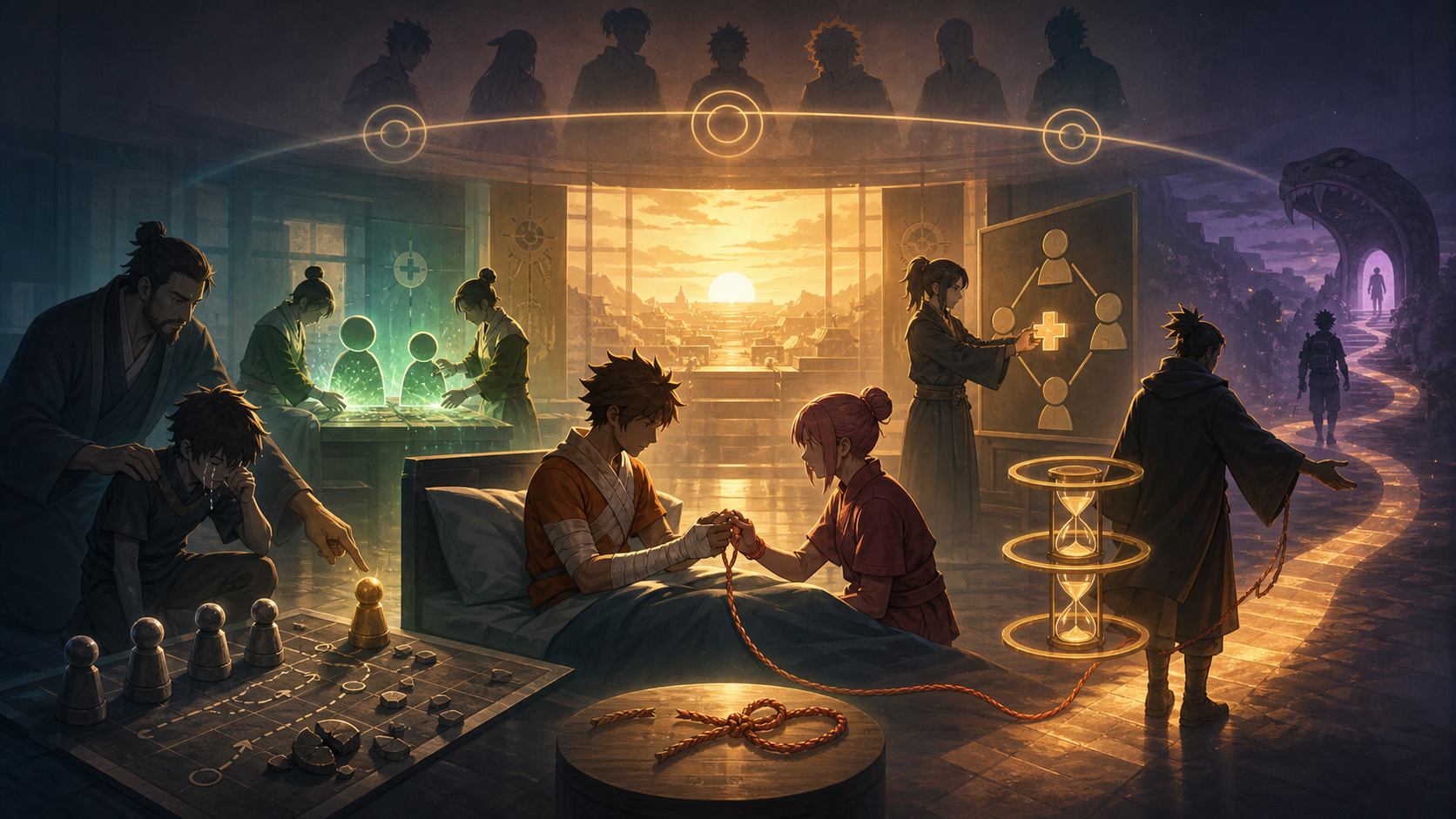
The Promise That Could Not Be Kept
The retrieval failed, but Shikamaru, Sakura, Tsunade and Naruto each turn the disaster into a different promise to do better.
RaeRae Reacts
Episode 135 does something Naruto needed badly after the Valley of the End.
It lets failure remain failure without treating failure as a final identity.
Naruto did not bring Sasuke home.
Shikamaru led a mission that left nearly every member of his squad close to death.
Sakura asked Naruto for a promise he nearly died trying to keep.
Nobody gets to pretend the outcome was good.
They do get to decide what the outcome changes.
Shikamaru commits to becoming a better leader. Sakura chooses training over helpless waiting. Naruto accepts three years of hard work while refusing to write Sasuke off.
The mission failed.
The people who survived it do not have to stop there.
The Medical Corps Receives a Disaster
Konoha gets its retrieval team back in pieces.
Kakashi carries Naruto home unconscious. Choji and Neji need extraordinary intervention. Kiba, Akamaru and the others return with injuries that make the mission report feel painfully clinical.
The Medical Corps moves from one crisis to another because five genin were sent to retrieve a teammate who had chosen Orochimaru.
That sentence should sound outrageous.
The village lacked better available manpower, but necessity does not make the cost smaller. Children carried combat far beyond their rank until skilled adults took over.
Shikamaru Counts Every Injury as His Failure
Shikamaru sees the wounded squad and decides he was not fit to lead.
His guilt makes sense.
He selected matchups and kept moving while teammates stayed behind against enemies who could kill them.
Shikamaru cannot hide behind the fact that everyone volunteered.
He was responsible for the plan.
The problem begins when he treats one failed command as proof that he should never command again.
Shikaku Does Not Let Him Quit
Shikaku forces his son to face the difference between grief and surrender.
If Shikamaru refuses future leadership, missions will not stop happening. His friends will still go into danger, possibly under someone who understands them less and plans worse.
Quitting cannot protect them.
It only protects Shikamaru from feeling this exact guilt again.
That is the hard lesson of command. Caring about casualties should change how a leader prepares, not become an excuse to abandon the role entirely.
Shikamaru cries because the cool, detached genius act cannot survive what happened.
Good.
The village needs a leader who understands that names on a squad list are people he loves.
The Team Comes Back Alive
News arrives that the retrieval team members will survive.
Choji and Neji came frighteningly close to death.
Tsunade, Shizune and Konoha's medical specialists pull them back through expertise, relentless treatment and knowledge that includes the Nara clan's medical records.
Their survival does not retroactively make Shikamaru's decisions safe.
It gives him a chance to lead those friends differently later.
Relief does not prove everybody worried too much. The boys live because excellent healers caught them in time.
Tsunade Learns From the Mission Too
Tsunade recognizes that four-person squads need medical capability.
That conclusion matters because the adults cannot demand that children learn from failure while the institution changes nothing.
Each serious injury forced a choice between stopping and continuing. A medical ninja cannot erase that problem, but immediate treatment changes who reaches home alive.
Tsunade turns the mission into policy rather than filing it as an unfortunate exception.
This is what useful leadership looks like after disaster.
Find the weakness, train people to address it, and do not make another squad bleed the same lesson onto the road.
Shikamaru Reports Back
Shikamaru faces Tsunade and commits to doing better.
He does not claim the mission succeeded because the squad survived. Sasuke is gone, and every member paid for the attempt.
He also does not resign from becoming someone others can trust.
Shikamaru will carry this mission into every formation he studies and every risk he weighs. His missing ingredient was experience.
Unfortunately, shinobi experience often arrives wearing the faces of injured friends.
Shikamaru cannot undo that price.
He can refuse to waste what it taught him.
Naruto Wakes With the Broken Promise
Naruto wakes in the hospital and understands immediately that Sasuke is not there.
He remembers what he promised Sakura.
Naruto said he would bring Sasuke back, gave everything he had, and still returned without him.
He does not protect his pride with excuses about the curse mark, Kakashi arriving late or Sasuke choosing not to return.
He says he failed.
His bandages show how far he carried that obligation.
Sakura Sees What Her Request Cost
Sakura visits Naruto and sees the physical result of the promise she asked him to make.
She has every right to grieve Sasuke's departure.
She does not have the right to make Naruto the only person responsible for reversing it.
Sakura recognizes that imbalance.
Instead of demanding another impossible guarantee from a hospital bed, she decides she needs the strength to participate next time.
That is a major correction.
Waiting at the village gate left Naruto carrying her hope and his own. Training under Tsunade offers Sakura a way to become useful where the retrieval mission proved the team desperately needed help.
The promise becomes shared work.
The Promise Is Delayed, Not Dead
Naruto does not withdraw the promise.
He failed to keep it on this mission. He still intends to bring Sasuke back.
Reality says Sasuke chose Orochimaru, defeated Naruto and escaped. Finality says nothing can ever change after that choice.
Naruto accepts the first statement and rejects the second.
He does not know how the next attempt will work.
For once, that uncertainty is honest. The answer cannot be another sprint into the forest with the same strength and the same plan.
The promise needs preparation.
Jiraiya Gives Naruto Three Years
Jiraiya arrives with a timeline and an offer.
Orochimaru cannot take Sasuke's body immediately. Akatsuki's larger movement also points toward a roughly three-year horizon.
Naruto has time, but not time to waste.
Jiraiya offers to train him personally so he can survive the enemies already gathering around the Nine-Tails and face the consequences of Sasuke's decision with more than stubbornness.
Naruto needs control, judgment and deeper foundations.
The Valley of the End proved that determination without sufficient power can leave him unconscious while the person he wants to save walks away.
Jiraiya Tells Him to Give Up on Sasuke
Jiraiya also tells Naruto to abandon Sasuke.
From a practical standpoint, the warning is defensible. Sasuke left willingly, attacked comrades and joined a missing-nin who wants to steal his body.
Jiraiya has personal experience loving someone who chose that road.
He sees Orochimaru in Sasuke and recognizes the years Naruto could lose chasing a person who may keep refusing rescue.
Still, calling Sasuke a lost cause asks Naruto to become a different person before the training even begins.
Naruto's strength grew because Iruka refused to reduce him to the Nine-Tails. He cannot easily accept reducing Sasuke to his worst decision.
Naruto Chooses to Be a Fool
Naruto accepts Jiraiya's training and rejects the order to give up.
If caring about Sasuke makes him a fool, he will remain one.
He ties the choice to becoming Hokage because leadership means more to him than receiving a title. If he cannot fight for one friend, public recognition would feel hollow.
Naruto's loyalty can become self-destructive when he treats his body as endlessly spendable. He must become strong and wise enough that caring does not require another suicidal plan.
That is the real work Jiraiya has agreed to begin.
Sasuke Reaches Orochimaru
Sasuke arrives with Orochimaru and Kabuto.
The sight removes any comforting ambiguity about where his victory led.
He did not leave Naruto for independent study and quiet reflection.
He delivered himself to a man who marked his body, engineered his desperation and intends to use him as a vessel.
Sasuke believes he can exploit Orochimaru's training without becoming Orochimaru's possession.
That confidence is the next gamble.
Naruto failed to stop him before he entered the snake's den.
The future rescue will be harder because Sasuke now has every reason to defend the choice he paid so much to make.
Akatsuki Uses the Same Clock
Akatsuki assembles through projected forms and looks toward its own future movement.
The three-year window is not private training time for Naruto. His enemies will prepare too. Zetsu witnessed the Valley of the End, and the organization now knows more about the Nine-Tails host and the Uchiha who defeated him.
What Changes After Episode 135
The retrieval squad returns to Konoha with severe injuries.
Shikamaru blames himself and considers abandoning leadership.
Shikaku pushes him to learn and lead better instead of quitting.
Choji and Neji survive through extraordinary medical treatment.
Tsunade recognizes the need for medical ninja on future squads.
Naruto apologizes to Sakura for failing to return Sasuke.
Sakura decides she must become strong enough to help.
Jiraiya offers Naruto three years of training.
Naruto accepts and refuses to give up on Sasuke.
Sasuke reaches Orochimaru and Kabuto.
Akatsuki prepares on the same three-year horizon.
The Sasuke Retrieval Mission ends in failure.
The medical corps receives the real cost of the retrieval order
Once the fighting stops, wounded children arrive under clinical light. The mission’s excitement becomes damaged organs, chakra depletion, blood loss, and families waiting for news. Medicine makes consequences harder to romanticize.
The healers’ skill saves lives. Their success should not be used to declare the original staffing acceptable.
Choji’s survival depends on preparation nobody should treat as disposable
The Akimichi pills gave Choji enough power to protect the squad and brought him close to death. Tsunade’s medical knowledge and the clan’s records create a route back.
Preparation matters, but a known antidote or treatment does not make sending a child toward a lethal side effect ethically simple.
Neji’s body records how alone he was left
He defeated Kidomaru after accepting wounds calculated to bypass the Byakugan. The result proved tactical brilliance and exposed the mission’s structure: holding the line meant facing a killing specialist without immediate backup.
Survival confirms Neji’s ability. It does not validate the circumstances that demanded it.
Kiba and Akamaru remind us that partners share consequences
Akamaru is not equipment that can be set aside when the mission becomes dangerous. He is Kiba’s bonded partner, and both bodies carry the damage from escape and pursuit.
Medical accountability must include the nonhuman teammate whose labor the village relies upon.
Shikamaru counts every injury as a personal leadership failure
He assigned positions, watched teammates remain behind, and returned without Sasuke. A newly promoted child interprets command as ownership of every outcome because nobody gave him enough authority or resources to match the responsibility.
Guilt feels rational when an institution makes one person’s decisions highly visible and its own constraints invisible.
Shikaku refuses to let quitting masquerade as accountability
His father does not tell him the mission went well. He argues that abandoning leadership would leave future squads with someone who has learned less from this disaster.
The lesson is valuable when paired with institutional review. A child should grow from mistakes without becoming the container for failures made above him.
Crying is part of Shikamaru’s leadership
He breaks down when he hears his teammates are alive. Relief and shame arrive together. The tears do not disqualify him from command. They show that the people under his care never became pieces on a strategy board.
A leader who feels the cost can learn to plan differently, provided adults do not weaponize that feeling into endless self-punishment.
The team returning alive is not the same as the mission succeeding
Survival is cause for gratitude. Sasuke still reaches Orochimaru, and several children nearly die. A clean report must hold both facts.
Institutions lose wisdom when they classify every operation as success or failure without examining which objectives, safeguards, and relationships broke.
Tsunade has to learn from the mission she authorized
As Hokage, she worked under staffing shortages and an urgent threat. Those constraints explain the roster. They do not end the review. Her authority includes responsibility for what the children endured.
Leadership means changing the conditions after survival exposes their danger.
Requesting Sand reinforcements was a strong decision that came late
Gaara, Temari, and Kankuro prevented further deaths through skills matched to each battlefield. The alliance worked materially rather than symbolically.
The outcome should encourage earlier coordination next time. Help that arrives at the final possible moment remains help, but timing decides how much harm has already occurred.
Shikamaru’s report should belong to the whole institution
He can explain tactical choices and communication gaps. Command should also examine intelligence quality, staffing, medical readiness, pursuit policy, and why a marked child could leave under active grooming.
A debrief is not complete if the youngest leader is the only person being evaluated.
Naruto wakes with the broken promise before he can process his body
His first emotional focus is that Sasuke escaped and Sakura trusted him. The bandages become evidence that effort was insufficient rather than evidence he survived something no child should have faced alone.
Naruto’s self-worth remains tied to usefulness. Failure threatens the belonging he has worked to build.
Sakura sees what her request cost Naruto
She asked him to bring Sasuke back because fear and desperation left few options. At the hospital, she confronts the bodily price Naruto paid while carrying that promise.
Recognizing the cost allows their relationship to become more honest. Her grief does not make her responsible for the entire mission design.
The promise is delayed rather than erased
Naruto tells Sakura he will still bring Sasuke home. The renewed commitment offers hope, but it can also preserve a burden no teenager should treat as a private debt.
A promise can guide action without guaranteeing outcome. Care needs room for limits, shared responsibility, and changing information.
Sakura’s choice to train changes her position in the story
She can no longer accept waiting as her only contribution. Seeking Tsunade’s instruction is not punishment for being weak. It is a decision to build skills that matter to the kind of crises her team faces.
Her growth should be valued beyond how effectively it supports Naruto and Sasuke. Medical power creates an independent field of agency.
Jiraiya offers Naruto time instead of an immediate repeat mission
Three years of training acknowledges that determination alone cannot close every gap. Naruto needs technique, knowledge, and greater control before confronting Akatsuki, Orochimaru, or Sasuke again.
A pause can serve the promise more honestly than another reckless chase.
Training also removes Naruto from a village Akatsuki can target
Travel with Jiraiya provides mobility and a guardian capable of recognizing high-level threats. The arrangement has strategic value beyond learning new jutsu.
Protection should be explicit, not hidden behind the idea that a child is simply going away to become stronger.
Jiraiya telling Naruto to give up repeats an adult failure of imagination
He sees Sasuke’s choice and Orochimaru’s influence and concludes pursuit may be foolish. The warning about obsession is important. Dismissing the endangered child risks treating grooming as a voluntary endpoint nobody should challenge.
Naruto needs boundaries and realism, not contempt for caring.
Naruto choosing to be a fool rejects the logic of disposability
He refuses a shinobi world that calls people lost causes as soon as rescue becomes costly. That refusal is one of his moral strengths.
It will need discipline. Saving Sasuke cannot require Naruto to destroy himself or ignore harm Sasuke causes along the way.
Sasuke reaching Orochimaru confirms the danger was real
He arrives at the adult who marked him, promised power, and wants an Uchiha body. The setting makes clear that departure did not carry him into neutral independence.
Respecting Sasuke’s reasons must coexist with naming the exploitation waiting to receive him.
Orochimaru’s delay does not make the destination safe
The body-transfer timing prevents immediate possession, giving Sasuke a temporary window. Predatory intent remains. A postponed threat is not informed consent or freedom.
Sasuke may use the delay strategically, but the power imbalance still shapes every lesson and demand.
Akatsuki works on the same long clock
The organization’s plans for Naruto create another deadline measured in years. His training period is therefore not leisurely recovery. It is preparation under looming pursuit.
Both Naruto and Sasuke are adolescents whose futures powerful adults schedule around access to their bodies.
The episode begins recovery without pretending anyone is healed
Bodies stabilize, plans form, and mentors accept students. Choji, Neji, Kiba, Naruto, Sakura, and Shikamaru remain changed by what happened.
Recovery is a process with medical, emotional, relational, and institutional parts. Discharge from immediate danger is only the first one.
The failed promise exposes why individual heroism cannot carry a village
Naruto gave everything and still could not return Sasuke. That outcome does not prove he lacked commitment. It proves one child’s will cannot replace coordinated care, accurate intelligence, and adult responsibility.
The village must become worthy of the loyalty it asks from its youngest people.
RaeRae’s full take
Episode 135 is where the mission stops being an adventure and arrives at the hospital. Choji and Neji live because healers, clan knowledge, and Tsunade’s skill meet the damage in time. I am grateful. I am also not letting relief excuse why children needed miracle-level treatment after a mission led by another child.
Shikamaru’s tears are leadership, not failure. Sakura deciding to train is agency, not penance. Naruto renewing the promise is love, but love cannot remain a private contract that demands his body every time Konoha fails to build a safer answer.
Sasuke reaches Orochimaru, and Naruto leaves with Jiraiya. Both boys enter long training paths shaped by adults who know powerful organizations want their bodies. The next chapter has to be about strength, yes, but also about whether any adult will finally make protection as serious as power.
RaeRae checkpoint: Naruto did not fail because effort was missing. One child’s promise could never substitute for adult staffing, trauma care, intelligence, and institutional responsibility.
RaeRae's Verdict
“The Promise That Could Not Be Kept” is not about pretending a broken promise never broke.
Naruto failed.
Shikamaru failed.
Konoha failed to keep Sasuke from reaching Orochimaru.
The episode lets each failure produce a better next decision.
Shikamaru chooses responsibility over retreat.
Sakura chooses training over waiting.
Tsunade chooses structural reform over accepting casualties as normal.
Naruto chooses years of work without surrendering the friend he could not save today.
That does not repair Team 7.
It means the Valley of the End will not get the final word.
Receipts and official routes
- Episode number and licensed title: Naruto Official Site.
- Japanese title, synopsis, and May 18, 2005 broadcast record: TV Tokyo.
- Streaming availability varies by region; use the licensed route maintained in the episode directory.