
Good-Bye Old Friend! I’ll Always Believe in You!
Choji spends the final pill, turns stored energy into wings, defeats Jirobo, and follows the road his friends left until his body can carry him no farther.
RaeRae Reacts
Episode 114 turns Choji's body into the answer to every person who ever used it against him.
The yellow pill gives him enough power to expand beyond Jirobo's control. Jirobo answers with the second state of Orochimaru's curse mark, lifts enlarged Choji and throws him aside.
One pill remains.
The red chili pill can give Choji the power to finish the fight. It can also kill him.
He takes it.
Not because he thinks his life matters less than the pursuit. Not because Shikamaru left him as disposable weight. Choji takes it because one friend saw his kindness before anybody respected his strength, and protecting that bond is a choice he makes with full knowledge of the risk.
Jirobo calls him fat like the insult explains his value.
Choji turns every stored calorie into wings.
That is one hell of a correction.
The Yellow Pill Makes Choji Enormous
The yellow curry pill multiplies Choji's power again.
He uses Super Multi-Size and brings his expanded body down on Jirobo with crushing force.
For a moment, the fight appears finished.
Choji's clan techniques make scale itself a weapon. Jirobo relies on strength to dominate close combat, but strength means little when the opponent can increase mass beyond what normal leverage can answer.
The move also exposes how ridiculous the mockery around Choji has always been.
People treat his body as evidence that he lacks discipline. The Akimichi clan understands it as stored energy, trained control and tactical possibility.
Choji does not become powerful by escaping his body.
He becomes powerful by using it with knowledge nobody mocking him bothered to learn.
Jirobo survives only by escalating Orochimaru's mark.
Jirobo Enters the Curse Mark's Second State
Jirobo activates the second state of his curse mark.
The transformation gives him enough strength to lift enlarged Choji and throw him away.
That reversal is brutal because the yellow pill already carries bodily cost. Choji spent his second emergency measure, reached a size capable of ending the fight and still watched Jirobo force the battle higher.
Orochimaru's power system works through escalation without care for what remains of the user. Need more strength? Give the mark more control. Let the body change. Pay for the consequences later, assuming Orochimaru allows a later.
Jirobo treats the transformation like proof of superiority.
It actually proves Choji forced him to use everything short of his own final limit.
The boy he dismissed has pushed a member of the Sound Four into full curse-mark transformation alone.
The Red Pill Is Almost a Death Sentence
Choji has one option left inside the clan case.
The red chili pill releases extraordinary power by converting the body's stored calories into chakra. Clan teaching warns that taking it will almost certainly kill the user.
This is not a standard boost with dramatic marketing.
It is an emergency weapon built around sacrificing the body to produce one final answer.
Choji understands that.
Shikamaru understands enough about the Akimichi pills to fear what Choji may need to do behind them.
The danger cannot be softened into a slogan about believing in yourself. Choji may win and still die beneath a tree where nobody can reach him in time.
The mission created this choice by sending children after enemy specialists without senior support.
Choji owns the decision.
Konoha still owns the conditions that made it necessary.
Childhood Taught Choji What People See First
Choji remembers how other children judged him.
They saw his size and appetite before his kindness. They treated him as slow, inconvenient or useful only when a joke needed a target.
Repeated rejection teaches a child to anticipate abandonment before friendship gets the chance to prove itself.
Choji did not lack the desire to connect.
He lacked people willing to look past the easiest visible trait.
That history makes Jirobo's insults familiar rather than original. He is another bully reaching for the same lazy vocabulary and expecting shame to finish what force has not.
The words still hurt.
Old wounds do not vanish because the person reopening them lacks imagination.
Choji's strength comes from knowing those judgments were incomplete, not from pretending they never affected him.
Shikamaru Recognized Choji's Kindness
Shikamaru became Choji's friend without demanding that Choji earn basic dignity first.
He recognized patience, loyalty and kindness where other children saw appetite.
That friendship gave Choji evidence against the village's judgment.
One person looking accurately can interrupt a whole crowd looking lazily.
Shikamaru never needed Choji to become louder, thinner or crueler to deserve company. He accepted the person already there and learned the power that person carried.
This is why Choji's loyalty to him matters so deeply.
Shikamaru did not manufacture Choji's worth.
He helped Choji see that worth without the distortion of everybody else's jokes.
Choji is not dying for the only person who made him valuable.
He is risking death for the friend who helped him understand he was valuable all along.
Shikamaru Leaves a Road Back
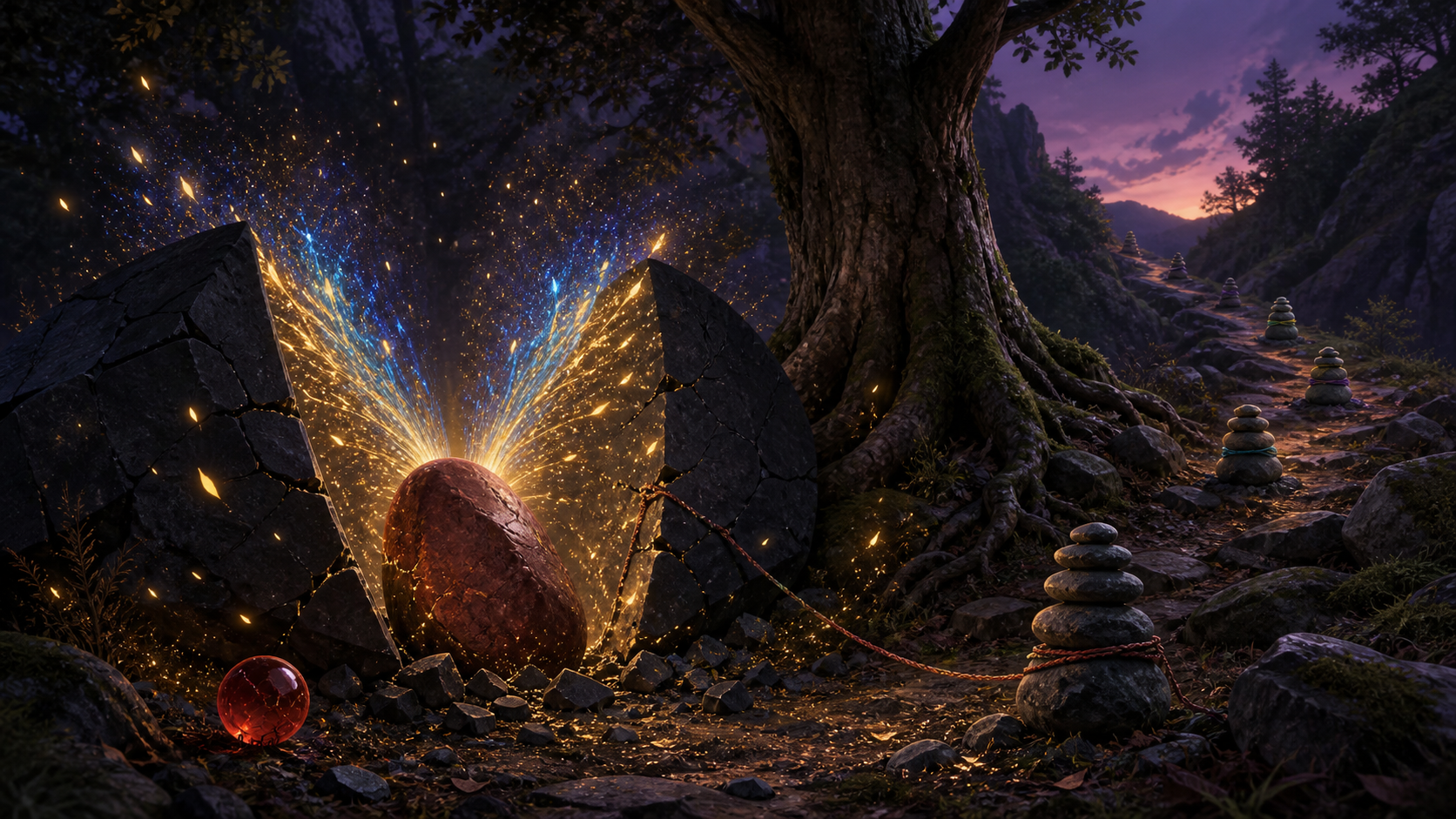
While the pursuit squad continues, Shikamaru leaves directional marks and messages along the trail.
Those marks destroy the idea that he abandoned Choji.
Shikamaru expects his friend to win.
He plans for Choji to follow.
The practical purpose is obvious. A solo fighter rejoining later needs a clear route to a moving team. The emotional purpose is stronger. Every carved direction says the squad still includes him.
Nobody is closing the roster behind his back.
Nobody assumes the person left with Jirobo has become the price of moving forward.
Shikamaru cannot return without risking the larger mission. He can make sure Choji has a path home to the group.
Belief becomes infrastructure.
It leaves signs.
Choji Takes the Red Chili Pill
Choji swallows the red pill.
His stored calories convert into a massive release of chakra. His body changes, and the chakra streams from his back in the shape of butterfly wings.
Jirobo mocked the energy Choji carried as excess.
Now that energy becomes power he cannot answer.
Butterfly Mode is visually beautiful, but the beauty should not hide the violence happening inside Choji's body. The transformation burns through the reserves that sustained him and converts them into a final combat state.
The wings are not a reward free of consequence.
They are the visible shape of a body spending itself.
Choji enters the form knowing the cost because letting Jirobo continue would endanger every friend ahead of him.
He does not hesitate once the choice is made.
Butterfly Bomb Ends the Fight
Choji gathers the butterfly-wing chakra into his fist.
He strikes Jirobo with Butterfly Bomb and defeats him.
One punch settles the argument Jirobo kept trying to turn into humiliation.
Choji's body was never the reason he lacked value. His appetite was never proof he lacked discipline. His gentleness was never permission to treat him as weak.
The Akimichi method converts the exact trait Jirobo mocked into overwhelming force.
That does not mean Choji must become violent to earn respect.
It means the enemy chose a fight and discovered that cruelty had not given him accurate information about the person standing there.
Choji wins because clan training, personal courage and friendship focus his power toward one decisive action.
Jirobo loses because he never learns to see beyond contempt.
The Victory Still Collects Its Price
After Jirobo falls, the pills begin collecting the cost Choji knew was coming.
He tries to follow his team.
That attempt matters as much as the punch.
Choji did not take the red pill intending to disappear nobly where nobody could challenge him. He planned to finish his assignment, rejoin his friends and continue the mission.
Along the route, he finds the marks the squad left for him.
They believed he would make it this far.
The messages give Choji proof that the people ahead did not forget him once the battle vanished behind them. He has friends waiting beyond the trees.
His body cannot carry him there.
Choji collapses beneath a tree with that knowledge.
The scene hurts because hope and danger occupy the same ground. He won. He knows he belongs. He may not survive long enough to hear his friends say it again.
What Changes After Episode 114
The yellow pill lets Choji use Super Multi-Size against Jirobo.
Jirobo activates the curse mark's second state and throws enlarged Choji aside.
Choji confronts the red pill's near-certain fatal risk.
Memories establish how Shikamaru's friendship challenged the judgments Choji faced as a child.
The pursuit squad leaves trail markers because it expects Choji to rejoin.
Choji takes the red chili pill and enters Butterfly Mode.
He concentrates the released chakra into Butterfly Bomb.
The final strike defeats Jirobo.
Choji follows the marked route after the battle.
The pills overwhelm him before he can catch the team.
Choji collapses knowing his friends believed he would return.
The yellow pill gives Choji scale and takes away time
Choji’s body expands enough to meet Jirobo’s force, but the pill does not provide stable strength. It converts stored energy into a temporary advantage while pain accumulates behind the transformation.
Every minute of increased power narrows the recovery margin. The battle looks larger while Choji’s available future becomes smaller.
Jirobo’s second state makes bodily exploitation visible
The curse mark changes Jirobo into a more powerful form and exposes how completely Orochimaru’s system treats bodies as equipment. Jirobo celebrates the increase because domination is the only result he has been taught to value.
The transformation does not make him free. It demonstrates how much of himself he is willing or required to hand over for Orochimaru’s mission.
Both fighters escalate through dangerous inherited systems
Jirobo relies on Orochimaru’s mark. Choji relies on Akimichi pills passed through clan knowledge. The sources and relationships differ, but both methods exchange bodily safety for immediate combat power.
The comparison should not flatten them into the same moral category. It should make us ask why shinobi institutions keep preserving techniques that expect young people to survive self-destruction.
The red pill is not a triumphant upgrade
Choji knows the final chili pill can kill him. Taking it is an emergency decision made alone after the rest of the squad has moved beyond reach. Nobody can reassess the mission, provide medical support, or tell him that retreat remains honorable.
Calling the choice heroic does not remove the conditions that made fatal risk feel like the only faithful option.
Childhood taught Choji that people would judge his body before his character
Other children excluded him, mocked his size, and treated appetite as proof that he could not belong. Repetition turns prejudice into expectation. Choji approaches new groups prepared to be dismissed.
The pain is not vanity. Social rejection shapes whether a child believes kindness will be recognized or exploited.
Shikamaru saw the person everyone else refused to meet
Shikamaru shared food, time, and attention without demanding that Choji change presentation first. He recognized gentleness and loyalty as strengths rather than weaknesses hidden beneath an unacceptable body.
That recognition did not magically create Choji’s worth. It gave Choji evidence that someone could see what was already there.
Their friendship grows through ordinary presence
The flashbacks matter because the bond was not born during a battlefield sacrifice. It grew through sitting together, talking, eating, and returning. Ordinary consistency made later trust possible.
Heroic loyalty becomes believable when a story remembers the quiet days that taught people they were safe with each other.
Shikamaru never treats Choji as a consolation friend
He does not include Choji out of pity or because nobody else will. He values Choji’s company and later selects him because his abilities matter to the mission.
Respect means refusing the idea that friendship with a stigmatized person is charity performed by the more socially acceptable child.
Jirobo attacks the bond because he cannot understand mutual loyalty
He claims Shikamaru abandoned Choji and uses separation as evidence that the squad sees him as expendable. The argument reflects a hierarchy where weaker members exist for stronger people to use.
Choji has years of evidence against that claim. The food trail, the assigned role, and Shikamaru’s trust all mean something Jirobo’s worldview cannot calculate.
Shikamaru leaves a road back instead of a memorial
The marked trees and provisions point forward. They communicate expectation: win, survive, follow. Shikamaru does not treat Choji’s stand as a predetermined death.
That expectation is emotionally protective. Choji fights as someone whose return remains part of the plan, not as a sacrifice already converted into strategy.
Belief can sustain Choji without making survival his sole responsibility
Knowing Shikamaru trusts him helps Choji access resolve. It cannot guarantee his body will tolerate the pill or Jirobo’s attacks. Friendship supports action; it does not control biology.
If Choji survives, the village owes that survival to medicine and recovery as much as personal will.
The butterfly transformation turns stored life into visible force
The final pill releases extraordinary chakra, and butterfly wings appear as Choji’s body converts reserves into power. The image is beautiful because it visualizes potential everybody underestimated.
It is terrifying because the beauty comes from consumption. Choji burns through the energy keeping him alive to create one decisive chance.
Butterfly Bomb answers Jirobo’s prejudice without validating it
Choji defeats the person who mocked his body and questioned his value. The victory feels satisfying. His worth did not require a near-fatal technique to become true.
Jirobo was wrong before the first pill. Combat only removes his ability to impose the judgment further.
Power becomes precise when Choji fights from clarity
The final attack is not uncontrolled rage. Choji knows who he protects, what Jirobo threatens, and why the squad must continue. His emotional center gives direction to overwhelming force.
That clarity distinguishes him from Jirobo, whose strength serves domination and contempt.
The victory belongs to Choji and carries Shikamaru inside it
Choji stands alone physically. Memories of Shikamaru, the trail, and their shared history shape his decision. Independence does not require pretending relationships disappear at the edge of a solo fight.
He wins through personal capability sustained by connection. Those truths strengthen rather than cancel each other.
The title says goodbye because Choji cannot know whether he will follow
After the attack, he has no assurance that his body will survive the pill. The squad is already ahead. His farewell lives inside uncertainty instead of confirmed death.
That uncertainty makes every marked tree painful. The road home exists, and Choji may not have enough life left to walk it.
The mission cannot ethically count his sacrifice as acceptable loss
Sasuke matters. So does Choji. A retrieval operation that saves one child by normalizing another child’s death has not solved the moral problem Orochimaru created.
Shikamaru did not want that exchange, and Konoha’s lack of senior support made it possible. Institutional review must follow survival.
Medical rescue should already be moving behind the squad
Genma and Raido were found injured. The pursuit route is known. A responsible village should dispatch medics and reinforcement as soon as personnel become available.
Children left as rear guards should not depend on luck, delayed discovery, or a teammate’s ability to crawl back alone.
Choji’s body deserves care after serving as the battlefield
The Akimichi technique uses fat reserves and cellular energy as combat resources. Recovery must address organ stress, chakra depletion, pain, and the psychological aftermath of believing death was required.
Celebrating courage without providing comprehensive care turns gratitude into extraction.
Shikamaru will carry the cost of every person he leaves
Command required him to continue. Friendship will make that decision personal regardless of tactical correctness. If Choji dies, Shikamaru will not experience the result as a neat calculation.
Leaders need support processing choices made under scarcity. Otherwise, responsibility becomes private guilt that shapes future judgment.
The episode honors Choji most when it lets kindness remain strength
Choji does not win by becoming crueler than Jirobo. He remains motivated by friendship, memory, and the belief that his teammates see him clearly. Softness and power coexist.
The shinobi world keeps confusing emotional hardness with readiness. Choji proves care can generate resolve without turning contempt into identity.
RaeRae’s full take
Episode 114 gives Choji the battle people who underestimated him never thought he could carry. The answer is not that mockery secretly made him stronger. Shikamaru’s ordinary friendship gave him a place where he never had to earn humanity through performance.
The red pill and butterfly wings are gorgeous and horrifying. Choji converts the energy keeping him alive into one attack because the mission offers no reinforcement and no safe second attempt.
He defeats Jirobo, but the story should never use victory to make the cost reasonable. Choji was worthy before the fight, loved before the sacrifice, and deserving of a road back even after the mission demanded everything he had.
RaeRae checkpoint: Choji’s butterfly power is beautiful because his full strength becomes visible. It is horrifying because the technique spends the life everybody else failed to protect.
RaeRae's Verdict
“Good-Bye Old Friend! I'll Always Believe in You!” gives Choji wings without pretending flight is free.
The red pill may kill him. He takes it because Jirobo will endanger everyone ahead if the fight continues.
Shikamaru's friendship matters because it helped Choji reject the lie that other people's mockery defined him. The trail marks matter because they prove the squad never treated him as disposable.
They made a road for him to come back.
Choji turns stored calories into butterfly-wing chakra and ends Jirobo with one punch.
Then he follows the road until his body gives out.
He does not collapse believing he was left behind.
He collapses knowing his friends are waiting.
Receipts and official routes
- Episode number and licensed title: Naruto Official Site.
- Japanese title, synopsis, and December 15, 2004 broadcast record: TV Tokyo.
- Streaming availability varies by region; use the licensed route maintained in the episode directory.