
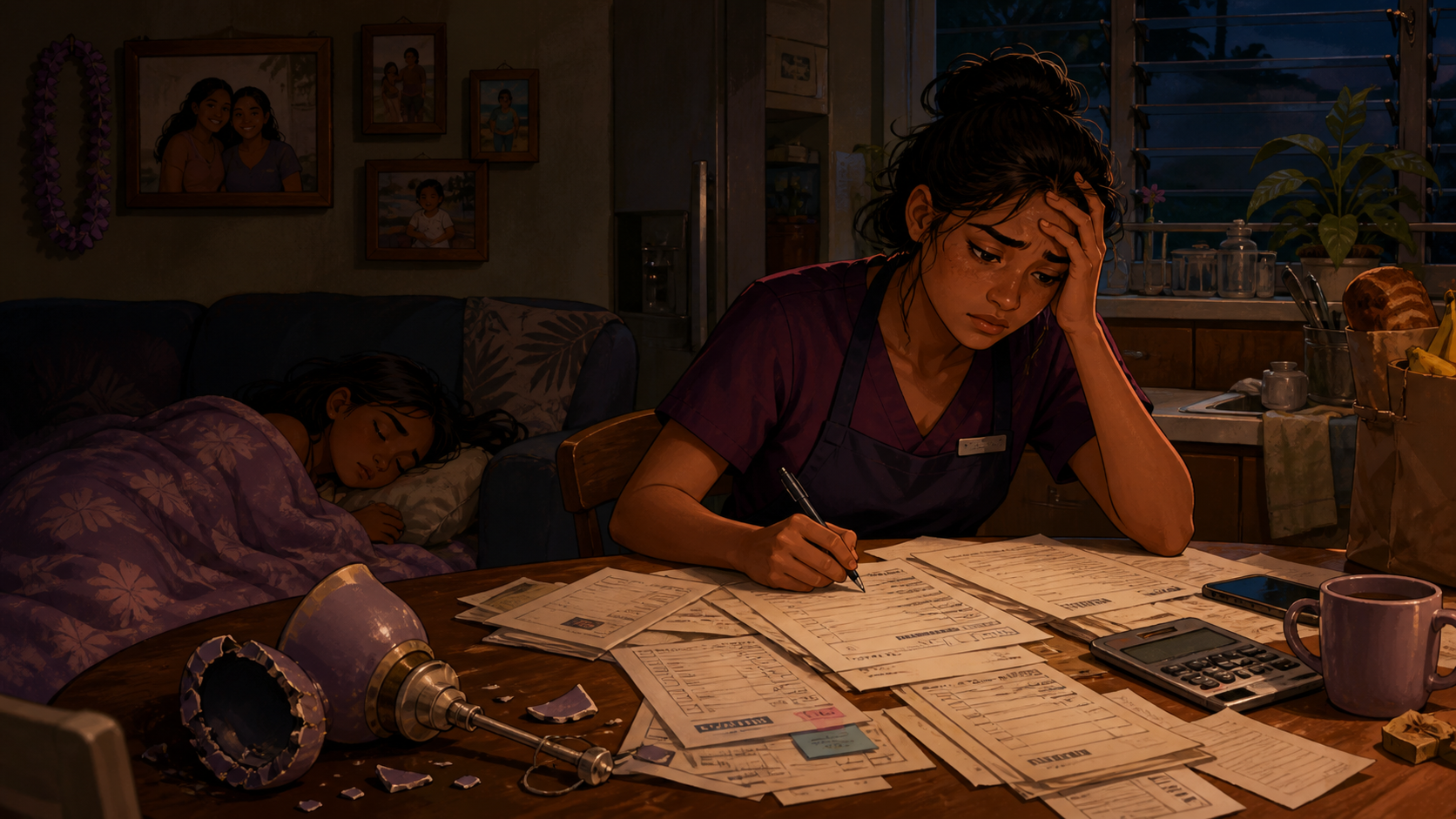
RAERAE RANT · CHILD WELFARE · KINSHIP CARE · GRIEF · ICONIC BY MISTAKE FORMAT
Nani Was Not Failing Lilo. Every Adult System Kept Giving Her Tests Instead of Help
Cobra kept asking whether Nani could hold the family together. Somebody needed to ask what every paid adult planned to carry.
The rant starts with the part everybody keeps calling failure
Nani loses a job, argues with Lilo, misses the polished-parenting performance, and cannot make a house under grief look calm on command. Every visible crack becomes evidence against her.
Meanwhile, the adults with authority keep assigning tests. Find work. Keep the house perfect. Control a grieving child. Explain the chaos without revealing aliens. Produce stability on a deadline. Nobody brings childcare, grief care, repair money, food assistance, or another adult scheduled to stay.
Cobra is right about danger and the system is still wrong about help
Lilo can get hurt. The household can become unsafe. Nani’s love cannot magically cover every supervision gap or explosion. Cobra has a duty to respond.
The irritation begins when response means observation, warning, and possible removal before material support becomes visible. Safety work should reduce danger. Watching a young guardian drown until the file proves she swallowed water is not safety work.
Nani became a parent while grieving the same parents
The movie asks her to become wage earner, legal guardian, disciplinarian, cook, driver, advocate, and emotional anchor after the family’s central loss. She does not receive an adaptation period because rent and custody deadlines do not care.
That context is not an excuse for every mistake. Context identifies the workload causing the mistakes. A useful intervention changes workload, resources, skills, or support. A useless intervention repeats that she must do better by Friday.
Lilo is not merely difficult
She is grieving, isolated, bullied, frightened of losing her sister, and trying to build control through routines adults find strange. Her behavior can be disruptive and dangerous.
Calling the child difficult names the inconvenience and hides the cause. Nani needs strategies, rest, school partnership, and trauma support. Lilo needs honesty, predictable care, and help regulating anger. The family needs more than another warning about appearances.
The film understands poverty without saying the word enough
Nani’s job loss threatens custody because income holds food, housing, transport, and institutional credibility together. One employment problem becomes a family-separation problem immediately.
That chain is not proof that she loves Lilo poorly. The chain is proof that money decides whether love receives time and room. A richer guardian could hire help, repair damage, miss a shift, and still look stable.
The house is judged as evidence while the house is under attack
Cobra sees disorder and damage. Those conditions matter in a child-safety assessment. The hidden cause includes an illegal experiment, galactic pursuit, armed capture, and technology Nani did not invite.
Because the real cause is classified or unbelievable, she carries responsibility for danger created by institutions and scientists with more power. The file sees the broken room and not the spaceship-shaped reason.
A deadline without resources is a threat dressed as a plan
Nani receives a narrow window to prove employment and stability. Deadlines can create urgency where a child faces immediate harm.
A competent service plan pairs each demand with help: childcare while interviewing, transportation, wage replacement after classified emergencies, grief counseling, home repair, and somebody who answers the phone after business hours.
The audience is trained to wait for her to fail
The plot builds tension around whether Nani can keep Lilo. Every missed opportunity feels like another mark against her. Viewers may begin auditing the guardian too.
RaeRae is putting the clipboard down. The better question is what changed around Nani after adults identified the risk. Too often, the answer is another person standing nearby with the clipboard.
Hawaiʻi’s stated child-welfare mission already knows family preservation matters
The Hawaiʻi Department of Human Services describes safety, permanency, and wellbeing in children’s own homes first, with out-of-home placement when necessary. The agency lists prevention, diversion, and family support among the work.
That official language matters because this rant is not asking a worker to ignore risk. The stated mission recognizes that protection can mean strengthening a home before separation.
Family First Hawaiʻi makes the missing support impossible to ignore
The state’s Family First framework describes preventing foster-care entry through services that strengthen families and keep children safely together.
Nani’s story becomes a brutal fictional example of why that order matters. Warning and removal authority without prevention services measure whether a family already possesses money, time, and backup.
Federal kinship-care guidance names the resources Nani needed
Child Welfare Information Gateway explains that agencies generally try to keep children with family when possible and may provide parent education, therapy, childcare, or housing help.
The list reads like a direct response to the film: grief therapy, childcare, housing stability, and practical support. Nani gets a job lead from David, not a coordinated public plan.
Kinship care preserves more than a legal placement
Keeping Lilo with Nani protects sisterhood, home, memories, community, cultural connection, and the daily language of their family.
Removal might solve one immediate supervision problem while creating another rupture after parental death. A safety analysis that counts only the tidy placement misses the emotional cost of one more separation.
Preference for kin cannot become exploitation of kin
Systems often praise relatives for stepping in, then expect love to replace training, money, childcare, respite, and legal support.
Nani is family, so the state benefits from her unpaid labor. If support would be provided to a licensed placement, asking why the sister receives less should not be controversial.
Grief support belongs in the safety plan
The National Child Traumatic Stress Network maintains caregiver resources around sibling death and childhood traumatic grief. The existence of specialized guidance reflects a simple truth: bereaved children and caregivers may need specific help.
Lilo’s behavior is not a cute eccentricity floating outside loss. Nani’s exhaustion is not a personal brand. Both sisters are carrying a death through every job interview, argument, school day, and visit.
The school should be part of the intervention
Mertle and the group repeatedly target Lilo, including wounds around her parents. Lilo then becomes the visible discipline problem when she reacts.
A family plan that tells Nani to control Lilo without requiring school action is incomplete. The environment provoking the behavior belongs in the case too.
The employer is part of the custody equation
A schedule, sudden firing, low wage, and intolerance for emergencies determine how much supervision Nani can provide. Child welfare cannot solve labor law through a home visit.
Agencies can still offer childcare, wage support, employment advocacy, and documentation for emergency absences. Pretending work conditions are private choices turns economic precarity into parental blame.
Cobra’s competence makes the structural problem easier to miss
He is observant, controlled, and ultimately capable of seeing the family beyond surface disorder. Viewers trust him more as the film reveals warmth and extraterrestrial knowledge.
A good official can soften a bad process. The family still depends on whether one powerful person interprets rules generously. Rights and services should not depend on winning over the intimidating man in the suit.
His secret knowledge creates an unfair examination
Cobra understands that alien events are possible. Nani must explain consequences without access to the classified context.
Imagine grading somebody on a test while hiding half the question. His later flexibility helps, but the agency record should be corrected once officials know her apparent failures came from an extraordinary threat.
Nani performs stability because honesty looks dangerous
Admitting exhaustion, resentment, or lack of control could be read as evidence for removal. She has every incentive to say the household is fine while the kitchen catches fire metaphorically and sometimes almost literally.
A support system needs enough trust that guardians can name problems before crisis. Surveillance-heavy systems teach concealment, then punish families for not asking sooner.
Lilo performs too
Children under review may become charming, oppositional, silent, or dramatic depending on what feels protective. Lilo understands that adult judgment can separate the sisters.
A worker should interpret behavior with context and speak plainly about the process. The child should not have to invent the correct personality to save the home.
The movie turns one bad day into a custody referendum
Job search, childcare, household repair, and alien disaster collide. No family could produce an accurate long-term picture under those conditions.
Urgent safety must be addressed, but final conclusions need patterns, supports attempted, and time. A crisis snapshot is evidence, not the entire family.
David provides the service plan informally
He brings job information, transportation, patience, familiarity, and another adult presence. The audience feels relief because help finally changes Nani’s options.
The state benefits from David without hiring him. His affection becomes unofficial public infrastructure. If the plan fails whenever the boyfriend has a shift, the plan is not stable.
Jumba and Pleakley add household labor and household risk
They become family and contribute knowledge, domestic work, and later care. They also brought danger, concealed information, and require resources.
Cobra should count support and risk honestly. “More adults” does not automatically mean safer when those adults include the scientist responsible for hundreds of volatile experiments.
Stitch changes the family and increases the burden before helping
Lilo’s attachment to Stitch gives her connection and eventually expands the family. Early destruction costs time, employment, repairs, and credibility Nani cannot spare.
A cute adoption story can obscure the guardian’s consent. Nani is effectively ordered to absorb a galactic rehabilitation case after the emotional decision has already happened.
The system keeps asking Nani for outputs
Employment. Clean house. Calm child. Reliable schedule. Safe pet. Polite meeting. Each output has a material input the story rarely provides through formal services.
Childcare produces attendance. Therapy supports regulation. Income stabilizes housing. Respite reduces conflict. Transportation makes appointments possible. Stop demanding the output while refusing the input.
Love is not an input the state can use for free
Nani’s love motivates impossible labor. Lilo’s love motivates adaptation. David’s love motivates help. The franchise celebrates ʻohana because nobody gets left behind.
Institutions love that sentence when family members pay the bill. Family loyalty should guide support, not excuse government withdrawal.
ʻOhana is not a magic word for unpaid women
The story’s most famous idea can become sentimental cover for Nani cooking, earning, repairing, parenting, and regulating everybody while aliens discover personal growth.
If nobody gets left behind, nobody should leave Nani behind under the laundry, forms, and exploded appliances. Family must redistribute labor, not merely announce belonging.
A safety plan needs names beside every task
Who handles Lilo after school? Who covers a night shift? Who repairs alien damage? Who secures experiment pods? Who contacts Cobra? Who pays?
If every answer is Nani or “somebody will figure the problem out,” the household is not stable. Jumba, Pleakley, David, Cobra, and the Federation need assigned responsibilities.
Respite is not abandonment
Nani needs sleep, privacy, friendship, romance, and time when no child or experiment requires an answer. A break can protect the relationship.
Guardians often fear that asking for respite will be used as proof they cannot cope. Good services make rest normal before exhaustion becomes danger.
Lilo needs truthful participation without adult responsibility
She should know plans affecting home, school, and custody in language she can understand. Her wishes matter.
She should not choose employment strategy, manage alien placements, or convince the state that Nani is fit. Child voice and child burden are different things.
The family needs money with no inspirational speech attached
Cash assistance, food support, childcare subsidy, emergency repair, and transportation can reduce risk directly. Material help often sounds less cinematic than a heartfelt conversation.
The refrigerator does not refill because everybody learned a lesson. Nani cannot pay rent with character development.
The house needs repair without shame
Damage can create hazards. Repair crews and grants solve hazards faster than moral judgment about housekeeping.
The difference between a messy home and an unsafe home matters. One may need routine and help. The other needs immediate correction. Neither improves because an official looks disappointed.
The vision is not unlimited family privacy
Some homes are unsafe. Children may need immediate protection, temporary placement, or permanent alternatives. Adults can love a child and still cause harm.
The rant rejects the false choice between surveillance without support and pretending every family should remain together at any cost. Safety, services, due process, and kinship can occupy the same plan.
The first intervention should change the next week
A useful plan produces a visible difference quickly: childcare starts, food arrives, a counseling intake is scheduled, repairs begin, and somebody covers the next interview.
Progress cannot wait for the family to become inspirational. Small material changes create the breathing room where better parenting and grief work become possible.
The second intervention should change the next six months
Emergency help without durable support creates another crisis later. Employment stability, healthcare, housing, school coordination, and respite need follow-through.
Review should ask whether services worked and whether the agency kept promises, not only whether Nani met conditions.
The third intervention should change the institution
Once Cobra learns classified events caused household damage and job disruption, he should correct records, secure compensation, and build an interagency protocol.
The lesson cannot remain a personal secret between competent adults. The next family should not face custody loss because another government department hid the cause.
Nani needs legal representation
A guardian facing removal power should understand evidence, timelines, appeal, and service rights. Fear and exhaustion make procedure harder to navigate.
Counsel should arrive before separation, not as an expensive rescue after damage. Cobra’s fairness does not make independent representation unnecessary.
Cobra needs supervision and a manageable caseload
The worker also operates inside demands, deadlines, and limited resources. A system may reward fast decisions and punish time spent building support.
Explaining pressure does not excuse poor practice. Staffing and supervision make better practice possible and protect workers from becoming the whole institution in one suit.
The Federation belongs in the service plan
Galactic actors caused direct risk. They possess technology, funds, personnel, and information beyond the household.
Jumba’s affection cannot replace restitution. The Grand Councilwoman’s mercy cannot replace a budget. Earth should not subsidize extraterrestrial rehabilitation through Nani’s wages.
The family should receive aftercare after the case closes
Crisis ending does not erase debt, grief, damaged trust, or new household responsibilities. Voluntary services should remain available without automatic surveillance.
Asking for help later should be evidence of insight, not a trigger that reopens the removal threat by default.
The film is honest enough to make this rant possible
Lilo & Stitch does not present Nani as endlessly serene. She loses patience, wants a life, makes mistakes, and keeps trying. The household feels lived in because love and irritation share space.
The story also lets economic pressure drive plot. A job is not a decorative adult detail. Employment determines whether the sisters remain together, which makes every alien disruption land harder.
Nani is heroic because the work remains work
She does not defeat grief through one speech. She keeps cooking, interviewing, apologizing, arguing, and returning.
Calling her heroic should not turn impossible endurance into the standard expected from every young kinship caregiver. Admiration should increase our demand for support, not lower that demand.
Cobra is useful because he changes his reading
He notices evidence that does not fit the original file and allows context to matter. That is good professional judgment.
The next ethical step is institutional: document why the judgment changed, repair the record, and build a process that does not require secret alien expertise.
Lilo needs accountability and protection at the same time
She bites, fights, lies, disrupts, and makes dangerous choices. Those actions need boundaries and repair.
She also experiences grief and bullying. Accountability works when adults address behavior and the conditions feeding behavior. Punishment alone will produce another explosion with better hiding.
Nani needs accountability without humiliation
She can mishandle conflict or expose Lilo to avoidable risk. A guardian should hear specific concerns and change specific practices.
Humiliation wastes energy and teaches concealment. Supportive accountability gives a clear action, a resource, a deadline, and a way to ask for help before failure.
The final tunnel ends where the paperwork began
The complaint was never that Cobra noticed danger. The complaint is that everyone kept asking Nani to manufacture safety alone while carrying grief, work, poverty, childcare, and an alien invasion.
If the system can write a removal order, the system can write a childcare authorization. If the system can inspect a broken house, the system can fund repair. If the system can schedule another visit, the system can schedule grief care.
Sources and further reading
Hawaiʻi Department of Human Services: Child Welfare Services describes child protection, prevention, diversion, family support, foster care, and the goal of safety and wellbeing in children’s own homes first.
Family First Hawaiʻi describes strengthening families and preventing foster-care entry through services that keep children safely together.
Child Welfare Information Gateway: Kinship Care and the Child Welfare System explains kinship preference and supports such as therapy, childcare, and housing help.
National Child Traumatic Stress Network: Sibling Death and Childhood Traumatic Grief Resources collects caregiver guidance for children experiencing traumatic grief.
The final RaeRae verdict does not fit in Cobra’s folder
Nani was not failing because she needed help. Needing help is the condition every family reaches eventually. The failure was building a process where asking could look like evidence against her.
Keep Lilo safe. Give Nani the truth. Pay for childcare. Repair the house. Treat the grief. Hold the school accountable. Make Jumba and the Federation carry the costs they caused. Let Cobra keep the clipboard if the clipboard helps coordinate actual support. Otherwise, move the paperwork and bring groceries, because the sister filling out form number twelve has already proved she loves that child. Love was never the missing resource. Time, money, rest, and honest adult help were.
The job interview should come with childcare already booked
Telling Nani to find work while leaving Lilo unsupervised creates the exact safety problem Cobra is evaluating. She should not have to choose between income and supervision for one interview.
A worker could arrange approved care, transportation, and a backup contact before handing over the job list. That small coordination would turn a demand into a plan.
A young guardian needs peers who understand the role
Nani carries responsibilities most people her age do not. Friends may care and still lack language for custody hearings, sibling discipline, grief, and benefit systems.
A kinship-care peer group could provide practical advice without treating her as a cautionary tale. Community knowledge becomes another protective factor when the state funds access.
Food assistance should not wait for a dramatic empty cupboard
Household scarcity can show through skipped meals, cheap substitutions, anxiety about groceries, or Nani pretending she already ate. Waiting for visible crisis increases harm.
Benefits screening should be routine, private, and free of shame. Feeding Lilo consistently supports safety more directly than another lecture about household order.
Transportation keeps appearing as somebody else’s favor
Jobs, school, appointments, groceries, court, and emergency care all require movement. David’s rides help because the formal plan offers little visible transport support.
Bus passes, mileage reimbursement, repair help, and scheduled rides could reduce missed obligations. A family should not lose custody because the car failed before the system did.
The sisters need one adult who is not evaluating them
Therapy, mentoring, or family support works differently when every disclosure does not feed a custody decision. Nani and Lilo need space to be angry and confused without performing safety.
Confidentiality still has mandated-reporting limits, but the relationship should not begin as another test. Help becomes usable when honesty does not automatically feel like evidence.
Alien damage needs a dedicated claims process
Nani should not negotiate each broken wall, missed shift, or destroyed appliance with Jumba during another emergency. The Federation needs a simple local compensation route.
Claims should cover property, wages, medical care, transport, and temporary housing without requiring public disclosure of classified events. The government that can cross galaxies can process a repair invoice.
The case plan should include joy
Safety plans often focus on preventing the next bad event. Lilo and Nani also need music, beach time, friends, birthdays, and moments where nobody discusses the file.
Positive family experience builds connection and gives grief somewhere to breathe. Joy is not a reward after perfect compliance. Joy is part of the environment that helps people recover.
The system should measure how much work Nani already performs
Forms may list deficits while domestic labor disappears because no paycheck records the hours. Cooking, supervision, school contact, cleaning, emotional care, and crisis response are work.
Counting that labor changes the diagnosis. Nani does not lack effort. She lacks enough adults, money, time, and institutional honesty to make the effort sustainable.
A family meeting should end with assignments for the adults
Lilo can say what feels scary. Nani can name what she cannot carry. David, Jumba, Pleakley, Cobra, and the Federation can each accept a concrete task.
The meeting fails if the final sentence tells Nani to communicate better. Communication only helps when somebody with resources answers.
Every evaluation ignores the emergency she already survived
Nani is not beginning from an ordinary parenting arrangement. She and Lilo have lost their parents, and Nani is grieving while becoming a guardian, wage earner, household manager, advocate, driver, cook, and emotional anchor without preparation. The systems evaluating her treat instability as evidence about character rather than a predictable result of catastrophe and insufficient support.
Cobra Bubbles is more humane than a simple villain, but his visits still place the burden of proof on the young woman with the fewest resources. Nani must demonstrate safety through a clean house, reliable job, calm child, and controlled schedule while every appointment introduces another consequence for failure. Monitoring consumes the time and emotional energy that support would have returned to the family.
The film never suggests Lilo needs no intervention. She is isolated, grieving, aggressive with peers, and processing loss through rituals adults around her do not fully understand. Nani also needs help. The indictment is that help arrives primarily as assessment. Imagine the difference if the household received temporary income, transportation, grief counseling chosen by the sisters, respite care, school advocacy, and repairs before separation became the central threat.
Nani’s anger and exhaustion are not disqualifying. They are information about the amount she is carrying. She keeps returning, apologizing, searching for work, protecting Lilo, and revising plans under impossible pressure. The system calls that household unstable because stability has been defined as performing middle-class order without middle-class resources. Nani was not failing the test. The test was designed to observe strain while withholding the conditions that reduce strain.
The ending should therefore be read as a beginning rather than proof that every danger has passed. Nani still needs steady income, Lilo still needs grief support and friendship, the house still needs repair, and their new alien family creates responsibilities nobody can explain to an ordinary agency. What changes is the network. David, Cobra Bubbles, Jumba, Pleakley, Stitch, and the wider community become people who can carry pieces of the crisis instead of watching Nani carry everything alone. That is the model the film has been building beneath the science fiction. Stability does not mean one young woman finally performs every role without visible strain. Stability means enough trustworthy people and resources surround the sisters that one lost job, broken appliance, difficult school day, or alien emergency does not threaten the existence of the family. Nani’s competence deserves admiration. The more loving response is to stop requiring competence at emergency volume before she qualifies for help. Nobody should have to become superhuman to prove a family is worth keeping together.
That network should remain visible in every sequel. If later stories restore Nani to permanent crisis while everybody else receives adventure, the franchise will have mistaken endurance for an unlimited resource. Let support become ordinary enough that she can plan beyond the next emergency, make mistakes without threatening the household, and enjoy a day that nobody needs her to save.
Keep exploring
Return to the Lilo & Stitch hub for the films, series, characters, reactions, and guides.