
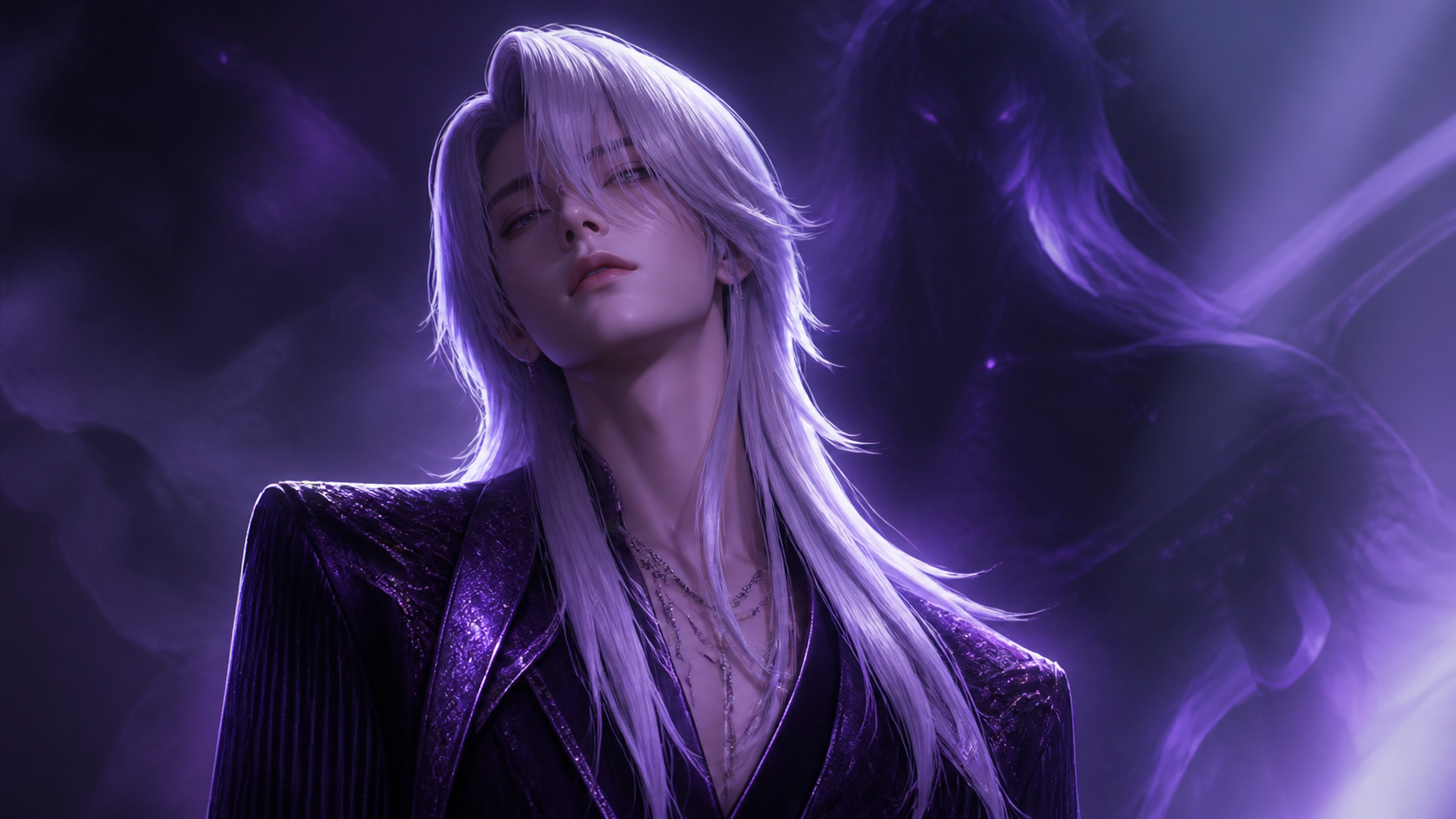
Mystery Saja in KPop Demon Hunters
| Character file | Verified details |
|---|---|
| Name | Mystery Saja |
| Group | Saja Boys |
| Position | Backup vocalist and mystery archetype |
| Nature | Old demon presented through a youthful emo-idol disguise |
| Speaking voice | Alan Lee |
| Singing voice | Kevin Woo |
| Leader | Jinu |
| Master | Gwi-Ma |
| Main opponent | Zoey |
| Public selling point | Face-obscuring purple hair, silence, distance, and unpredictable charm |
| First appearance | With the Saja Boys in Gwi-Ma's demon realm |
| Final appearance | Destroyed by Zoey during the final battle |
Mystery Saja has one spoken contribution people remember, and it is a bark. That should not work. It absolutely works. The film gives him purple hair covering most of his face, a carefully managed silhouette, one tear during a spicy-food challenge, backup vocals, and enough distance for fans to build a complete imaginary boyfriend behind the bangs. He is not underwritten by accident. He is an experiment in how little information attraction actually needs.
The official production explanation makes the design even sharper. Head of story Ryan Savas says the guiding idea was to imagine a one-eyed demon underneath perfect hair, while character designer Marion Bordeyne says the team still treated him as beautiful as fans assume. Concealment is not a missing step waiting for a reveal. Concealment is the product.
That makes Mystery perfect for a film about idols who convert attention into supernatural access. He does not persuade with confession. He creates a gap and lets the audience rush to fill it. Zoey calls him her type because the absence itself reads as possibility. Then she has to punch through the fantasy when the group stops pretending to be harmless.
The bangs are a narrative device
Mystery's hair does more than establish an emo aesthetic. It limits facial information, which changes how viewers read every movement. A fully visible expression might settle whether he is amused, bored, shy, threatening, or confused. The bangs keep several answers available at once.
Ambiguity produces attention because the eye keeps looking for completion. Fans study the small portion of his face that appears, track the angle of his head, and interpret a mouth line like evidence in a criminal case. The design turns ordinary viewing into participation.
That participation serves the Saja Boys. A member who appears unknowable can hold interest without giving the audience anything concrete to judge. Mystery does not need a detailed public history. The audience supplies emotional depth because the silhouette invites it.
Beautiful even when the film refuses proof
The designers reportedly worked from the assumption that Mystery is as beautiful as fans imagine. That detail protects the concept from becoming a simple joke where the hidden face must be ugly. The story is not punishing attraction with a gotcha reveal. It is asking why the promise of beauty can become powerful before confirmation.
This is closer to idol marketing than a secret-monster gag. Controlled glimpses, partial profiles, teaser images, and withheld information can make a performer feel more desirable because access appears limited. Scarcity raises the value of every visible fragment.
Mystery's demon truth does not cancel his beauty. It changes the meaning of the concealment. The hair hides predatory identity and one-eyed distortion while preserving the fantasy fans already chose. Attraction and danger remain in the same frame.
The emo archetype arrives fully packaged
Purple hair, covered eyes, quiet posture, narrow gestures, and emotional distance place Mystery inside an archetype audiences recognize immediately. He reads as the member who writes in a notebook, stares out of van windows, and answers interview questions with six words that fans analyze for a week. The film never confirms those habits. The visual language makes viewers imagine them anyway.
That speed matters because the Saja Boys have no visible trainee years or documented pre-debut history. They need market segmentation on arrival. Mystery captures fans drawn to distance, melancholy, alternative styling, and the fantasy of being the only person who can make the quiet member open up.
The concept is funny because it is accurate. Entertainment marketing often assigns emotional narratives through styling before an artist says anything. Mystery removes the artist's actual biography and proves the packaging can still operate.
Silence is not the same as shyness
Fans often translate quietness into shyness because shyness feels intimate and safe. Mystery might be shy. The film does not establish it. He could be aloof, predatory, uninterested, disciplined, confused by human behavior, or simply following a concept selected for the plan.
Keeping those possibilities separate matters. A profile becomes dishonest when it turns audience projection into character fact. The lack of dialogue is evidence of limited access, not proof of a gentle inner life.
His silence also gives the group texture. Jinu controls language and strategy. Romance displays affection. Baby interrupts expectations with rap. Abby dominates through physical performance. Mystery contributes suspense. The members feel distinct because each manages attention differently.
Then he barks
The autograph-signing bark breaks the elegant distance with one ridiculous sound. It becomes memorable because it violates the concept while somehow strengthening it. Fans do not receive clarity. They receive a new mystery: why did the beautiful quiet man bark at somebody?
The moment also reveals how fandom converts almost any behavior into content. A normal answer might disappear inside the event. A bark becomes a clip, meme, reaction, and personality theory. Unpredictability refreshes the attention cycle.
At a darker level, the sound briefly lets the demon animality leak through the idol disguise while everybody treats it as charming fanservice. The truth appears, but the performance context prevents the crowd from recognizing it as a warning.
The spicy challenge tear gives fans a tiny emotional event
Mystery sheds a tear during the spicy-food challenge, and the reaction lands because his face usually provides so little. One visible sign of discomfort becomes precious. The event offers a controlled breach in the wall without requiring any personal disclosure.
Variety content thrives on this kind of small revelation. A food preference, startled expression, or competitive habit can make a distant performer feel newly knowable. The information is real but low-risk, which protects the larger mystery while rewarding attention.
For a demon, the moment also plays with bodily authenticity. Does the spice truly affect him, or is the tear another performance? The film does not answer, and the uncertainty belongs to the character's function.
Backup vocalist does not mean decorative silence
Netflix identifies Mystery as a backup vocalist. That role matters because the Saja Boys' musical credibility depends on more than Jinu's lead. Harmonies, layered textures, and distributed lines make the group sound full enough to compete with HUNTR/X.
His concept creates a useful contrast between limited speech and audible song. The public may hear more of Mystery inside a polished group track than in conversation. Music becomes the approved access point, shaped by arrangement and shared with other voices.
That split mirrors how fans can feel attached to a voice while knowing little about the person producing it. The recording supplies emotional color, but the listener still builds the story around it.
Alan Lee gives one line enough character to travel
Alan Lee provides Mystery's speaking voice in the English-language version. The role demonstrates that performance impact is not measured by paragraph count. Timing, tone, breath, and commitment can turn a tiny vocal moment into one of the character's most repeated scenes.
The bark works because it is delivered without an explanation begging the audience to laugh. Mystery does not step outside the concept and apologize for being strange. The sound lands, the event keeps moving, and viewers do the rest.
Crediting Alan Lee also prevents the character from disappearing behind the singing performer. Animated musical roles can divide labor across actors, and each contribution deserves a clear name.
Kevin Woo builds the singing identity
Kevin Woo serves as Mystery's singing voice and performs as part of the Saja Boys ensemble on Soda Pop and Your Idol. His idol experience gives the casting another layer because the character is parodying and celebrating recognizable group performance at the same time.
Mystery's backup-vocal position asks for integration rather than constant vocal dominance. His voice helps the Saja Boys sound like a real unit while the visual design preserves his separate appeal. Ensemble craft often works best when the audience feels the fullness before identifying every component.
The singing credit is not interchangeable with Alan Lee's dialogue work. One gives Mystery his scarce spoken presence. The other helps create the polished musical lure that makes his silence marketable.
Soda Pop lets the hair do half the singing
Soda Pop introduces a group designed to appear sweet, available, and impossible to resist. Mystery contributes less through overt interaction than through image. His hair moves, his partial profile enters formation, and the audience receives enough visual rhythm to attach desire to the voice.
The bright concept makes concealment feel playful instead of threatening. A man hiding his face in a dark alley would activate suspicion. A beautiful idol hiding his face inside candy-colored choreography activates curiosity.
That difference is the trap. Context teaches the audience how to interpret missing information. Soda Pop labels the absence as flirtation before anybody considers it might hide a demon.
Your Idol turns mystery into ritual authority
Your Idol places the Saja Boys inside darker styling, supernatural staging, and direct commands. Mystery's hidden face fits the shift easily because his concept always carried a shadow. The bright debut did not need to be replaced. It only needed to reveal what was underneath.
The black hats and ritualized formation make partial visibility feel less like coy fanservice and more like submission to a larger force. Mystery no longer invites fans to wonder. The group uses accumulated fascination to hold the crowd inside Gwi-Ma's extraction system.
He participates fully in that performance. Limited dialogue does not mean limited responsibility. Mystery helps create the musical event that places fans in danger, and the profile cannot let good hair distract from that fact.
Zoey calls him her type before she knows him
Zoey's attraction works as a compact fandom joke because she has almost no information about Mystery. She responds to the hair, mood, and distance, then names the pattern. “My type” often means a familiar visual or emotional category, not a relationship built through knowledge.
The joke does not make Zoey foolish. People notice patterns of attraction quickly. The danger appears if the pattern becomes evidence of trust. Mystery's concept is designed to encourage exactly that shortcut.
Their pairing, often called Zooestry by fans, grows from possibility rather than shared scenes. That leaves enormous room for fan art and fiction, but a canon profile should not pretend the movie gave them a hidden romance.
Attraction is not a character reference
Mystery gives the film a clean way to separate attraction from evidence. Zoey can be drawn to him and still admit that she does not know him. The audience can enjoy the design and still remember that he serves Gwi-Ma. Desire reports a response. It does not certify the object of that response as safe.
This matters beyond the joke because parasocial marketing often encourages fans to treat aesthetic familiarity as moral knowledge. A preferred hairstyle, quiet manner, or apparently sensitive image can feel like proof of shared values. Mystery removes the biography and lets the shortcut operate in public.
The final battle forces Zoey to update her judgment. She does not need to deny that he was her type. She needs to act on the information that the type is currently trying to help harvest human souls.
Zoey defeating him is the punch line and the boundary
Zoey punches and destroys Mystery during the last confrontation. The matchup pays off their tiny running connection without turning it into a rescue fantasy. She recognizes the attraction, then chooses her friends, fans, and mission.
That decision is a boundary, not a rejection of romance as a concept. Zoey does not become wiser by pretending she never liked his face. She becomes effective by refusing to let liking determine what harm she will tolerate.
The fight also gives the film a satisfying reversal. Mystery's hidden features made Zoey curious. In the final sequence, she stops waiting for a reveal and responds to the behavior already visible. He has shown enough.
A face reveal would not answer the important questions
Fandom naturally wants to see what sits behind Mystery's bangs. The production design encourages that desire while confirming that beauty was always part of the assumption. A reveal could be fun, but it would not produce character depth by itself.
The real unknowns concern choice. Why does he serve Gwi-Ma? What does he want from the Saja Boys? Does he experience loyalty to Jinu? Does the bark emerge from his actual personality or assigned fanservice? Does he remember another life? A complete face cannot answer any of those questions.
If a sequel reveals him, it should change a relationship or decision rather than functioning only as a screenshot reward. Otherwise the mystery disappears while the character remains just as blank.
The one-eyed demon idea changes the silhouette
The filmmakers' idea of a one-eyed demon beneath perfect hair gives the design a structural reason for concealment. The hairstyle is not simply trendy. It organizes the human disguise around the transformed anatomy.
That creates a satisfying relationship between marketing and monster design. Mystery turns the feature that might expose him into the signature trait that attracts fans. The concealment does not fight the promotional concept. It becomes the promotional concept.
This is one of the film's smartest recurring tricks. The Saja Boys do not hide danger by becoming ordinary. They edit danger into desirable archetypes. Abby turns scale into muscles. Baby turns menace into cuteness. Mystery turns missing visual information into mystique.
Old demon, youthful idol, missing history
Netflix describes Mystery as an old demon with a youthful emo appearance. That establishes age category without giving a number or human origin. He may have existed for centuries, but the film does not confirm that he was once human like Jinu.
The youthful disguise lets him enter an industry that markets controlled newness. Fans receive a fresh debut, not an ancient being with a documented history. The age gap between appearance and existence becomes another hidden truth under the concept.
A future story should clarify what “old demon” means in this world. Native demons, transformed humans, and constructed servants would have different relationships to Gwi-Ma, mortality, memory, and choice. Mystery could deepen the cosmology without borrowing Jinu's biography.
Gwi-Ma owns the soul, but the film withholds the contract
The official character file identifies Gwi-Ma as the manipulative overlord who owns Mystery's soul. Ownership establishes coercive power. It does not tell us how that ownership began, what refusal costs, or whether Mystery seeks release.
That missing contract matters for moral judgment. He participates in the plan and remains responsible for the danger he helps create. Coercion may limit his choices, but viewers cannot assume a secret rebellion the film never shows.
The strongest sequel route would make the terms specific. Jinu's shame-based captivity should not become the universal demon template. Mystery deserves a form of control tied to his own concept, perhaps visibility, identity, or the cost of being fully seen.
Jinu leads him, but does he trust Jinu?
Mystery follows Jinu's plan and performs inside the group Jinu assembled. The film does not give them private conversation, conflict, or affection. Their relationship is organizational before it is personal.
That absence supports the Saja Boys as a constructed unit. They coordinate perfectly in public while viewers know almost nothing about how they relate offstage. Group chemistry can be produced through blocking and music even when emotional bonds remain unproven.
If Jinu's sacrifice disrupts Gwi-Ma's control, Mystery's response could reveal whether the leader inspired loyalty or only managed the assignment. Grief, anger, opportunism, or indifference would each tell a different story.
The Saja Boys show how archetypes replace biographies
Each member can be summarized in one marketable word: leader, romance, abs, mystery, baby. The labels make the group easy to learn and easy to merchandise. They also reduce people into functions before the audience can ask what exists outside those functions.
Mystery makes the mechanism most visible because his label describes the absence of information itself. The less the story says, the more perfectly he fulfills the name. The concept protects its own emptiness.
This does not mean fans are wrong to build stories around him. Fan creation thrives in open space. It means editorial pages should mark the difference between what the film designed, what official sources confirm, and what fandom lovingly invented.
What the camera does with partial access
Mystery's shots often preserve the hair line and profile instead of searching for a clean full-face angle. The camera collaborates with the concept. It does not behave like a documentary trying to expose him.
That choice makes every exception valuable. A visible eye, tear, mouth movement, or sharper demon glimpse carries more weight because the visual system has trained viewers to expect less. Scarcity changes scale.
The strategy also respects the design's comedy. If the camera constantly slipped behind the bangs, the audience would stop treating concealment as a relationship. By protecting the angle, the movie lets fans feel as if they are always almost receiving access.
Fan projection is not stupidity
People project onto fictional characters because stories invite emotional participation. A character with open space can become especially useful for exploring preferences, identity, romance, or alternate outcomes. Mystery's popularity makes sense because the design offers a strong frame with very little fixed interior content.
The problem begins when projection is presented as official fact or used to excuse canon harm. Mystery can be gentle in a fan story. Canon Mystery still performs in the soul-harvesting scheme. Both versions can exist if nobody quietly swaps the labels.
Respecting that distinction makes fandom richer. It protects creators' freedom to imagine while keeping reference pages trustworthy enough to show where imagination began.
Why the bark became more memorable than dialogue
The bark condenses surprise, sound, timing, and concept violation into a second. Longer dialogue would provide more information but might generate less memory. Human attention often keeps the thing that breaks pattern.
Mystery's pattern is elegant silence. The animal sound breaks it without explaining it, so the audience receives surprise plus a fresh gap. Was it flirting? Demon instinct? A dare? A fanservice routine? The clip can circulate with every interpretation still attached.
That is efficient character branding. One sound does the work of a variety-show compilation while preserving the central promise that viewers do not quite know him.
Defeat should have consequences if he returns
Zoey's victory completes her movement from attraction to action. Bringing Mystery back with no cost would weaken that payoff. A return needs to preserve what she chose and what the battle changed.
Consequences could include an altered demon body, damaged voice, broken contract, missing memory, or inability to restore the exact human disguise. Any of those would force the character to exist beyond the perfect mystery package.
The most interesting version would make visibility unavoidable. A character who survived by hiding might have to be seen clearly before he can choose a new allegiance.
What a sequel owes Mystery
First, establish whether he wants anything. Desire creates direction. It can be freedom, recognition, privacy, revenge, music, loyalty, or the right never to bark on command again. The specific answer matters less than giving him one.
Second, clarify his relationship to performance. Does he enjoy singing? Is backup vocalist an assigned role or a chosen strength? Kevin Woo's vocal contribution gives the character musical credibility worth developing beyond ensemble texture.
Third, let Zoey meet the person after confronting the threat. That does not require romance. A real conversation could confirm incompatibility, create grudging respect, or expose how much of “her type” came from a design rather than a shared value.
Mystery and the labor of permanent intrigue
Maintaining mystique is work. The person must limit disclosure, control expression, repeat the visual signature, and allow audiences to treat small accidents as major revelations. Mystery's supernatural construction hides that labor because he appears born inside the concept.
Real performers assigned a quiet or mysterious role do not stop having ordinary moods and needs. The brand may reward them for withholding those parts, which can make authenticity feel like a risk to the identity fans purchased.
The film could deepen its idol satire by showing Mystery offstage. Does he remove the hair from his eye immediately? Does he talk constantly? Is the bark rehearsed? One private scene could expose how much effort goes into looking effortless and unknowable.
RaeRae's verdict
Mystery Saja proves you can build a whole fandom emergency out of bangs, one tear, a backing vocal, and a bark. I respect the efficiency. The character is not deep in the biographical sense, but the design has a real argument: people will turn controlled absence into intimacy if the packaging gives them enough room.
Zoey calling him her type is funny because it is honest. She recognizes the visual category before she knows the man. Her final punch is even better because she does not need to rewrite attraction as innocence. She simply refuses to let attraction make the decision.
If Mystery returns, I want more than a face reveal. Give him a choice, a voice, and an answer about Gwi-Ma's ownership. Then let the hair remain dramatic because some things are not problems. They are branding.
Animation lets the concealment stay physically perfect
Mystery's concept benefits from animation because every strand can cooperate with the story. Live hair moves unpredictably, separates under stage wind, and exposes angles a camera did not intend. Animated hair can preserve exactly the amount of face the scene wants viewers to receive while still looking soft and responsive.
That control makes the bangs feel like part of his anatomy instead of a styling inconvenience. Layout artists can choose a profile that protects the eye, animators can give the hair enough secondary motion to feel alive, and lighting can outline the hidden structure without revealing it. The audience senses a face behind the design even when the film refuses access.
The demon transformation then uses the same control for horror. Shapes can sharpen, symmetry can break, and the hidden eye can become a supernatural fact without asking a physical performer to sustain an impossible silhouette. Animation does not merely decorate Mystery. It makes his entire contract with the audience possible.
This is also why a future full reveal has to be staged carefully. Once the camera crosses the boundary, it cannot recreate the first-film scarcity by dropping the hair back into place. The reveal would permanently change how viewers interpret earlier shots and every later attempt at concealment.
The smart choice may be partial confirmation rather than a clean portrait. Show enough of the demon anatomy to answer the one-eyed design, but keep the human face connected to movement and emotion instead of presenting it like a collectible reward. Mystery should become more knowable through decisions, not because the camera finally completed a beauty check.
The animation team also deserves credit for resisting accidental disclosure across crowded group choreography. Mystery turns, bends, performs, and fights while the visual rule remains readable. That consistency is character work performed through hundreds of coordinated production decisions, not a wig sitting still for one promotional photograph.
Official production sources
Netflix Tudum's official Mystery Saja character file confirms his backup-vocalist role, old-demon status, youthful emo appearance, Alan Lee dialogue credit, Kevin Woo singing credit, relationship to Gwi-Ma and Jinu, attraction from Zoey, bark, spicy-challenge tear, first appearance, and defeat by Zoey. It also reports the filmmakers' one-eyed-demon design prompt and their intention that the hidden face remain beautiful.
Netflix's official soundtrack feature credits Kevin Woo among the Saja Boys performers on Soda Pop and Your Idol and explains how the first song hides demonic consumption inside bright boy-group appeal while the second supports Gwi-Ma's soul harvest.
Those sources establish production facts. The analysis of concealment, scarcity, projection, idol archetypes, visual access, moral responsibility, group labor, and sequel possibilities is RaeRae editorial interpretation of the completed film.