
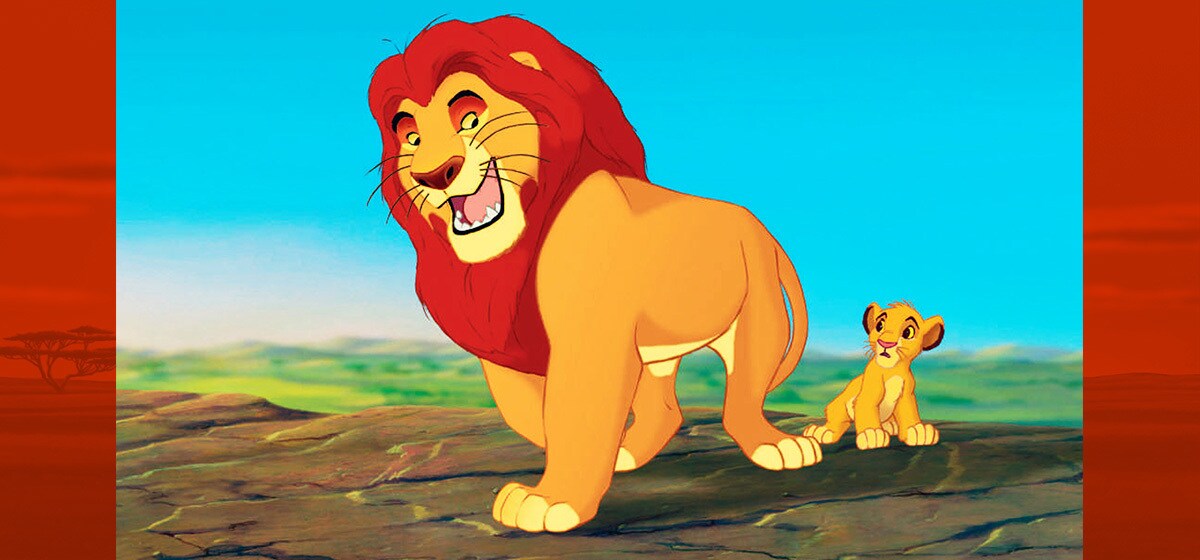
LION KING CHARACTER · FATHER, KING, MURDERED BROTHER, ANCESTOR, AND THE VOICE SIMBA MUST REMEMBER WITHOUT BECOMING
Mufasa: The Father, King, and Legacy Simba Loves More Safely Once He Stops Trying to Become Him
Mufasa teaches that courage can contain fear and power must answer to a larger cycle. His death leaves Simba with love, false guilt, a kingdom, and a legacy powerful enough to guide or overwhelm him.
The quick file
Mufasa is king of the Pride Lands, mate of Sarabi, father of Simba, brother of Scar in the 1994 animated continuity, and the emotional standard Simba spends most of his life trying to remember without being crushed by it. He teaches responsibility, rescues Simba twice, is murdered by Scar during the wildebeest stampede, and continues through memory, reflection, spirit, ritual, and the choices other characters make in his name.
James Earl Jones voices Mufasa in the 1994 film and returns for the 2019 photoreal remake. Later animation and games use additional performers, including Gary Anthony Williams in parts of The Lion Guard branch. Mufasa: The Lion King creates a separate photoreal biography with Braelyn Rankins and Aaron Pierre portraying younger stages of Mufasa’s life before he becomes the father Simba knows.
Name, title, and family
Mufasa is presented as king, husband, father, brother, ancestor, and guardian of an ecological and political order. In the 1994 continuity, Sarabi is his mate, Simba his son, and Scar his brother. The original film does not supply a detailed childhood, parentage, or accession history. His authority appears complete when the story opens.
The photoreal continuity changes the background. Mufasa: The Lion King describes him as an orphaned cub who meets Taka, heir to another royal line, and eventually becomes part of a journey toward Milele. That account belongs to the 2019 branch. It should not be retroactively treated as confirmed childhood history for the 1994 animated Mufasa.
A king introduced through somebody else’s ceremony
The opening does not show Mufasa winning a battle or issuing an order. It shows him receiving Rafiki, standing beside Sarabi, and presenting Simba to gathered animals. His first function is relational and ceremonial. The body is immense, the movement restrained, and the public responds before he speaks.
That staging makes authority feel sacred and settled. Pride Rock, sunrise, music, weather, and collective bowing all validate one family. The craft is breathtaking. It also means the audience receives monarchy as part of the landscape before learning how the kingdom makes decisions or whose consent supports the crown.
James Earl Jones makes stillness feel powerful
Jones gives Mufasa a voice capable of warmth, humor, correction, threat, and reassurance without chasing volume. The performance lets silence hold authority. When he speaks softly to Simba under the stars, the same voice that terrified hyenas becomes intimate enough for a child’s fear.
The vocal design shapes visual interpretation. A calm line makes Mufasa’s large body feel controlled rather than merely dangerous. The performance became so identified with the character that Disney brought Jones back for the 2019 remake while replacing most of the surrounding cast. Familiarity became part of the new film’s claim to continuity.
Relationship with Sarabi
Sarabi shares the presentation of Simba, the family’s private affection, and the public role of queen. The original film gives Mufasa more dialogue and symbolic authority while Sarabi and the lionesses perform much of the pride’s hunting labor. Their partnership is visible and underwritten.
A fuller profile should resist treating Sarabi as ceremonial confirmation of Mufasa’s family. She is leader, survivor, mother, and later the lion who confronts Scar with material evidence of famine. Mufasa’s good rule depends on work performed by a partner the film rarely lets debate him on screen.
Relationship with Simba
Mufasa plays, teaches, disciplines, rescues, and allows Simba to see that courage can include fear. He does not demand adult perfection from the cub. After the elephant graveyard, he names the danger and his own terror rather than using shame as the only teaching tool.
The relationship becomes Simba’s internal model of safety and leadership. Scar’s lie becomes so destructive because the child does not merely believe he caused a death. He believes he failed the person whose love organized the world. Recovery requires separating Mufasa’s actual voice from Scar’s imitation of what Mufasa would think.
The pouncing lesson
Zazu’s morning report becomes part of a playful hunting exercise when Mufasa encourages Simba to practice pouncing. The scene reveals family warmth, court informality, and a father able to let the future king remain a child. It also places Zazu’s body inside royal play without asking whether the adviser consents to becoming the target.
The joke is affectionate because Zazu remains trusted and Mufasa participates rather than ordering distant humiliation. Still, the scene demonstrates how hierarchy shapes play. What a king calls a lesson can become everybody else’s obligation. Mufasa’s benevolence makes the imbalance feel safe, not absent.
Everything the light touches
Mufasa shows Simba the kingdom and identifies both its scale and its border. The speech teaches that authority has limits, yet “everything the light touches” gives the royal family an enormous claim over land occupied by many species. The shadowy elephant graveyard appears outside legitimate order.
The boundary protects Simba from danger and preserves a political exclusion the film never fully explains. Hyenas participate in the same ecology but live beyond the light. Scar later uses that division. He does not invent marginalization. He recruits a population already separated from resources and recognition.
The Circle of Life lesson
Mufasa explains that lions eat antelope and eventually feed the grass after death. The lesson gives predation an ethical frame of dependence and return. A king is powerful and temporary. Bodies reenter systems no title can escape. For a cub imagining rule as unlimited freedom, the correction is essential.
Ecological interdependence does not prove hereditary monarchy. The film binds them because Mufasa’s personal wisdom stands in for institutional legitimacy. His lesson remains meaningful when separated: humility, limits, death, food, and reciprocal dependence can survive even if viewers question whether lions should govern everybody in the food web.
The elephant graveyard rescue
Mufasa enters the graveyard at speed, fights off Shenzi, Banzai, and Ed, protects both cubs, and commands the hyenas to leave. The action establishes physical authority and the willingness to risk himself for children. The aftermath matters more than the victory because he chooses teaching over permanent terror.
He is angry and frightened. Simba hears the anger first, then learns that courage does not mean searching for danger. Mufasa admits fear. That admission gives the cub permission to understand a strong adult as somebody who feels vulnerability and acts responsibly within it.
Relationship with Scar
Scar is Mufasa’s brother, former heir before Simba’s birth, and a lion whose intelligence operates through resentment, theatrical contempt, and indirect violence. Mufasa knows Scar is difficult and disloyal enough to skip Simba’s presentation. He does not recognize or contain the full danger before the plot succeeds.
Their scenes show affection depleted into procedure. Mufasa warns, Scar deflects, and Zazu translates hostility into manageable family irritation. The king’s physical confidence may contribute to underestimating a brother who cannot defeat him directly. Scar builds power through information, exclusion, and other bodies rather than open challenge.
Why Mufasa does not exile Scar earlier
The film does not give a complete policy explanation. Mufasa may value family, believe Scar manageable, lack evidence of treason, or prefer visible tolerance to a succession conflict. Any answer beyond the screen remains interpretation. The choice leaves a dangerous insider close to Simba and a marginalized hyena population available for conspiracy.
Hindsight should not become blame for being murdered. Scar owns the plan and the killing. Leadership analysis can still ask whether the court had oversight, intelligence, succession safeguards, and ways to respond to escalating behavior. Good character does not make a system invulnerable to betrayal.
The stampede rescue
Mufasa enters the gorge because Simba is trapped. He fights through a moving herd, reaches the cub, and uses his final available strength to place Simba on safety. The rescue proves that fatherhood outranks self-preservation in the decisive moment. Scar has predicted this and designed the murder around it.
The scene is often remembered as fate because the fall is visually overwhelming. It is an assassination. The stampede is engineered, the rescue is exploited, and Scar physically throws his brother from the cliff. Calling the death an accident repeats the confusion Scar needs Simba to keep.
The last look toward Simba
Mufasa’s fall is framed through Simba’s limited perspective. The father looks, reaches, disappears into dust, and becomes a body the cub tries to wake. The sequence gives no final conversation capable of protecting Simba from Scar’s explanation. Love remains visible and unspoken.
That absence creates the franchise’s central grief. Simba knows Mufasa died saving him and cannot interpret the knowledge without self-condemnation. The very act proving the father’s love becomes evidence in the child’s false case against himself.
Death does not remove Mufasa from the story
Mufasa continues through Simba’s memory, Scar’s propaganda, Sarabi’s resistance, Rafiki’s ritual knowledge, the stars, reflection, spirit, and the shape of the adult Simba. Each return answers a different need. Memory preserves relationship. Propaganda distorts it. Ritual reopens it. Resemblance makes inheritance visible.
The character becomes larger after death because everybody can use his image. Simba uses Mufasa as a standard. Scar treats the name as a threat. Sarabi invokes the past against false rule. Later children inherit a grandfather they know through stories. A legacy can guide and become pressure when the person is no longer present to revise it.
Look inside yourself
Rafiki leads Simba to water where the reflection shifts toward Mufasa. The moment does not claim the son and father are identical. It gives Simba evidence that connection survived exile. The adult body carries history the shame story taught him to ignore.
Mufasa’s spiritual message asks Simba to remember rather than imitate. The distinction is crucial. Remembering can restore courage and responsibility. Imitation would require Simba to erase Timon, Pumbaa, exile, uncertainty, and everything Mufasa never experienced. A living heir should continue values without becoming a copy of the dead.
Remember who you are can heal and burden
The line interrupts Scar’s accusation and reconnects Simba with a wider identity. It also ties return to royal duty. The emotional healing and political demand arrive in one command. Simba must recover himself and become king at the same time.
Later stories reveal the burden. A king who remembers Mufasa primarily as perfect may respond to risk by preserving the father’s order rather than asking what the next generation needs. Legacy becomes healthiest when it supplies principles and remains open to correction.
Mufasa as the standard under Scar’s rule
Sarabi tells Scar he is not half the king Mufasa was. The comparison functions as resistance and provokes violence. Mufasa’s name represents abundance, legitimacy, protection, and a time before famine. The memory keeps an alternative political reality alive inside occupation.
Idealization is understandable because Scar’s rule is catastrophic. It can flatten the earlier kingdom’s borders and hierarchies. The hyenas were already outside. Lionesses already carried hunting labor. Many species bowed without speaking. Mufasa can be a better ruler than Scar without making every prior arrangement just.
The Lion King II and the inherited grandfather
Simba’s Pride places Mufasa in the sky and inside Simba’s relationship with Kiara. The dead father’s memory becomes a standard for the adult son’s parenting and rule. Simba wants to protect continuity, yet fear of Scar makes him distrust Kovu and restrict Kiara.
Kiara inherits Mufasa as family mythology more than direct relationship. Her challenge to division can be understood as continuing the Circle’s interdependence beyond Simba’s border policy. A grandchild may honor a legacy by changing what the intermediate generation treats as fixed.
The Lion Guard and the Roar of the Elders
The Lion Guard makes ancestral authority more explicit through Kion’s Roar and visions or guidance associated with Mufasa. The grandfather becomes mentor to a child he did not meet in life. The series expands family continuity and supernatural governance at the same time.
Gary Anthony Williams voices Mufasa in much of this television branch, following James Earl Jones’s participation in the introductory movie. The change should be credited rather than hidden. Performance continuity can preserve character while allowing another actor to carry warmth, gravity, and guidance across episodic storytelling.
Relationship with Kion
Kion receives advice from an ancestor whose legend already shapes Simba. Mufasa can help the younger lion understand the Roar, leadership, fear, and responsibility without the ordinary friction of a living family relationship. The spiritual format gives guidance and little opportunity for Kion to observe flaws.
That imbalance can make ancestral approval feel like objective truth. Strong stories allow Kion’s lived evidence and cross-species team to matter even when tradition speaks with Mufasa’s voice. Guidance should develop judgment, not replace it.
The Lion King 1½ and the off-center king
The retelling keeps Mufasa’s death and Simba’s grief emotionally serious while moving narrative attention toward Timon and Pumbaa. Mufasa remains central to Simba without remaining central to every life in the world. That distinction restores scale to a franchise often organized around one royal family.
The movie also reminds viewers that history contains workers and witnesses outside the ceremonial frame. Mufasa’s legacy can be enormous and incomplete as a map of the Pride Lands. A king does not own every story happening during his reign.
The 2019 photoreal Mufasa
The remake retains James Earl Jones and places the voice inside a computer-generated lion designed for naturalistic anatomy and movement. The performance carries decades of audience memory while facial expression and body exaggeration become more constrained. Authority shifts toward voice, scale, camera position, and environmental realism.
Reusing Jones creates continuity and comparison. The new Mufasa can feel familiar even when the visible acting system changes. That familiarity is powerful and can prevent the remake from discovering a fully independent interpretation. The character arrives with a performance history the new image is asked to house.
Mufasa: The Lion King creates another childhood
Barry Jenkins’s 2024 film tells a photoreal-branch story where Mufasa begins as an orphaned cub, meets Taka, joins a royal family, travels with companions, and moves toward the identity later known to Simba. Aaron Pierre voices the older young Mufasa, while Braelyn Rankins voices the cub stage.
This biography changes the meaning of royalty. Mufasa is not simply born into the line he later represents. Leadership emerges through displacement, relationship, action, and contested belonging. The story also reframes Scar through Taka, making brotherhood a history rather than a condition already poisoned when the 1994 film opens.
Taka and the separate continuity rule
Taka’s identity and relationship with Mufasa belong to the photoreal continuity. The animated Scar should not be assigned every prequel event without evidence from that branch. Shared names, plot functions, and visual references do not erase separate production histories.
Keeping the branches distinct protects both versions. Animated Mufasa can remain a figure whose childhood is largely open. Photoreal Mufasa can be judged through the specific orphan, brotherhood, Milele, and accession story the prequel constructs. Fandom can compare themes without flattening canon.
Voice and performance history
James Earl Jones defines Mufasa’s 1994 voice and returns in 2019. Gary Anthony Williams voices the character across much of The Lion Guard, with additional performers appearing in games, attractions, localized versions, and other media. Mufasa: The Lion King casts Aaron Pierre and Braelyn Rankins for younger life stages.
Credits matter because “the voice of Mufasa” changes by age, continuity, and format. Jones’s performance is iconic and should not erase the work required to sustain the character elsewhere. A profile can honor the defining voice while naming the full branch-specific ensemble.
Design and shape language
Animated Mufasa uses broad chest, heavy mane, warm red and gold color, rounded strength, and controlled posture. Scar uses angles, darker color, thinner mass, and restless precision. The brothers communicate their different relationships to power before either states an argument.
Mufasa’s resemblance to adult Simba makes succession readable and links memory to body. The design also risks turning physical magnificence into evidence of moral worth. A strong king can look powerful without powerful-looking bodies becoming the only shape associated with goodness.
Benevolent monarchy and structural vulnerability
Mufasa embodies the fairy-tale good king: wise, protective, loved, ecologically responsible, and personally brave. Scar’s coup succeeds because the system concentrates succession, security, and public order around a small family. One murder and one missing cub permit total capture.
The lesson should extend beyond choosing a better monarch. Institutions require shared authority, succession safeguards, accountable advisers, information channels, resource planning, and participation from people expected to live under decisions. Mufasa’s virtue gives the kingdom stability and leaves it dependent on one body.
The hyena question
Mufasa enforces the boundary keeping hyenas outside the Pride Lands. The film associates that border with safety, then shows Scar exploit exclusion through promises of access and food. The hyenas’ later violence does not make prior marginalization irrelevant.
A mature account of Mufasa’s rule should ask what alternatives existed, what conflict preceded the border, and whether ecological management became species hierarchy. The story gives insufficient evidence for a final answer. The absence is a reason to avoid treating the king’s policy as natural fact.
Fatherhood without perfection
Mufasa is a loving father who cannot protect Simba from every consequence after death. His teaching contains wisdom and an inheritance burden. He takes the cub’s fear seriously and still raises him inside public expectation. Both truths belong in the profile.
Idealizing a dead parent can become another way grief prevents relationship from changing. Simba needs Mufasa’s love more than perfection. Remembering the father as a person allows the son to keep guidance, question structure, and become a different kind of parent.
Common fandom misconceptions
Mufasa’s death is not an accident caused by Simba. Scar engineers the stampede and murders him. The 2024 childhood is not automatically the biography of the 1994 animated character. James Earl Jones is the defining English-language performer and not the only performer across every branch.
Mufasa’s ecological lesson does not prove every political choice was correct. Being better than Scar does not remove the hyena border, invisible lioness labor, or institutional fragility. Critique of the system does not require denying that he loved his family and died saving his child.
What future stories owe Mufasa
Future animated stories could explore his relationship with Sarabi, earlier conflict with Scar, the origins of the hyena border, how he learned leadership, mistakes corrected before Simba’s birth, and the ordinary work of a reign the first movie presents mostly through symbols.
Photoreal stories can continue the Taka branch without turning every disagreement into destiny. Let Mufasa’s leadership include compromise, error, dependence on others, and choices that cost more than a triumphant title. A legend becomes humanly useful when the story permits learning.
Profile conclusion
Mufasa is father, mate, brother, king, teacher, murder victim, ancestor, and a legacy large enough to rescue Simba from shame or trap him inside imitation. His most enduring lesson is not that power makes a lion important. It is that power remains temporary and relationship continues after the body returns to the land.
Return to The Lion King hub for films, series, guides, reviews, Reacts, rants, and the complete character directory. Every branch keeps its own history there without asking one version of Mufasa to overwrite the others.
The character receipt Pride Rock cannot flatten
Mufasa cannot be reduced to a place in the royal family tree. The profile’s central problem is loving fatherhood inside a monarchy that confuses a good ruler with a safe institution. That argument becomes visible through decisions, not biography labels. The story tells us who belongs near Pride Rock, but the character receipt asks who has information, who controls movement, whose fear is believed, and who performs the work after a public decision becomes a private emergency.
The relationship map includes Simba, Sarabi, Nala, Scar, Rafiki, Zazu, the lionesses, and the subjects gathered beneath Pride Rock. Each connection places a different demand on Mufasa. Love may require truth, friendship may require interruption, leadership may require listening, and family may require a boundary that ceremony cannot override. A complete profile follows what changes between two people after conflict. Repeating the word family is not evidence that repair occurred.
The performance matters at the same level as plot: James Earl Jones makes authority sound protective and intimate, while the animation lets stillness, scale, and eye line reveal the limits of that certainty. Breath, tempo, silence, posture, and distance frequently carry what the screenplay leaves unspoken. The Lion King uses animals with highly readable human emotion while preserving movement drawn from observation. That balance lets a lowered head or delayed step become moral evidence without translating every feeling into dialogue.
The 1994 film also places Mufasa inside an African-inspired world assembled by an American studio through research, music, language, landscape photography, theatrical tradition, and fairy-tale structure. The result is culturally meaningful to many viewers without becoming a documentary map of one country or people. The profile names specific influences where evidence supports them and does not use “Africa” as a decorative adjective that ends the inquiry.
Later films, television series, stage productions, photoreal remakes, and the Mufasa branch revise Mufasa through different continuities. More screen time can expose a missing motive, but it can also tidy a contradiction that made the original performance interesting. The comparison asks what each version permits Mufasa to know, choose, refuse, remember, and repair. Visual realism alone does not make a characterization more truthful.
The final JIN test is whether Mufasa leaves behind a person rather than a symbol. Symbols can carry grief, monarchy, exile, ecology, parenthood, or chosen family, but people contradict the role assigned to them. The best future scene would let Mufasa make an ordinary choice with no ceremony watching, then allow that choice to matter later. Continuity begins when the franchise remembers what the character already paid to learn.