
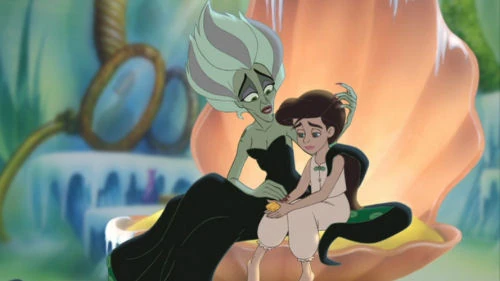
Character File · Return to the Sea · Inheritance, Revenge, and the Child in the Middle
Morgana
Her mother taught her that Ursula was the real daughter. Morgana spends the sequel proving she learned the comparison perfectly, because even her rebellion is built from Ursula’s unfinished war.
Quick file
Film: The Little Mermaid II: Return to the Sea (2000). Performer: Pat Carroll, who also performed Ursula. Family: Ursula is her sister and an unnamed mother structures the comparison haunting them both.
Agents: Undertow, Cloak, and Dagger. Objective: obtain Triton’s trident, avenge Ursula, and claim the superiority she believes family recognition denied. Primary target: Melody, a twelve-year-old child whose hidden heritage becomes leverage.
The sequel introduces a family wound and then weaponizes it
Morgana remembers a mother who preferred Ursula and criticized the daughter who remained. The wound gives her bitterness a history before the film reduces her to a new threat.
Family comparison can distort identity for decades. It does not force somebody to attack a baby, manipulate a child, or dominate a kingdom. Explanation becomes morally useful only when it preserves agency.

Ursula is dead, but still controls the room
Morgana claims to want vindication against the sister who eclipsed her. Every plan nevertheless imitates Ursula’s methods: identify a royal family fracture, offer transformation, conceal the true price, and seize Triton’s power.
The rivalry traps her in imitation. She cannot defeat Ursula as the family standard while treating Ursula’s unfinished revenge as the only meaningful measure of success.
Pat Carroll performs kinship without repetition
Pat Carroll voices both sisters, linking them through vocal texture while giving Morgana a colder, narrower tension. Ursula expands into appetite and theatrical confidence. Morgana contracts around resentment and calculation.
The dual casting turns performance into family resemblance. The same instrument produces two relationships to power, one delighted by manipulation and one desperate for proof.

The baby attack establishes the ethical floor
Morgana appears at Melody’s presentation and threatens the newborn as part of a demand for Triton’s trident. The child has no agency in Ursula’s death or the older generation’s conflict.
Targeting a baby makes the revenge explicitly intergenerational. Morgana does not seek accountability from the person who harmed her. She selects a vulnerable body whose family will surrender power to protect it.
The wall is her first strategic victory
Ariel responds to the threat by cutting Atlantica away and building a seawall. Morgana fails to obtain the trident that day but changes two kingdoms for twelve years.
Terror succeeds when fear reorganizes ordinary life. The wall isolates Melody from ancestry, Ariel from family, and both communities from one another. Morgana’s leverage persists even while she remains in hiding.

She watches the silence become an opening
Morgana learns that Melody wants the sea and does not know why it feels like home. The family’s secrecy has created a child with powerful longing and no trusted explanation.
A manipulator does not need to invent every vulnerability. She needs to identify what responsible adults left unattended. Morgana offers recognition precisely where the parents offer prohibition.
Validation becomes grooming when it serves extraction
Morgana treats Melody’s desire to be a mermaid as meaningful and possible. That recognition feels like care because the family has framed the same desire as dangerous.
The apparent care is conditional. Morgana withholds her identity, the political stakes, and the plan for Triton’s trident. She validates the child only to convert longing into labor.

The transformation bargain repeats Ursula without the contract theater
Ursula uses a formal scroll and a three-day deadline. Morgana uses a promise that Melody’s new body can become permanent if she completes a task.
Both arrangements place asymmetric information inside a fantasy of choice. The adult knows the real objective. The younger target sees a route toward belonging. Consent cannot be informed when the bargain’s author hides the conflict.
She recruits a twelve-year-old into an adult war
Melody is asked to retrieve a royal weapon from a grandfather she does not know. The task risks her body, two kingdoms, and a family relationship hidden from her since infancy.
Morgana frames the mission as the price of identity. That is exploitation, not mentorship. A child should not have to prove belonging by performing political theft for the first adult who names her desire.
Body shame is part of the inheritance
Morgana repeats comparisons about appearance and worth that she associates with her mother’s preference for Ursula. The sequel invites the audience to see a woman whose body has become evidence in a family ranking system.
Body shame can create lasting pain without creating moral innocence. Morgana understands humiliation well enough to use insecurity against others. Instead of ending the inheritance, she operationalizes it.
The thinner sister is not automatically the less dangerous one
The franchise often remembers Ursula through size and appetite while presenting Morgana as physically different. Treating body type as a moral shorthand would reproduce the exact comparison the story identifies as harmful.
Their villainy lies in coercion, predation, and pursuit of domination. Analysis should not turn one body into confidence and the other into deficiency as if anatomy explains ethics.

Undertow lives inside a promise controlled by her
Triton shrinks Undertow, and Morgana promises that the trident will restore him. His desire for his former size keeps him attached to her plan.
She criticizes the royal family’s power while reproducing the same leverage structure. Restoration remains conditional on service, and the means of restoration stays in her hands.
Cloak and Dagger make harm feel administrative
Morgana delegates surveillance and interception to agents who can move through spaces she does not enter. The plan depends on observation, timing, and plausible distance.
Delegation does not dilute responsibility. It lets her experience control as strategy while others perform the immediate intimidation. The coldness of the system distinguishes her from Ursula’s more theatrical presence.

The trident is recognition imagined as an object
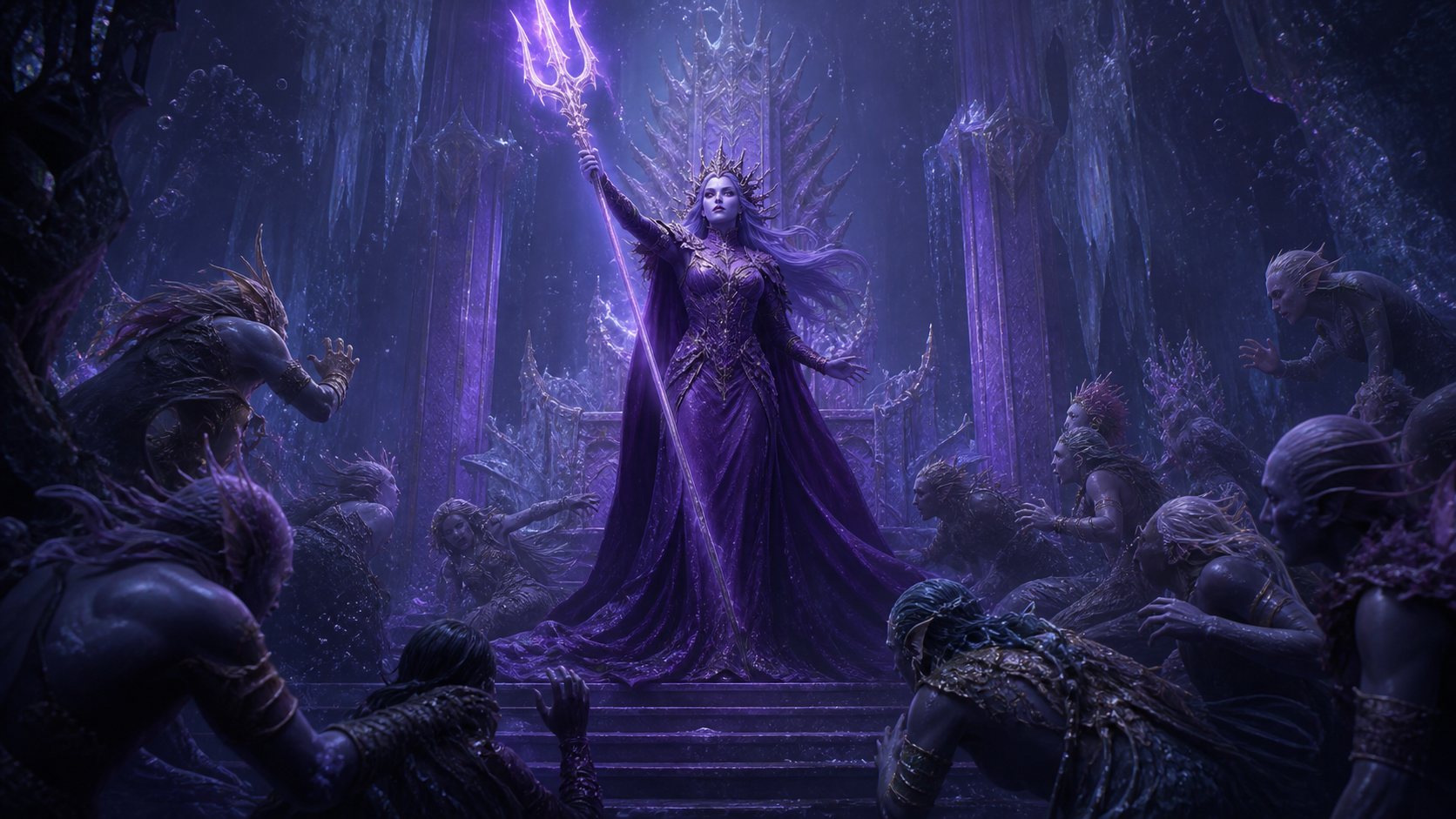
Morgana believes possession of Triton’s weapon will prove power, complete revenge, and reverse the family hierarchy. The trident carries political authority and private validation at once.
No object can deliver the childhood acknowledgment she wants. Once she holds it, the unresolved self remains, so domination must continue in order to keep the victory feeling real.
Freezing the kingdom is not liberation from comparison
With the trident, Morgana immobilizes others and claims control. She has escaped the role of lesser sister only by creating a world where nobody can challenge the new ranking.
That is not self-definition. It is comparison enforced at scale. The wounded child inside the adult receives no repair from subjects who kneel because magic removed their choice.

Melody breaks the plan by reclaiming the story
Melody learns who Morgana is, what the trident means, and how the bargain exploited missing family truth. She stops treating the sorceress as the only adult who understands her.
The reversal works because identity separates from the manipulator. Melody can still want the sea while rejecting the person who used that desire. Being deceived does not make the original longing false.
The ice defeat mirrors emotional isolation
Morgana ends trapped in ice while the trident falls away. The image makes permanent the cold enclosure from which she planned revenge.
The symmetry is satisfying but not restorative. It stops immediate harm without addressing the family history, institutional exile, or conditions that allowed two sisters to build power through predatory contracts.
Ariel and Triton must not use Morgana to excuse the wall
Morgana is a real threat and specifically targets Melody. That does not prove that hiding the entire sea for twelve years was the only responsible protection.
A manipulator’s guilt should not erase parental accountability. The wall created the secrecy Morgana exploited. Specific security and honest history could have reduced both exposure and isolation.
She is a sequel villain designed around repetition
The film intentionally echoes Ursula through family relation, performer, transformation, a child of Ariel, and a struggle for Triton’s trident. Repetition gives the sequel immediate continuity.
It also risks making Morgana feel like a substitute rather than a complete person. Her strongest independent material is the comparison wound. The movie needed more time inside how that history shaped a different strategy and emotional vocabulary.
An alternate future requires accountability before sympathy
Understanding maternal harm can support a richer character without demanding forgiveness from Melody, Ariel, Undertow, or Atlantica. The victims do not owe rehabilitation to the person who targeted them.
Morgana would need to return stolen power, dismantle leverage systems, disclose agents and plans, name the child exploitation, accept consequence, and build an identity unrelated to finishing Ursula’s war.
The mother is absent and still governs
The sequel never needs to place the mother physically in the present because Morgana has internalized the family verdict. Ursula was preferred. Morgana was measured against her. Approval belonged elsewhere. That hierarchy follows her into every room.
An absent parent can remain powerful through the standards children keep enforcing on themselves. Morgana’s tragedy begins when she accepts the old ranking as the only available language of worth instead of questioning why a mother made sisters compete for love.
Sibling comparison manufactures enemies inside a family
When affection is presented as scarce, one child’s success can feel like theft from another. Ursula becomes not only a sister with power but evidence that Morgana was judged deficient. The target of resentment shifts from the parent who created the contest to the sibling who appeared to win it.
That shift is common because confronting the source threatens the fantasy that approval could still be earned. Defeating Ursula symbolically through revenge feels more attainable than admitting the competition was abusive and the prize may never have existed in a healthy form.
Ursula’s death removes the possibility of direct confrontation
Morgana cannot argue with Ursula, demand acknowledgment, compare memories, or discover whether the favored sister also suffered under their mother. Death freezes the rivalry at its most painful interpretation.
Revenge against Ariel’s family becomes a substitute conversation. Each victory is addressed to somebody who is no longer present. That structure guarantees dissatisfaction because no defeated descendant can answer the question Morgana actually carries: why was I never enough?
Pat Carroll uses restraint as the difference
Ursula’s voice can expand across a room, savoring language and turning salesmanship into performance. Morgana often sounds compressed, as though every sentence must pass through an old grievance before it reaches the listener.
Carroll’s dual work matters because similarity is audible without sameness. The family relation lives in texture and attack. The personality difference lives in tempo, pressure, and how much pleasure each sister takes in occupying attention.
Revenge gives her a job that never ends
Morgana organizes years of life around the royal family. Surveillance, hiding, magical research, managing Undertow, and waiting for access create a full-time identity.
The plan protects her from the emptier question of what she wants outside the rivalry. If revenge ends, she must build a self with no sister to defeat and no mother to impress. Endless preparation postpones that terrifying freedom.
The presentation attack changes Ariel before Melody can know her
Morgana’s threat arrives at the moment Ariel is introducing her child to the sea family. Celebration turns into emergency, and Ariel’s own history of prohibition becomes the template she reaches for under fear.
The villain therefore influences Melody’s upbringing indirectly for twelve years. Morgana does not need continuous access. One targeted act becomes a parental worldview, a wall, a secret, and a family silence that shapes the child daily.
A wall is a monument to the enemy’s importance
Ariel builds the barrier to keep Morgana out, but its scale announces how completely the threat controls policy. Every stone says the family expects the enemy to define what contact with the sea can mean.
Security can become tribute when it reorganizes identity around fear. Morgana remains central to Melody’s life despite being unnamed because the absence of the ocean is structured around her.
Morgana reads the family more accurately than the family reads Melody
She notices the girl’s longing, isolation, and responsiveness to sea identity. Ariel and Eric see rule breaking and danger. The antagonist studies desire because desire is useful to the plan.
This creates a painful imbalance. The manipulator offers a more accurate description of the child’s feelings than the loving parents do. Accuracy of observation is not goodness of intention, but it makes predation more persuasive.
Grooming begins with making the target feel uniquely seen
Morgana does not open with political history or a demand for theft. She creates the feeling that Melody’s unusual desire has finally found an adult who understands it.
The tactic isolates the child further from family by making secrecy feel like intimacy. Once Morgana becomes the keeper of the validating story, questioning her threatens the only available path toward the identity Melody wants.
The transformation does not create the desire
Melody wants the sea before Morgana intervenes. The sorceress provides a magical form and a manipulative explanation, not the underlying longing.
This distinction protects the child from a common moral shortcut. Being exploited through a desire does not prove the desire was corrupt. The wrongdoing belongs to the adult who attaches hidden political labor to it.
Morgana turns identity into a performance review
The promise says Melody can remain a mermaid if she completes the trident task. Belonging becomes conditional on productivity and obedience.
That structure echoes Morgana’s own family wound. She believes worth had to be earned by matching Ursula. She passes the same test-based love to Melody: prove usefulness, then perhaps receive the self you were promised.
Undertow is both accomplice and controlled worker
Undertow participates in intimidation and revenge. He is not innocent simply because Morgana holds leverage over his size. At the same time, the promise of restoration structures his dependence.
Power analysis can hold both facts. A subordinate may cause harm and still operate inside coercive incentives. Morgana criticizes domination while mastering its administration.
Cloak and Dagger absorb the personality the film withholds
The manta-ray agents extend Morgana’s reach and give the sequel visual movement around her colder headquarters. Their names reduce them to functions of secrecy and attack.
A deeper version would ask why they serve, what they receive, and whether they understand the child-targeting plan. Villain organizations feel shallow when every subordinate exists as an interchangeable extension of one grievance.
The trident cannot distinguish authority from capability
Possessing Triton’s weapon gives Morgana enormous magical capacity. It does not give her legitimate authority, public trust, knowledge of governance, or a constructive program for the people she freezes.
The gap matters because conquest often mistakes control of force for fitness to rule. Morgana can compel stillness. She cannot produce consent, belonging, or the recognition she imagines a throne will confirm.
Her victory reproduces the mother’s hierarchy
Once empowered, Morgana does not create a world beyond comparison. She places herself at the top and immobilizes those below.
The family lesson survives intact: one figure deserves admiration, everyone else exists as lesser proof. She changes who wins without challenging why worth must be arranged vertically at all.
Body shame travels through villain design and audience response
The script’s comparison between sisters can invite viewers to rank their appearances, repeating the family violence as entertainment. Commentary must resist treating one woman’s size, thinness, age, or silhouette as an explanation for confidence or resentment.
Design communicates personality through shape and movement, but moral analysis belongs to choices. Morgana targets a baby, deceives a child, and seeks domination. None of those acts becomes clearer through body ridicule.
Pat Carroll performing both sisters complicates replacement language
Morgana can be described as a sequel counterpart, but the shared performer means the role is not simply a studio attempt to imitate Ursula from outside. Carroll carries vocal memory across the family line.
The performance asks listeners to hear inheritance. Familiar power returns with a different emotional engine. The actor becomes the bridge through which resemblance and difference remain active at once.
The film gives her psychology but not enough interior time
Maternal preference, body comparison, sibling resentment, and years of preparation could support a dense villain study. The sequel states these elements quickly while prioritizing the adventure around Melody.
As a result, Morgana’s motive can feel like explanatory shorthand. More scenes alone would not redeem her, but they could clarify when resentment became ideology, how she recruited agents, and whether she ever imagined a life unrelated to revenge.
Melody is the person most qualified to reject her logic
Melody also grows inside family secrecy and inherited fear. She has reason to resent adults who define her identity without listening.
The difference is what she does with the wound. Once the truth appears, Melody works toward reconnection rather than placing another child beneath her. The story quietly rejects the claim that inherited pain dictates repetition.
Ariel’s apology and Morgana’s guilt can coexist
The family made harmful choices around the seawall and secrecy. Morgana then exploited the predictable consequences. Assigning one responsibility does not cancel the other.
This matters because villains often become excuses for institutions. If every failure is attributed to manipulation, parents and rulers learn nothing. If every vulnerability is blamed on secrecy, the adult predator disappears. Ethical analysis distributes agency accurately.
Freezing is the perfect power for unresolved time
Ice suspends movement. Morgana’s inner life is similarly fixed around an old comparison and a dead sister. She cannot let the family story change because revenge requires the grievance to remain untouched.
Her final entrapment literalizes that condition. The sorceress who froze a kingdom becomes a preserved image of herself at the moment the plan fails, unable to reach a future beyond it.
Punishment stops harm but does not produce understanding
The ice ending removes the immediate threat and restores the kingdom. It does not investigate the magical economy that produced Ursula and Morgana, the family environment they describe, or the systems of exile and contract predation surrounding them.
Justice can require containment. Prevention requires more. Atlantica must study how vulnerable people encounter sorceresses, why power concentrates in private artifacts, and how royal secrecy repeatedly creates exploitable isolation.
Accountability would be long and unglamorous
A hypothetical surviving Morgana would not earn redemption through one sacrifice or apology. She would need to provide intelligence, release dependents, return power, compensate harmed communities, and accept restrictions she did not design.
She would also need to stop using pain as a demand for priority. The story can understand her childhood without arranging every victim around the project of making her feel finally chosen.
The self she never attempted to build
Morgana demonstrates patience, strategic thinking, magical research, organizational skill, and the ability to read desire. Those capacities could support scholarship, diplomacy, or protection if separated from domination.
A different life would not erase Ursula or the mother. It would make them history rather than job description. Her greatest unrealized act of rebellion is refusing to let the family comparison choose her vocation.
Revenge mistakes attention for love
Morgana forces the royal family to organize around her threat. Guards, walls, secrets, searches, and years of fear all testify that she matters. That attention can resemble the centrality she was denied at home, but it is produced by danger rather than affection.
The distinction explains why escalation never satisfies. Fear can make a person impossible to ignore. It cannot make the frightened people choose intimacy, admiration, or kinship. Every new display of power increases attention while moving love farther away.
What she owes Melody specifically
An apology to the kingdom would be too abstract. Morgana watched a child, studied her isolation, validated a concealed identity, altered her body, and sent her to steal from unknown family. The harm was tailored, so accountability must name the tailoring.
Melody would retain the right to refuse contact, forgiveness, or participation in rehabilitation. Repair cannot become another assignment given to the girl because adults find the villain’s childhood sympathetic.
What the family archive should disclose
The royal record should document Ursula and Morgana as sisters, their known magical practices, the contracts and leverage they used, and the family testimony about maternal comparison without turning rumor into fact. Hiding the history would create another opening for manipulation.
Truth does not require romanticizing either sister. It requires enough public memory that future children recognize the pattern before a private promise becomes a political weapon.
Final character receipt
Morgana is not tragic because she was secretly right to seek revenge. She is tragic because she recognizes how comparison deformed her and chooses to reproduce the same hierarchy with herself on top.
Her story asks whether inherited pain becomes destiny. The answer is no. She had choices, including the choice not to make a twelve-year-old pay for a mother’s preference and a sister’s death.
Keep exploring The Little Mermaid
Return to The Little Mermaid hub for films, reviews, Reacts, rants, lore, guides, and the full character directory.
Morgana’s resentment explains her appetite for recognition, but it does not turn harm into destiny. Her character becomes sharper when we separate being diminished by Ursula’s legacy from the decisions she makes once another vulnerable girl becomes useful to her plan.